Key takeaways
- Promptwatch is the most complete option if you want to both track and fix your AI visibility -- it covers monitoring, content gap analysis, AI content generation, crawler logs, and traffic attribution in one platform.
- Profound is the closest enterprise-grade competitor to Promptwatch, with strong monitoring and content agents, but starts at $499/month and lacks Reddit/YouTube tracking.
- Semrush is worth considering if you already use it for traditional SEO and want to add basic AI visibility tracking without switching tools -- but its GEO features are shallow compared to dedicated platforms.
- Peec AI and Otterly.AI are solid entry-level monitors for teams that just want to see where they stand in AI search, without needing optimization tools.
- Relixir takes an autonomous "AI employee" angle -- it generates and deploys content for you -- which is interesting but comes with a $500/month starting price and less transparency than self-serve tools.
- Scrunch AI sits in the middle ground: better than basic monitors, with crawler logs and optimization tips, but not as deep as Promptwatch or Profound on content generation.
- AthenaHQ is a credible enterprise option (Coinbase, ZoomInfo are customers) but is monitoring-heavy and leans on manual workflows.
- Goodie AI's domain appears to be for sale, which raises obvious questions about its viability as a product.
Geostar launched with an interesting pitch -- a GEO platform for AI search visibility -- but as of early 2026, the website is still showing a "Launching Soon" page with nothing but a contact form. There's no product to evaluate, no pricing to compare, and no screenshots to judge. If you landed here looking for Geostar and found a holding page, you're not alone.
That means anyone seriously trying to improve their brand's visibility in ChatGPT, Perplexity, Claude, Gemini, or Google AI Overviews needs to look elsewhere. The good news: the GEO tool market has matured quickly, and there are real, working options across a range of budgets and use cases.
Here's an honest look at the best Geostar alternatives available right now.
The alternatives
Promptwatch

Promptwatch is the platform I'd point most teams to first, and not just because this site is run by them. The honest reason: it's the only tool in this space that closes the full loop from "where am I invisible?" to "here's the content that will fix it" to "here's proof it worked."
Most GEO tools show you a dashboard. Promptwatch shows you a dashboard and then helps you do something about what you see. The Answer Gap Analysis identifies specific prompts where competitors are getting cited and you're not -- not vague topic clusters, but the actual questions AI models are answering without mentioning you. From there, the built-in AI writing agent generates articles and comparisons grounded in real citation data (over 880 million citations analyzed). Then page-level tracking shows whether those new pages actually start getting cited.
That cycle -- find gaps, create content, track results -- is what separates it from monitoring-only tools.
A few things worth calling out specifically: the AI Crawler Logs show you in real time which pages ChatGPT, Claude, and Perplexity are crawling, how often, and whether they're hitting errors. Most competitors don't have this at all. Promptwatch also tracks Reddit and YouTube discussions that influence AI recommendations, monitors ChatGPT Shopping carousels, and supports 10 AI models including DeepSeek, Grok, and Mistral alongside the obvious ones.
Pricing starts at $99/month for the Essential plan (1 site, 50 prompts, 5 articles), $249/month for Professional (2 sites, 150 prompts, crawler logs, state/city tracking), and $579/month for Business (5 sites, 350 prompts, 30 articles). A 7-day free trial is available.
Best for: Marketing and SEO teams that want to actually improve their AI visibility, not just measure it. Agencies managing multiple clients will find the multi-site plans and white-label reporting particularly useful.
Semrush
Semrush is the obvious choice if you're already paying for it and want to add AI visibility tracking without onboarding a new tool. Its AI Visibility toolkit tracks how your brand appears in ChatGPT, Perplexity, and Gemini responses, and the competitive perception features let you see sentiment and share of voice against competitors.
The honest trade-off: Semrush's AI features feel like an add-on to a traditional SEO platform, because that's exactly what they are. The prompts are largely fixed rather than custom, there's no AI traffic attribution, no crawler logs, and no content generation tied to citation data. If you're trying to systematically improve your LLM citation rates, Semrush will show you where you stand but won't help you move.
Where Semrush genuinely wins is breadth. Keyword research, backlink analysis, site audits, PPC tools, social media management, and now AI visibility -- all in one subscription. For teams that need to justify a single platform budget, that consolidation has real value.
Pricing starts at $165/month (Starter), $290/month (Pro+), and $580/month (Advanced). Enterprise pricing is custom. A 7-day free trial is available.
Best for: Teams already using Semrush for traditional SEO who want basic AI visibility data without adding another tool. Not the right choice if AI search is your primary focus.
Profound
Profound

Profound is probably the most direct enterprise-grade competitor in this space. It covers monitoring across ChatGPT, Perplexity, Claude, Gemini, Grok, Copilot, and others, includes prompt volume data, AI crawler behavior analysis, and has content generation agents built in. Customers include MongoDB, Ramp, and Mercury -- so it's clearly working for serious teams.
Where Profound pulls ahead of basic monitors: the Agents feature lets you build automated content workflows, and the prompt volume data helps you prioritize which queries to target. The SOC 2 compliance is a real differentiator for enterprise buyers with security requirements.
Where it falls short compared to Promptwatch: no Reddit or YouTube tracking (both of which directly influence AI recommendations), no ChatGPT Shopping monitoring, and pricing starts at $499/month for the Lite tier with no free trial. That's a significant commitment before you've seen whether it fits your workflow.
The interface is polished and the research output (Profound Index, AEO Report) is genuinely useful for understanding the AI search landscape.
Pricing: Lite from $499/month (3 seats, 24k responses/month, 2-month history). Enterprise custom. No free trial.
Best for: Enterprise marketing and AEO teams with security requirements and budgets to match. Companies like MongoDB that need SOC 2 compliance and dedicated support.
Peec AI

Peec AI is a clean, focused monitoring tool. It tracks visibility, position, and sentiment across ChatGPT, Perplexity, Claude, and Gemini, lets you add custom prompts, and shows competitor benchmarking. The interface is genuinely nice to use -- the dashboard makes it easy to see at a glance how your brand is trending.
The limitation is that it stops at monitoring. There's no content gap analysis, no AI writing tools, no crawler logs, and no traffic attribution. You'll know your visibility score went up or down, but Peec won't tell you why or what to do about it.
For teams that are just getting started with AI visibility tracking and want to understand the landscape before investing in a full optimization platform, Peec AI is a reasonable starting point. The €89/month Starter plan is accessible, and the free trial means you can test it without a credit card.
Pricing: Starter €89/month (~$103, 50 prompts, 10 models), Growth €199/month (150 prompts, 2 workspaces), Enterprise custom.
Best for: Small marketing teams or individuals who want basic AI visibility tracking at a reasonable price, without needing optimization tools yet.
Otterly.AI
Otterly.AI

Otterly.AI covers six AI search engines -- ChatGPT, Perplexity, Google AI Overviews, Google AI Mode, Gemini, and Copilot -- and includes a GEO Audit tool that analyzes 25+ on-page factors to identify what's holding your site back from earning citations. That audit feature is a step beyond pure monitoring, which puts Otterly slightly ahead of Peec AI in terms of actionability.
The $29/month Lite plan (15 prompts) makes it the most accessible entry point in this comparison. The Standard plan at $189/month gets you 100 prompts and automated reporting, which is enough for most mid-sized teams.
What it doesn't have: AI crawler logs, content generation, prompt volume data, or traffic attribution. The GEO Audit gives you recommendations, but acting on them is entirely on you. It's also worth noting that Otterly monitors fewer AI models than Promptwatch (6 vs 10), which matters if you care about DeepSeek, Grok, or Mistral visibility.
Pricing: Lite $29/month (15 prompts), Standard $189/month (100 prompts), Premium custom. 14-day free trial, no credit card required.
Best for: Budget-conscious teams that want to start tracking AI visibility without a large upfront commitment. The free trial and low entry price make it easy to test.
Relixir
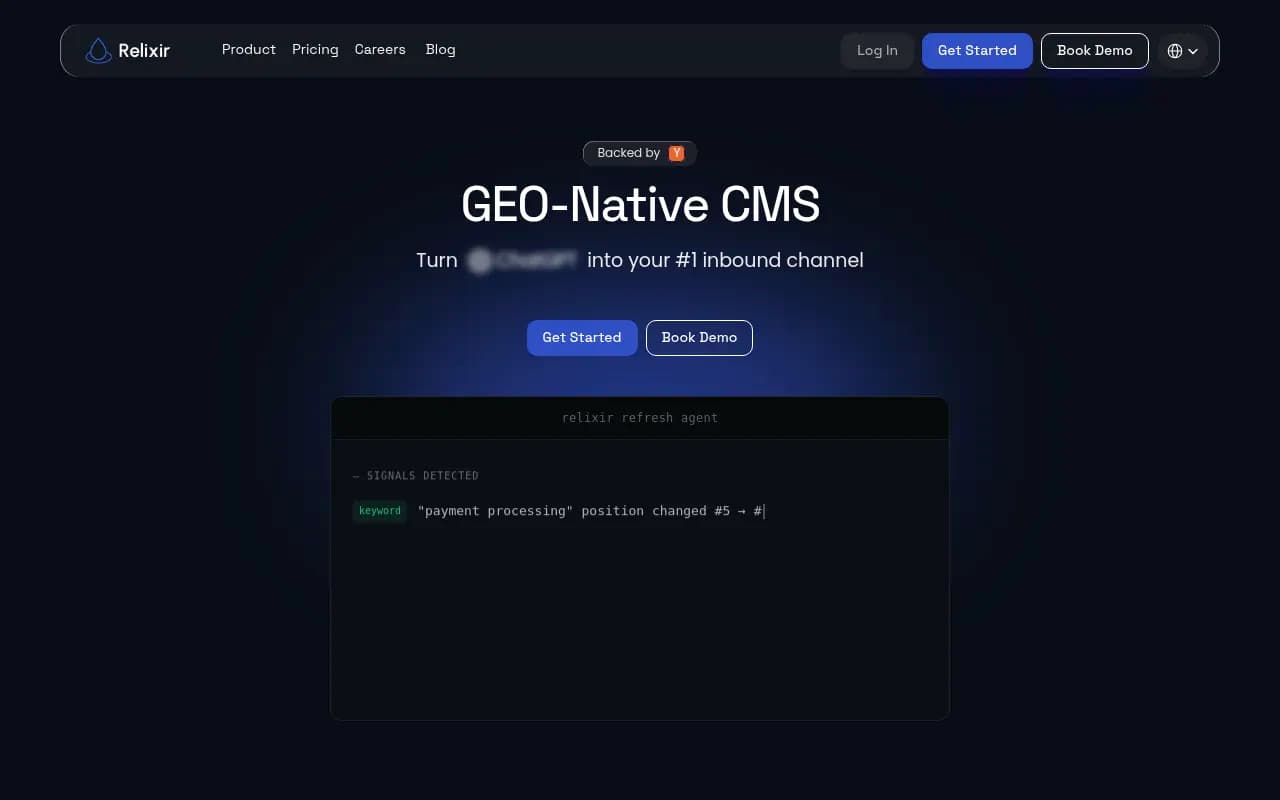
Relixir takes a different angle than most tools here. Instead of giving you a dashboard and leaving you to figure out what to do, it positions "Rex" as an autonomous GEO employee -- a system that monitors your brand, generates GEO-optimized content, and deploys it. The pitch is that you get AI search visibility improvements without having to manage the workflow yourself.
That's genuinely interesting, especially for lean teams. The customer list includes Rippling, Airwallex, and HackerRank, which suggests it's working for real B2B companies.
The trade-off is control and transparency. Autonomous content deployment sounds appealing until you're wondering what exactly went live on your site and why. For teams that want to stay hands-on with their content strategy, Relixir's model may feel like a black box. Pricing starts at $500/month, which is steep for a tool where you're handing over significant control.
Pricing: From $500/month (Starter). Enterprise and managed services on request. No free tier.
Best for: B2B teams with limited bandwidth for content operations who want to outsource the GEO workflow entirely, and are comfortable with an autonomous approach.
AthenaHQ

AthenaHQ has a credible enterprise customer list -- Coinbase, ZoomInfo, SoFi, PagerDuty -- and has been featured in the Wall Street Journal and Forbes. It covers 8+ LLMs, provides citation source analysis, and includes automated content optimization recommendations.
The platform is built around a credit model (1 credit = 1 AI query), which can make costs unpredictable as you scale up prompt tracking. The Self-Serve plan at $295/month ($95 for the first month) is a reasonable entry point for enterprise-adjacent teams.
Where AthenaHQ lags: it's primarily a monitoring and recommendation platform. Content generation is limited compared to Promptwatch or Profound, and there's no Reddit/YouTube tracking or ChatGPT Shopping monitoring. The GEO workflow management is solid, but you're still doing most of the execution work yourself.
The free 10-minute audit is a good way to get a quick read on your current AI visibility before committing.
Pricing: Self-Serve $295/month ($95 first month promotional). Enterprise custom. Annual plans with 17% discount.
Best for: Enterprise marketing teams at established brands (Coinbase-scale) that want a credible, well-supported monitoring platform with optimization recommendations.
Scrunch AI
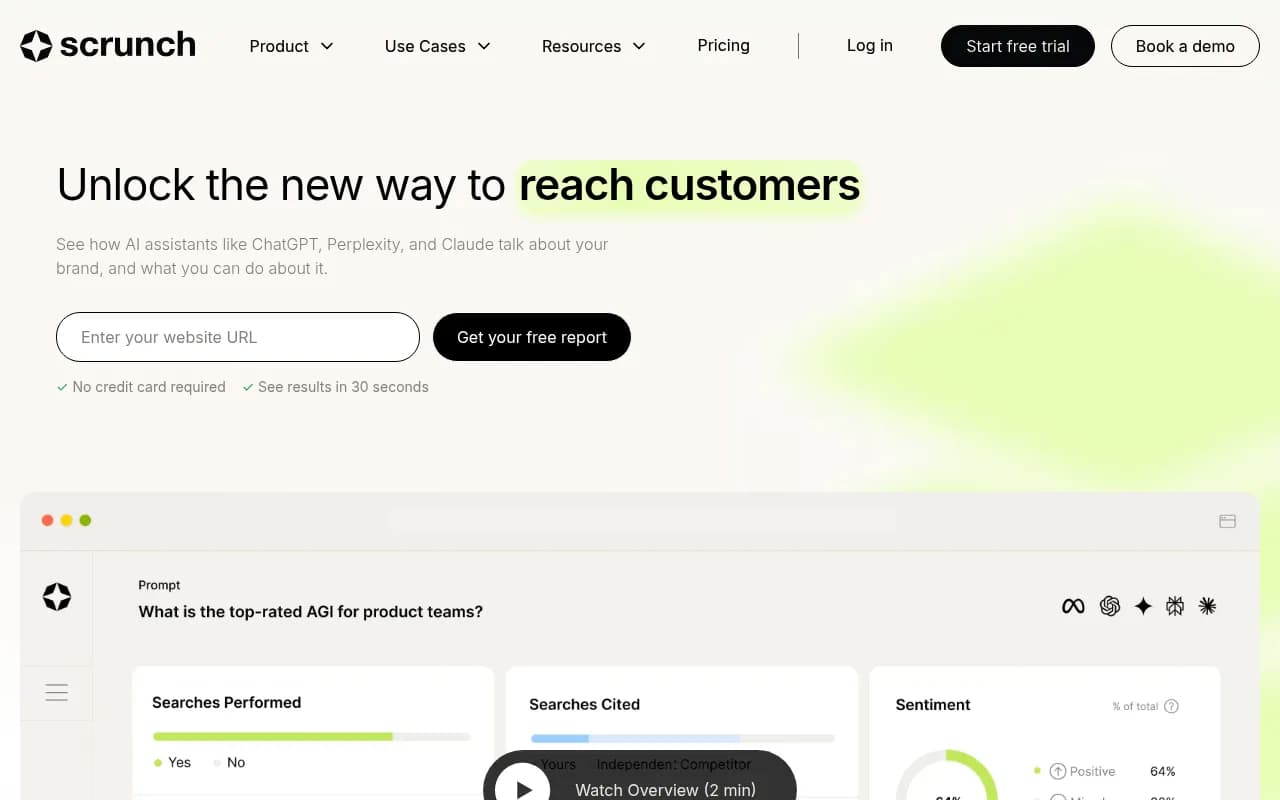
Scrunch sits in an interesting middle position. It has real monitoring depth -- competitor benchmarking by persona, topic, and geo; citation tracking; AI crawler logs -- plus an "Agent Experience Platform" that translates your site content for AI traffic without disrupting the human UX. That last feature is genuinely novel and worth paying attention to.
The crawler log feature puts Scrunch ahead of Peec AI and Otterly.AI in terms of technical depth. Customers include Lenovo, Crunchbase, and Penn State University, which suggests it works across different types of organizations.
The gap compared to Promptwatch is content generation. Scrunch gives you optimization tips and crawler insights, but doesn't generate the actual content for you. The $83/month Explorer plan (billed annually) is the most affordable entry point among the mid-tier tools, which makes it worth testing if you want more than basic monitoring but aren't ready for a $249+ commitment.
Pricing: Explorer $83/month (billed annually), Growth $417/month, Enterprise custom. 7-day free trial.
Best for: Technical marketing teams that want crawler log access and optimization insights at a lower price point than Profound or Promptwatch, and are comfortable creating their own content.
Goodie AI
Worth mentioning briefly: Goodie AI's domain (goodie.ai) appears to be listed for sale on Spaceship.com for $80,000 at the time of writing. This is a significant red flag for anyone considering it as a tool. A domain for sale typically means the company has shut down or pivoted. I'd avoid this one until there's clarity on what's actually happening with the product.
Which one should you pick?
Here's a quick decision guide based on what actually matters:
If you want to track and fix AI visibility (not just measure it), Promptwatch is the most complete option. The combination of gap analysis, AI content generation, crawler logs, and traffic attribution in one platform -- starting at $99/month with a free trial -- makes it the clearest choice for teams serious about GEO.
If you're an enterprise with SOC 2 requirements and a $500+/month budget, Profound is worth evaluating alongside Promptwatch. The content agents are solid and the customer list is credible.
If you already pay for Semrush and just want to add AI visibility data without a new tool, use the Semrush AI Visibility toolkit. Just don't expect it to replace a dedicated GEO platform.
If you're just getting started and want to understand your baseline before investing in optimization, Peec AI (€89/month) or Otterly.AI ($29/month) are low-risk starting points.
If you want crawler logs and technical depth at a mid-range price, Scrunch AI at $83/month (annual) is worth a look.
If you want to hand off the GEO workflow entirely and trust an autonomous system, Relixir is the only tool here built around that model -- but go in with eyes open about the control trade-offs.
Geostar itself may eventually launch and be worth evaluating. But right now, it's a holding page. The tools above are live, tested, and actively used by real teams.