Key takeaways
- Ahrefs is a full-stack SEO platform with AI search monitoring as one feature among many. Ansehn is built exclusively for AI search visibility. These tools are solving different problems.
- Ahrefs has transparent public pricing starting at $83/mo (Lite). Ansehn requires a demo booking with no published pricing -- a red flag for smaller teams or anyone who hates sales calls.
- Ahrefs' Brand Radar uses fixed prompts for AI monitoring, which limits how customizable your tracking can be. Ansehn lets you simulate buyer journeys and track custom prompts across ChatGPT, Perplexity, Claude, and Google AI Mode.
- If you need backlink analysis, keyword research, site audits, or rank tracking, Ahrefs wins by a mile. Ansehn doesn't touch traditional SEO at all.
- Neither tool offers the full action loop (find gaps, generate content, track results) that purpose-built GEO platforms provide -- Ahrefs gets closer with content tools, but AI search optimization is still a secondary feature.
- For most marketing teams, Ahrefs is the safer default. Ansehn makes sense only if AI search visibility is your primary focus and you're ready to commit to a custom enterprise contract.
Overview
Ahrefs
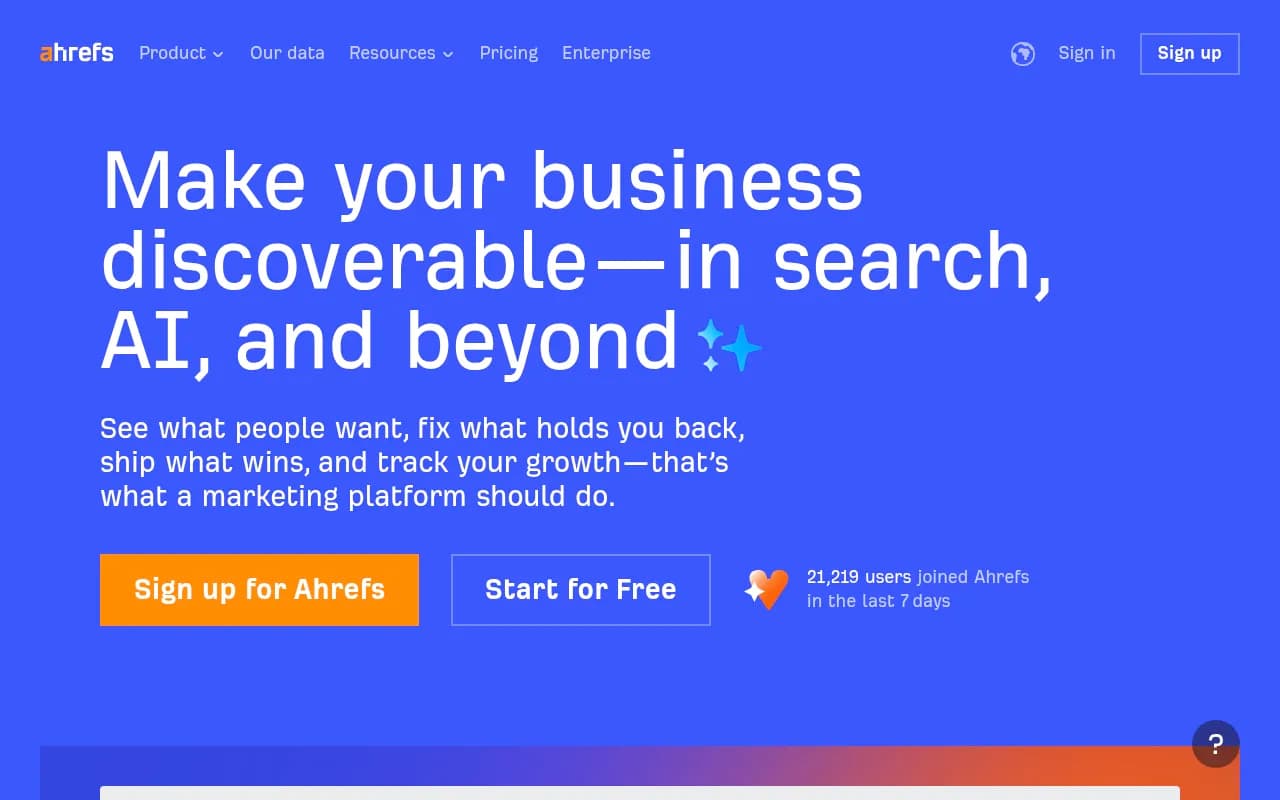
Ahrefs started as a backlink analysis tool and grew into one of the most widely used SEO platforms in the world -- 44% of Fortune 500 companies use it, according to the company. Today it covers keyword research, site audits, rank tracking, content gap analysis, PPC research, and social media management. In 2024-2025, Ahrefs added Brand Radar, its AI search monitoring feature, positioning itself as an "AI Marketing Platform." The pitch is that you can manage traditional SEO and AI search visibility from one place. Whether that pitch holds up depends heavily on how seriously you take AI search optimization.
The platform is built on what Ahrefs claims is the web's largest backlink index and a keyword database covering billions of queries. That data foundation is genuinely impressive and is the main reason people pay for it.
Ansehn
Ansehn
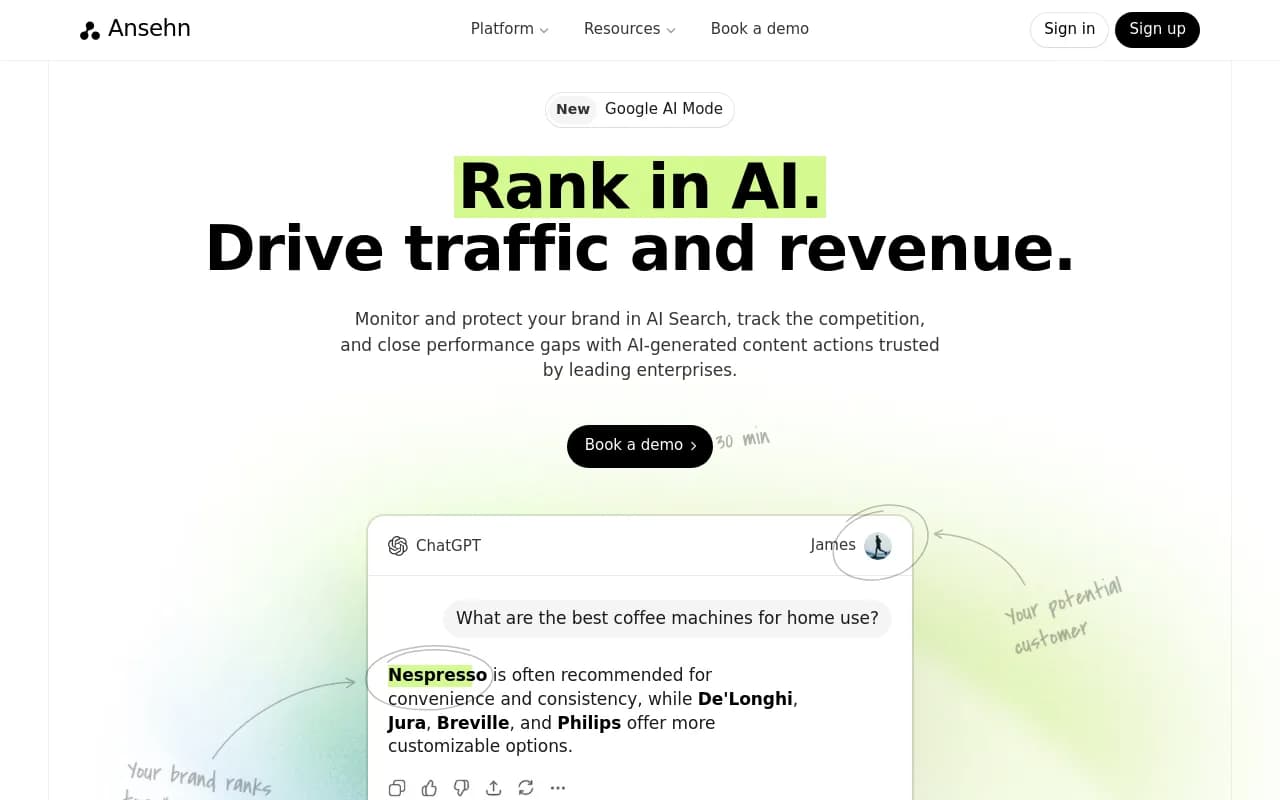
Ansehn is a newer, narrower tool. It monitors how brands appear in AI-generated search results -- specifically across ChatGPT, Perplexity, Google AI Mode, and Claude. The core idea is simulating how a potential buyer would use AI to research a purchase decision, then showing you where your brand ranks in those responses. Customers listed on their site include Bosch, Pixum, and Quirion, which suggests a European enterprise focus.
Ansehn doesn't do traditional SEO. No backlinks, no keyword database, no site audits. It's entirely focused on the GEO/AEO space -- tracking AI mentions, benchmarking competitors, and surfacing content recommendations to improve AI visibility.
Side-by-side comparison
| Feature | Ahrefs | Ansehn |
|---|---|---|
| Primary focus | Full-stack SEO + AI search monitoring | AI search visibility only |
| AI models tracked | Brand Radar (limited, fixed prompts) | ChatGPT, Perplexity, Claude, Google AI Mode |
| Custom prompt tracking | Limited (fixed prompts in Brand Radar) | Yes |
| Backlink analysis | Yes (industry-leading index) | No |
| Keyword research | Yes (billions of keywords) | No |
| Rank tracking (Google) | Yes | No |
| Site audit | Yes | No |
| Content gap analysis | Yes (traditional SEO) | Yes (AI search focused) |
| Content generation | Yes (AI writing tools) | Content recommendations only |
| AI traffic attribution | No | Unclear (not publicly documented) |
| AI crawler logs | No | No |
| Competitor benchmarking | Yes (SEO + AI) | Yes (AI search only) |
| Public pricing | Yes ($29-$333+/mo) | No (demo required) |
| Free trial | Yes | No (demo only) |
| API access | Yes | Yes (documented) |
| Target audience | SEO teams, marketers, agencies | Enterprise marketing teams |
Head-to-head feature deep-dive
AI search monitoring
This is where the comparison gets interesting, because it's the only area where both tools actually overlap.
Ahrefs' Brand Radar tracks brand mentions across AI search engines and shows you where competitors appear. The limitation is that it uses fixed prompts -- you can't define your own buyer journey queries or track niche, industry-specific questions. There's also no AI traffic attribution, so you can't connect your Brand Radar data to actual website visits or revenue. It's a monitoring dashboard, not an optimization workflow.
Ansehn's entire product is built around this problem. You can simulate how a buyer searches for your product category in ChatGPT or Perplexity, see where your brand ranks in the response, and benchmark that against competitors. The "buyer journey simulation" framing is genuinely useful -- it mirrors how real customers actually use AI tools to make purchase decisions. Ansehn also surfaces content recommendations tied to what's missing from your AI visibility.
The gap: Ansehn is more purpose-built here, but neither tool closes the full loop. For teams that want to not just track AI visibility but also generate content to improve it and then measure the impact, dedicated GEO platforms like Promptwatch go further -- with answer gap analysis, an AI writing agent trained on citation data, and page-level tracking that connects content to visibility scores.

Verdict: Ansehn wins on AI search monitoring depth. Ahrefs' Brand Radar is adequate for a quick overview but not built for serious GEO work.
Traditional SEO capabilities
Ahrefs is in a completely different league here. Its backlink index is one of the two largest in the industry (alongside Semrush). The keyword explorer covers billions of queries with accurate search volume data, keyword difficulty scores, and click-through rate estimates. Site Audit crawls your entire site and flags technical issues with clear explanations. Rank Tracker monitors your Google positions daily.
Ansehn has none of this. It's not trying to compete here -- the product is scoped entirely to AI search.
Verdict: Ahrefs wins, completely. If traditional SEO is part of your workflow, Ansehn isn't even in the conversation.
Content tools
Ahrefs has a content suite that includes a Content Explorer (find top-performing content in any niche), a Content Gap tool (find keywords competitors rank for that you don't), and AI writing assistance for generating and optimizing articles. It's not the deepest content generation tool on the market, but it's solid for teams that want everything in one place.
Ansehn offers content recommendations -- it tells you what topics or angles to cover to improve your AI search visibility. Whether it generates actual content or just surfaces suggestions isn't clearly documented on their public site. Based on available information, it leans toward recommendations rather than full content creation.
Verdict: Ahrefs wins on content tooling breadth. Ansehn's recommendations are useful but narrower in scope.
Competitor analysis
Both tools offer competitor benchmarking, but in different dimensions.
Ahrefs lets you compare backlink profiles, keyword overlap, traffic estimates, and content performance against any competitor. It's one of the best competitive intelligence tools in SEO.
Ansehn benchmarks how your brand ranks in AI responses compared to competitors for the same prompts. That's a genuinely useful view -- seeing that a competitor appears in 70% of ChatGPT responses for your target queries while you appear in 20% is actionable data.
Verdict: Depends on what you're measuring. Ahrefs for traditional SEO competitive intelligence; Ansehn for AI search competitive benchmarking.
Ease of use and onboarding
Ahrefs has a well-documented learning curve. The platform is large, with dozens of tools and reports. New users typically spend a few weeks getting comfortable. The documentation and YouTube channel are genuinely good, which helps. The Starter plan ($29/mo) is a low-commitment way to explore the interface before committing to a full plan.
Ansehn requires booking a demo to get started, which adds friction. There's no self-serve free trial. For a team that just wants to evaluate the product quickly, that's a real barrier. The documentation site (docs.ansehn.com) exists and appears comprehensive, but you can't access the product without going through a sales process first.
Verdict: Ahrefs wins on accessibility. The demo-only model at Ansehn slows down evaluation significantly.
Integrations and API
Ahrefs has a public API, Looker Studio integration, and connects with common SEO workflows. The API is well-documented and used by agencies to build custom reporting pipelines.
Ansehn also has a documented API (docs.ansehn.com), which is a good sign for a newer tool. Specific integration details beyond the API aren't publicly listed.
Verdict: Roughly equal on API availability. Ahrefs has a longer track record of third-party integrations.
Pricing comparison
| Plan | Ahrefs | Ansehn |
|---|---|---|
| Entry-level | $29/mo (Starter -- very limited) | Not available |
| Core plan | $83/mo (Lite) | Not disclosed |
| Mid-tier | $166/mo (Standard) | Not disclosed |
| Advanced | $333/mo (Advanced) | Not disclosed |
| Enterprise | Custom pricing | Custom pricing (demo required) |
| Free trial | Yes | No |
| Annual discount | 20% | Unknown |
Ahrefs' pricing is transparent and accessible. The Starter plan at $29/mo is genuinely limited (no rank tracking, limited crawls), but it lets you test the interface. The Lite plan at $83/mo is the practical entry point for most users.
Ansehn's pricing opacity is a real issue. "Book a demo" with no pricing page typically means the product is positioned for enterprise buyers with budgets to match. If you're a small team or agency trying to evaluate options, you'll need to invest time in a sales conversation before knowing if it's even in your budget.
Pros and cons
Ahrefs
Pros:
- Best-in-class backlink index and keyword database
- Transparent, accessible pricing with a free trial
- Covers the full SEO workflow in one platform
- Strong content tools and competitor analysis
- Large user community and excellent documentation
- Used by major enterprises and agencies worldwide
Cons:
- Brand Radar (AI search monitoring) uses fixed prompts -- not customizable
- No AI traffic attribution to connect AI visibility to revenue
- No AI crawler logs or deep GEO optimization workflow
- Can feel overwhelming for new users given the feature breadth
- AI search features feel like an add-on, not a core product
Ansehn
Pros:
- Purpose-built for AI search visibility -- not an afterthought
- Buyer journey simulation is a genuinely useful framing
- Custom prompt tracking across major AI models
- Documented API for custom workflows
- Content recommendations tied to AI visibility gaps
Cons:
- No traditional SEO capabilities whatsoever
- No public pricing -- demo required to evaluate
- No free trial, which makes comparison shopping harder
- Smaller customer base and less established track record
- Unclear whether content recommendations extend to actual content generation
- No AI crawler logs or traffic attribution documented
Who should pick which tool
Pick Ahrefs if:
- Traditional SEO (backlinks, keywords, rank tracking, site audits) is central to your work
- You want one platform for SEO, content research, and a basic view of AI search
- Transparent pricing and a free trial matter to your evaluation process
- You're an agency managing multiple clients across SEO and content
- You need competitive intelligence beyond just AI search
Pick Ansehn if:
- AI search visibility is your primary focus and you're not doing traditional SEO
- You're at an enterprise brand that needs to simulate buyer journeys in AI tools
- You want custom prompt tracking rather than fixed-prompt monitoring
- You have budget for a custom enterprise contract and don't mind a sales process
- Your team is specifically tasked with GEO/AEO optimization
Consider neither if:
- You need the full action loop: find AI visibility gaps, generate content to fix them, track the results. Both tools have gaps in that workflow. A dedicated GEO platform would serve that need better.
Final verdict
Ahrefs and Ansehn are solving different problems, so "which is better" depends entirely on what you're trying to do.
For traditional SEO work, Ahrefs is the obvious choice -- it's one of the best tools in the industry and Ansehn doesn't compete here at all. For AI search visibility specifically, Ansehn is more purpose-built, but the lack of public pricing and the demo-only model make it hard to recommend without knowing your budget.
The honest answer: most marketing teams should start with Ahrefs for its SEO foundation and evaluate dedicated AI search tools separately if GEO/AEO becomes a priority. Ansehn is worth a look if you're an enterprise team with a specific mandate around AI search optimization -- just go in knowing you'll need to sit through a sales demo before you can evaluate anything.