Key takeaways
- Ahrefs is a traditional SEO powerhouse that has added AI search monitoring as a feature. Brantial is a GEO-first platform that was built specifically for the AI search era -- these are fundamentally different tools solving different problems.
- If you still care about Google organic rankings, backlinks, and keyword research (you probably should), Ahrefs wins by a mile. Brantial doesn't touch any of that.
- Brantial's entry price ($59/mo) is lower than Ahrefs' meaningful entry point ($83/mo Lite), but Ahrefs covers far more ground for that price.
- Ahrefs' AI monitoring (Brand Radar) uses fixed prompts and lacks AI traffic attribution -- a real limitation for teams trying to act on AI visibility data, not just observe it.
- Brantial's content optimization is specifically designed to make pages citable by LLMs (schema, entity signals, contextual structuring). Ahrefs' content tools are built for traditional SEO content workflows.
- Neither tool is the most comprehensive option for pure GEO work -- dedicated platforms like Promptwatch go deeper on AI visibility with crawler logs, prompt intelligence, content gap analysis, and AI traffic attribution that both Ahrefs and Brantial lack.
Overview
Ahrefs
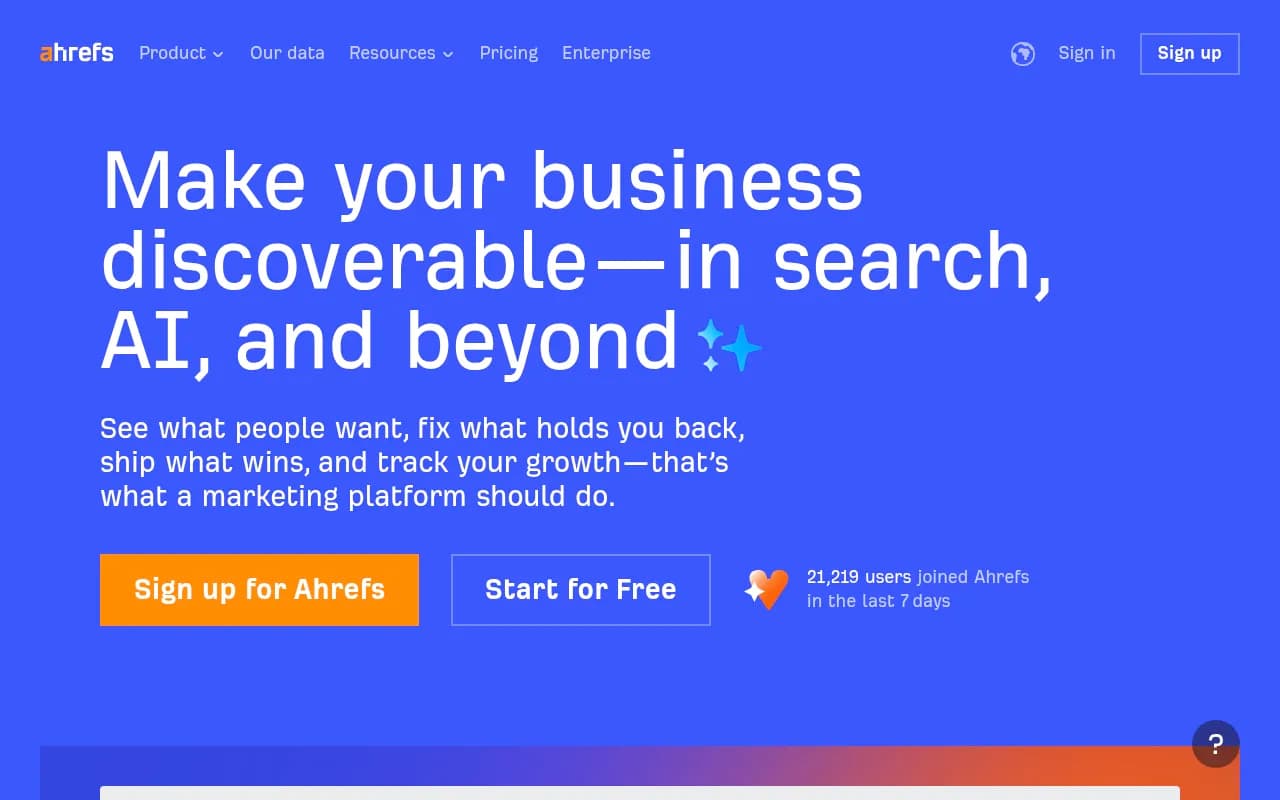
Ahrefs has been the go-to SEO toolkit for serious marketers since around 2011, and it's earned that reputation. The backlink index is genuinely the largest available, the keyword database covers billions of queries, and tools like Site Audit and Rank Tracker are used daily by SEO teams at companies like Adobe, IBM, and Shopify. In 2024-2025, Ahrefs started expanding into AI search territory with Brand Radar and AI content tools -- a logical move, but one that still feels like an add-on to a traditional SEO platform rather than a native AI search product.
Brantial
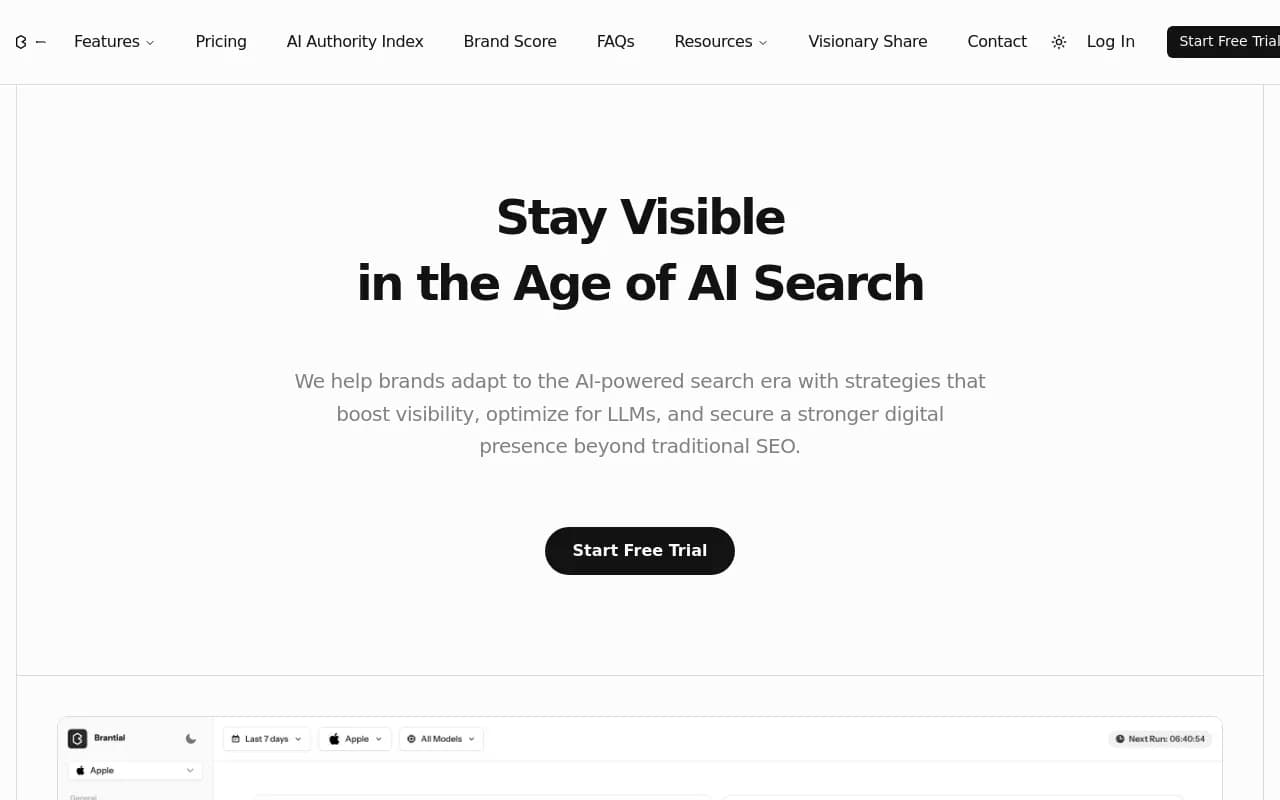
Brantial is a newer GEO platform built from the ground up for the AI search era. The pitch is straightforward: as AI answers replace traditional search results, your brand needs to show up in those answers, and Brantial helps you get there. It covers AI visibility monitoring, content optimization for LLM citations, prompt analysis, and analytics. It's a focused tool -- you won't find backlink analysis or traditional rank tracking here. Teams at Vercel, Revolut, and GitLab are listed as users, which suggests it's found traction with tech-forward brands.
Side-by-side comparison
| Feature | Ahrefs | Brantial |
|---|---|---|
| Starting price | $83/mo (Lite) | $59/mo (Starter) |
| Free tier | No (Starter $29/mo is very limited) | Free trial available |
| Traditional SEO tools | Yes (full suite) | No |
| Backlink analysis | Yes (largest index) | No |
| Keyword research | Yes (billions of keywords) | No |
| AI search monitoring | Yes (Brand Radar, fixed prompts) | Yes (core feature) |
| AI models tracked | Limited (fixed prompts) | ChatGPT, Google SGE, other LLMs |
| Content generation | Yes (AI writing tools) | Yes (LLM-optimized content) |
| Schema/entity optimization | No | Yes |
| AI traffic attribution | No | Yes (impressions, inclusion rate, referral clicks) |
| Rank tracking (Google) | Yes | No |
| Site audit | Yes | No |
| PPC/ads research | Yes | No |
| Social media tools | Yes | No |
| API access | Yes (Advanced+) | Not confirmed |
| Target user | SEO teams, agencies, enterprises | GEO-focused marketers, growth teams |
Head-to-head feature deep-dive
Traditional SEO capabilities
This is where the comparison is almost unfair. Ahrefs has spent 15 years building one of the most comprehensive SEO toolkits available. The backlink index processes petabytes of crawl data. Keyword Explorer covers 100+ countries. Site Audit catches technical issues that most tools miss. Content Explorer surfaces link-worthy content ideas. These aren't features Brantial is trying to compete with -- it simply doesn't offer them.
Brantial's position is essentially: "traditional SEO is declining, so we're not building those tools." That's a defensible bet for a startup, but it means any team that still needs to manage Google organic rankings (which is most teams) will need Ahrefs or a similar tool alongside Brantial.
Verdict: Ahrefs wins completely. Brantial doesn't compete here by design.
AI search monitoring
This is where things get interesting. Ahrefs added Brand Radar to track AI search visibility, but it has a known limitation: it uses fixed prompts. You can see how your brand appears in AI answers, but you can't customize the prompts to match how your actual customers search. There's also no AI traffic attribution -- you can't connect AI visibility to actual site visits or revenue.
Brantial was built for this. It monitors brand mentions across ChatGPT, Google SGE/AI Overviews, and other LLMs, tracks which pages get cited, measures inclusion rates, and connects AI appearances to referral clicks and assisted conversions. The analytics layer is more purpose-built for GEO work.
That said, neither tool is the deepest option here. Platforms built specifically around AI visibility monitoring -- tracking 10+ models, with crawler logs, prompt volume data, and query fan-outs -- go considerably further than either Ahrefs or Brantial on this dimension.
Verdict: Brantial wins for AI monitoring depth and actionability. Ahrefs' Brand Radar is useful but limited.
Content optimization for AI search
Ahrefs has solid content tools: Content Gap analysis, AI writing assistance, and workflows for creating SEO-optimized articles. These are genuinely useful for traditional content strategy. But they're designed to rank in Google, not to get cited by ChatGPT or Perplexity.
Brantial takes a different approach. Its content optimization is specifically about making pages AI-readable and citable -- schema markup, entity signals, contextual structuring, and iterating content to match what LLMs want to reference. This is a meaningfully different skill set from traditional SEO content work.
Verdict: Depends on your goal. For Google rankings, Ahrefs. For LLM citations, Brantial.
Analytics and reporting
Ahrefs has mature reporting across all its tools -- dashboards, custom reports, data exports, and API access on higher plans. It's been refined over years of enterprise use.
Brantial's analytics are focused on AI visibility KPIs: impressions in AI answers, inclusion rate, referral clicks from AI sources, and assisted conversions. This is actually more relevant for teams trying to prove the ROI of GEO work, since traditional SEO metrics don't capture AI-driven traffic well.
Verdict: Ahrefs for breadth and maturity. Brantial for AI-specific reporting that connects to business outcomes.
Ease of use and learning curve
Ahrefs is powerful but genuinely complex. New users often spend weeks getting comfortable with all the tools. The interface has improved, but there's a lot to learn. The upside is that the depth is real -- once you know it, you can do a lot.
Brantial is a narrower tool, which makes it easier to get started. If your job is specifically AI visibility, you're not wading through backlink analysis and PPC research to find what you need.
Verdict: Brantial is easier to get started with. Ahrefs has a steeper curve but more to offer once you're up to speed.
Integrations and ecosystem
Ahrefs integrates with Google Search Console, Google Analytics, and has API access on Advanced and Enterprise plans. It also has a Looker Studio connector and various third-party integrations built by the community.
Brantial's integration story is less clear from public documentation. It mentions workflow automation, but specific integration details aren't prominently documented.
Verdict: Ahrefs wins on integrations, especially for teams already in the Google ecosystem.
Pricing comparison
| Plan | Ahrefs | Brantial |
|---|---|---|
| Entry/Starter | $29/mo (very limited, no rank tracking) | $59/mo (1 user) |
| Core/Lite | $83/mo | -- |
| Mid-tier | $166/mo (Standard) | $149/mo (Growth, 5 users) |
| Pro/Advanced | $333/mo (Advanced) | $299/mo (Pro, 10 users) |
| Enterprise | Custom | Not listed |
| Free trial | Yes | Yes |
| Annual discount | 20% | Not confirmed |
A few things worth noting on pricing: Ahrefs' $29/mo Starter is so limited (no rank tracking, no site audit, no API) that most users end up on the $83/mo Lite plan at minimum. Brantial's $59/mo Starter is a more complete entry point for what the tool does.
For teams that need both traditional SEO and AI visibility, the real cost comparison is Ahrefs ($83-166/mo) plus a dedicated GEO tool -- which adds up quickly. Brantial at $59-149/mo is cheaper if you're only focused on AI visibility, but you'd still need another tool for traditional SEO.
Pros and cons
Ahrefs
Pros:
- The most complete traditional SEO toolkit available -- backlinks, keywords, site audit, rank tracking, content tools all in one place
- Trusted by 44% of Fortune 500 companies; mature, reliable platform
- Excellent data quality and database size
- Covers PPC research and social media monitoring too
- Strong API and reporting for enterprise teams
Cons:
- AI monitoring (Brand Radar) uses fixed prompts -- you can't customize for your actual customer queries
- No AI traffic attribution -- can't connect AI visibility to revenue
- Complex and expensive for teams that only need AI search monitoring
- Content tools are built for Google, not for LLM citation optimization
- The $29/mo Starter is misleadingly limited; real use starts at $83/mo
Brantial
Pros:
- Purpose-built for GEO and AI search visibility -- the focus shows in the product
- Content optimization specifically targets LLM citability (schema, entity signals)
- AI-specific analytics: inclusion rate, referral clicks, assisted conversions
- More affordable entry point for AI-only use cases
- Easier to get started with for teams new to GEO
Cons:
- No traditional SEO tools at all -- you'll need a separate tool for Google rankings
- Smaller company with less established track record than Ahrefs
- Integration details are sparse in public documentation
- AI model coverage details aren't fully transparent
- Less proven at enterprise scale
Who should pick which tool
Pick Ahrefs if:
- You need a full SEO platform covering backlinks, keywords, site audits, and rank tracking
- Your primary channel is still Google organic search
- You want AI monitoring as one feature within a broader marketing toolkit
- You're an agency managing multiple clients across all aspects of SEO
- You need enterprise-grade reporting and API access
Pick Brantial if:
- AI search visibility is your primary focus and you're willing to use a separate tool for traditional SEO
- You want content optimization specifically designed for LLM citations, not just Google rankings
- You need AI-specific analytics that connect to business outcomes (referral clicks, conversions)
- You're a growth-stage tech company that has already shifted focus from traditional SEO to AI search
- Budget is a constraint and you only need the GEO piece
Consider a dedicated GEO platform if:
- You need deep AI visibility monitoring across 10+ models with prompt customization, crawler logs, and content gap analysis
- You want to track AI traffic attribution and connect it to revenue
- You need both monitoring and content generation in one AI-native workflow
For teams serious about AI search visibility specifically, it's worth knowing that Promptwatch covers the full GEO workflow -- from finding content gaps to generating AI-optimized content to tracking results -- in a way that neither Ahrefs nor Brantial fully does.

Final verdict
These two tools aren't really competing for the same customer. Ahrefs is the right choice for any team that needs a complete SEO platform -- it's one of the best in the business for traditional search, and its AI monitoring is a useful addition even if it's not the deepest available. Brantial is the right choice for teams that have made a deliberate bet on AI search as their primary channel and want a focused tool built specifically for that job.
Most marketing teams in 2026 still need both traditional SEO and AI visibility -- which means Ahrefs alone covers more ground, but Brantial goes deeper on the AI piece. The honest answer for most teams: Ahrefs for SEO fundamentals, and a purpose-built GEO platform for serious AI visibility work.