Key takeaways
- Ahrefs is a full SEO platform that added AI search tracking; GeoGen is an AI visibility tool that does little else -- they're solving different problems.
- GeoGen is significantly cheaper for AI monitoring alone (from €20/mo vs Ahrefs' $83/mo for a usable plan), but Ahrefs gives you backlink analysis, rank tracking, site audits, and keyword research on top.
- Ahrefs' Brand Radar uses fixed prompts and has no AI traffic attribution -- it's a monitoring add-on, not a GEO-first product.
- GeoGen covers ChatGPT, Gemini, Perplexity, Grok, and Copilot; Ahrefs' AI coverage is narrower and less documented.
- Neither tool offers a full optimization loop (find gaps, generate AI-optimized content, track results with traffic attribution) -- they both stop at monitoring.
- If your primary goal is improving how AI search engines recommend your brand, both tools have real gaps that a dedicated GEO platform fills better.
Overview
These two tools are not really competing for the same buyer. Ahrefs is a mature, comprehensive SEO platform that has been adding AI search features over the past year. GeoGen is a newer, leaner tool built specifically for Generative Engine Optimization. The fact that they're being compared at all says something about where the market is heading -- everyone wants AI visibility now, and buyers are trying to figure out whether to add a specialist tool or lean on their existing SEO platform.
Ahrefs

Ahrefs has been one of the two dominant SEO platforms (alongside Semrush) for years. Its backlink index is genuinely the largest available, and its keyword database covers billions of queries. The platform now spans site audits, rank tracking, content explorer, keyword research, PPC analysis, social media management, and -- more recently -- AI search monitoring through Brand Radar. Used by 44% of Fortune 500 companies, it's a serious enterprise-grade tool. The AI features feel like a layer added to an existing product rather than something built from the ground up for GEO.
GeoGen
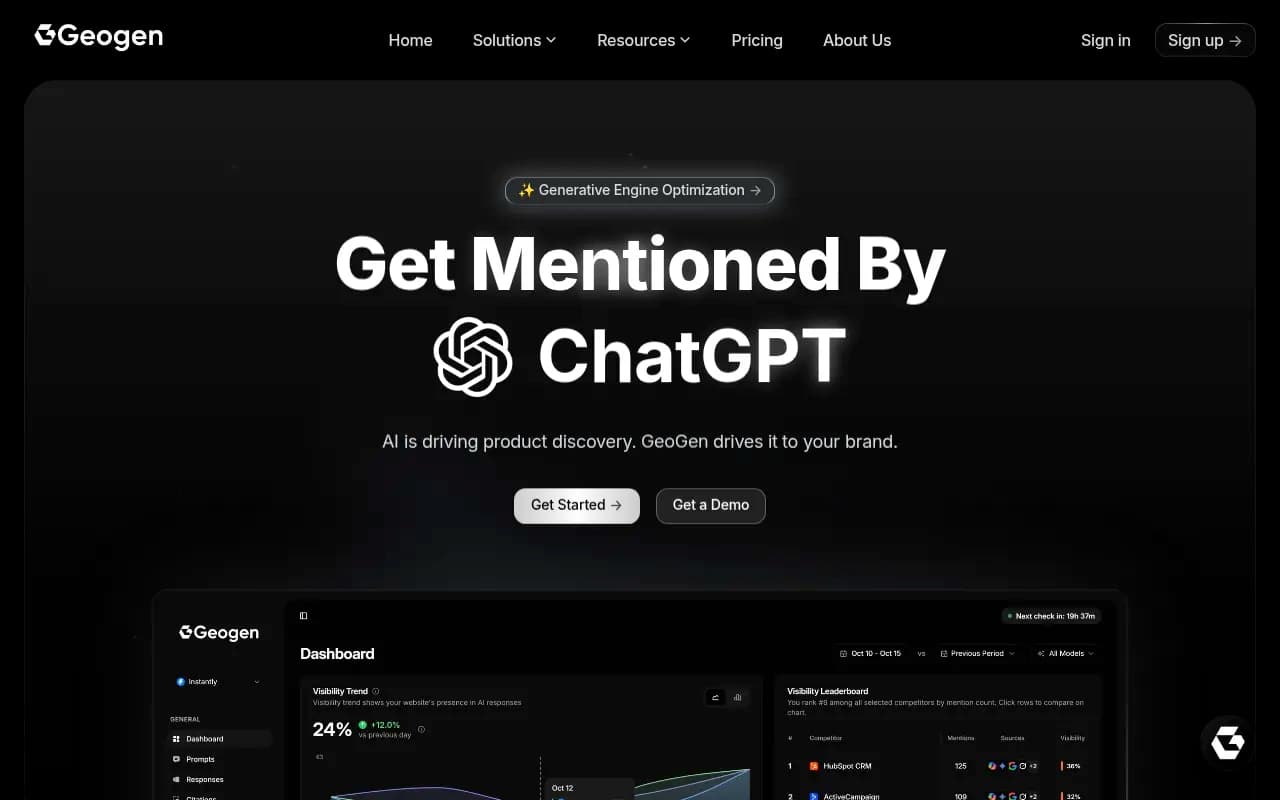
GeoGen launched to address a specific gap: brands want to know if ChatGPT, Gemini, and Perplexity are recommending them, and most SEO tools weren't built for that. It tracks brand mentions across major AI models, shows competitor rankings in AI responses, and gives recommendations for improving your AI search presence. The customer list is smaller and less recognizable than Ahrefs', but the focus is sharper. It's a tool for teams that have already figured out traditional SEO and now want to understand the AI layer.
Side-by-side comparison
| Feature | Ahrefs | GeoGen |
|---|---|---|
| Primary focus | Full SEO platform | AI search visibility (GEO) |
| AI models tracked | Limited (Brand Radar) | ChatGPT, Gemini, Perplexity, Grok, Copilot |
| Traditional SEO tools | Full suite (backlinks, audits, rank tracking, KW research) | None |
| Backlink analysis | Yes (largest index) | No |
| Keyword research | Yes (billions of keywords) | No |
| Site audit | Yes | No |
| AI brand mention tracking | Yes (fixed prompts) | Yes (custom prompts) |
| Competitor AI visibility | Yes | Yes |
| Content gap analysis | Basic | Basic recommendations |
| AI content generation | Yes (general writing assistant) | No |
| AI traffic attribution | No | No |
| AI crawler logs | No | No |
| Prompt volume/difficulty scoring | No | No |
| Reddit/YouTube AI source tracking | No | No |
| ChatGPT Shopping tracking | No | No |
| Entry price | $29/mo (Starter, limited) / $83/mo (Lite) | €20/mo (Micro) |
| Free trial | Yes | Yes (sign-up available) |
| Annual discount | 20% | 20% |
| Target user | SEO teams, agencies, enterprises | Brands focused on AI visibility |
Head-to-head feature deep-dive
AI search monitoring
This is where the comparison gets interesting. GeoGen was built for this. It tracks brand mentions across ChatGPT, Gemini, Perplexity, Grok, and Microsoft Copilot, lets you set up custom prompts relevant to your business, and shows you where competitors appear in AI responses. The interface is clean and focused on this single job.
Ahrefs' Brand Radar is the newer addition. It monitors how your brand appears in AI search results, but it works with fixed prompts rather than custom ones -- meaning you're tracking what Ahrefs decides to track, not necessarily the queries your actual customers are using. There's also no AI traffic attribution, so you can't connect AI visibility to actual site visits or revenue.
Verdict: GeoGen wins on AI monitoring depth and flexibility. Ahrefs' Brand Radar is a starting point, not a complete solution.
Traditional SEO capabilities
This isn't even a contest. Ahrefs has one of the best backlink indexes on the web, a keyword database covering billions of queries across 170+ countries, a site audit tool that crawls millions of pages, and a rank tracker that handles large-scale monitoring. GeoGen has none of this. It doesn't do traditional SEO at all.
If you're evaluating these tools purely on SEO fundamentals, Ahrefs wins by default. GeoGen isn't trying to compete here.
Verdict: Ahrefs wins completely. GeoGen doesn't offer traditional SEO tools.
Content creation and optimization
Ahrefs has content creation workflows and an AI writing assistant. It can help you research topics, identify content gaps based on keyword data, and generate drafts. This is useful for traditional SEO content, but it's not specifically engineered to get your content cited by AI models -- it's keyword-driven content creation, not citation-driven.
GeoGen offers optimization recommendations based on what it observes in AI responses, but there's no built-in content generation. You get guidance on what to improve, but you have to do the writing yourself or use another tool.
Neither tool offers what a purpose-built GEO platform would: content generated specifically to match the citation patterns of ChatGPT, Claude, or Perplexity, grounded in analysis of what those models actually cite.
Verdict: Ahrefs has more content tooling, but neither tool is purpose-built for AI search content optimization. Worth noting that Promptwatch takes a different approach here -- its built-in AI writing agent generates content specifically engineered to get cited by AI models, grounded in 880M+ citations analyzed.

Competitor analysis
Ahrefs is excellent at traditional competitor analysis -- you can see any competitor's backlink profile, their top-ranking pages, their keyword gaps, and their traffic estimates. This is deep, reliable data built on years of crawling.
GeoGen focuses competitor analysis on AI search: which competitors appear in AI responses for your target prompts, how often, and in what context. That's genuinely useful data that Ahrefs doesn't provide at the same depth.
Verdict: Depends on what you need. Ahrefs for traditional SEO competitor analysis; GeoGen for AI search competitor visibility.
Ease of use and onboarding
Ahrefs is a large platform with a lot of features. New users typically need time to find their way around, and the sheer volume of data can be overwhelming. That said, Ahrefs has invested heavily in documentation, tutorials, and an active YouTube channel -- so the learning resources are good.
GeoGen is simpler by design. Fewer features means less to learn. You can set up brand monitoring and start seeing AI visibility data relatively quickly. For teams that just want to answer "are we showing up in ChatGPT?", GeoGen gets there faster.
Verdict: GeoGen is easier to get started with. Ahrefs has a steeper curve but more depth.
Integrations and reporting
Ahrefs integrates with Google Search Console, Google Analytics, and has an API for custom workflows. It generates reports that can be exported and shared. For agencies managing multiple clients, there are multi-seat options.
GeoGen's integration ecosystem is smaller and less documented. It's a newer product, and the third-party integrations are limited compared to what Ahrefs offers.
Verdict: Ahrefs wins on integrations and reporting flexibility.
Pricing comparison
| Plan | Ahrefs | GeoGen |
|---|---|---|
| Entry/Micro | $29/mo (Starter -- very limited) | €20/mo (Micro) |
| Lite/Basic | $83/mo (Lite) | ~€49-99/mo (estimated mid tier) |
| Standard/Pro | $166/mo (Standard) | €399/mo (Pro) |
| Advanced | $333/mo (Advanced) | -- |
| Enterprise | Custom | Custom |
| Annual discount | 20% | 20% |
| Free trial | Yes | Yes |
A few things worth noting on pricing: Ahrefs' $29/mo Starter plan is quite restricted -- most serious users need at least the Lite plan at $83/mo. GeoGen's entry point is genuinely low at €20/mo, which makes it accessible for small brands just starting to think about AI visibility. But GeoGen's Pro plan at €399/mo is actually more expensive than Ahrefs' Standard plan, which is a surprising flip at the top end.
For teams that only need AI visibility monitoring, GeoGen is cheaper at the low end. For teams that need a full SEO toolkit plus some AI monitoring, Ahrefs delivers more value per dollar.
Pros and cons
Ahrefs
Pros:
- Best-in-class backlink index and keyword database
- Comprehensive SEO suite covering audits, rank tracking, content, and PPC
- Trusted by major enterprises with a long track record
- Good documentation and learning resources
- AI writing assistant included in higher plans
- Integrates with GSC and GA
Cons:
- Brand Radar uses fixed prompts -- you can't customize what AI queries you track
- No AI traffic attribution (can't connect AI visibility to revenue)
- No AI crawler logs
- No prompt volume or difficulty scoring for AI queries
- AI features feel bolted on rather than native to the product
- Expensive for small teams that only need AI monitoring
- Starter plan is too limited to be genuinely useful
GeoGen
Pros:
- Purpose-built for AI search visibility tracking
- Affordable entry point (€20/mo)
- Custom prompt tracking across major AI models
- Clean, focused interface
- Competitor AI visibility analysis
- Good for teams that have traditional SEO covered elsewhere
Cons:
- No traditional SEO tools at all
- No AI traffic attribution
- No content generation capabilities
- No AI crawler logs
- No prompt volume or difficulty scoring
- Smaller integration ecosystem
- Less established than Ahrefs -- fewer case studies and third-party reviews
- No Reddit/YouTube source tracking
Who should pick which tool
Pick Ahrefs if:
- You need a full SEO platform and AI monitoring is a secondary requirement
- Backlink analysis, keyword research, and site audits are core to your workflow
- You're an agency or enterprise that needs deep traditional SEO data
- You want a single platform that covers most of your marketing intelligence needs
- You're already paying for Ahrefs and want to see if Brand Radar is good enough for your AI visibility needs (it might be, if your requirements are basic)
Pick GeoGen if:
- AI search visibility is your primary concern and you already have traditional SEO covered
- You're a small to mid-sized brand with a limited budget for AI monitoring
- You want custom prompt tracking rather than fixed queries
- You need a quick, simple way to answer "are we showing up in ChatGPT and Gemini?"
- You're evaluating AI visibility tools before committing to a larger platform
Consider neither if:
- You need a full GEO optimization workflow -- find gaps, generate AI-optimized content, track results with traffic attribution. Both tools stop at monitoring. A dedicated GEO platform like Promptwatch covers the full loop: content gap analysis, AI-specific content generation, crawler logs, prompt volume scoring, and traffic attribution.
Final verdict
Ahrefs and GeoGen are solving different problems, which makes a direct "winner" call less useful than it sounds. Ahrefs is the right choice if you need a comprehensive SEO platform and want AI monitoring included -- just go in knowing that Brand Radar is not a deep GEO solution. GeoGen is the right choice if AI search visibility is your specific focus and you want a cheaper, purpose-built tool for that job.
The honest answer for teams serious about GEO: neither tool fully delivers. Ahrefs has the data infrastructure but hasn't built the optimization workflow. GeoGen has the focus but lacks the depth. Both are monitoring tools that show you data without giving you a clear path to acting on it.