Key takeaways
- Ahrefs is a full SEO platform first -- backlinks, keywords, rank tracking, site audits -- with AI search monitoring added on through Brand Radar. LLM Pulse is built from scratch for AI search visibility and does nothing else.
- LLM Pulse tracks prompts weekly with custom queries; Ahrefs Brand Radar uses fixed prompts, which limits how precisely you can monitor your specific brand context.
- Ahrefs starts at $83/mo and covers an enormous amount of ground. LLM Pulse starts at €49/mo but you'll still need a separate SEO tool alongside it.
- Neither tool offers AI crawler log monitoring (seeing when ChatGPT-bot or ClaudeBot actually crawls your site) -- that's a gap both share.
- If your team already pays for Ahrefs and just wants a basic read on AI visibility, Brand Radar may be enough. If AI search is your primary concern and you want granular prompt tracking, LLM Pulse is the more focused choice.
- For teams who want to go beyond monitoring and actually fix their AI visibility gaps with content generation and citation analysis, neither tool fully covers that loop -- worth knowing before you commit.
Overview
Ahrefs
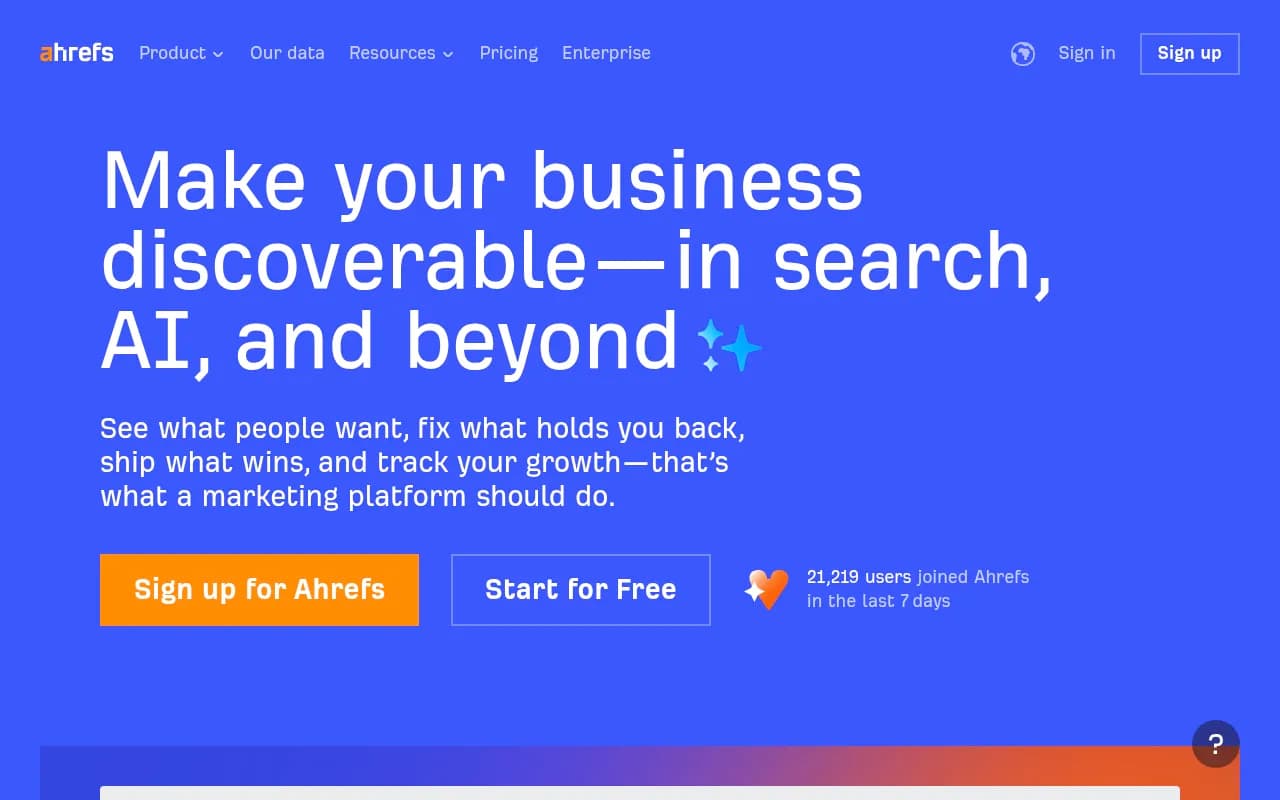
Ahrefs has been the go-to SEO toolkit for serious marketers for years, and it's used by 44% of Fortune 500 companies. Its backlink index is the largest available, its keyword database covers billions of queries, and its site audit tool is genuinely thorough. In 2024-2025, Ahrefs expanded into AI search monitoring with Brand Radar, and more recently added content creation workflows, social media management, and PPC research. The pitch is a single platform for all marketing intelligence -- traditional search, AI search, content, and paid.
The AI monitoring piece (Brand Radar) is real but limited. It tracks brand mentions across AI models using a set of fixed prompts, which means you can see whether your brand shows up but can't easily customize the exact queries being tracked. There's no AI traffic attribution, no crawler log monitoring, and no content gap analysis tied to AI search specifically.
LLM Pulse
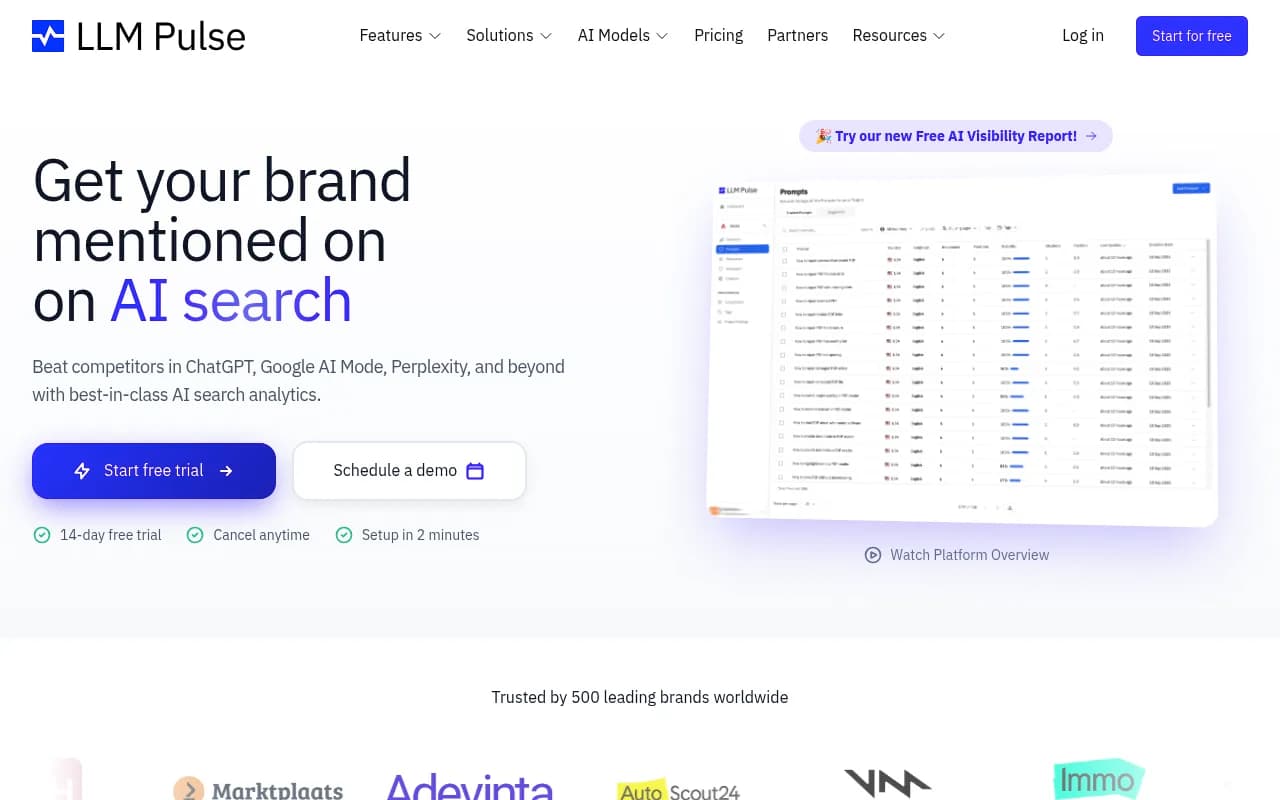
LLM Pulse launched as a dedicated AI search visibility tracker, and that focus shows in the product. You set up custom prompts, it runs them weekly across ChatGPT, Perplexity, Gemini, Google AI Mode, AI Overviews, and several others, then surfaces your visibility score, citation rate, sentiment, and share of voice against competitors. The "optimize" step gives AI-powered recommendations for improving how you appear in LLM responses.
It's used by 500+ brands including Swiss Marketplace Group and Voicemod. The interface is clean and setup takes minutes. What it doesn't do: traditional SEO. No backlinks, no keyword research, no rank tracking for Google organic. It's a single-purpose tool, which is both its strength and its limitation.
Side-by-side comparison
| Feature | Ahrefs | LLM Pulse |
|---|---|---|
| Primary focus | Full SEO + AI monitoring | AI search visibility only |
| AI models tracked | Multiple (via Brand Radar) | 10+ (ChatGPT, Perplexity, Gemini, Google AI Mode, AI Overviews, DeepSeek, Grok, Claude, Copilot, Meta AI) |
| Custom prompt tracking | Fixed prompts only | Yes, fully custom |
| Prompt frequency | Not real-time | Weekly |
| Citation analysis | Basic | Yes, with source breakdown |
| Sentiment analysis | No | Yes |
| Competitor benchmarking | Yes (SEO + AI) | Yes (AI only) |
| Content recommendations for AI | No | Yes (AI-powered) |
| Content generation | Yes (AI writing tools) | No |
| Backlink analysis | Yes (largest index) | No |
| Keyword research | Yes | No |
| Rank tracking (Google) | Yes | No |
| Site audit | Yes | No |
| AI traffic attribution | No | No |
| AI crawler log monitoring | No | No |
| Free trial | Yes | 14-day free trial |
| Starting price | $83/mo (Lite) | €49/mo (Starter) |
| Annual discount | 20% | 17% |
Head-to-head feature deep-dive
AI search monitoring
This is where the comparison gets interesting. Both tools track brand visibility in AI models, but they approach it differently.
Ahrefs Brand Radar monitors AI mentions using a fixed set of prompts. You can see where your brand appears, which AI models mention you, and how that changes over time. The data feeds into the same dashboard as your traditional SEO metrics, which is convenient if you're already an Ahrefs user. The limitation is the fixed prompts -- you can't ask "what does ChatGPT say when someone asks for the best project management tool for remote teams in Germany?" You get what Ahrefs decides to track.
LLM Pulse lets you define your own prompts. That's a meaningful difference. You can track the exact questions your potential customers are asking, monitor specific competitor comparisons, and see how AI responses shift week over week. The weekly cadence isn't real-time, but for most teams it's sufficient. You also get sentiment scoring on each response -- not just "did we appear?" but "how positively were we described?"
Verdict: LLM Pulse wins on AI monitoring depth. Custom prompts and sentiment analysis make it more actionable for teams where AI search is a priority.
Citation and source analysis
LLM Pulse shows which sources AI models cite when answering prompts in your space -- whether that's your own content, a competitor's blog, a Reddit thread, or a third-party review site. This helps you understand where the narrative is being shaped and where you might need to publish or optimize.
Ahrefs doesn't offer this kind of citation breakdown within its AI monitoring. Its strength is backlink analysis for traditional search, which is a different (though related) question.
Verdict: LLM Pulse is more useful here for AI-specific citation intelligence.
Traditional SEO capabilities
Ahrefs is in a different league. Its backlink index covers trillions of links. Keyword Explorer has data on billions of queries across 170+ countries. Site Audit crawls your entire website and flags technical issues. Rank Tracker monitors your Google positions daily. Content Explorer finds top-performing content in any niche.
LLM Pulse has none of this. Zero. It doesn't track Google rankings, doesn't analyze backlinks, doesn't audit your site. If you're comparing these two tools as your only SEO tool, Ahrefs wins by default for anything traditional-search-related.
Verdict: Ahrefs wins completely. Not a close comparison.
Content tools
Ahrefs has been building out content creation workflows -- AI writing assistance, content gap analysis for traditional search, and a content calendar. These are useful for teams producing SEO content at scale.
LLM Pulse offers "AI-powered recommendations" to improve your AI search presence. In practice, this means suggestions like "publish more content about X topic" or "your competitor is being cited for Y -- here's how to address that." It's advisory rather than generative -- it tells you what to do but doesn't write the content for you.
Worth noting: if you want a tool that both identifies AI content gaps and generates the actual content to fill them, Promptwatch is built specifically for that workflow -- it analyzes 880M+ citations to surface what's missing, then has a built-in AI writing agent to create content engineered to get cited by ChatGPT, Claude, and Perplexity.

Verdict: Ahrefs has more mature content generation. LLM Pulse has more targeted AI-specific recommendations.
Competitor analysis
Both tools offer competitor benchmarking, but in different dimensions. Ahrefs gives you deep competitor intelligence for traditional search -- their backlinks, their ranking keywords, their traffic estimates, their content gaps. It's comprehensive and battle-tested.
LLM Pulse benchmarks competitors specifically in AI search -- share of voice across models, which competitors get cited more, how their sentiment compares to yours. For teams focused on AI visibility, this is the more relevant comparison.
Verdict: Depends on what you're optimizing for. Ahrefs for traditional search competition; LLM Pulse for AI search competition.
User experience and setup
LLM Pulse claims 2-minute setup, and that's roughly accurate. You add your brand, set up some prompts, connect competitors, and you're tracking. The interface is clean and purpose-built.
Ahrefs is more complex -- not because it's poorly designed, but because it does a lot more. New users typically spend time learning which tools to use for which tasks. The learning curve is real but manageable, and Ahrefs has extensive documentation and tutorials.
Verdict: LLM Pulse is faster to get value from. Ahrefs takes longer to master but rewards the investment.
Integrations and reporting
Ahrefs integrates with Google Search Console, has an API for enterprise users, and supports data exports. Its reporting is comprehensive for SEO use cases.
LLM Pulse offers reporting dashboards within the platform. Enterprise plans likely include API access and custom reporting, but the public documentation is less detailed on this front.
Verdict: Ahrefs has more mature integration options, particularly for teams already in the Google ecosystem.
Pricing comparison
| Plan | Ahrefs | LLM Pulse |
|---|---|---|
| Entry-level | $29/mo (Starter -- very limited) | €49/mo (Starter) |
| Core plan | $83/mo (Lite) | €99/mo (Growth) |
| Mid-tier | $166/mo (Standard) | €299/mo (Scale) |
| Advanced | $333/mo (Advanced) | Enterprise (custom) |
| Enterprise | Custom | Custom |
| Free trial | Yes | 14-day free trial |
| Annual discount | 20% | 17% |
A few things worth noting on pricing:
Ahrefs' $29 Starter plan is genuinely limited -- it's more of a taste than a working plan. The Lite plan at $83/mo is where real usage begins. LLM Pulse's €49 Starter is more functional for its core use case.
If you're a team that needs both traditional SEO and AI search monitoring, you'd likely end up paying for both tools -- Ahrefs for SEO and LLM Pulse for AI tracking. That combined cost starts around $130-150/mo. Worth factoring in when evaluating.
Pros and cons
Ahrefs
Pros:
- The most complete SEO toolkit available -- backlinks, keywords, rank tracking, site audit, content tools all in one place
- Brand Radar adds AI monitoring without needing a separate subscription
- Trusted by Fortune 500 companies; data quality is consistently high
- Content Explorer and keyword tools are genuinely best-in-class for traditional search
- Strong documentation and learning resources
Cons:
- Brand Radar uses fixed prompts -- you can't customize what AI queries get tracked
- No sentiment analysis on AI responses
- No AI traffic attribution (can't connect AI visibility to actual website traffic or revenue)
- No AI crawler log monitoring
- Expensive if you only need AI search monitoring
- Learning curve is real for new users
LLM Pulse
Pros:
- Purpose-built for AI search visibility -- the focus shows in the product
- Custom prompt tracking lets you monitor exactly the queries that matter to your business
- Sentiment analysis on AI responses is a meaningful differentiator
- Clean interface, fast setup
- More affordable entry point for AI-only monitoring
- Tracks 10+ AI models including newer ones like DeepSeek and Grok
Cons:
- Zero traditional SEO capabilities -- you'll need a separate tool for Google search
- Weekly prompt tracking isn't real-time
- No AI crawler log monitoring
- Content recommendations are advisory, not generative
- Smaller user base and less established than Ahrefs
- No AI traffic attribution
Who should pick which tool
Pick Ahrefs if:
- You need a full SEO platform and want AI monitoring as part of the package
- Traditional search (Google rankings, backlinks, technical SEO) is your primary channel
- You're already an Ahrefs customer and Brand Radar covers your AI monitoring needs
- Your team doesn't have the budget for multiple specialized tools
- You need content creation tools alongside your monitoring
Pick LLM Pulse if:
- AI search visibility is your primary concern and you already have an SEO tool
- You need custom prompt tracking -- not just fixed queries
- Sentiment analysis on AI responses matters to your brand monitoring workflow
- You want a lightweight, focused tool that's fast to set up and easy to explain to stakeholders
- You're a smaller brand or startup where the lower price point matters
Consider neither if:
- You want to go beyond monitoring and actually generate content to fix your AI visibility gaps -- neither tool has a complete answer-gap-to-content-creation workflow built in
Final verdict
These tools solve different problems. Ahrefs is a mature, comprehensive SEO platform that has added AI monitoring to its existing suite. LLM Pulse is a focused AI search tracker that does one thing well. The "better" tool depends entirely on what you're trying to do.
If AI search is your main focus and you want custom prompt tracking with sentiment data, LLM Pulse is the more purpose-built choice. If you need a full SEO toolkit and want AI monitoring included, Ahrefs is the practical option -- just go in knowing Brand Radar's fixed prompts are a real limitation. Most teams doing serious AI search optimization will end up using a dedicated AI visibility platform rather than relying on either of these alone.