Key takeaways
- Ahrefs is a mature, full-stack SEO platform with AI monitoring added on top. Orchly is built AI-first, with SEO as a secondary layer.
- Orchly is roughly half the price of Ahrefs at entry level ($49/mo vs $83/mo), and considerably cheaper at every tier.
- Ahrefs' backlink index and keyword database are in a different league. If backlink analysis or deep keyword research is central to your work, Orchly can't replace it.
- For AI search visibility specifically, Orchly goes deeper: sentiment analysis, competitor AI heatmaps, and a content automation workflow. Ahrefs' Brand Radar uses fixed prompts and has no AI traffic attribution.
- Orchly includes a full content publishing workflow (brand voice training, auto-publish, scheduling). Ahrefs has content research tools but stops short of publishing.
- If you're already paying for Ahrefs for SEO, adding Orchly for AI visibility is a reasonable stack. They're not true head-to-head replacements.
Overview
Ahrefs
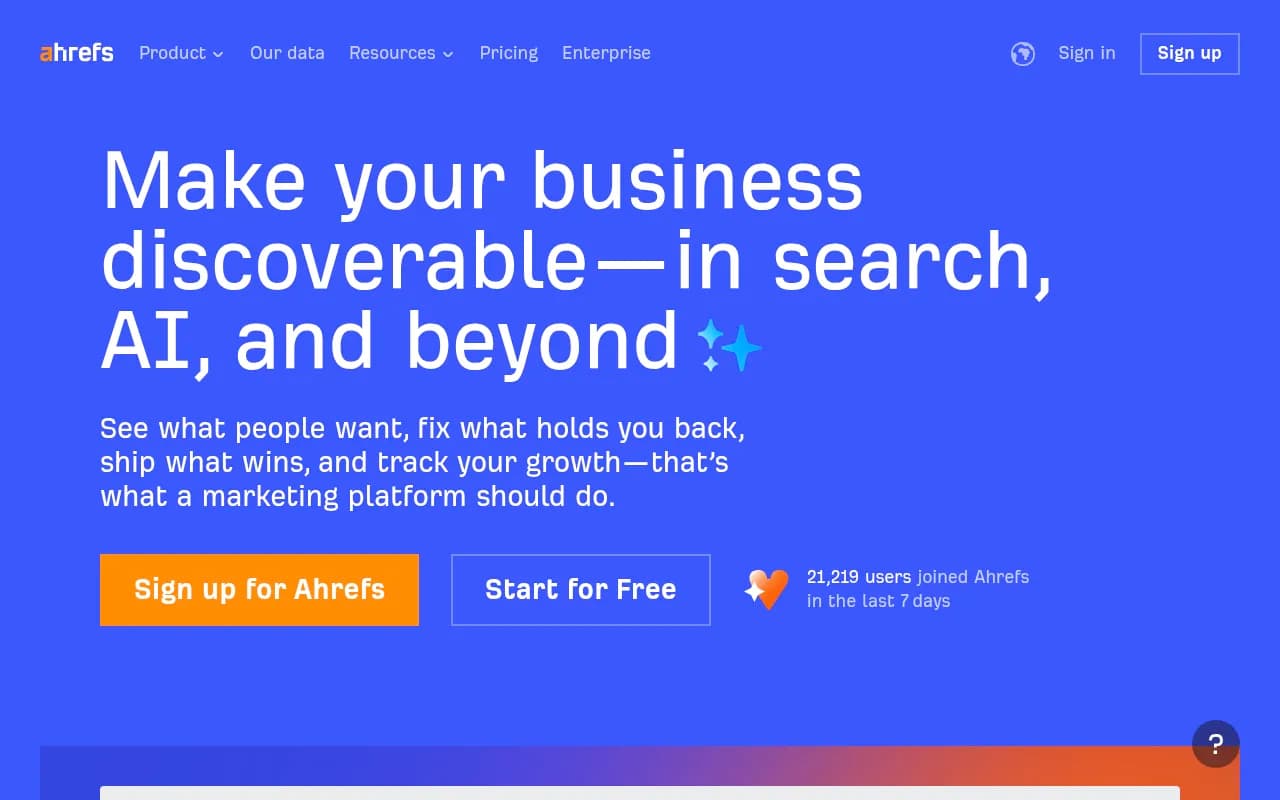
Ahrefs has been a staple in SEO teams for over a decade. It built its reputation on the world's largest backlink index and a keyword database covering billions of queries. Over the past couple of years it's expanded aggressively: AI search monitoring via Brand Radar, a social media management module, PPC research, and content tools. It's used by 44% of Fortune 500 companies, which tells you something about its depth and reliability. The trade-off is price and complexity -- it's a lot of tool, and the AI monitoring features feel like additions to an SEO platform rather than a native AI visibility product.
Orchly
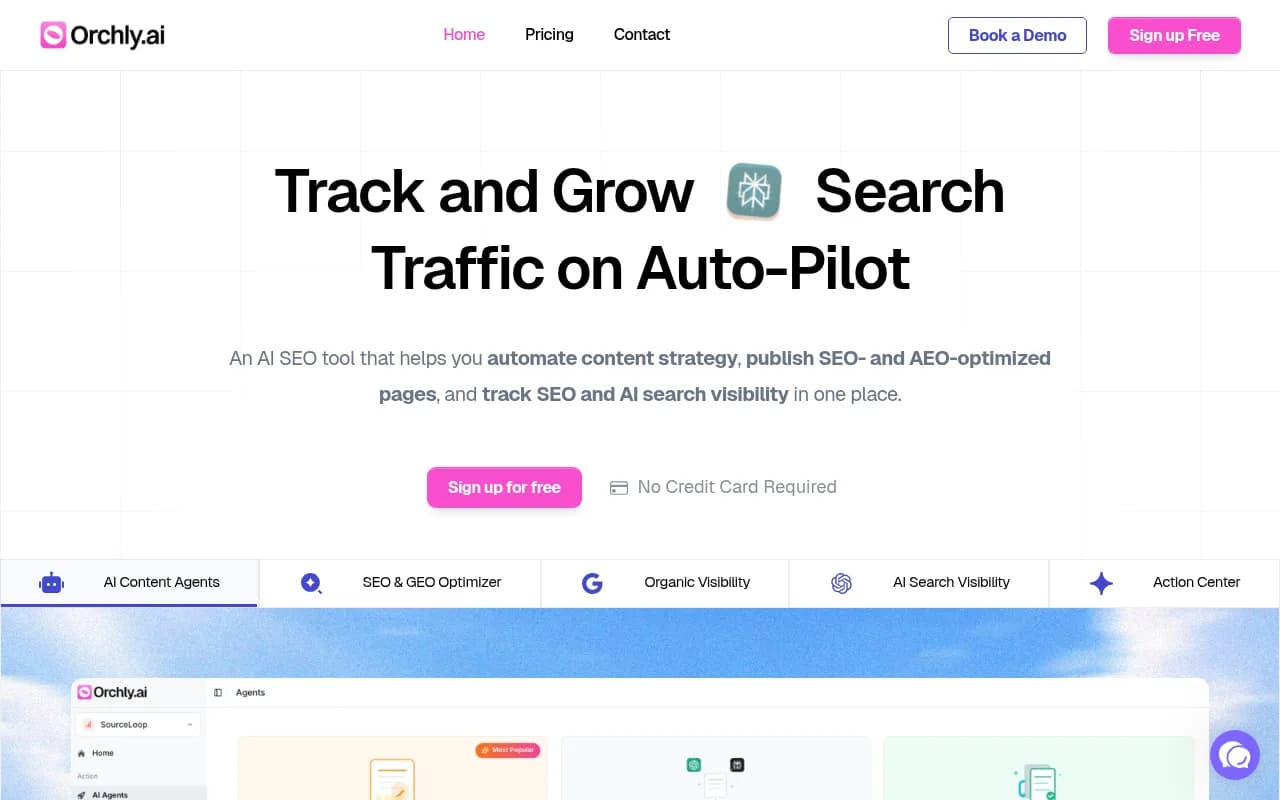
Orchly is a newer entrant that positions itself as an "AI SEO" platform -- tracking visibility across both traditional Google search and AI engines (ChatGPT, Claude, Perplexity, Gemini, Grok) from a single dashboard. It also includes an AI content writer with brand voice training, auto-publish capabilities, and an "Action Center" that surfaces what to fix. The pitch is that you don't need five separate tools -- one platform handles tracking, content creation, and optimization. It's more affordable than Ahrefs and more focused on AI visibility, but it doesn't have the same depth on the traditional SEO side.
Side-by-side comparison
| Feature | Ahrefs | Orchly |
|---|---|---|
| Starting price | $83/mo (Lite) | $49/mo (Essential) |
| Free tier | Webmaster Tools (own site only) | 14-day free trial |
| AI search monitoring | Yes (Brand Radar) | Yes (core feature) |
| AI models tracked | Limited (fixed prompts) | ChatGPT, Claude, Perplexity, Gemini, Grok |
| Sentiment analysis | No | Yes |
| Competitor AI heatmaps | No | Yes |
| AI traffic attribution | No | Yes (bot traffic analytics) |
| Content creation/publishing | Research tools only | Full workflow (write, schedule, auto-publish) |
| Brand voice training | No | Yes |
| Backlink analysis | Yes (industry-leading) | No |
| Keyword research | Yes (billions of keywords) | Basic |
| Site audit | Yes | Yes |
| Organic rank tracking | Yes | Yes |
| White-label reports | No (Enterprise only) | Yes |
| API access | Yes | Yes |
| Annual discount | 20% | 25% |
Head-to-head feature deep-dive
AI search visibility
This is where the two tools diverge most sharply.
Ahrefs' Brand Radar monitors AI mentions across ChatGPT and a handful of other models, but it uses fixed prompts -- you can't customize what queries it tracks. There's no AI traffic attribution, meaning you can't connect AI visibility to actual site visits or revenue. It's a monitoring dashboard, not an optimization tool.
Orchly was built around AI visibility from the start. It tracks ChatGPT, Claude, Perplexity, Gemini, and Grok with customizable prompts, sentiment scoring (positive/neutral/negative), and competitor heatmaps that show how your brand stacks up across each model. The bot traffic analytics module specifically tracks AI crawler behavior on your site, which is something most tools in this space skip entirely.
Verdict: Orchly wins clearly on AI visibility depth and actionability.
Traditional SEO capabilities
This is Ahrefs' home turf. Its backlink index is the largest available commercially -- over 35 trillion links crawled. The keyword database covers billions of queries across 170+ countries. Site Explorer, Keywords Explorer, and Site Audit are genuinely best-in-class tools that agencies and in-house teams have relied on for years.
Orchly has keyword tracking, a site audit, and organic rank monitoring. These are functional but not deep. You won't find the kind of backlink gap analysis, SERP feature tracking, or historical data depth that Ahrefs provides.
Verdict: Ahrefs wins by a wide margin for traditional SEO.
Content creation and publishing
Ahrefs has Content Explorer (for finding top-performing content in any niche) and an AI Content Helper that assists with writing. But it doesn't publish content -- it's a research and optimization layer that feeds into your existing CMS workflow.
Orchly includes a full AI content writer with brand voice training, style guide integration, content scheduling, and auto-publish. You can go from "I need an article on X" to a published, SEO-optimized page without leaving the platform. The brand voice feature is genuinely useful for teams that need consistent tone across AI-generated content.
Verdict: Orchly wins for end-to-end content workflow. Ahrefs wins for content research depth.
Competitor analysis
Ahrefs' competitor analysis is comprehensive for traditional SEO: backlink gap, keyword gap, content gap, traffic share. You can dissect a competitor's entire organic strategy in detail.
Orchly focuses competitor analysis on AI visibility -- tracking how competitors rank in AI responses, their sentiment scores, and where they're outperforming you across different models. It's a narrower lens but directly relevant if AI search is your priority.
Verdict: Depends on what you're competing on. Ahrefs for organic search; Orchly for AI search.
Reporting and white-labeling
Ahrefs has solid reporting but white-label reports are locked to Enterprise plans. For agencies managing multiple clients, this is a meaningful limitation unless you're on a high-tier plan.
Orchly includes white-label reports at lower tiers, which makes it more accessible for smaller agencies that need to present branded reports to clients without paying enterprise prices.
Verdict: Orchly is more agency-friendly on reporting at lower price points.
Ease of use
Ahrefs has improved its UX considerably over the years, but it's a complex platform. New users typically need a few weeks to get comfortable with all the modules. The breadth of features is also the source of the learning curve.
Orchly is more focused, which makes it easier to onboard. The Action Center concept -- surfacing what to do next -- reduces the cognitive load of figuring out where to start.
Verdict: Orchly is easier to get started with. Ahrefs rewards investment in learning it.
Pricing comparison
| Plan | Ahrefs | Orchly |
|---|---|---|
| Entry / Starter | $29/mo (Starter, very limited) | Free 14-day trial |
| Lowest full plan | $83/mo (Lite) | $49/mo (Essential) |
| Mid-tier | $166/mo (Standard) | $125/mo (Pro) |
| Advanced | $333/mo (Advanced) | Custom (Enterprise) |
| Enterprise | Custom | Custom |
| Annual discount | 20% | 25% |
A few things worth noting: Ahrefs' $29 Starter plan is heavily restricted and not really usable for professional work. The Lite plan at $83/mo is the realistic entry point. Orchly's $49/mo Essential plan is a genuine working tier, not a teaser.
For teams that need both traditional SEO and AI visibility, running both tools costs $132/mo at minimum -- which is still less than Ahrefs' Standard plan alone.
Pros and cons
Ahrefs
Pros:
- Best-in-class backlink index and keyword database
- Trusted by large enterprises and agencies globally
- Comprehensive traditional SEO toolkit in one platform
- Reliable, mature product with years of data history
- Strong integrations and API
Cons:
- AI monitoring (Brand Radar) uses fixed prompts, no customization
- No AI traffic attribution
- No content publishing workflow
- White-label only on Enterprise
- Expensive for teams that only need AI visibility
- Learning curve is real for new users
Orchly
Pros:
- Purpose-built for AI search visibility
- Tracks ChatGPT, Claude, Perplexity, Gemini, Grok with sentiment analysis
- Full content creation and auto-publish workflow
- Brand voice training for consistent AI-generated content
- White-label reports at lower tiers
- More affordable at every price point
- Bot traffic analytics (AI crawler monitoring)
Cons:
- Backlink analysis is absent
- Keyword research is basic compared to Ahrefs
- Newer platform, less proven at scale
- Smaller user base and community resources
- Less historical data depth
Who should pick which tool
Pick Ahrefs if:
- Backlink analysis and link building are central to your SEO strategy
- You need deep keyword research across hundreds of thousands of queries
- You're already invested in the Ahrefs ecosystem and just want to add AI monitoring
- You work at an enterprise where platform reliability and brand recognition matter
- You need comprehensive competitor organic analysis
Pick Orchly if:
- AI search visibility is your primary focus in 2026
- You want a content creation workflow that goes from brief to published page
- You're an agency that needs white-label reports without paying enterprise prices
- Budget is a constraint and you don't need deep backlink data
- You want sentiment analysis and competitor AI heatmaps out of the box
Consider running both if:
- You have an established SEO program (Ahrefs) and want to add AI visibility tracking (Orchly) without rebuilding your workflow
- You're an agency managing clients across both traditional SEO and AI search performance
If you're specifically focused on tracking and improving how your brand appears in AI search results, it's also worth looking at Promptwatch -- it goes beyond monitoring to include content gap analysis, an AI writing agent grounded in citation data, and crawler log monitoring across 10 AI models.

Final verdict
Ahrefs and Orchly are solving different problems, which makes this comparison less of a straight fight than it might appear.
Ahrefs is the right choice if traditional SEO is your foundation. Its backlink and keyword tools are genuinely best-in-class, and Brand Radar adds a layer of AI monitoring for teams that don't want to manage a separate tool. The limitations are real though -- fixed prompts, no traffic attribution, no content publishing -- so if AI search is where you're spending most of your attention in 2026, Brand Radar will feel thin.
Orchly is the right choice if AI search visibility is your primary goal. It's more affordable, more focused, and more actionable on the AI side. The content automation workflow is a genuine differentiator. What it can't do is replace Ahrefs for backlink analysis or serious keyword research.
The honest answer for most teams: if you're already on Ahrefs, keep it and evaluate Orchly as an add-on for AI visibility. If you're starting fresh and AI search is your priority, Orchly gives you more for less.