Key Takeaways
- GetMint costs €229/mo for Growth tier vs AthenaHQ's $295/mo Self-Serve -- GetMint is 22% cheaper and includes unlimited seats from the start
- AthenaHQ has stronger documented case studies (Rootly's 10x citation growth, $126K in attributed revenue) while GetMint's customer proof is less specific
- GetMint uses project-based scaling (unlimited seats, pay per project) vs AthenaHQ's credit-based model (1 credit = 1 AI query) -- different cost structures for different team sizes
- Both platforms track 8+ LLMs including ChatGPT, Perplexity, Claude, and Gemini, but neither offers crawler log analysis or Reddit/YouTube tracking like some competitors
- AthenaHQ positions itself as an "end-to-end workflow management" platform for dedicated GEO specialists, while GetMint markets as a simpler "monitor and optimize" tool for broader marketing teams
- If you're also tracking how AI crawlers interact with your site or need content gap analysis with AI-generated articles, Promptwatch covers those angles that both platforms miss

Overview
AthenaHQ overview

AthenaHQ came out of Y Combinator and has gotten press in Forbes and the Wall Street Journal. It's used by recognizable brands like Coinbase, ZoomInfo, and SoFi. The platform calls itself an "end-to-end AEO & GEO platform" and positions heavily around workflow management for dedicated GEO specialists. The homepage emphasizes executive dashboards, ROI tracking, and "command center" language -- this is a tool built for teams that have someone owning AI search optimization as a primary responsibility.
Pricing starts at $295/month for the Self-Serve tier (discounted to $95 for the first month), with Enterprise custom pricing above that. It uses a credit-based model where 1 credit = 1 AI query. Annual plans get a 17% discount.
GetMint overview
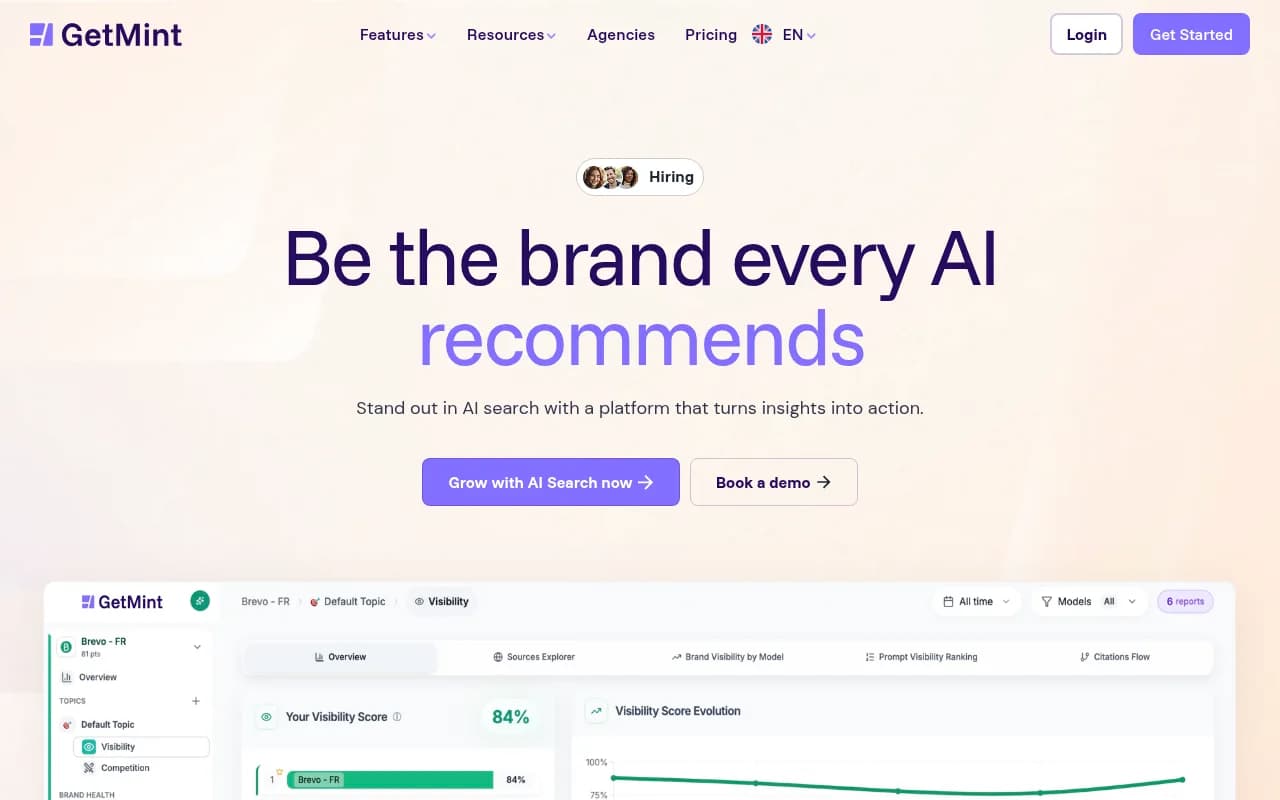
GetMint describes itself as "the first platform for Generative Engine Optimization" and claims 200+ leading brands and agencies as customers. The positioning is broader than AthenaHQ -- it's marketed to general marketing teams, not just GEO specialists. The homepage focuses on monitoring and improving visibility across ChatGPT, Gemini, and "all major LLMs."
Pricing is €229/mo for Growth and €499/mo for Pro, with unlimited seats included and project-based scaling. Free trial available. GetMint is a European company (pricing in euros), which may matter for invoicing and data residency.
Side-by-Side Comparison
| Feature | AthenaHQ | GetMint |
|---|---|---|
| Starting price | $295/mo ($95 first month) | €229/mo (~$250/mo) |
| Pricing model | Credit-based (1 credit = 1 query) | Project-based, unlimited seats |
| Free trial | Not mentioned | Yes |
| AI engines tracked | 8+ (ChatGPT, Perplexity, Claude, Gemini, Google AI Overviews, etc.) | 8+ (ChatGPT, Claude, Gemini, Perplexity, etc.) |
| Citation tracking | Yes | Yes |
| Content optimization | Automated recommendations | Real-time monitoring with actionable insights |
| Case studies | Strong (Rootly: 10x citation growth, $126K revenue) | Vague ("200+ brands") |
| Target audience | Dedicated GEO specialists, enterprise teams | Broader marketing teams, agencies |
| Workflow management | End-to-end GEO workflow, executive dashboards | Monitor and optimize focus |
| Seats included | Not specified (likely limited on Self-Serve) | Unlimited on all plans |
| Annual discount | 17% | Not specified |
| Company location | US (Y Combinator backed) | Europe (pricing in euros) |
| Press coverage | Forbes, WSJ, Y Combinator | Not mentioned |
| API access | Not mentioned | Not mentioned |
Pricing comparison
| Plan | AthenaHQ | GetMint |
|---|---|---|
| Entry tier | Self-Serve: $295/mo ($95 first month) | Growth: €229/mo (~$250/mo) |
| Mid tier | Not listed (jumps to Enterprise) | Pro: €499/mo (~$545/mo) |
| Enterprise | Custom pricing | Not listed separately (Pro may serve this) |
| Free trial | No | Yes |
| Annual discount | 17% off | Not specified |
| Billing model | Credit-based (1 credit per AI query) | Project-based scaling |
| Seats | Not specified | Unlimited on all plans |
GetMint is slightly cheaper at the entry level when you convert euros to dollars, and it includes unlimited seats from the start. AthenaHQ's credit-based model means your costs scale with query volume, which could be better or worse depending on how many prompts you're tracking. If you're running thousands of queries per month, credits could get expensive fast. If you're tracking a focused set of high-value prompts, the credit model might be more efficient than paying for unused project capacity.
User interface and workflow
AthenaHQ leans hard into "command center" and "executive dashboard" language. The homepage shows role-specific views: AEO/GEO Manager, CMO, SEO, PR, Content Marketing, Brand Marketing. This suggests a more complex interface with different permission levels and reporting views. The emphasis on "end-to-end workflow management" implies you're living in this tool daily if you're a GEO specialist.
GetMint's positioning is simpler: "Monitor, improve, and grow your visibility." The language suggests a more straightforward dashboard experience without the role-based complexity. For a small team or someone wearing multiple hats, this is probably easier to onboard and use without a learning curve.
Verdict: AthenaHQ if you have a dedicated GEO person who needs deep workflow tools. GetMint if you want something your whole marketing team can log into without training.
AI engine coverage
Both platforms claim to track 8+ LLMs. AthenaHQ specifically lists ChatGPT, Perplexity, Google AI Overviews, Claude, and "other LLMs." GetMint lists ChatGPT, Claude, Gemini, and Perplexity. Neither provides a complete public list of exactly which models and which versions.
What's missing from both: Neither mentions tracking ChatGPT Shopping, Reddit discussions that influence AI responses, YouTube video citations, or AI crawler logs (which pages AI bots are actually reading on your site). These are gaps that matter if you want the full picture of how AI engines interact with your brand.
Verdict: Functionally tied on core LLM coverage. Both miss some newer channels.
Citation tracking and source analysis
AthenaHQ explicitly mentions "citation source analysis and link building" as a feature. This suggests you can see which URLs AI models are citing when they mention (or don't mention) your brand, and potentially identify link-building opportunities.
GetMint's website says it provides "real-time monitoring with actionable insights" but doesn't break out citation source analysis as a specific feature. The lack of detail here is a red flag -- if it's a core capability, why not say so clearly?
Verdict: AthenaHQ appears stronger on citation source analysis based on what's publicly documented.
Content optimization
AthenaHQ promises "automated content optimization recommendations." This implies the platform analyzes your current content, compares it to what AI models want, and suggests changes. How automated this actually is -- whether it's just flagging gaps or generating draft content -- isn't clear from the website.
GetMint says it helps you "optimize your brand visibility" but doesn't specify content optimization as a distinct feature. The focus seems more on monitoring what's happening than on fixing it.
Neither platform appears to offer AI-generated content creation as part of the core product. If you want a tool that not only shows you gaps but also writes the articles to fill them, you're looking at a different category of platform.
Verdict: AthenaHQ has more explicit content optimization features. GetMint is more monitoring-focused.
Case studies and proof
AthenaHQ has the strongest documented case study in the GEO category: Rootly achieved roughly 10x citation rate growth and attributed $126K in revenue to their AI search optimization efforts. That's a specific, auditable claim. The client roster (Coinbase, ZoomInfo, SoFi) is also impressive and verifiable.
GetMint claims "200+ leading brands and agencies" but doesn't name them or provide specific results. This is a weaker proof point. Saying you have 200 customers without showing what they achieved is marketing fluff.
Verdict: AthenaHQ wins on credibility. The Rootly case study alone is worth more than vague customer counts.
Team size and collaboration
GetMint includes unlimited seats on all plans. This is a big deal if you have a 5-10 person marketing team that all wants access. You pay for the project scope, not the headcount.
AthenaHQ doesn't specify seat limits on the Self-Serve tier, which usually means they're limited and you pay more for additional users. The Enterprise tier likely includes more seats, but that's custom pricing.
Verdict: GetMint is better for teams. AthenaHQ is priced for individual specialists or small core teams.
Enterprise features and support
AthenaHQ has a dedicated Enterprise tier with custom pricing. The homepage emphasizes "executive-level insights," "ROI tracking," and "strategic oversight" -- language aimed at larger organizations with budget and multiple stakeholders.
GetMint's Pro tier at €499/mo is their top public plan. No mention of enterprise-specific features like SSO, custom SLAs, dedicated support, or advanced permissioning. This suggests GetMint is more mid-market focused.
Verdict: AthenaHQ is built for enterprise buyers. GetMint is better for smaller, faster-moving teams.
Geographic and language considerations
GetMint is a European company with pricing in euros. If you're a European brand, this might simplify invoicing, VAT, and data residency questions. If you're a US company, you're dealing with currency conversion and potentially different support hours.
AthenaHQ is US-based (Y Combinator, pricing in dollars). Better fit for North American companies.
Verdict: Pick based on where your company is located.
What both platforms miss
Neither AthenaHQ nor GetMint offers:
- AI crawler log analysis (which pages are AI bots actually reading?)
- Reddit and YouTube tracking (discussions and videos that influence AI recommendations)
- ChatGPT Shopping monitoring (product recommendation carousels)
- AI-generated content creation (they show you gaps but don't write the articles)
- Prompt volume estimates or difficulty scoring (which prompts are worth targeting?)
If these capabilities matter to your strategy, you're looking at a different tier of platform. Tools like Promptwatch cover crawler logs, content gap analysis with AI article generation, and Reddit/YouTube tracking -- filling in the action side that monitoring-only platforms miss.
Pros and cons
AthenaHQ pros
- Strong case study proof (Rootly: 10x citation growth, $126K revenue)
- Recognizable customer logos (Coinbase, ZoomInfo, SoFi)
- End-to-end workflow management for dedicated GEO specialists
- Citation source analysis and link building features
- Automated content optimization recommendations
- Press coverage in Forbes and WSJ
- Enterprise tier for larger organizations
AthenaHQ cons
- More expensive starting tier ($295/mo vs GetMint's €229/mo)
- Credit-based pricing can get costly with high query volumes
- Likely limited seats on Self-Serve tier
- No free trial mentioned
- Complex interface may have steeper learning curve
- Missing crawler logs, Reddit/YouTube tracking, content generation
GetMint pros
- Cheaper entry price (€229/mo vs $295/mo)
- Unlimited seats on all plans
- Free trial available
- Simpler positioning for broader marketing teams
- Project-based pricing (predictable costs)
- European company (may be better for EU customers)
GetMint cons
- Weak customer proof ("200+ brands" with no names or results)
- Less explicit content optimization features
- No clear enterprise tier or advanced features
- Pricing in euros (currency risk for US companies)
- Appears more monitoring-focused than action-oriented
- Missing crawler logs, Reddit/YouTube tracking, content generation
Who should pick AthenaHQ
Pick AthenaHQ if:
- You have a dedicated GEO specialist or team member who will own this full-time
- You need strong case study proof to justify the investment to leadership
- You're an enterprise with budget for custom pricing and want executive dashboards
- Citation source analysis and link building are core to your strategy
- You want automated content optimization recommendations
- You're a US-based company and prefer dollar pricing
- You're tracking a focused set of high-value prompts (credit model works in your favor)
Who should pick GetMint
Pick GetMint if:
- You're a smaller marketing team (5-10 people) who all need access
- You want predictable project-based pricing without worrying about query credits
- You prefer a simpler tool without role-based complexity
- You're a European company and want euro pricing
- You want to test with a free trial before committing
- You're okay with less explicit content optimization in exchange for lower cost
- You don't need enterprise features like SSO or custom SLAs
Final verdict
AthenaHQ is the stronger platform if you're serious about GEO and have the budget. The Rootly case study alone proves it can drive real revenue, and the feature set is more complete for someone who's doing this as their primary job. The credit-based pricing is a gamble -- it could be efficient or it could spiral if you're tracking hundreds of prompts.
GetMint is the better deal for smaller teams who want to start monitoring AI search without a big commitment. Unlimited seats and project-based pricing make it easier to get your whole team involved. But the lack of customer proof and vague feature descriptions are concerning. You're betting on a platform that hasn't publicly shown results.
If I had to pick one today, I'd go with AthenaHQ for the case study credibility and more explicit optimization features. But I'd negotiate hard on the credit pricing and ask for a pilot to see actual costs before signing an annual contract. GetMint is worth a free trial if you're budget-conscious and don't need enterprise features, but I'd want to see specific results from their customer base before scaling up.
Both platforms are monitoring-first tools. If you want to close the loop from tracking to content creation to results, you're looking at a different category -- platforms that not only show you where you're invisible but also help you fix it with content gap analysis and AI-generated articles. That's where the real optimization happens.