Key Takeaways
- LLM Pulse is 3x cheaper for small teams: €99/mo gets you 5 AI models vs AthenaHQ's $295/mo for similar coverage
- AthenaHQ targets enterprise buyers with custom pricing and a credit-based model that can get expensive fast (1 credit = 1 query)
- LLM Pulse tracks 10+ models out of the box (ChatGPT, Perplexity, Gemini, Google AI Mode, DeepSeek, Grok, Claude, Copilot, Meta AI, AI Overviews) while AthenaHQ covers 8+ but gates some behind enterprise plans
- Both are monitoring-focused platforms -- neither offers built-in content generation or crawler log analysis like Promptwatch does
- AthenaHQ has stronger brand recognition (Y Combinator backed, clients like Coinbase and ZoomInfo) but LLM Pulse delivers similar core functionality at a fraction of the cost
- Setup speed matters: LLM Pulse claims 2-minute setup with a 14-day free trial; AthenaHQ offers a discounted first month ($95) but no trial period
Overview
AthenaHQ

AthenaHQ is a Y Combinator-backed Generative Engine Optimization (GEO) platform that helps marketing teams track how their brand appears in AI search results. It monitors ChatGPT, Perplexity, Google AI Overviews, Claude, and other LLMs, providing citation tracking and visibility metrics. The company raised $2.2 million and counts Coinbase, ZoomInfo, and SoFi among its clients. AthenaHQ positions itself as an "end-to-end AEO & GEO platform" with a credit-based pricing model starting at $295/month (discounted to $95 for the first month).
The platform emphasizes executive dashboards, ROI tracking, and cross-platform visibility analysis. It's built for teams that want a polished interface and are willing to pay enterprise prices for brand-name backing.
LLM Pulse
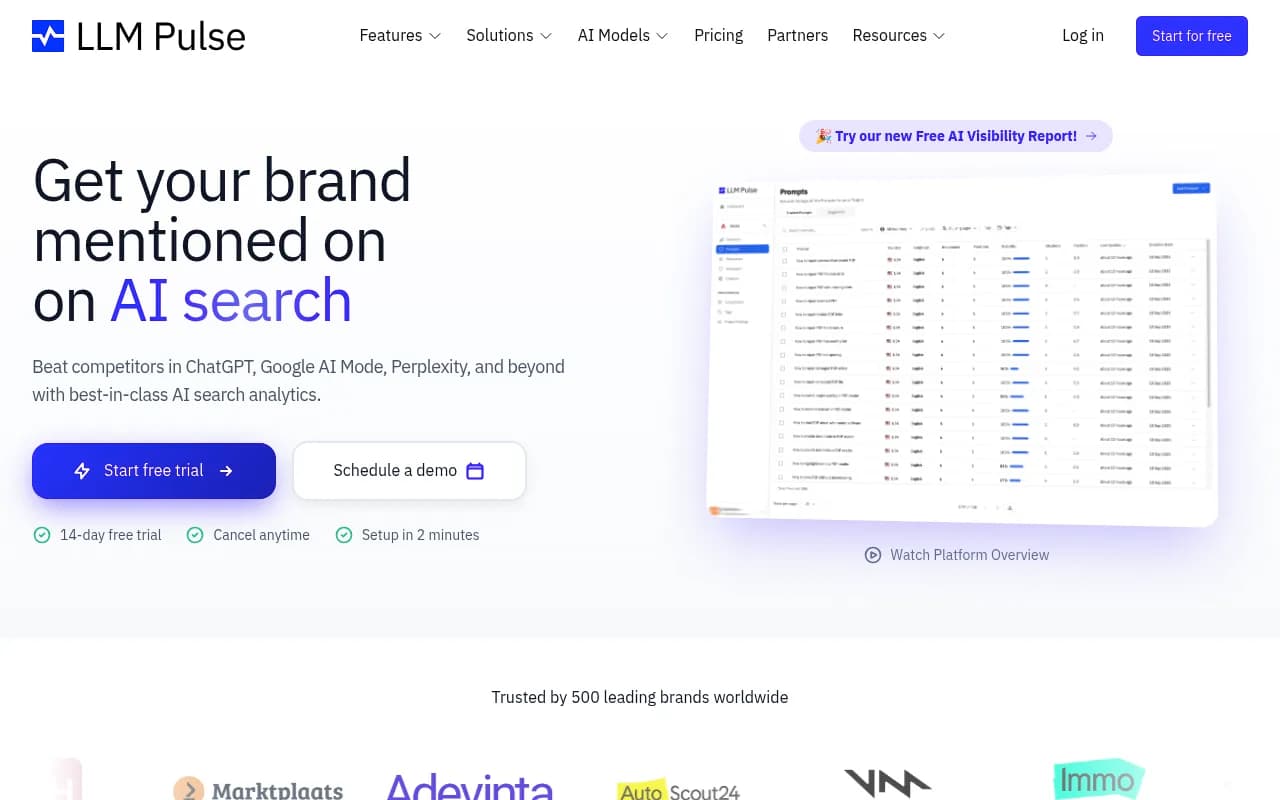
LLM Pulse is an AI search visibility tracker that monitors how ChatGPT, Perplexity, Gemini, Google AI Mode, and other LLMs mention your brand. Used by 500+ brands including Swiss Marketplace Group and Voicemod, it tracks prompts weekly, analyzes citations and sentiment, benchmarks competitors, and provides content recommendations. Pricing starts at €49/month for the Starter plan, with a 14-day free trial and 2-minute setup.
LLM Pulse covers 10+ AI models and focuses on making AI visibility tracking accessible to smaller teams and agencies. The interface is straightforward: track key prompts, measure visibility scores, analyze citation sources, and get optimization suggestions.
Side-by-side comparison
| Feature | AthenaHQ | LLM Pulse |
|---|---|---|
| Starting price | $295/mo ($95 first month) | €49/mo (~$52/mo) |
| Mid-tier price | Enterprise custom | €99/mo (~$105/mo) |
| Free trial | No (discounted first month) | 14 days |
| AI models tracked | 8+ (some enterprise-only) | 10+ (all plans) |
| Credit system | Yes (1 credit = 1 query) | No (unlimited queries per plan) |
| Prompt tracking | ✓ | ✓ |
| Citation analysis | ✓ | ✓ |
| Competitor benchmarking | ✓ | ✓ |
| Sentiment analysis | ✓ | ✓ |
| Content recommendations | ✓ | ✓ |
| Setup time | Not specified | 2 minutes |
| Annual discount | 17% | 17% |
| Target audience | Enterprise, large marketing teams | SMBs, agencies, mid-market |
Pricing breakdown
This is where the two platforms diverge sharply.
| Plan | AthenaHQ | LLM Pulse |
|---|---|---|
| Entry | $295/mo self-serve ($95 first month) | €49/mo Starter |
| Mid-tier | Enterprise (custom) | €99/mo Growth |
| High-tier | Enterprise (custom) | €299/mo Scale |
| Enterprise | Custom pricing | Custom (above €299/mo) |
| Billing model | Credit-based (1 credit = 1 AI query) | Flat monthly fee |
| Free trial | No | 14 days |
AthenaHQ's credit system is a wildcard. If you're tracking 50 prompts across 5 models weekly, that's 1,000 queries/month. At scale, credits burn fast. LLM Pulse's flat-fee model is more predictable -- you know exactly what you're paying each month.
The $95 first-month discount on AthenaHQ looks attractive until you realize month two jumps to $295. LLM Pulse's 14-day trial lets you test the platform risk-free before committing.
Model coverage and tracking
Both platforms track the major AI models, but LLM Pulse is more transparent about what you get at each tier.
LLM Pulse explicitly lists 10+ models: ChatGPT, Perplexity, Gemini, Google AI Mode, AI Overviews, DeepSeek (Enterprise), Grok (Enterprise), Claude (Enterprise), Copilot (Enterprise), Meta AI (Enterprise). The base plans include the top 5 models; enterprise plans unlock the rest.
AthenaHQ claims "8+ LLMs" but doesn't break down which models are available at which pricing tier. The website mentions ChatGPT, Perplexity, Google AI Overviews, and Claude, but it's unclear if all are included in the $295/mo plan or if some require enterprise pricing.
Verdict: LLM Pulse wins on transparency. You know exactly what you're getting at each price point.
User interface and workflow
Both platforms follow a similar three-step workflow: track prompts, analyze visibility, optimize content.
AthenaHQ emphasizes executive dashboards and "command center" interfaces. The marketing copy targets CMOs and AEO/GEO managers with language like "unified command center for all GEO activities" and "ROI tracking for AI optimization efforts." The interface appears polished and enterprise-focused, but there's no public demo or screenshots beyond the homepage hero image.
LLM Pulse shows more of its interface upfront. The homepage includes screenshots of the prompt tracking dashboard, citation analysis, and optimization recommendations. The workflow is straightforward: add prompts, set tracking frequency (weekly), view results across models, analyze citation sources, get content suggestions. Setup claims to take 2 minutes.
Verdict: LLM Pulse is more transparent about what you're actually buying. AthenaHQ's marketing is heavier on positioning, lighter on specifics.
Citation and source analysis
Both platforms analyze which sources AI models cite when mentioning your brand.
AthenaHQ offers "citation source analysis and link building" as part of its feature set. The platform identifies which websites, articles, and third-party sources LLMs reference when discussing your brand or industry. This helps you understand if your own content is being cited or if competitors and media outlets are shaping the narrative.
LLM Pulse provides "citations analysis" that shows which sources AI trusts in your space. You can see if your content gets cited or if competitors and third parties dominate. The platform also tracks citation rate as a key metric alongside visibility score and sentiment.
Verdict: Functionally equivalent. Both platforms surface the same core insight -- which sources AI models trust.
Competitor benchmarking
Tracking your own brand is half the story. Knowing how you stack up against competitors is the other half.
AthenaHQ includes competitor benchmarking in its feature set, though details are sparse. The platform likely lets you add competitor brands and compare visibility scores, citation rates, and share of voice across prompts.
LLM Pulse explicitly mentions "benchmark against competitors" and "share of voice" as core features. You can track multiple brands (yours + competitors) and see who gets mentioned most often for key prompts. The platform also shows which AI models favor which brands.
Verdict: Both platforms offer competitor tracking. LLM Pulse is more upfront about it.
Content optimization and recommendations
Neither platform generates content for you, but both offer suggestions.
AthenaHQ provides "automated content optimization recommendations" as part of its workflow. The platform analyzes gaps in your AI visibility and suggests content topics or angles to improve how LLMs describe your brand. It's unclear how actionable these recommendations are or if they include specific keywords, prompts, or content structures.
LLM Pulse offers "AI-powered content recommendations to improve how you appear in LLM responses." The platform's "Optimize" step shows content gaps and suggests topics to cover. Like AthenaHQ, it's a recommendation engine, not a content generator.
Verdict: Both platforms stop at recommendations. If you want a tool that actually helps you create the content -- not just tell you what's missing -- Promptwatch includes a built-in AI writing agent that generates articles, listicles, and comparisons grounded in real citation data and prompt volumes.

Reporting and analytics
Both platforms provide dashboards and reports, but they target different audiences.
AthenaHQ emphasizes "executive-level insights" and "ROI tracking for AI optimization efforts." The platform is built for teams that need to justify AI search investments to leadership. Expect polished reports, high-level metrics, and share-of-voice charts that look good in board decks.
LLM Pulse focuses on actionable metrics: visibility score, citation rate, sentiment, and share of voice. The dashboards are designed for practitioners -- SEO managers, content leads, and agency teams who need to track week-over-week changes and spot trends quickly.
Verdict: AthenaHQ for executives who need pretty slides. LLM Pulse for practitioners who need to get work done.
Setup and onboarding
AthenaHQ doesn't specify setup time. The platform offers a "Free Audit (10m)" -- a 10-minute consultation call, not a free trial. Onboarding likely involves a sales call, custom pricing discussion, and account setup by their team.
LLM Pulse claims "Setup in 2 minutes" and offers a 14-day free trial with no credit card required. You sign up, add your prompts, and start tracking immediately. The low-friction onboarding matches the self-serve pricing model.
Verdict: LLM Pulse wins on speed and ease. AthenaHQ's sales-led approach adds friction.
Customer base and social proof
Both platforms name-drop impressive clients, but the scale differs.
AthenaHQ lists Coinbase, ZoomInfo, SoFi, OneSignal, Nextiva, Paperless Post, DeVry University, Volkswagen, and others. The company is Y Combinator-backed and raised $2.2 million. It's been featured in Forbes, Wall Street Journal, and Y Combinator's announcements. The brand positioning is enterprise-first.
LLM Pulse claims "500+ brands" including Swiss Marketplace Group and Voicemod. The client logos on the homepage are less recognizable than AthenaHQ's, but the volume (500+) suggests broader adoption among smaller companies and agencies.
Verdict: AthenaHQ has stronger brand recognition and enterprise logos. LLM Pulse has wider adoption across smaller teams.
What's missing from both platforms
Neither AthenaHQ nor LLM Pulse offers:
- AI crawler logs: You can't see which AI models are actually crawling your website, how often, or which pages they're reading. Promptwatch tracks real-time logs of ChatGPT, Claude, Perplexity, and other crawlers hitting your site.
- Content generation: Both platforms tell you what content to create but don't help you create it. Promptwatch includes an AI writing agent that generates articles optimized for AI search based on citation data and competitor analysis.
- Traffic attribution: Neither platform connects AI visibility to actual website traffic or revenue. Promptwatch offers code snippet integration, Google Search Console sync, and server log analysis to close the loop.
- Reddit and YouTube tracking: AI models cite Reddit threads and YouTube videos heavily, but neither platform surfaces these discussions. Promptwatch includes Reddit and YouTube insights as part of its citation analysis.
If you need more than monitoring -- if you want to actually fix the gaps these platforms identify -- you'll need a complementary tool.
Pros and cons
AthenaHQ pros
- Strong brand recognition (Y Combinator, $2.2M raised)
- Enterprise clients (Coinbase, ZoomInfo, SoFi)
- Executive-focused dashboards and ROI tracking
- Featured in Forbes, WSJ, and other major outlets
- Polished positioning and marketing
AthenaHQ cons
- Expensive ($295/mo after first month)
- Credit-based model can get costly at scale
- No free trial (only discounted first month)
- Unclear which AI models are included at each tier
- Sales-led onboarding adds friction
- Monitoring-only -- no content generation or crawler logs
LLM Pulse pros
- 3x cheaper than AthenaHQ (€99/mo vs $295/mo for similar coverage)
- Transparent pricing with flat monthly fees (no credit system)
- 14-day free trial with 2-minute setup
- 10+ AI models clearly listed by tier
- Self-serve onboarding with no sales calls
- 500+ brands using the platform
LLM Pulse cons
- Less brand recognition than AthenaHQ
- Fewer enterprise logos in client list
- Interface may feel less polished than AthenaHQ's executive dashboards
- Monitoring-only -- no content generation or crawler logs
- Some advanced models (Claude, Grok, DeepSeek) require enterprise plan
Who should pick AthenaHQ
Pick AthenaHQ if:
- You're an enterprise marketing team with budget to spare
- You need polished executive dashboards for board presentations
- Brand recognition matters (Y Combinator backing, enterprise client logos)
- You're already in conversations with their sales team and got custom pricing
- You value a sales-led onboarding process over self-serve setup
AthenaHQ is built for companies where $295/month is a rounding error and the CMO needs pretty slides to justify AI search investments.
Who should pick LLM Pulse
Pick LLM Pulse if:
- You're a small to mid-sized marketing team or agency
- You want transparent, predictable pricing without a credit system
- You need to test the platform before committing (14-day trial)
- You want fast, self-serve setup without sales calls
- You're tracking 10+ AI models and want them all included in one plan
- You're budget-conscious and want similar functionality at 1/3 the cost
LLM Pulse is the practical choice for teams that need AI visibility tracking without enterprise overhead.
Final verdict
LLM Pulse delivers 80% of AthenaHQ's functionality at 30% of the cost. Unless you specifically need AthenaHQ's brand recognition or executive dashboards, LLM Pulse is the smarter pick for most teams. The transparent pricing, free trial, and self-serve setup make it easier to get started, and the flat monthly fees are more predictable than AthenaHQ's credit-based model.
That said, both platforms are monitoring-only tools. They'll show you where you're invisible in AI search, but they won't help you fix it. If you want to close the loop -- track visibility, generate optimized content, and measure the impact -- you'll need a platform like Promptwatch that combines monitoring with content creation and traffic attribution.
For pure monitoring on a budget: LLM Pulse wins. For enterprise buyers who need brand-name backing: AthenaHQ fits the bill. For teams that want to actually optimize, not just monitor: look beyond both.