Key Takeaways
- AthenaHQ is purpose-built for AI search visibility -- if your primary goal is tracking and optimizing how ChatGPT, Perplexity, Claude, and Google AI Overviews cite your brand, AthenaHQ is the specialist. Lumar added GEO as one module in a much broader platform.
- Lumar is an enterprise-scale Swiss Army knife -- it combines GEO, technical SEO, site speed, web accessibility, and custom analytics in one platform. If you need all of those capabilities and manage large, complex sites, Lumar's breadth is the draw.
- Pricing reflects focus: AthenaHQ starts at $295/month (credit-based, self-serve tier available), while Lumar is custom enterprise pricing only -- expect a significantly higher entry point and annual contracts.
- AthenaHQ's credit model can get expensive at scale -- 1 credit per AI query means high-volume monitoring burns through credits fast. Lumar's enterprise pricing is opaque but likely more predictable for large teams.
- Lumar's strength is technical depth across the board -- if your team needs to audit crawlability, fix Core Web Vitals, test WCAG compliance, and monitor AI citations all in one place, Lumar delivers. AthenaHQ doesn't touch site speed or accessibility.
- AthenaHQ has tighter AI-specific workflows -- citation source analysis, sentiment tracking, and AI search volume estimates are core to the product. Lumar's GEO toolkit is newer and less mature.
Overview
AthenaHQ: AI search specialist

AthenaHQ launched as a Generative Engine Optimization (GEO) platform and that's still its core identity. It tracks how your brand shows up across ChatGPT, Perplexity, Google AI Overviews, Claude, Gemini, and other LLMs. The pitch is simple: AI search is replacing traditional search for many queries, and if you're not visible in AI results, you're losing traffic and mindshare. AthenaHQ monitors brand mentions, citation sources, sentiment, and AI search volume, then gives you recommendations to improve visibility. Used by Coinbase, ZoomInfo, and SoFi. Y Combinator-backed, featured in Forbes and WSJ.
The platform is designed for marketing teams, SEO teams, and dedicated AEO/GEO managers who want a command center for AI visibility. It's not trying to be a full SEO suite -- it's focused on the AI search layer.
Lumar: Enterprise optimization platform
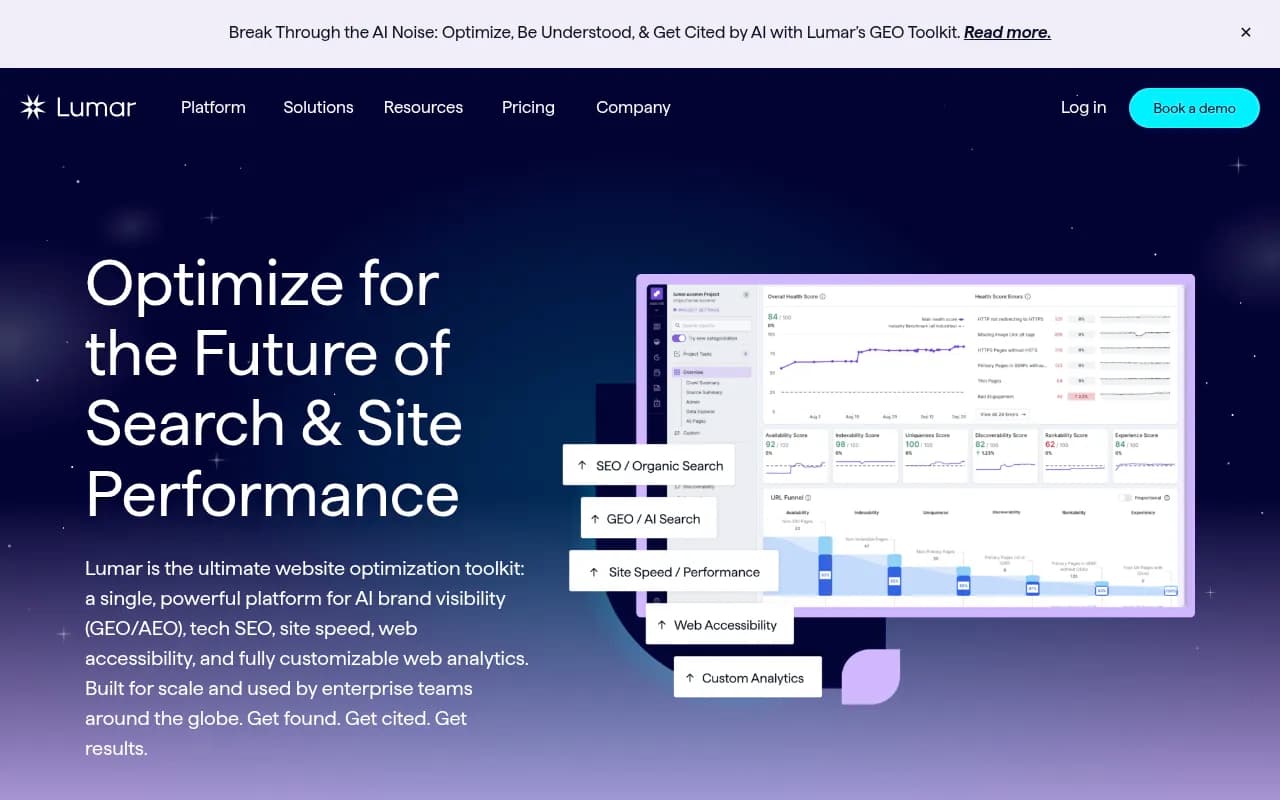
Lumar (formerly DeepCrawl) is an enterprise website optimization platform that does technical SEO, GEO/AEO, site speed monitoring, web accessibility testing, and custom analytics. It's built for large-scale sites -- think Adobe, Deloitte, and other global brands managing thousands or millions of pages. The GEO module is a recent addition; Lumar's roots are in technical SEO crawling and site audits.
The value proposition: one platform for all your website optimization needs. Instead of stitching together separate tools for SEO, performance, accessibility, and AI visibility, Lumar consolidates everything. The trade-off is complexity and cost -- this is enterprise software with enterprise pricing.
Side-by-Side Comparison
| Feature | AthenaHQ | Lumar |
|---|---|---|
| Primary focus | AI search visibility (GEO/AEO) | Enterprise SEO + GEO + performance + accessibility |
| AI platforms tracked | ChatGPT, Perplexity, Google AI Overviews, Claude, Gemini, others (8+ LLMs) | Major AI platforms (specific list not disclosed) |
| Technical SEO auditing | Not included | Core feature -- crawling, indexing, site structure |
| Site speed monitoring | Not included | Yes -- Lighthouse, Core Web Vitals, CrUX data |
| Web accessibility testing | Not included | Yes -- WCAG 2.2 compliance testing |
| Custom analytics | Not included | Yes -- AI-generated code for custom metrics |
| Citation source analysis | Yes -- see which pages/domains AI models cite | Limited GEO metrics |
| Sentiment tracking | Yes -- track brand sentiment in AI responses | Not disclosed |
| AI search volume estimates | Yes | Not disclosed |
| Pricing model | Credit-based: $295/mo self-serve, enterprise custom | Custom enterprise pricing only |
| Free trial | Free audit available | Demo required |
| Target audience | Mid-market to enterprise marketing/SEO teams | Enterprise teams managing large, complex sites |
| Ease of setup | Self-serve option, faster onboarding | Enterprise sales cycle, longer implementation |
GEO and AI visibility capabilities
This is where the two platforms diverge most sharply.
AthenaHQ's GEO toolkit is the product. You get:
- Brand mention tracking across 8+ LLMs (ChatGPT, Perplexity, Google AI Overviews, Claude, Gemini, etc.)
- Citation source analysis -- see exactly which URLs, domains, and content types AI models are pulling from when they mention (or don't mention) your brand
- Sentiment analysis -- track whether AI responses about your brand are positive, neutral, or negative
- AI search volume estimates -- understand how often specific queries are being asked in AI platforms
- Competitor benchmarking -- compare your AI visibility against competitors
- Automated content optimization recommendations -- get specific suggestions for improving AI citations
The workflow is: monitor where you're visible, identify gaps, get recommendations, track changes over time. It's a closed loop focused entirely on AI search.
Lumar's GEO module is one piece of a larger puzzle. The platform offers:
- AI brand mentions and sentiment tracking across major platforms
- Content and technical GEO metrics (less detail available publicly)
- AI-powered GEO suggestions
- Integration with the rest of Lumar's SEO and performance data
Lumar's advantage is context -- you can see GEO metrics alongside technical SEO issues, site speed problems, and accessibility gaps. The disadvantage is depth. AthenaHQ's citation source analysis and AI search volume data are more granular because that's all they do. Lumar's GEO toolkit feels like a feature add-on, not the core product.
Verdict: If AI visibility is your top priority, AthenaHQ is the better tool. If you need GEO as part of a broader optimization strategy, Lumar's integration makes sense.
Technical SEO and site auditing
This is where Lumar dominates because AthenaHQ doesn't play in this space at all.
Lumar's technical SEO capabilities:
- Enterprise-scale crawling (millions of pages)
- Hundreds of built-in SEO reports covering crawlability, indexing, internal linking, structured data, canonicalization, redirects, and more
- Custom data extraction -- pull any data from your site's HTML, not just pre-built metrics
- AI dev ticket writer -- automatically generate actionable tasks for developers based on issues found
- Integration with Google Search Console, Google Analytics, and other SEO tools
- Historical data and trend tracking
Lumar's roots are in technical SEO. It started as DeepCrawl, a best-in-class crawler for large sites. If you're managing an enterprise site with complex architecture, Lumar gives you the visibility and diagnostics you need to fix indexing issues, optimize crawl budget, and clean up technical debt.
AthenaHQ has no technical SEO features. It doesn't crawl your site, audit your sitemap, or flag broken links. It's purely focused on the AI search layer.
Verdict: Lumar wins by default. If you need technical SEO auditing, AthenaHQ isn't an option.
Site speed and performance monitoring
Another area where Lumar has capabilities and AthenaHQ doesn't.
Lumar's site speed toolkit:
- Lighthouse reporting at scale -- run performance audits across your entire site, not just a handful of pages
- Core Web Vitals tracking -- monitor LCP, FID, CLS over time
- CrUX field data -- see real-user performance metrics from Chrome User Experience Report
- Detailed diagnostics -- understand what's slowing down your pages (render-blocking resources, large images, JavaScript execution time, etc.)
Site speed impacts both SEO rankings and user experience. Lumar lets you monitor performance alongside other optimization priorities.
AthenaHQ doesn't touch site speed. It's not in scope.
Verdict: Lumar is the only option here.
Web accessibility
Same story -- Lumar has it, AthenaHQ doesn't.
Lumar's accessibility features:
- WCAG 2.2 compliance testing (Levels A, AA, AAA)
- Automated issue detection (missing alt text, insufficient color contrast, keyboard navigation problems, etc.)
- Instant suggested fixes for accessibility issues
- Reporting for legal compliance and internal audits
Web accessibility is increasingly important for legal compliance (ADA, Section 508) and for reaching all users. Lumar's testing helps you identify and fix issues at scale.
AthenaHQ has no accessibility features.
Verdict: Lumar is the only choice if accessibility is a requirement.
Custom analytics and reporting
Lumar offers custom analytics capabilities that let you build tailored metrics and dashboards. You can use AI-generated code to extract and report on practically any website data. This is useful for answering unique optimization questions that go beyond standard SEO or performance metrics.
AthenaHQ's reporting is focused on AI visibility metrics. You get dashboards for brand mentions, citations, sentiment, and competitor comparisons, but you can't build fully custom metrics outside that domain.
Verdict: Lumar's custom analytics are more flexible. AthenaHQ's reports are purpose-built for GEO and less customizable.
Pricing comparison
| Plan | AthenaHQ | Lumar |
|---|---|---|
| Entry tier | Self-Serve: $295/month ($95 first month) | Not available -- enterprise only |
| Credit model | 1 credit = 1 AI query | N/A |
| Enterprise | Custom pricing | Custom pricing (contact for quote) |
| Annual discount | 17% off annual plans | Likely available (not disclosed) |
| Free trial | Free audit (10 minutes) | Demo required |
AthenaHQ's credit-based model is straightforward but can get expensive. If you're running hundreds of AI queries per month to track visibility across multiple prompts and competitors, you'll burn through credits quickly. The self-serve tier is accessible for mid-market teams, but enterprise customers will likely need custom pricing.
Lumar doesn't publish pricing. It's enterprise software sold through a sales team. Expect annual contracts and pricing based on site size, number of users, and modules enabled. This is not a tool you can sign up for and start using today -- there's a sales cycle and implementation process.
Verdict: AthenaHQ is more accessible for smaller teams or companies testing AI visibility tracking. Lumar is enterprise-only and requires a bigger commitment upfront.
Pros and cons
AthenaHQ pros:
- Deep, specialized focus on AI search visibility
- Citation source analysis and AI search volume data are unique
- Self-serve pricing option makes it accessible
- Faster time to value -- sign up and start tracking AI mentions quickly
- Used by recognizable brands (Coinbase, ZoomInfo, SoFi)
AthenaHQ cons:
- Credit-based pricing can get expensive at scale
- No technical SEO, site speed, or accessibility features
- Newer platform -- less mature than established SEO tools
- Limited integrations outside AI visibility domain
Lumar pros:
- All-in-one platform -- GEO, technical SEO, site speed, accessibility, custom analytics in one place
- Enterprise-scale crawling and auditing for large, complex sites
- Deep technical SEO capabilities with decades of DeepCrawl heritage
- Custom analytics and reporting flexibility
- Trusted by major enterprises (Adobe, Deloitte)
Lumar cons:
- GEO module is less mature and detailed than AthenaHQ's
- Enterprise-only pricing -- no self-serve option, higher cost
- Longer sales cycle and implementation timeline
- Overkill if you only need AI visibility tracking
- Complexity -- steep learning curve for teams not managing large sites
Who should pick which tool
Pick AthenaHQ if:
- Your primary goal is tracking and improving AI search visibility
- You want citation source analysis, sentiment tracking, and AI search volume data
- You're a mid-market or enterprise marketing/SEO team focused on GEO/AEO
- You need a self-serve option or faster onboarding
- You already have technical SEO and site speed tools and just need the AI layer
Pick Lumar if:
- You're managing a large, complex enterprise site (thousands or millions of pages)
- You need technical SEO auditing, site speed monitoring, and web accessibility testing in addition to GEO
- You want one platform for all website optimization priorities
- You have the budget and timeline for enterprise software
- You need custom analytics and reporting beyond standard SEO metrics
Consider both if:
- You're an enterprise team that needs deep GEO capabilities (AthenaHQ) alongside comprehensive technical SEO (Lumar). Some teams use AthenaHQ for AI visibility and Lumar for everything else.
If you're also looking to track how your brand shows up in AI search results and take action on content gaps, Promptwatch is worth a look -- it combines AI visibility monitoring with content gap analysis and an AI writing agent that generates articles grounded in real citation data.

Final verdict
AthenaHQ and Lumar solve different problems. AthenaHQ is the specialist -- if AI search visibility is your focus, it's the better tool. The citation source analysis, sentiment tracking, and AI search volume data are more granular than what you'll find in Lumar's GEO module. The self-serve pricing makes it accessible, though the credit model can get pricey at scale.
Lumar is the generalist -- if you're managing a large enterprise site and need technical SEO, site speed, accessibility, and GEO all in one platform, Lumar's breadth is the value. The trade-off is cost, complexity, and a less mature GEO toolkit compared to AthenaHQ.
For most teams, the decision comes down to this: do you need a dedicated AI visibility platform (AthenaHQ) or an all-in-one enterprise optimization suite (Lumar)? If you only need GEO, AthenaHQ is the sharper tool. If you need everything, Lumar consolidates your stack.