Key Takeaways
- AthenaHQ is monitoring-focused with deep citation analysis and sentiment tracking -- best for teams that need visibility data to inform strategy but handle content creation elsewhere
- Orchly combines visibility tracking with built-in AI content agents and automated publishing -- better if you want an all-in-one platform that tracks AND creates optimized content
- Pricing: Orchly starts at $49/mo (Essential) vs AthenaHQ at $295/mo ($95 first month). Orchly is significantly cheaper for small teams.
- AthenaHQ covers 8+ LLMs and has stronger enterprise clients (Coinbase, ZoomInfo, SoFi). Orchly covers 5 platforms but adds SEO tracking alongside AI search.
- If you need end-to-end content ops (research, writing, optimization, publishing), Orchly wins. If you need deep AI visibility insights to guide a separate content team, AthenaHQ wins.
- Neither platform offers content gap analysis or crawler log monitoring -- if those matter, Promptwatch covers that angle with 880M+ citations analyzed and real-time AI crawler tracking.
Overview
AthenaHQ

AthenaHQ is a Generative Engine Optimization (GEO) platform built for marketing teams that need to understand how their brand shows up in AI search results. It monitors ChatGPT, Perplexity, Google AI Overviews, Claude, and other LLMs, tracking citations, sentiment, and competitor performance. Used by companies like Coinbase, ZoomInfo, and SoFi, it positions itself as an "end-to-end AEO & GEO platform" -- though in practice it's strongest as a monitoring and analytics tool. You get visibility data, citation source analysis, and ROI tracking, but content creation and optimization happen outside the platform.
Orchly
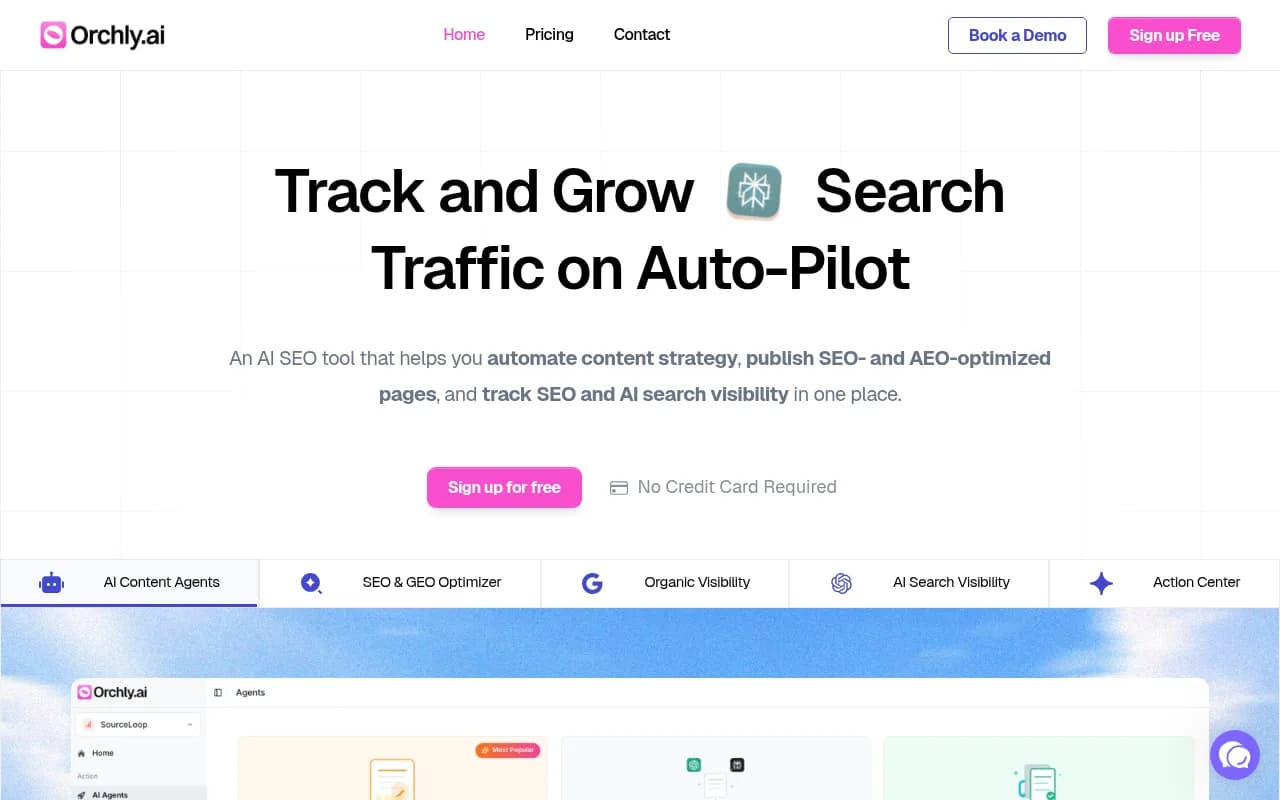
Orchly takes a different approach: it's an AI SEO automation platform that tracks visibility AND handles content operations. You monitor Google, ChatGPT, Claude, Perplexity, and Gemini, but you also get AI content agents that research, write, refresh, and publish SEO- and AEO-optimized pages. The pitch is "content ops on autopilot" -- track where you rank, get action recommendations, then let AI agents create the content to close gaps. It's aimed at marketing teams that want one tool for the entire workflow, not just the tracking piece.
Side-by-Side Comparison
| Feature | AthenaHQ | Orchly |
|---|---|---|
| Starting price | $295/mo ($95 first month) | $49/mo (Essential) |
| Free trial | No (free audit available) | Yes, 14 days |
| AI platforms tracked | 8+ (ChatGPT, Perplexity, Claude, Google AI, others) | 5 (Google, ChatGPT, Claude, Perplexity, Gemini) |
| SEO tracking | No | Yes (organic visibility included) |
| Content creation | No | Yes (AI agents for writing, refreshing, publishing) |
| Citation analysis | ✓ Deep citation source tracking | ✓ Basic citation tracking |
| Sentiment tracking | ✓ | ✓ |
| Competitor benchmarking | ✓ | ✓ |
| Content optimization | Recommendations only | ✓ 150+ factors, automated enrichment |
| Auto-publishing | No | ✓ Schedule and publish directly |
| White-label reports | No | ✓ |
| Enterprise clients | Coinbase, ZoomInfo, SoFi, Volkswagen | Not disclosed |
| Credit-based model | ✓ (1 credit = 1 AI query) | No |
Tracking depth and platform coverage
AthenaHQ monitors 8+ LLMs, which gives you broader coverage if you care about visibility across the full AI search landscape. The platform emphasizes "cross-platform AI visibility tracking" and citation source analysis -- you see which pages, Reddit threads, or external sources AI models cite when they mention your brand. Sentiment tracking is a core feature, so you know whether AI models are positioning you positively or negatively.
Orchly covers 5 platforms but adds Google organic search tracking, which AthenaHQ doesn't do. If you're optimizing for both traditional SEO and AI search (which most teams are), Orchly gives you one dashboard for both. The AI visibility tracking is less granular than AthenaHQ's -- you get mentions and competitor comparisons, but the citation source analysis isn't as deep.
Verdict: AthenaHQ wins on AI search depth. Orchly wins if you need SEO + AI search in one place.
Content creation and optimization
This is where the platforms diverge sharply.
AthenaHQ provides "automated content optimization recommendations" but doesn't create content for you. You get insights on what to fix or write, then you hand that off to your content team or another tool. The platform is designed to inform strategy, not execute it.
Orchly has AI content agents built in. You can research topics, generate articles, refresh existing pages, and publish directly from the platform. The agents are "trained on your data" (their claim), so the output should be more brand-specific than generic AI slop. The optimizer analyzes 150+ factors and automatically adds structured data, internal/external links, images, tables, and NLP keywords. You can schedule content to publish on autopilot.
Verdict: Orchly wins decisively if you want content creation and publishing. AthenaHQ isn't competing in this category.
Workflow and use case fit
AthenaHQ is built for teams that have a content operation already in place. You use it to monitor AI visibility, benchmark competitors, track ROI, and feed insights to your SEO or content team. The "AEO/GEO Manager Command Center" positioning makes sense -- it's a control panel for specialists who are managing AI search strategy across an organization.
Orchly is built for teams that want to collapse the workflow. Track visibility, get action recommendations, create content, optimize it, and publish it -- all in one platform. The "content ops on autopilot" pitch targets smaller marketing teams or agencies that don't have dedicated GEO specialists.
Verdict: AthenaHQ for larger teams with dedicated roles. Orchly for lean teams that need to move fast.
Pricing comparison
| Plan | AthenaHQ | Orchly |
|---|---|---|
| Entry tier | $295/mo ($95 first month) | $49/mo (Essential) |
| Mid tier | Enterprise (custom) | $125/mo (Pro) |
| Enterprise | Custom pricing | Custom pricing |
| Annual discount | 17% | 25% |
| Free trial | No (free audit) | 14 days |
| Credit model | Yes (1 credit = 1 AI query) | No |
AthenaHQ's entry price is 6x higher than Orchly's. The $95 first month is a trial-ish offer, but you're still paying $295/mo after that. The credit-based model means you're paying per AI query, which can get expensive if you're tracking a lot of prompts. AthenaHQ positions itself as an enterprise tool, and the pricing reflects that.
Orchly's $49/mo Essential plan is accessible for small teams. The Pro plan at $125/mo is still cheaper than AthenaHQ's base tier. You get a 14-day free trial and 25% off annual plans. No credit system -- you pay a flat monthly fee.
Verdict: Orchly is dramatically cheaper. AthenaHQ's pricing makes sense if you're Coinbase or ZoomInfo, less so if you're a startup or small agency.
Enterprise features and client base
AthenaHQ has a strong enterprise client roster: Coinbase, ZoomInfo, SoFi, Volkswagen, DeVry University. The platform is Y Combinator-backed and has been featured in Forbes and the Wall Street Journal. It offers "executive-level insights" and ROI tracking, which matters if you're reporting to a CMO or board.
Orchly doesn't disclose major clients on its site. It offers white-label reports, which suggests it's targeting agencies or consultants who need to rebrand the tool for clients. The feature set is more horizontal -- useful for a wide range of teams, but not specifically built for enterprise complexity.
Verdict: AthenaHQ has the enterprise credibility. Orchly is better for agencies and mid-market teams.
What's missing from both
Neither platform offers AI crawler log monitoring. You can't see which pages ChatGPT or Perplexity are actually crawling on your site, how often they return, or what errors they encounter. That's a blind spot if you're trying to optimize for AI indexing.
Neither platform does content gap analysis at the prompt level -- showing you exactly which prompts competitors rank for but you don't, then helping you create content to fill those gaps. You get competitor benchmarking, but not the granular "here's what you're missing" breakdown.
If those capabilities matter, Promptwatch handles both: real-time AI crawler logs and Answer Gap Analysis that shows missing content opportunities based on 880M+ citations analyzed.

Pros and cons
AthenaHQ pros:
- Deep citation source analysis across 8+ LLMs
- Strong sentiment tracking and competitor benchmarking
- Enterprise-grade platform with proven clients
- ROI tracking and executive dashboards
- Comprehensive AI visibility monitoring
AthenaHQ cons:
- Expensive ($295/mo base, credit-based model)
- No content creation or publishing capabilities
- No SEO tracking (AI search only)
- No free trial (just a free audit)
- Monitoring-focused -- you still need other tools to act on insights
Orchly pros:
- All-in-one: tracking + content creation + optimization + publishing
- Much cheaper ($49/mo entry vs $295/mo)
- Tracks both SEO and AI search visibility
- AI content agents automate repetitive tasks
- 14-day free trial, 25% annual discount
- White-label reports for agencies
Orchly cons:
- Less granular AI visibility tracking than AthenaHQ
- Covers fewer AI platforms (5 vs 8+)
- No disclosed enterprise clients
- Citation analysis is basic compared to AthenaHQ
- AI content quality depends on training and oversight
Who should pick which tool
Pick AthenaHQ if:
- You're an enterprise or well-funded company with budget for premium tools
- You have a dedicated GEO/AEO specialist or team
- You need deep citation analysis and sentiment tracking across 8+ LLMs
- Your content creation happens elsewhere (agency, in-house team, other tools)
- You're reporting AI visibility ROI to executives and need polished dashboards
- You're competing in a space where AI search visibility is mission-critical (fintech, SaaS, education)
Pick Orchly if:
- You're a small to mid-sized marketing team or agency
- You want one platform for visibility tracking AND content operations
- You need to track both Google SEO and AI search in one place
- You want AI agents to automate content research, writing, and publishing
- Budget matters -- you can't justify $295/mo for monitoring alone
- You need white-label reports for clients
Final verdict
AthenaHQ and Orchly solve different problems. AthenaHQ is a monitoring powerhouse -- it tells you where you stand in AI search with enterprise-grade depth, but it stops there. Orchly is a content operations platform that happens to include AI visibility tracking -- it's built for teams that need to track AND act in one workflow.
If you're a large company with a content team and you need the best AI visibility data available, AthenaHQ justifies its price. If you're a lean team that needs to move fast and can't afford to stitch together five different tools, Orchly gives you 80% of the tracking at 20% of the cost, plus content creation and publishing.
The real question: do you need a command center or a factory? AthenaHQ is the command center. Orchly is the factory.