Key Takeaways
- Birdeye is a reputation management and customer experience platform for multi-location brands; Gushwork is a content marketing engine for B2B lead generation—they solve different problems
- Birdeye starts at $299/mo and focuses on review generation, social media, listings management, and AI search visibility across existing locations
- Gushwork starts at $800/mo with a 6-month minimum and builds 100+ pages from scratch to generate inbound leads within 90 days
- If you run multiple physical locations and need to manage reviews, social engagement, and local search presence, Birdeye is the clear choice
- If you're a B2B company with weak organic traffic and need a hands-off system to build content and generate qualified leads, Gushwork fits better
- Neither tool replaces the other—Birdeye manages reputation across existing touchpoints, Gushwork creates new content assets to drive pipeline
Overview
Birdeye: Agentic marketing platform for multi-location brands

Birdeye positions itself as an "agentic marketing platform" that replaces fragmented tools with one enterprise system. It's built for businesses with multiple locations—restaurants, healthcare chains, retail franchises, service providers—that need to manage reviews, respond to customers, publish social content, and track how they appear in AI-generated answers across ChatGPT, Gemini, and Perplexity.
The platform includes AI agents for review generation, review responses, social publishing, social engagement, listings optimization, lead generation via messaging, and reporting. The Search AI module specifically tracks brand mentions in AI search engines, which is where it overlaps with what tools like Promptwatch do in more depth for AI visibility optimization.

Birdeye is designed for companies that already have an established presence and need to manage reputation at scale. It's not building your content strategy from zero—it's managing the customer experience across dozens or hundreds of locations.
Gushwork: Automated content engine for B2B lead generation
Gushwork
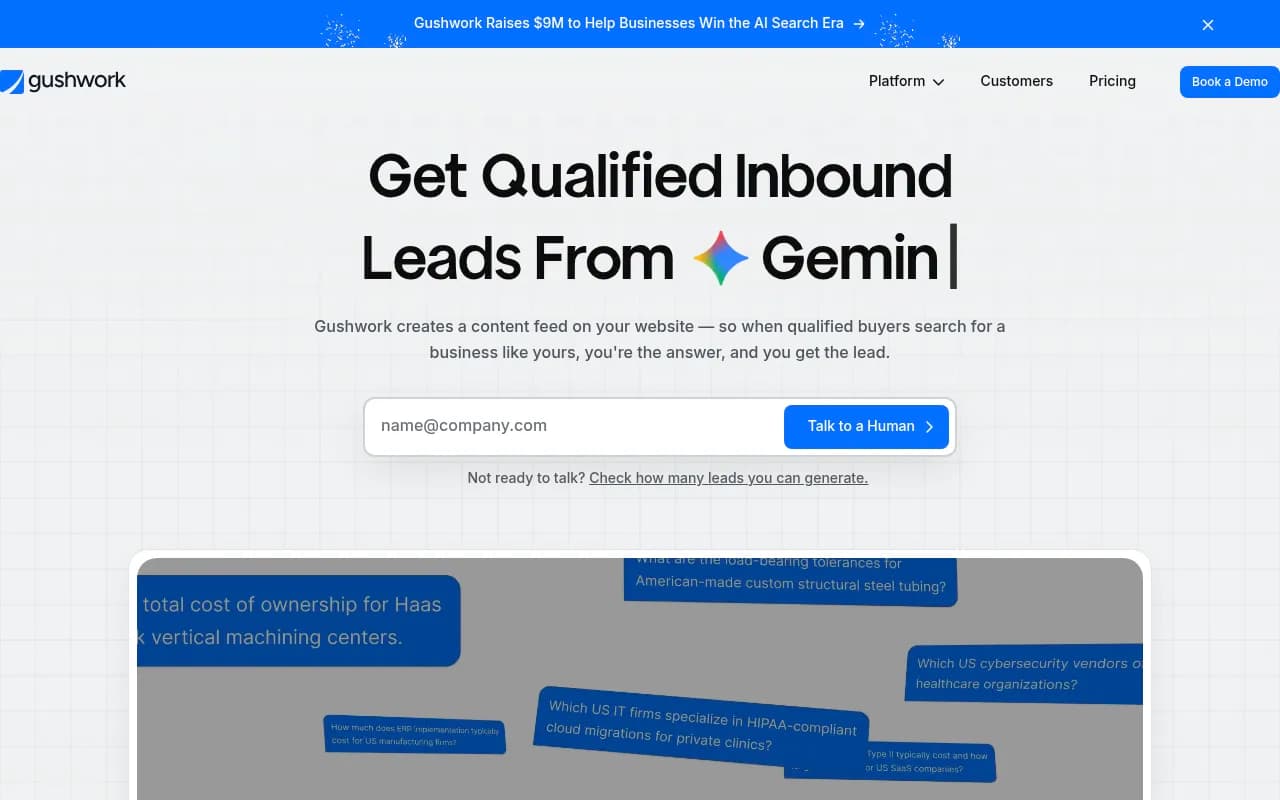
Gushwork takes a completely different approach. It's a hands-off content marketing system that builds 100+ pages on your website, optimizes them for Google and AI search engines, and delivers qualified B2B leads within 90 days. The entire process is automated—keyword research, content creation, publishing, backlink building, and lead tracking.
The platform is designed for B2B companies tired of inconsistent lead flow. You're not managing anything day-to-day. Gushwork's AI agents analyze your business, identify what your buyers are searching for, reverse-engineer what's ranking, generate landing pages and educational content, publish it to a resource center on your site, and build citations across the web to boost rankings.
It's a content-first lead generation engine, not a reputation management tool. You're paying Gushwork to build your inbound pipeline from scratch.
Side-by-Side Comparison
| Feature | Birdeye | Gushwork |
|---|---|---|
| Primary use case | Reputation management, customer experience, AI search visibility for multi-location brands | Automated content marketing and B2B lead generation |
| Target audience | Multi-location businesses (restaurants, healthcare, retail, franchises) | B2B companies with weak organic traffic |
| Starting price | $299/mo (Standard plan) | $800/mo (Launch plan, 6-month minimum) |
| Free trial | Demo available | No free trial |
| Content creation | Social posts, review responses (AI-generated) | 100+ landing pages, guides, FAQ content (fully automated) |
| Review management | Yes—generation, monitoring, responses | No |
| Social media tools | Publishing, engagement, scheduling | No |
| Listings management | Yes—sync across 150+ directories | No |
| AI search tracking | Yes—ChatGPT, Gemini, Perplexity mentions | Yes—optimizes content for AI search engines |
| Lead generation | Messaging, webchat, text campaigns | Organic inbound leads from content |
| Backlink building | No | Yes—automated citations and backlinks |
| Hands-off operation | Requires setup and ongoing management | Fully automated after onboarding |
| Time to results | Immediate for review/social tools; AI search tracking ongoing | 90-150 days for first leads |
| Best for | Managing existing customer touchpoints at scale | Building inbound pipeline from scratch |
Head-to-head feature breakdown
Core purpose and positioning
Birdeye is a customer experience platform. It assumes you already have locations, customers, reviews, and social accounts. The job is to manage all of that efficiently—respond to reviews faster, publish social content consistently, track how your brand shows up in AI answers, and convert more inquiries into customers.
Gushwork is a content marketing engine. It assumes your website isn't generating enough leads and you don't have the time or team to fix it. The job is to build a content library that ranks in Google and AI search engines, then funnel qualified prospects to your inbox.
They're solving different problems. Birdeye is about managing reputation and customer interactions. Gushwork is about creating demand and filling your pipeline.
Verdict: Choose based on what you need. If you're managing multiple locations and customer touchpoints, Birdeye. If you need inbound leads and don't have content, Gushwork.
AI search visibility and optimization
Both platforms mention AI search engines, but they approach it differently.
Birdeye's Search AI module tracks how often your brand appears in ChatGPT, Gemini, and Perplexity responses. You can see which queries trigger mentions, monitor visibility over time, and get insights into how AI models are representing your business. It's a monitoring and reputation tool—you're checking whether AI engines know about you and what they're saying.
Gushwork doesn't give you a tracking dashboard. Instead, it optimizes the content it creates so AI search engines cite your pages. The 100+ pages it builds are designed to rank in both Google and AI-generated answers. You're not monitoring visibility—you're engineering it by publishing content that AI models want to reference.
If you also want deeper AI search tracking and optimization beyond what either tool offers, Promptwatch covers that angle with prompt-level visibility, content gap analysis, and AI crawler logs across 10 models.
Verdict: Birdeye tracks AI mentions for reputation management. Gushwork builds content to get cited. Different goals.
Content creation and publishing
Birdeye generates social media posts and review responses using AI. You can schedule posts, respond to reviews in bulk, and maintain a consistent brand voice across locations. It's content creation in the context of customer engagement—reactive and relationship-focused.
Gushwork generates 100+ landing pages, educational guides, and FAQ content based on buyer intent research. It publishes everything to a resource center on your website. The content is designed to rank, answer specific search queries, and convert visitors into leads. It's proactive content creation aimed at capturing demand.
| Content type | Birdeye | Gushwork |
|---|---|---|
| Social media posts | Yes | No |
| Review responses | Yes | No |
| Landing pages | No | Yes (100+) |
| Educational guides | No | Yes |
| FAQ content | No | Yes |
| Publishing automation | Scheduling for social | Fully automated to your site |
Verdict: Birdeye creates content for engagement. Gushwork creates content for lead generation. No overlap.
Lead generation and conversion
Birdeye's lead generation tools are built around messaging—webchat, SMS campaigns, review requests that turn into conversations. You're capturing leads from people who are already interacting with your business (visiting your site, reading reviews, engaging on social). The Lead Generation Agent helps you start conversations and move prospects through the funnel.
Gushwork generates leads by ranking content in search engines. Someone searches for a solution, finds your page, reads it, and submits an inquiry. Leads land in your inbox and a clean dashboard. The platform promises 5-10 qualified leads per month by month 4, scaling from there.
Verdict: Birdeye converts existing traffic and engagement into leads. Gushwork creates new traffic and converts it. Different stages of the funnel.
Review and reputation management
Birdeye is built for this. Review generation, review monitoring across 200+ sites, AI-powered response drafting, sentiment analysis, competitive benchmarking. If you're a multi-location business, managing reviews is probably half the reason you'd buy Birdeye.
Gushwork doesn't touch reviews. It's not in the product.
Verdict: Birdeye wins by default. Gushwork isn't competing here.
Social media management
Birdeye includes a full social media suite—publishing, scheduling, engagement tracking, AI-generated posts, multi-location management. You can create content once and deploy it across all locations, or customize per location.
Gushwork has no social media tools.
Verdict: Birdeye is the only option if you need social management.
Listings and local SEO
Birdeye syncs your business information across 150+ directories (Google, Yelp, Facebook, Apple Maps, etc.). It ensures NAP consistency, monitors for duplicate listings, and helps you rank in local search.
Gushwork doesn't manage listings. It builds backlinks and citations to boost the content it creates, but that's different from local SEO and directory management.
Verdict: Birdeye for local businesses. Gushwork isn't built for this.
Automation and hands-off operation
Birdeye automates specific tasks—review requests, response drafting, social post scheduling, report generation. But you're still managing the platform. You're setting up campaigns, approving content, monitoring dashboards, and making decisions.
Gushwork is designed to be completely hands-off after onboarding. You don't write content, you don't publish pages, you don't build backlinks. The AI agents handle everything. You just check the lead dashboard and respond to inquiries.
Verdict: Gushwork is more hands-off. Birdeye requires ongoing management.
Time to value
Birdeye delivers value immediately. You can start generating review requests, responding to reviews, and publishing social content on day one. AI search tracking is ongoing—you'll see data as soon as the platform starts monitoring.
Gushwork takes 90-150 days to deliver leads. The first 60-90 days are spent building content, publishing it, and building backlinks. Rankings take time. By month 3, you should see the first inquiries. By month 4, expect 5-10 qualified leads.
Verdict: Birdeye for immediate impact. Gushwork is a longer-term investment.
Pricing comparison
| Plan | Birdeye | Gushwork |
|---|---|---|
| Entry tier | $299/mo (Standard) | $800/mo (Launch, 6-month minimum) |
| Mid tier | $399/mo (Professional) | $1,200/mo (Grow, 6-month minimum) |
| High tier | Custom (Premium) | $2,200/mo (Scale, 6-month minimum) |
| Free trial | Demo available | No |
| Minimum commitment | Monthly billing | 6 months |
| Pricing scales with | Number of locations | Volume of content and leads |
Birdeye is cheaper at the entry level, but pricing scales with the number of locations you're managing. A 50-location franchise could easily be paying $1,000+/mo.
Gushwork is more expensive upfront and requires a 6-month commitment. You're paying for the content creation, publishing, and backlink building—plus the promise of qualified leads within 90 days. If you don't have an in-house content team, $800/mo is cheaper than hiring a writer, SEO specialist, and outreach coordinator.
Verdict: Birdeye is more accessible for small businesses. Gushwork is a bigger bet but includes more labor.
Pros and cons
Birdeye pros
- Comprehensive platform for multi-location reputation management
- AI agents automate review responses, social posts, and reporting
- Tracks brand mentions in ChatGPT, Gemini, and Perplexity
- Listings management across 150+ directories
- Messaging and webchat for lead capture
- Immediate value—start using tools on day one
- Scales across hundreds of locations
Birdeye cons
- Pricing scales with locations—can get expensive fast
- Requires ongoing management and setup
- Not designed for content marketing or inbound lead generation
- AI search tracking is monitoring-only, not optimization
- Overkill if you're a single-location business or don't need review management
Gushwork pros
- Fully automated content creation and publishing—100+ pages built for you
- Hands-off operation after onboarding
- Optimized for both Google and AI search engines
- Backlink building and citation management included
- Delivers qualified B2B leads within 90 days
- No need to hire content writers or SEO specialists
- Clean lead dashboard with spam filtering
Gushwork cons
- Expensive—$800/mo minimum with 6-month commitment
- Long time to value (90-150 days for first leads)
- No free trial to test the platform
- Doesn't handle reviews, social media, or listings
- Built for B2B lead generation, not local businesses or e-commerce
- You're trusting AI to create all your content—less control over voice and messaging
Who should choose which tool
Choose Birdeye if you:
- Run a multi-location business (franchise, healthcare chain, retail, restaurants)
- Need to manage reviews across dozens or hundreds of locations
- Want to automate social media publishing and engagement
- Need to track how your brand appears in AI-generated answers
- Want to sync business listings across Google, Yelp, and other directories
- Need messaging and webchat tools to capture leads from existing traffic
- Want immediate value and are willing to manage the platform actively
Choose Gushwork if you:
- Run a B2B company with weak organic traffic and inconsistent lead flow
- Don't have a content marketing team or the time to build one
- Want a hands-off system that builds content and generates leads automatically
- Can commit to a 6-month minimum and wait 90 days for results
- Need 100+ pages of optimized content published to your website
- Want backlinks and citations built automatically to boost rankings
- Prefer to focus on closing leads rather than creating content
Choose neither if you:
- Need deep AI search visibility tracking and content optimization—consider Promptwatch for prompt-level insights, content gap analysis, and AI crawler logs across 10 models
- Want a DIY content marketing solution—Gushwork is hands-off, not customizable
- Run a single-location business without complex review management needs—Birdeye is overkill
- Need e-commerce tools or product-focused content—neither platform is built for that
Final verdict
Birdeye and Gushwork aren't competitors. They solve different problems for different businesses.
Birdeye is the right choice for multi-location brands that need to manage customer experience at scale—reviews, social media, listings, messaging, and AI search reputation. It's a platform you actively manage to maintain your brand across hundreds of touchpoints. If you're a franchise, healthcare chain, or retail brand, Birdeye makes sense.
Gushwork is the right choice for B2B companies that need inbound leads and don't have the resources to build a content marketing engine themselves. It's a hands-off system that builds 100+ pages, optimizes them for search, and delivers qualified prospects to your inbox. If you're tired of inconsistent pipeline and want a predictable lead flow, Gushwork is worth the investment.
The decision comes down to what you're trying to fix. Managing reputation and customer experience? Birdeye. Building inbound pipeline from scratch? Gushwork. Both use AI, but they're not solving the same problem.