Key Takeaways
- Birdeye starts at $299/mo and targets multi-location brands with an all-in-one reputation and marketing platform, while Nightwatch starts at $24/mo and focuses purely on SEO/AI tracking for agencies and in-house teams
- Nightwatch covers more AI engines (ChatGPT, Gemini, Claude, Perplexity) plus traditional search (Google, Bing, Yahoo, DuckDuckGo), while Birdeye's AI tracking is part of a broader marketing suite
- If you need review management, social media, listings, and messaging in one platform, Birdeye is the clear choice -- it's built for franchises and multi-location businesses managing customer experience at scale
- If you're an SEO team or agency focused on ranking data and AI visibility, Nightwatch delivers better price-to-performance with real-time rank tracking, keyword research, and prompt analysis starting at $24/mo
- Nightwatch offers a 14-day free trial, Birdeye requires a demo and custom quote for most plans
- Both platforms miss the content optimization loop -- they show you where you rank but don't help you create content that improves those rankings. Tools like Promptwatch fill that gap by analyzing citation data and generating AI-optimized content based on what's actually missing from your site.

Overview
Birdeye: Agentic marketing platform for multi-location brands

Birdeye positions itself as an "agentic marketing platform" -- a unified system that replaces fragmented tools with AI agents handling reviews, social media, listings, messaging, and search visibility. The platform is built for franchises, healthcare networks, retail chains, and other multi-location businesses that need to manage customer experience across dozens or hundreds of locations.
AI search tracking (what Birdeye calls "Search AI") is one module within this broader ecosystem. You're not just monitoring where you show up in ChatGPT or Gemini -- you're also generating reviews, responding to customers, publishing social content, and managing business listings from the same dashboard.
Pricing starts at $299/mo for the Standard plan, $399/mo for Professional, and custom pricing for Premium. Costs scale with the number of locations you're managing.
Nightwatch: SEO and AI tracking for performance-obsessed teams
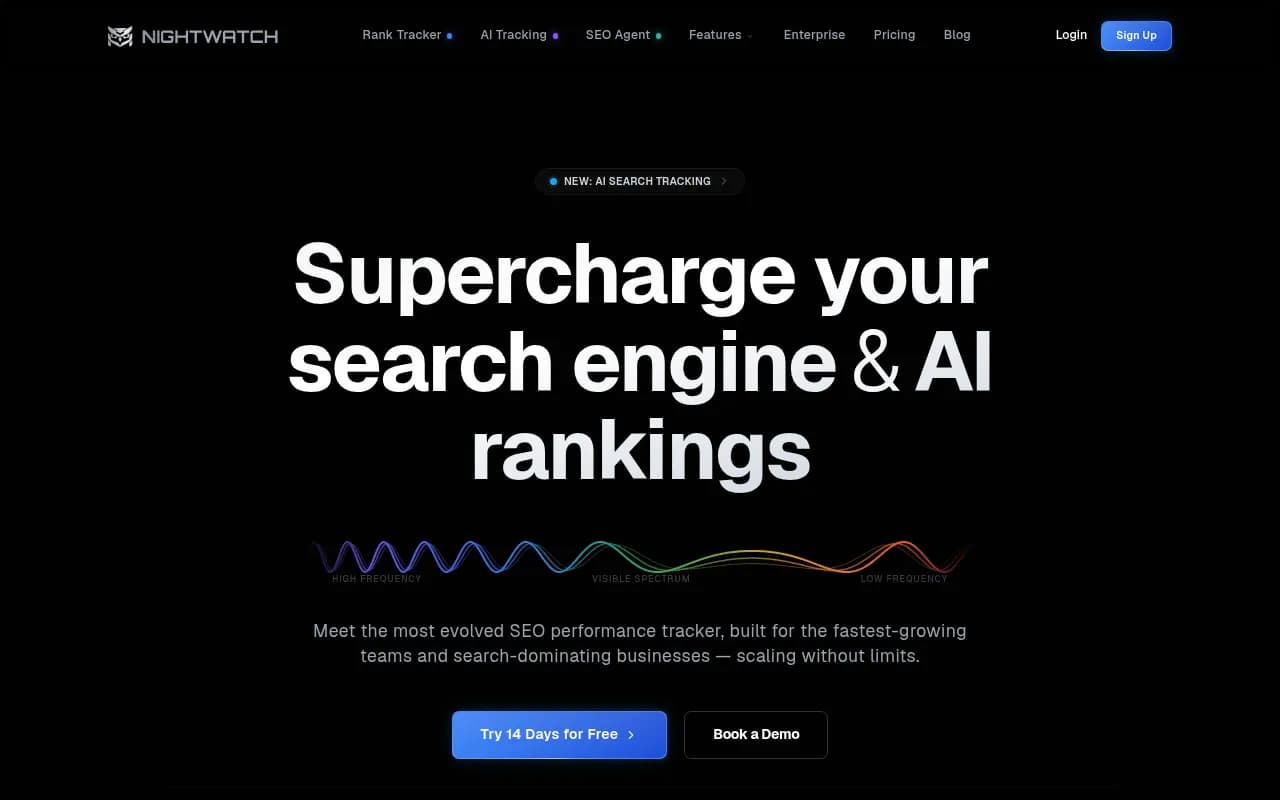
Nightwatch is a specialized rank tracking and AI visibility platform built for SEO teams, agencies, and businesses that want precise, real-time data on search performance. It tracks traditional search engines (Google, Bing, Yahoo, DuckDuckGo) alongside AI platforms (ChatGPT, Gemini, Claude, Perplexity) in a unified dashboard.
The platform emphasizes data accuracy and frequency -- real-time rank updates, 107,000+ location tracking down to zip code level, and high-volume keyword monitoring without the enterprise price tag. Nightwatch also includes keyword research, prompt analysis, site audits, and an SEO AI agent that automates workflow tasks.
Pricing starts at $24/mo for Starter, $59/mo for Optimize, and custom Enterprise pricing. There's a 14-day free trial with no credit card required.
Side-by-Side Comparison
| Feature | Birdeye | Nightwatch |
|---|---|---|
| Starting Price | $299/mo | $24/mo |
| Free Trial | Demo required | 14 days, no credit card |
| AI Engines Tracked | ChatGPT, Gemini, Perplexity (implied) | ChatGPT, Gemini, Claude, Perplexity |
| Traditional Search | Google focus | Google, Bing, Yahoo, DuckDuckGo |
| Review Management | ✓ Core feature | ✗ |
| Social Media Tools | ✓ Publishing, engagement, agents | ✗ |
| Listings Management | ✓ Multi-location sync | ✗ |
| Messaging/Webchat | ✓ Unified inbox | ✗ |
| Rank Tracking | Part of Search AI module | ✓ Core feature, real-time |
| Keyword Research | Limited | ✓ Dedicated tool |
| Prompt Analysis | Not specified | ✓ Prompt research tool |
| Site Audit | Not specified | ✓ Technical SEO audit |
| API Access | Enterprise plans | Available |
| Looker Studio Integration | Not specified | ✓ Native connector |
| Target Audience | Multi-location brands, franchises | SEO teams, agencies, in-house marketers |
Head-to-head feature deep-dive
Platform focus and positioning
Birdeye is a customer experience platform that happens to include AI search tracking. The core value is unifying reputation management, social media, listings, messaging, and visibility into one system for brands managing multiple locations. If you're a franchise with 50 locations and you need to respond to reviews, publish social content, track local search rankings, and handle customer messages -- Birdeye consolidates all of that.
Nightwatch is a pure-play SEO and AI visibility tracker. It doesn't touch reviews, social media, or customer messaging. The entire product is built around one question: where do we rank, and how is that changing? If you're an SEO manager or agency tracking hundreds of keywords across clients, Nightwatch gives you the data infrastructure without the bloat.
Verdict: Different tools for different jobs. Birdeye wins if you need an all-in-one marketing stack. Nightwatch wins if you just want best-in-class rank tracking.
AI search coverage
Birdeye's "Search AI" module tracks brand visibility across AI platforms including ChatGPT, Gemini, and Perplexity (based on their marketing materials). The feature is designed to show multi-location brands how often they appear in AI-generated answers when users ask for local recommendations.
Nightwatch explicitly tracks ChatGPT, Gemini, Claude, and Perplexity, with detailed prompt analysis and entity tracking. You can see which prompts trigger your brand, how your visibility changes over time, and which competitors are appearing alongside you. The platform also includes a "Prompt Research" tool that helps you discover high-value queries to target.
Verdict: Nightwatch has more explicit AI engine coverage and deeper prompt-level analysis. Birdeye's AI tracking is less granular but sufficient for brands that just want a visibility score.
Traditional search tracking
Birdeye focuses primarily on Google search visibility, which makes sense for local businesses where Google dominates. The platform tracks local pack rankings, organic positions, and search visibility metrics tied to business listings.
Nightwatch tracks Google, Bing, Yahoo, and DuckDuckGo with real-time rank updates, 107,000+ location options (down to zip code), and on-demand keyword refreshes. You can monitor desktop vs mobile rankings, track SERP features, and scale to millions of keywords without hitting artificial limits.
Verdict: Nightwatch is the clear winner for comprehensive search tracking. Birdeye's search features are built for local SEO, not enterprise-scale rank monitoring.
Review and reputation management
Birdeye has an entire suite of review tools: automated review generation (SMS/email requests), AI-powered response agents that write on-brand replies, sentiment analysis, review monitoring across 200+ sites, and competitive benchmarking. This is a core strength -- Birdeye started as a reputation management platform.
Nightwatch doesn't touch reviews at all. It's not in scope.
Verdict: Birdeye wins by default. If reviews matter to your business, Nightwatch can't help.
Social media capabilities
Birdeye includes social publishing agents (auto-generate and schedule posts), social engagement agents (respond to comments and messages), and unified social inbox management. The AI agents can create content, suggest replies, and maintain brand voice across locations.
Nightwatch has zero social media features.
Verdict: Another Birdeye-only capability. If social is part of your workflow, Nightwatch isn't relevant.
Keyword and prompt research
Birdeye doesn't appear to offer dedicated keyword research tools. The platform is more about monitoring existing visibility than discovering new opportunities.
Nightwatch has a full keyword research module with search volume data, competition analysis, and keyword difficulty scoring. The "Prompt Research" tool specifically helps you find AI search queries worth targeting -- essentially keyword research for the AI search era.
Verdict: Nightwatch wins. If you're building an SEO strategy from scratch, you need research tools. Birdeye assumes you already know what you're tracking.
Technical SEO and site audits
Birdeye focuses on off-site factors (listings, reviews, citations) rather than on-site technical SEO. There's no mention of crawling, site audits, or technical issue detection.
Nightwatch includes a site audit tool that crawls your website, identifies technical SEO issues (broken links, missing meta tags, slow pages, indexability problems), and provides actionable recommendations.
Verdict: Nightwatch wins for teams that need technical SEO monitoring. Birdeye isn't built for this.
Reporting and integrations
Birdeye offers custom reporting dashboards, white-label reports for agencies, and integrations with CRMs, review sites, and social platforms. The focus is on client-facing reports that show reputation and visibility metrics.
Nightwatch has a native Looker Studio connector, customizable dashboards, automated email reports, and API access for custom integrations. The reporting is built for SEO teams who want to slice data by keyword groups, locations, devices, and time periods.
Verdict: Tie, but for different reasons. Birdeye's reports are better for client presentations. Nightwatch's reports are better for deep SEO analysis.
Multi-location management
Birdeye is explicitly designed for multi-location brands. You can manage hundreds of locations from one dashboard, with location-specific review generation, social publishing, and visibility tracking. Franchisees can have limited access to their own location data while corporate retains oversight.
Nightwatch supports multi-location tracking through its 107,000+ location database, but it's not architected around franchise management. You're tracking keywords in different locations, not managing location-specific marketing workflows.
Verdict: Birdeye wins for franchises and multi-location operations. Nightwatch can track rankings by location but doesn't handle the operational complexity of managing multiple storefronts.
Pricing comparison
| Plan | Birdeye | Nightwatch |
|---|---|---|
| Entry Level | $299/mo (Standard) | $24/mo (Starter) |
| Mid Tier | $399/mo (Professional) | $59/mo (Optimize) |
| Enterprise | Custom (Premium) | Custom (Enterprise) |
| Free Trial | Demo required | 14 days, no credit card |
| Pricing Model | Per location | Per keyword/feature tier |
| Annual Discount | Not specified | 30% off (Black Friday promo) |
Birdeye's pricing scales with the number of locations you're managing. A single-location business pays less than a 50-location franchise. The platform is priced for businesses where customer experience and reputation directly drive revenue.
Nightwatch's pricing scales with keyword volume and feature access. The Starter plan covers basic rank tracking, while Optimize adds AI tracking, prompt research, and advanced reporting. Enterprise plans support millions of keywords and white-label options for agencies.
Bottom line: Nightwatch is 10-12x cheaper at the entry level, but you're comparing apples to oranges. Birdeye includes review management, social media, and messaging -- features that would cost hundreds per month if purchased separately. Nightwatch is cheaper because it does less.
Pros and cons
Birdeye pros
- All-in-one platform eliminates tool sprawl for multi-location brands
- Strong review generation and management features
- AI agents automate repetitive tasks (responding to reviews, publishing social content)
- Built for franchise operations with location-level access controls
- Unified inbox for customer messages across channels
Birdeye cons
- Expensive for single-location businesses or pure SEO use cases
- AI search tracking is less detailed than specialized tools
- No free trial -- requires demo and sales conversation
- Overkill if you only need rank tracking
- Limited technical SEO capabilities
Nightwatch pros
- Extremely affordable starting at $24/mo
- Comprehensive AI engine coverage (ChatGPT, Gemini, Claude, Perplexity)
- Real-time rank updates and on-demand keyword refreshes
- Dedicated keyword and prompt research tools
- Site audit for technical SEO issues
- 14-day free trial with no credit card required
- Looker Studio integration for custom reporting
Nightwatch cons
- No review management, social media, or customer messaging features
- Steeper learning curve for non-SEO users
- Not designed for multi-location franchise operations
- Requires separate tools for off-site reputation management
Who should pick which tool
Pick Birdeye if you:
- Run a multi-location business (franchise, healthcare network, retail chain)
- Need to manage reviews, social media, listings, and messaging in one place
- Want AI agents to automate customer interactions at scale
- Care more about overall customer experience than granular SEO data
- Have budget for an enterprise marketing platform ($299+/mo per location)
- Need location-level access controls for franchisees
Pick Nightwatch if you:
- Run an SEO agency or in-house marketing team
- Want precise, real-time rank tracking across search and AI platforms
- Need keyword research and prompt analysis to build your strategy
- Care about technical SEO and site health monitoring
- Want to track hundreds or thousands of keywords affordably
- Prefer a specialized tool over an all-in-one suite
- Want to test before committing (14-day free trial)
Consider both if:
- You're a large multi-location brand that needs Birdeye's customer experience tools AND wants deeper SEO visibility. Run Birdeye for reputation/social/messaging and Nightwatch for granular rank tracking. The overlap is minimal.
Final verdict
Birdeye and Nightwatch aren't really competitors -- they solve different problems for different buyers.
Birdeye is a customer experience platform for multi-location brands. If you're managing reviews, social media, listings, and customer messaging across dozens of locations, Birdeye consolidates that chaos into one system. The AI search tracking is a nice bonus, but it's not the main event. You're paying for operational efficiency and brand consistency at scale.
Nightwatch is a specialized SEO and AI visibility tracker for teams that live in ranking data. If you're an agency tracking 50 clients or an in-house team monitoring thousands of keywords, Nightwatch gives you the precision and frequency you need at a fraction of enterprise SEO tool pricing. It won't help you manage reviews or publish social content, but that's not the job.
The decision comes down to your primary use case. Need an all-in-one marketing stack for multi-location operations? Birdeye. Need best-in-class rank tracking and AI visibility monitoring? Nightwatch. Need both? Run them in parallel -- they don't overlap enough to conflict.