Key Takeaways
- Pricing transparency: AthenaHQ offers self-serve plans starting at $295/month with a $95 first-month trial. Bluefish requires custom quotes (estimated $4,000+/month) with no public pricing.
- Target audience split: Bluefish is built exclusively for Fortune 500 enterprise teams with dedicated account management. AthenaHQ serves mid-market to enterprise, including companies like Coinbase and ZoomInfo.
- Feature depth: Both platforms track AI visibility across major LLMs, but AthenaHQ provides automated content optimization recommendations and citation source analysis. Bluefish emphasizes custom audiences and tailored prompts for competitive differentiation.
- Content generation: Neither platform includes AI content generation tools -- both focus on monitoring and optimization recommendations rather than creating content that ranks in AI search.
- Self-service vs white-glove: AthenaHQ lets you sign up and start tracking immediately. Bluefish requires a sales demo and custom implementation, making it slower to get started but more hands-on for large teams.
- Commerce tracking: Bluefish explicitly covers agentic commerce channels (AI shopping recommendations). AthenaHQ focuses on search visibility without a dedicated commerce module.
Overview
Bluefish AI
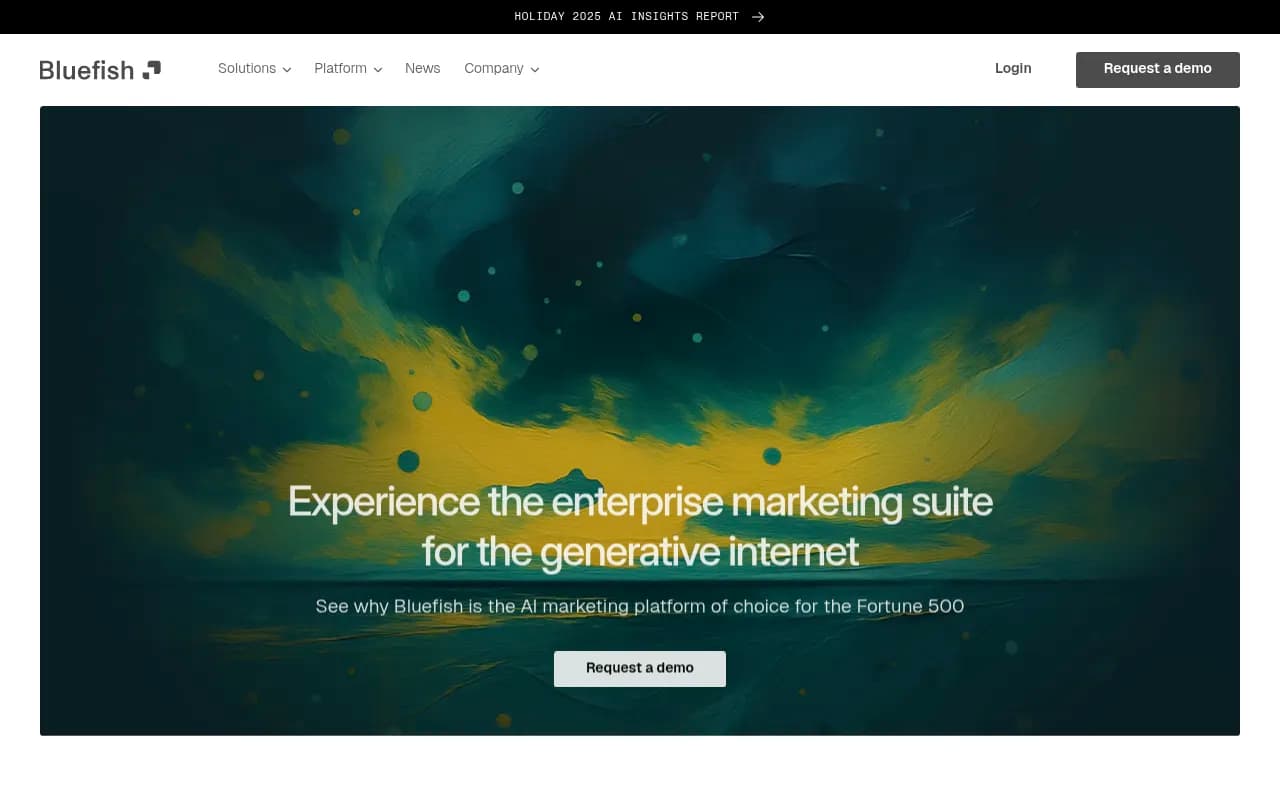
Bluefish AI positions itself as "the AI marketing platform of choice for the Fortune 500." It's an enterprise-focused GEO platform designed for large marketing teams that need deep control over their AI presence. The platform tracks performance across AI search and agentic commerce, with an emphasis on custom audiences, tailored prompts, and what they call understanding how AI "thinks." Bluefish passes enterprise infosec reviews and offers white-glove service, but you won't find transparent pricing or a self-serve option -- everything runs through sales.
AthenaHQ

AthenaHQ calls itself an "end-to-end AEO & GEO platform" used by companies like Coinbase, ZoomInfo, and SoFi. It monitors brand visibility across ChatGPT, Perplexity, Google AI Overviews, Claude, and other LLMs, with a focus on giving marketing teams actionable insights. The platform uses a credit-based model (1 credit = 1 AI query) and offers both self-serve and enterprise plans. AthenaHQ is Y Combinator-backed and has been featured in Forbes and the Wall Street Journal for its approach to AI search optimization.
Side-by-Side Comparison
| Feature | Bluefish AI | AthenaHQ |
|---|---|---|
| Starting price | Custom quote (~$4,000+/mo) | $295/mo ($95 first month) |
| Free trial | Demo only | First month discount |
| Self-serve signup | No | Yes |
| Target audience | Fortune 500 enterprise | Mid-market to enterprise |
| AI models tracked | Major LLMs + commerce | 8+ LLMs (ChatGPT, Perplexity, Claude, etc.) |
| Content optimization | Recommendations only | Automated recommendations + citation analysis |
| Content generation | No | No |
| Custom audiences | Yes (core feature) | Not specified |
| Commerce tracking | Yes (agentic commerce) | No dedicated module |
| Citation source analysis | Not specified | Yes |
| Implementation | White-glove, sales-led | Self-serve or enterprise support |
| Infosec compliance | Enterprise-grade | Standard |
Pricing comparison
| Plan | Bluefish AI | AthenaHQ |
|---|---|---|
| Entry tier | Custom quote (estimated $4,000+/month) | Self-Serve: $295/month ($95 first month) |
| Enterprise | Custom quote | Custom pricing |
| Annual discount | Not disclosed | 17% off |
| Billing model | Custom contract | Credit-based (1 credit = 1 AI query) |
| Free option | No (demo only) | No (discounted first month) |
The pricing gap here is massive. AthenaHQ's self-serve plan at $295/month is accessible for mid-sized marketing teams testing GEO strategies. Bluefish's estimated $4,000+/month entry point (based on enterprise positioning and lack of public tiers) puts it firmly in Fortune 500 territory. If you need to know the price before talking to sales, Bluefish isn't for you.
Target audience and positioning
Bluefish makes no attempt to hide who it's for: Fortune 500 brands with large marketing budgets and complex infosec requirements. The entire site emphasizes "enterprise scale," "custom audiences," and "deep expertise." You're not signing up online -- you're scheduling a demo, going through a sales process, and likely negotiating a six-figure annual contract. This works if you're a category leader in a competitive market where generic datasets won't cut it, but it's overkill (and financially out of reach) for most companies.
AthenaHQ casts a wider net. It serves mid-market companies and enterprises, with clients ranging from startups (Y Combinator connection) to public companies like Coinbase. The self-serve tier means you can start tracking AI visibility today without talking to anyone. The platform is built for marketing teams that want to own their GEO strategy without waiting for vendor handholding. If you're a scrappy team trying to crack AI search, AthenaHQ meets you where you are.
Feature depth: monitoring and optimization
Both platforms track AI visibility across major LLMs -- ChatGPT, Perplexity, Claude, Google AI Overviews, etc. The core monitoring functionality is table stakes. Where they diverge is in how they help you act on that data.
Bluefish emphasizes custom audiences and tailored prompts. The idea: generic prompt sets don't reflect how your actual customers search, so Bluefish lets you define custom audiences and track prompts that matter to your business. This is valuable if you're in a niche market or targeting specific personas, but it requires more upfront strategy work. Bluefish also tracks agentic commerce -- AI shopping recommendations and product placements -- which is critical if you're in e-commerce or retail.
AthenaHQ focuses on automated content optimization recommendations and citation source analysis. It tells you which pages are getting cited, which sources AI models prefer, and what you need to fix to improve visibility. The citation analysis is particularly useful -- you can see exactly which Reddit threads, YouTube videos, or competitor pages are influencing AI responses, then decide where to publish or what to optimize. AthenaHQ doesn't do content generation (neither does Bluefish), but it gives you a clearer roadmap for what to create.
Neither platform includes AI crawler logs, visitor analytics, or content generation tools. If you want to see which AI bots are hitting your site or generate articles grounded in citation data, you'll need to look elsewhere. Tools like Promptwatch cover that angle with crawler logs, content gap analysis, and an AI writing agent that creates content engineered to get cited by LLMs.

User experience and implementation
Bluefish is a white-glove operation. You schedule a demo, go through a sales cycle, and get a custom implementation plan. This works well for large teams that need vendor support and have the budget for it, but it's slow. Expect weeks (or months) from first contact to actually using the platform.
AthenaHQ lets you sign up and start tracking immediately if you go self-serve. The credit-based model is straightforward: 1 credit = 1 AI query. You can scale up or down based on how many prompts you're monitoring. For teams that want to move fast and iterate on their GEO strategy without vendor dependencies, this is a huge advantage.
Commerce tracking and advanced features
Bluefish explicitly covers agentic commerce -- tracking how your brand appears in AI shopping recommendations and product carousels. If you're in retail, e-commerce, or any category where AI models recommend products, this is a differentiator. AthenaHQ doesn't have a dedicated commerce module, though it tracks general AI visibility that could include product mentions.
Bluefish also emphasizes "understanding how AI thinks" and optimizing beyond share-of-voice metrics. The marketing language is vague, but the implication is deeper analysis of why AI models cite certain sources. AthenaHQ's citation source analysis covers similar ground in a more concrete way -- showing you exactly which URLs and content types AI models prefer.
What's missing from both platforms
Neither Bluefish nor AthenaHQ includes:
- AI content generation: You get optimization recommendations, but you're on your own to create the content
- AI crawler logs: No visibility into which AI bots are crawling your site or what errors they encounter
- Visitor analytics: No way to track actual traffic or conversions from AI search
- Prompt volume data: No estimates of how often specific prompts are being asked
- Reddit/YouTube tracking: Limited or no coverage of social platforms that influence AI responses
Both platforms are monitoring-focused. They show you where you stand and suggest improvements, but they don't help you execute those improvements. If you want a platform that closes the loop from gap analysis to content creation to tracking results, you're looking at a different category of tool.
Pros and cons
Bluefish AI pros
- Enterprise-grade infosec and compliance
- Custom audiences and tailored prompts for competitive differentiation
- Agentic commerce tracking for retail/e-commerce brands
- White-glove service and dedicated account management
- Built for Fortune 500 scale and complexity
Bluefish AI cons
- No transparent pricing (estimated $4,000+/month)
- No self-serve option -- requires sales demo and custom contract
- Slow implementation timeline
- Overkill for mid-market companies
- No content generation or crawler logs
AthenaHQ pros
- Self-serve plan at $295/month with discounted first month
- Automated content optimization recommendations
- Citation source analysis shows exactly what AI models prefer
- Credit-based model scales with your needs
- Faster time-to-value -- sign up and start tracking today
AthenaHQ cons
- No dedicated commerce tracking module
- Less emphasis on custom audiences and tailored prompts
- No content generation tools
- No AI crawler logs or visitor analytics
- Limited social platform coverage (Reddit/YouTube)
Who should pick which tool
Pick Bluefish AI if:
- You're a Fortune 500 brand with a large marketing budget
- You need enterprise infosec compliance and vendor support
- You're in e-commerce or retail and need agentic commerce tracking
- You want custom audiences and tailored prompts for competitive markets
- You're willing to go through a sales process and wait for implementation
Pick AthenaHQ if:
- You're a mid-market company or growing enterprise
- You want to start tracking AI visibility today without a sales demo
- You need automated optimization recommendations and citation analysis
- You prefer a credit-based model that scales with your usage
- You want to own your GEO strategy without vendor dependencies
Look elsewhere if:
- You need AI content generation tools (consider platforms with built-in writing agents)
- You want AI crawler logs and visitor analytics (look at more comprehensive GEO platforms)
- You need prompt volume data and difficulty scoring (not available in either tool)
- You want Reddit/YouTube tracking (limited coverage in both platforms)
Final verdict
Bluefish AI and AthenaHQ serve different markets. Bluefish is a luxury option for Fortune 500 brands that need white-glove service, custom implementations, and commerce tracking. AthenaHQ is a practical choice for mid-market teams that want to start optimizing AI visibility without a six-figure budget or a three-month sales cycle.
For most marketing teams reading this, AthenaHQ is the better starting point. The self-serve plan at $295/month gets you in the door, and the automated optimization recommendations plus citation analysis give you a clear roadmap for improving visibility. You can sign up today and start tracking tomorrow.
Bluefish makes sense if you're already spending millions on marketing, have complex infosec requirements, and need a vendor that can handle Fortune 500 scale. But if you're trying to figure out whether GEO is worth investing in, or you're a lean team that needs to move fast, the pricing opacity and sales-led process are friction you don't need.
One thing both platforms lack: they show you the problem but don't help you fix it. If you want a platform that goes from gap analysis to content creation to tracking results, that's a different conversation. But for pure monitoring and optimization recommendations, AthenaHQ delivers more value per dollar for the majority of companies exploring AI search visibility in 2026.