Key Takeaways
- Pricing gap is massive: Bluefish requires custom quotes (estimated $4,000+/month for enterprise) with no self-service option. Nimt starts at $59/month with a 7-day free trial and transparent tiers.
- Target audience is opposite: Bluefish is built exclusively for Fortune 500 brands and large marketing teams. Nimt targets startups, SMBs, and agencies that need affordable AI visibility tracking.
- Nimt includes content optimization: Nimt generates prioritized "Boost Actions" that tell you exactly how to improve visibility. Bluefish focuses on monitoring and analytics but lacks content generation and crawler logs.
- Bluefish offers deeper customization: Custom audiences, tailored prompts, and enterprise-grade segmentation make Bluefish more flexible for complex brand architectures. Nimt uses standardized prompt sets.
- Both lack key optimization features: Neither platform offers AI crawler logs, content gap analysis, or built-in AI writing tools -- features that platforms like Promptwatch provide to close the loop from tracking to action.
- Nimt is easier to start: Self-service signup, transparent pricing, and a free trial mean you can be tracking visibility in minutes. Bluefish requires a sales demo and custom contract negotiation.
Overview
Bluefish AI
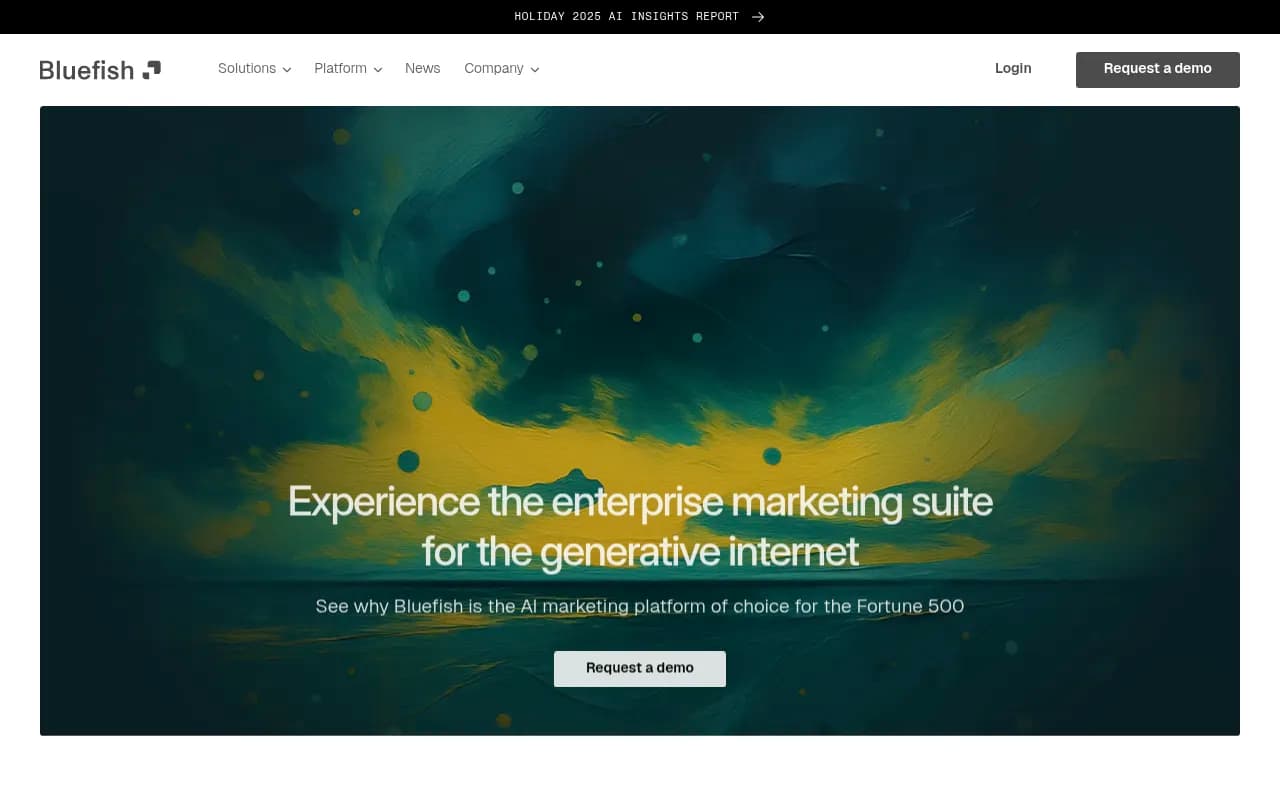
Bluefish AI positions itself as "the AI marketing platform of choice for the Fortune 500." It's an enterprise-focused platform that monitors brand presence across AI search engines (ChatGPT, Perplexity, Gemini) and agentic commerce channels. Built for large marketing teams, Bluefish emphasizes custom audiences, tailored prompts, and deep performance analytics. The platform consistently passes enterprise infosec reviews and offers advanced segmentation capabilities that generic datasets can't match. However, it lacks content generation, crawler logs, and several optimization features found in more comprehensive GEO platforms. Pricing is custom quote-based with no transparent tiers or self-service options.
Nimt AI
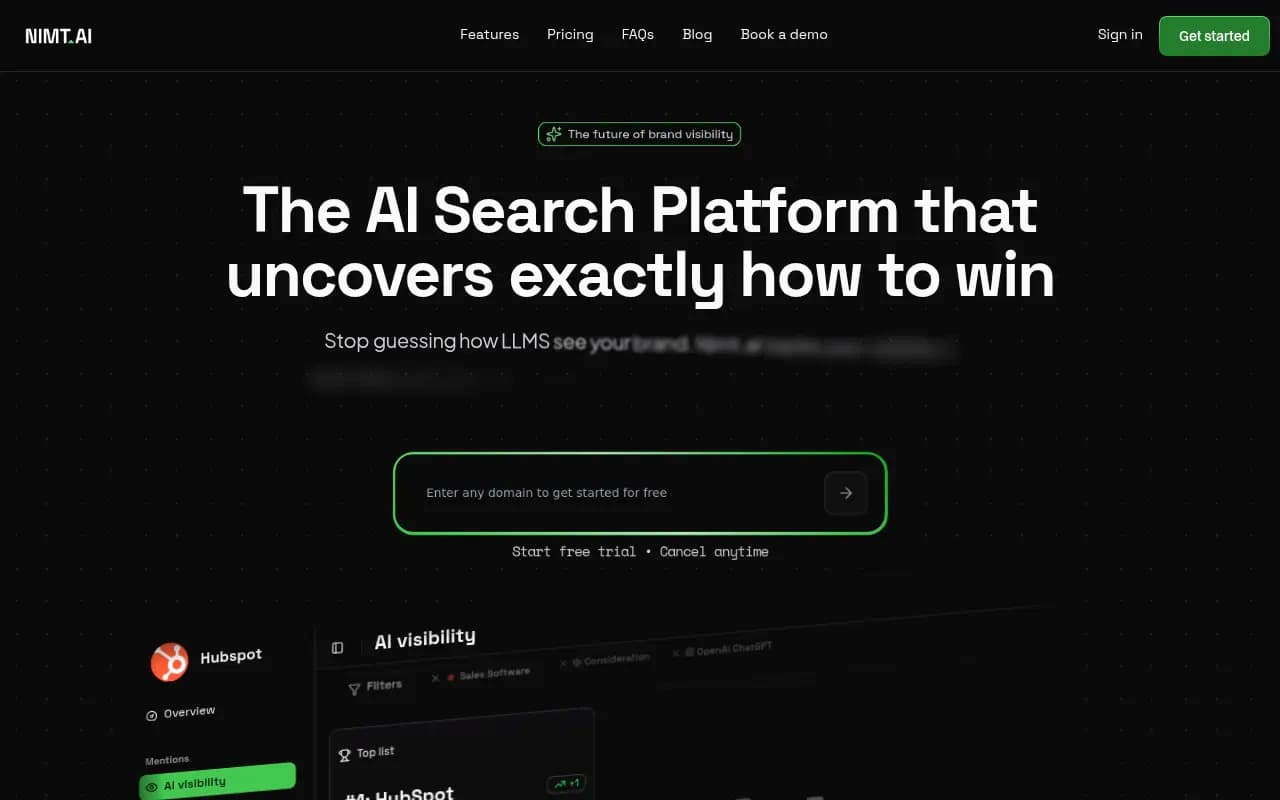
Nimt.ai is an AI search visibility platform that tracks how brands appear in ChatGPT, Perplexity, Gemini, and other LLMs. Built for marketing teams and agencies, it monitors brand mentions, sentiment, rankings, and citations across AI models, then generates prioritized "Boost Actions" to improve visibility. Unlike traditional SEO tools, Nimt focuses on AI recommendation algorithms rather than Google rankings. The platform offers transparent pricing starting at $59/month with a 7-day free trial, making it accessible to startups and SMBs. Nimt tracks AI Brand Strength, share of voice, and domain comparisons, but lacks advanced features like crawler logs and content gap analysis.
Side-by-Side Comparison
| Feature | Bluefish AI | Nimt AI |
|---|---|---|
| Starting Price | Custom quote ($4,000+/mo estimated) | $59/mo (Starter) |
| Free Trial | No (demo required) | Yes (7 days) |
| Target Audience | Fortune 500, enterprise marketing teams | Startups, SMBs, agencies |
| Self-Service Signup | No | Yes |
| AI Models Tracked | ChatGPT, Perplexity, Gemini, agentic commerce | ChatGPT, Perplexity, Gemini, other LLMs |
| Custom Audiences | Yes (enterprise feature) | No |
| Tailored Prompts | Yes | Standardized prompt sets |
| Boost Actions | No | Yes (prioritized recommendations) |
| Content Generation | No | No |
| Crawler Logs | No | No |
| Sentiment Tracking | Yes | Yes |
| Citation Analysis | Yes | Yes |
| Share of Voice | Yes | Yes |
| Domain Comparisons | Yes | Yes |
| Project Management | Advanced segmentation | Multi-project support |
| API Access | Enterprise only | Not specified |
| Infosec Compliance | Enterprise-grade (passes reviews) | Not specified |
Pricing comparison
| Plan | Bluefish AI | Nimt AI |
|---|---|---|
| Free Tier | None | None |
| Starter | Not available | $59/mo (20 prompts) |
| Pro | Not available | $69/mo (20-500 prompts, unlimited projects) |
| Enterprise | Custom quote (estimated $4,000+/mo) | Custom pricing |
| Free Trial | No (demo required) | 7 days |
| Annual Discount | Not specified | Not specified |
The pricing gap here is the most dramatic difference between these two platforms. Bluefish doesn't publish pricing and requires a sales conversation before you see a quote. Based on their enterprise positioning and Fortune 500 client base, estimates put their entry point at $4,000+ per month. Nimt, by contrast, starts at $59/month with transparent tiers and a free trial. You can sign up and start tracking visibility in minutes.
Target audience and positioning
Who Bluefish is built for
Bluefish explicitly targets Fortune 500 brands and large enterprise marketing teams. Their website emphasizes passing infosec reviews, advanced segmentation, and custom audiences -- all signals that they're solving for complex organizational needs. If you're a global brand with multiple product lines, regional teams, and a marketing budget measured in millions, Bluefish offers the depth and control you need. Their custom prompt creation and tailored audiences mean you can track exactly how AI models respond to your specific brand architecture.
The trade-off: you're paying for white-glove service and enterprise-grade infrastructure. There's no self-service option. You need to go through a sales process, get a custom quote, and likely commit to an annual contract. For a startup or SMB, this is a non-starter.
Who Nimt is built for
Nimt targets the opposite end of the market: startups, SMBs, and agencies that need AI visibility tracking without enterprise overhead. The $59/month entry point and 7-day free trial make it accessible to teams with limited budgets. You can sign up, add your brand, and start tracking mentions across ChatGPT and Perplexity without talking to sales.
Nimt's "Boost Actions" feature is designed for teams that don't have dedicated GEO specialists. Instead of dumping raw data on you, Nimt prioritizes specific actions you should take to improve visibility. This is helpful if you're a small marketing team juggling multiple channels and need clear next steps.
The limitation: Nimt uses standardized prompt sets rather than custom audiences. If you need to track highly specific scenarios or segment by region, persona, or product line, Nimt won't give you that level of control.
Feature depth and customization
Bluefish's enterprise-grade segmentation
Bluefish's core differentiator is customization. You can create custom audiences (e.g. "C-suite executives in healthcare" vs "mid-market IT buyers"), tailor prompts to match your specific use cases, and segment data in ways that generic platforms can't. This matters for enterprise brands where a single "share of voice" metric doesn't capture the complexity of how different buyer personas interact with AI.
Bluefish also emphasizes "understanding how AI thinks" -- going beyond surface-level metrics like mention counts to analyze influence and impact. Their analytics are built for teams that need to justify AI visibility investments to executives and tie performance to business outcomes.
What's missing: Bluefish doesn't offer content generation, crawler logs, or content gap analysis. You get deep visibility into how AI models currently see your brand, but you're on your own for optimization. There's no built-in way to identify which content you're missing or generate articles that improve your citations.
Nimt's Boost Actions and actionability
Nimt's standout feature is Boost Actions -- prioritized recommendations that tell you exactly what to do next. Instead of staring at a dashboard full of metrics, you get a ranked list of actions: "Create content about X," "Optimize page Y," "Target prompt Z." This is valuable for small teams that don't have the bandwidth to interpret raw data.
Nimt also tracks AI Brand Strength (a composite score), share of voice, sentiment, and rankings across multiple LLMs. You can compare your performance against competitors and see which domains AI models cite most often. The interface is clean and focused on the metrics that matter for AI visibility.
What's missing: Nimt doesn't offer custom audiences or tailored prompts. You're working with their standardized prompt library, which may or may not match your specific needs. There's also no mention of crawler logs, content gap analysis, or AI writing tools. Like Bluefish, Nimt focuses on monitoring and basic recommendations but doesn't close the loop to actual content creation.
AI models and coverage
Both platforms track the major AI search engines: ChatGPT, Perplexity, and Gemini. Bluefish also mentions "agentic commerce channels," which likely refers to AI shopping assistants and recommendation engines. Nimt references "other LLMs" without specifying which ones.
Neither platform appears to track Google AI Overviews, Claude, Meta AI, DeepSeek, Grok, or Mistral -- models that more comprehensive platforms like Promptwatch monitor. If you need visibility across the full spectrum of AI models (10+ engines), both Bluefish and Nimt will leave gaps in your coverage.

Sentiment and citation tracking
Both platforms track sentiment (positive, neutral, negative) and citations (which sources AI models reference when mentioning your brand). This is table stakes for AI visibility tracking. You need to know not just if you're mentioned, but how you're positioned and what evidence AI models use to support their recommendations.
Bluefish emphasizes "influence and control" -- understanding not just that you're mentioned, but whether AI models position you favorably compared to competitors. Nimt tracks sentiment as part of their AI Brand Strength score, which combines mentions, rankings, and sentiment into a single metric.
Neither platform offers Reddit or YouTube tracking, which is a blind spot. AI models increasingly cite Reddit discussions and YouTube videos when making recommendations, especially for product comparisons and user experience questions. Missing this data means you're not seeing the full picture of what influences AI responses.
Content optimization and gap analysis
This is where both platforms fall short. Bluefish focuses on monitoring and analytics but doesn't offer content generation or gap analysis. You can see how AI models currently perceive your brand, but you're on your own for creating content that improves your visibility.
Nimt's Boost Actions provide prioritized recommendations, which is a step in the right direction. But these are high-level suggestions ("create content about X") rather than detailed gap analysis that shows you exactly which prompts competitors rank for but you don't, or which topics AI models want answers to but can't find on your site.
For teams that want to close the loop from tracking to action, this is a significant limitation. You're paying for visibility data but still need to figure out what content to create, how to structure it, and whether it's actually working. Platforms that combine monitoring with content gap analysis and AI writing tools (like Promptwatch) offer a more complete solution.
Ease of use and onboarding
Bluefish: Enterprise sales process
Bluefish requires a sales demo before you can access the platform. There's no self-service signup, no free trial, and no transparent pricing. You fill out a contact form, schedule a call, sit through a demo, negotiate a custom quote, and likely sign an annual contract. For enterprise buyers used to this process, it's standard. For startups or SMBs, it's a dealbreaker.
Once you're onboarded, Bluefish offers "deep expertise" and custom setup. You're not just getting software -- you're getting a team that helps you configure custom audiences, tailor prompts, and set up segmentation. This is valuable if you have complex needs, but it also means a longer time-to-value.
Nimt: Self-service and fast setup
Nimt offers self-service signup with a 7-day free trial. You can create an account, add your brand, and start tracking visibility in minutes. The interface is clean and focused on the metrics that matter. There's no steep learning curve or complex configuration.
For small teams that need to move fast, this is a huge advantage. You can test the platform, see if it meets your needs, and decide whether to upgrade -- all without talking to sales. The trade-off is less customization and no white-glove onboarding.
Project and prompt management
Both platforms offer project management features, but with different levels of sophistication.
Bluefish emphasizes advanced segmentation and custom prompt creation. You can set up multiple projects, each with tailored audiences and prompts that match your specific brand architecture. This is critical for enterprise brands with multiple product lines or regional teams. You're not stuck with a one-size-fits-all prompt library.
Nimt offers multi-project support and prompt management, but uses standardized prompt sets. You can track multiple brands or product lines, but you're working with Nimt's pre-defined prompts rather than creating your own. For most SMBs, this is fine -- the standard prompts cover common use cases. For enterprise brands with unique needs, it's limiting.
Data export and integrations
Bluefish mentions that "data teams get more ways to customize, segment, and optimize data in ways competitors can't match." This suggests robust export capabilities and possibly API access, though details aren't public. Enterprise buyers will likely get custom integrations and data pipelines as part of their contract.
Nimt doesn't specify API access or integrations on their public site. For a $59-$69/month tool, you're probably looking at CSV exports and basic reporting rather than API-driven workflows.
If you need to pipe AI visibility data into your data warehouse, BI tools, or custom dashboards, Bluefish is the safer bet. Nimt is more of a standalone tool.
Infosec and compliance
Bluefish explicitly mentions that they "consistently pass infosec reviews with ease." For Fortune 500 buyers, this is critical. You need SOC 2 compliance, data residency options, SSO, role-based access control, and audit logs. Bluefish is built to meet these requirements.
Nimt doesn't mention infosec or compliance on their public site. For startups and SMBs, this may not matter. For enterprise buyers, it's a red flag. If you need to pass a security review before signing a contract, Nimt probably isn't ready for that conversation.
What both platforms are missing
Neither Bluefish nor Nimt offers:
- AI crawler logs: Real-time logs of AI crawlers (ChatGPT, Claude, Perplexity) hitting your website. You can't see which pages AI models read, errors they encounter, or how often they return.
- Content gap analysis: Detailed breakdowns of which prompts competitors rank for but you don't, or which topics AI models want answers to but can't find on your site.
- AI content generation: Built-in tools to create articles, listicles, and comparisons grounded in citation data and prompt volumes.
- Reddit and YouTube tracking: Surface discussions that directly influence AI recommendations.
- Traffic attribution: Code snippets or integrations to connect AI visibility to actual website traffic and revenue.
These are significant gaps. You're paying for visibility data but still need to figure out how to act on it. Platforms like Promptwatch that combine monitoring with optimization tools offer a more complete solution for teams that want to improve their AI visibility, not just track it.
Pros and cons
Bluefish AI pros
- Enterprise-grade infrastructure that passes infosec reviews
- Custom audiences and tailored prompts for complex brand architectures
- Advanced segmentation and data customization
- Deep analytics that go beyond surface-level metrics
- White-glove onboarding and support
- Built for Fortune 500 scale and complexity
Bluefish AI cons
- No transparent pricing (custom quotes only)
- No self-service signup or free trial
- Estimated $4,000+/month makes it inaccessible to SMBs
- Lacks content generation and optimization tools
- No crawler logs or content gap analysis
- Long sales cycle and time-to-value
Nimt AI pros
- Affordable pricing starting at $59/month
- 7-day free trial with self-service signup
- Boost Actions provide prioritized recommendations
- Clean interface focused on actionable metrics
- Multi-project support for agencies
- Fast setup and time-to-value
Nimt AI cons
- Standardized prompt sets (no custom audiences)
- Limited customization compared to enterprise platforms
- No crawler logs or content gap analysis
- No content generation tools
- Lacks advanced segmentation and data export
- No mention of infosec compliance or API access
Who should pick which tool
Pick Bluefish if:
- You're a Fortune 500 brand or large enterprise with a marketing budget measured in millions
- You need custom audiences, tailored prompts, and advanced segmentation
- You have complex brand architecture (multiple product lines, regions, personas)
- You need to pass enterprise infosec reviews
- You want white-glove onboarding and dedicated support
- You're willing to go through a sales process and commit to an annual contract
- You have a dedicated GEO team that can interpret analytics and build optimization strategies
Pick Nimt if:
- You're a startup, SMB, or agency with a limited budget
- You need transparent pricing and a free trial to test before committing
- You want self-service signup and fast time-to-value
- You need Boost Actions that tell you exactly what to do next
- You're tracking a single brand or a handful of projects
- You don't need custom audiences or advanced segmentation
- You're comfortable with standardized prompt sets
Consider alternatives if:
- You need AI crawler logs, content gap analysis, and AI writing tools in addition to monitoring
- You want to track 10+ AI models including Claude, Meta AI, DeepSeek, and Google AI Overviews
- You need Reddit and YouTube tracking to see what influences AI recommendations
- You want traffic attribution to connect AI visibility to revenue
- You're looking for a platform that closes the loop from tracking to optimization to content creation
Final verdict
Bluefish and Nimt serve completely different markets. Bluefish is an enterprise-only platform with custom pricing ($4,000+/month) built for Fortune 500 brands that need deep customization and white-glove service. Nimt is a self-service tool starting at $59/month built for startups and SMBs that need affordable AI visibility tracking.
If you're a large enterprise with complex needs and a big budget, Bluefish offers the depth and control you need. If you're a small team with limited resources, Nimt gives you actionable insights without enterprise overhead.
Both platforms focus on monitoring and analytics but lack optimization features like crawler logs, content gap analysis, and AI writing tools. If you want a platform that helps you improve your AI visibility -- not just track it -- you'll need to look at more comprehensive GEO platforms that close the loop from data to action.