Key Takeaways
- Brandlight is enterprise-focused with Fortune 500 clients and starts at $199/mo, while Ceyo targets SMBs and agencies starting at $49/mo -- a 4x price difference
- Brandlight raised $30M Series A and positions itself as a comprehensive platform with activation features, while Ceyo is a leaner monitoring-focused tool
- Both track the same core AI engines (ChatGPT, Perplexity, Claude, Gemini), but Brandlight adds more enterprise features like multi-brand deployments
- Ceyo's pricing makes it accessible for smaller teams testing AI visibility, while Brandlight's feature set and support structure target marketing departments with bigger budgets
- Neither platform offers the content gap analysis and AI content generation that tools like Promptwatch provide -- they're monitoring-first, not optimization-first
- If you're a startup or agency managing multiple small clients, Ceyo's price point makes sense. If you're a Fortune 500 brand with complex requirements, Brandlight is built for that.
Overview
Brandlight.ai
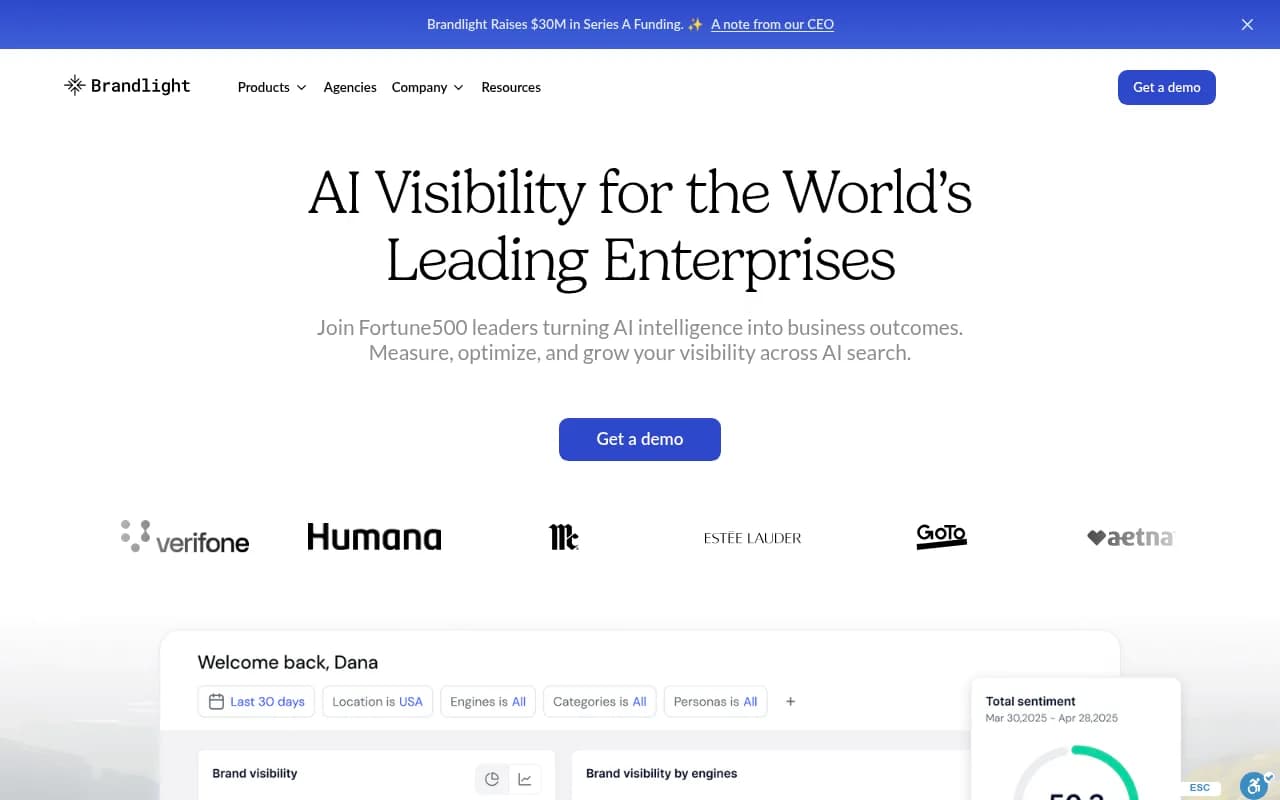
Brandlight is an enterprise AI visibility platform that monitors how brands appear across ChatGPT, Perplexity, Claude, Gemini, and other AI search engines. The company recently raised $30M in Series A funding and works with Fortune 500 clients including Mastercard, Estée Lauder, Humana, and Verifone. The platform tracks brand mentions, sentiment, citations, and competitive positioning. Brandlight positions itself as more than monitoring -- they talk about "activation" and influencing AI responses, though the specifics of how that works aren't entirely clear from their public materials. Pricing starts at $199/mo for basic monitoring and goes up to $750/mo for their activation plan, with custom enterprise pricing for multi-brand deployments.
Ceyo
Ceyo
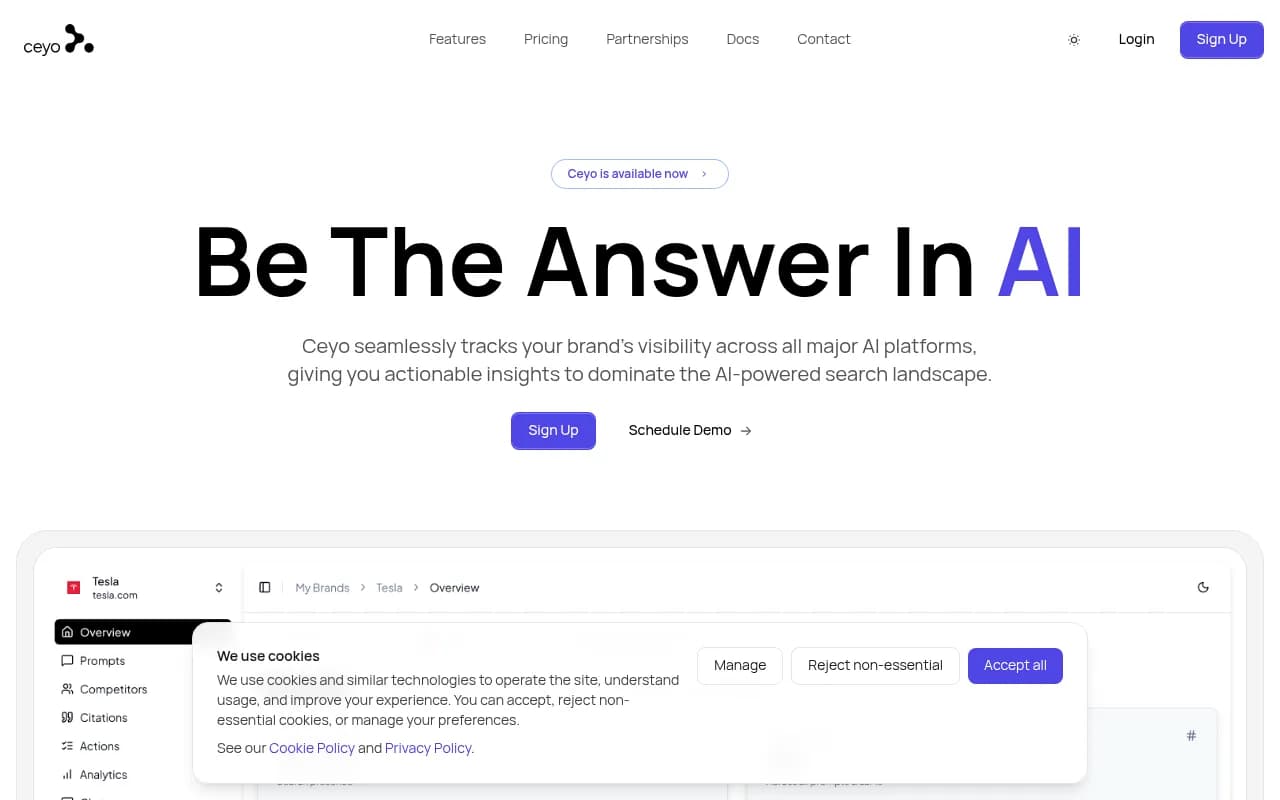
Ceyo is a GEO (Generative Engine Optimization) platform that tracks brand visibility across ChatGPT, Gemini, Claude, and Perplexity. The platform monitors prompt performance, sentiment, and competitor mentions across thousands of queries. Ceyo targets a different market segment -- agencies, SMBs, and brands that want AI visibility tracking without enterprise complexity or pricing. Their Core plan starts at $49/mo, making it one of the more affordable options in this space. The platform provides actionable insights and recommendations, though like most competitors in this category, it's primarily a monitoring dashboard rather than an optimization platform.
Side-by-side comparison
| Feature | Brandlight.ai | Ceyo |
|---|---|---|
| Starting price | $199/mo | $49/mo |
| Free tier | Yes (limited) | No |
| AI engines covered | ChatGPT, Perplexity, Claude, Gemini, others | ChatGPT, Gemini, Claude, Perplexity |
| Target audience | Fortune 500, enterprise marketing teams | SMBs, agencies, startups |
| Sentiment tracking | Yes | Yes |
| Competitor monitoring | Yes | Yes |
| Multi-brand support | Yes (enterprise) | Not specified |
| Custom prompts | Yes | Yes (thousands) |
| Activation features | Yes ($750/mo plan) | Limited |
| API access | Enterprise only | Not specified |
| Recent funding | $30M Series A | Not disclosed |
| Support level | Dedicated enterprise support | Standard support |
Pricing comparison
| Plan | Brandlight.ai | Ceyo |
|---|---|---|
| Entry tier | $199/mo (basic monitoring) | $49/mo (Core) |
| Mid tier | $750/mo (activation plan) | Standard (price not public) |
| Enterprise | Custom pricing | Enterprise (price not public) |
| Free option | Yes (limited features) | No |
| Annual discount | Not specified | Available |
The pricing gap is the most obvious difference. Ceyo's $49/mo entry point is 4x cheaper than Brandlight's $199/mo basic plan. If you're a small team or agency testing AI visibility tracking for the first time, that difference matters. Brandlight's pricing reflects its enterprise positioning -- you're paying for the infrastructure, support, and feature depth that Fortune 500 companies need.
AI engine coverage
Both platforms cover the big four: ChatGPT, Perplexity, Claude, and Gemini. Brandlight mentions "other AI search engines" in their materials but doesn't specify which ones. Ceyo lists exactly four engines on their site.
Neither platform tracks as many AI models as some competitors. For reference, Promptwatch monitors 10 AI engines including Google AI Overviews, Meta/Llama, DeepSeek, Grok, Mistral, and Copilot on top of the core four.

The four engines both platforms cover are the most important ones for most brands, so this isn't necessarily a dealbreaker. But if you need comprehensive coverage across every AI model your customers might use, you'll want to look at platforms with broader monitoring.
Prompt tracking and analytics
Both platforms let you track custom prompts and see how your brand performs across thousands of queries. Ceyo's dashboard shows prompt-level data including visibility percentage, sentiment, average position, impact level, and which brands appear in responses. Their interface looks clean and focused on the core metrics.
Brandlight talks about "measuring, optimizing, and growing your visibility" but the public-facing materials don't show as much detail about the actual analytics interface. The enterprise focus suggests more customization and deeper reporting, but you'd need to get a demo to see what that looks like in practice.
What both platforms are missing: prompt volume estimates and difficulty scoring. If you're deciding which prompts to optimize for, knowing which ones get asked 10,000 times a month vs 50 times matters. Neither Brandlight nor Ceyo surfaces that data publicly. This is where monitoring-only tools fall short compared to optimization platforms that help you prioritize.
Competitor analysis
Both platforms track competitor mentions. Ceyo's dashboard shows which brands appear alongside yours in AI responses. Brandlight mentions competitive positioning as a core feature.
The question is what you do with that data. Seeing that a competitor appears in 85% of responses for a key prompt is useful information. But then what? Most monitoring tools stop there. You're left figuring out why they're winning and how to close the gap on your own.
Platforms that go beyond monitoring -- like Promptwatch's Answer Gap Analysis -- show you the specific content competitors have that you're missing. That's the difference between knowing you're losing and knowing how to fix it.
Activation and optimization features
Brandlight's $750/mo activation plan is interesting. They talk about "influencing" AI responses and turning intelligence into business outcomes. The specifics aren't public, but the positioning suggests they're trying to move beyond pure monitoring.
Ceyo mentions "actionable insights and recommendations" but doesn't detail what those recommendations look like or how actionable they actually are.
Here's the reality: most tools in this category are dashboards. They show you data. Some add light recommendations. Very few help you actually create the content that will improve your visibility. That's the gap between monitoring and optimization.
If you want to track visibility and figure out optimization on your own, either platform works. If you want the platform to help you close the gaps -- showing you what content to create, generating drafts grounded in citation data, tracking the results -- you need something built for that workflow.
Enterprise features and support
Brandlight is clearly built for enterprise. Multi-brand deployments, custom pricing, dedicated support, Fortune 500 client roster. If you're managing visibility for multiple brands across regions, Brandlight has the infrastructure.
Ceyo doesn't emphasize enterprise features in their public materials. They have an Enterprise tier, but the focus is on making AI visibility tracking accessible to smaller teams. The partner logos on their site (agencies like Brandfirm and Zigt) suggest they're targeting the agency market.
Support level matters if you're rolling this out across a large organization. Brandlight's pricing includes the hand-holding and custom setup that enterprise marketing teams expect. Ceyo's pricing suggests more self-service.
User interface and ease of use
Ceyo's screenshots show a clean, modern interface with tables and clear metrics. It looks like something you could start using without a multi-week onboarding process.
Brandlight's site focuses more on messaging than showing the actual product. The enterprise positioning suggests a more complex platform with more configuration options. That's not necessarily bad -- enterprise tools need flexibility -- but it probably means a steeper learning curve.
If you want to sign up and start tracking visibility this week, Ceyo's approach seems more plug-and-play. If you need custom workflows and integrations, Brandlight's enterprise focus is the better fit.
Data freshness and accuracy
Neither platform publishes specifics about how often they refresh data or how they handle the non-deterministic nature of AI responses. This is a blind spot across the category.
AI models don't give the same answer twice. Running the same prompt 10 times produces 10 different responses with different brand mentions. Some platforms run each prompt once and call it done. Others run multiple samples and aggregate. The methodology matters for accuracy, but most vendors don't talk about it publicly.
If data quality is critical for your use case, ask both vendors directly: How many samples per prompt? How often do you refresh? How do you handle variability?
Integration and API access
Brandlight mentions API access at the enterprise level. Ceyo doesn't specify API availability in their public materials.
If you need to pull AI visibility data into your existing reporting stack or build custom workflows, API access is non-negotiable. This is another area where you'll need to ask vendors directly about capabilities and pricing.
Pros and cons
Brandlight.ai pros
- Built for enterprise scale with Fortune 500 clients
- $30M in funding suggests long-term stability
- Activation features beyond pure monitoring
- Multi-brand deployment support
- Dedicated enterprise support
Brandlight.ai cons
- $199/mo starting price is steep for smaller teams
- Limited public information about actual features and interface
- Activation plan at $750/mo is expensive without clear ROI details
- Requires demo/sales process to understand full capabilities
Ceyo pros
- $49/mo entry price makes it accessible for SMBs and agencies
- Clean, straightforward interface focused on core metrics
- Covers the four most important AI engines
- Agency-friendly positioning and partnerships
- No sales process required to get started
Ceyo cons
- Limited public information about advanced features
- No free tier to test before committing
- Fewer enterprise features for complex deployments
- Monitoring-focused without deep optimization capabilities
- Smaller company with less disclosed funding/stability
Who should choose Brandlight.ai
Pick Brandlight if you're a Fortune 500 brand or large enterprise with:
- Budget for $199-750+/mo per brand
- Need for multi-brand monitoring across regions
- Complex requirements that need custom configuration
- Expectation of dedicated support and account management
- Willingness to go through a sales process and demo cycle
Brandlight makes sense when you're managing AI visibility at scale and need a vendor that can handle enterprise complexity. The $30M funding round suggests they're investing in building out the platform for this market.
Who should choose Ceyo
Pick Ceyo if you're:
- A startup, SMB, or agency managing multiple small clients
- Working with a limited budget and need to prove ROI before scaling up
- Looking for straightforward monitoring without enterprise complexity
- Comfortable with self-service onboarding and standard support
- Focused on the core four AI engines (ChatGPT, Perplexity, Claude, Gemini)
Ceyo's pricing makes it a good entry point for teams that want to start tracking AI visibility without a massive upfront commitment. The agency partnerships suggest they understand that use case well.
What both platforms are missing
Here's what neither Brandlight nor Ceyo solves: the gap between monitoring and optimization.
Both platforms show you where you're visible and where you're not. They track sentiment and competitor mentions. That's valuable data. But then you're on your own to figure out what content to create, how to structure it, and whether it's actually working.
This is the difference between a dashboard and an optimization platform. Dashboards show you problems. Optimization platforms help you fix them.
If you want to track visibility and handle optimization separately, either Brandlight or Ceyo works depending on your budget and scale. If you want the platform to close the loop -- showing you content gaps, helping you create optimized content, tracking the impact -- you need something built for that workflow from the ground up.
Final verdict
Brandlight vs Ceyo comes down to budget and scale. Brandlight is the enterprise choice with Fortune 500 clients, $30M in funding, and pricing to match. Ceyo is the accessible option for smaller teams and agencies that need AI visibility tracking without enterprise complexity or cost.
Both platforms are monitoring-first tools. They'll show you how your brand appears in AI search results. Neither will help you systematically close the gaps with content optimization and generation. That's fine if you have a content team that can take the insights and run with them. It's a limitation if you want the platform to be more hands-on.
For most teams reading this: if you're a Fortune 500 brand, Brandlight is built for you. If you're not, Ceyo's $49/mo entry point makes more sense than Brandlight's $199/mo minimum. The feature gap between the two isn't huge based on public information -- the main difference is enterprise infrastructure and support.
One sentence summary: Brandlight is enterprise AI visibility monitoring with the price tag and support to match, while Ceyo offers the same core tracking at a fraction of the cost for teams that don't need enterprise complexity.