Key Takeaways
- Completely different tools: Cognizo monitors brand visibility in AI search engines (ChatGPT, Perplexity, Gemini), while Amplitude tracks user behavior and product engagement -- they solve unrelated problems
- Pricing gap: Cognizo starts at $300/mo for 350 prompts; Amplitude has a free tier up to 10K monthly tracked users, then $49/mo for 300K MTUs
- Use case split: Pick Cognizo if you need to track how AI models cite your brand and create content that ranks in AI search. Pick Amplitude if you need to understand how users interact with your product.
- Integration potential: Marketing teams might use both -- Cognizo for external AI visibility, Amplitude for internal product metrics -- but they don't overlap
- Maturity difference: Amplitude is a mature product analytics leader (2,500+ reviews, used by Square, Walmart, NBC). Cognizo is a newer AEO platform riding the AI search wave.
- No direct competition: This comparison only makes sense if you're evaluating both for a broader marketing/analytics stack. They're not alternatives to each other.
Overview
Cognizo: AI visibility monitoring
Cognizo
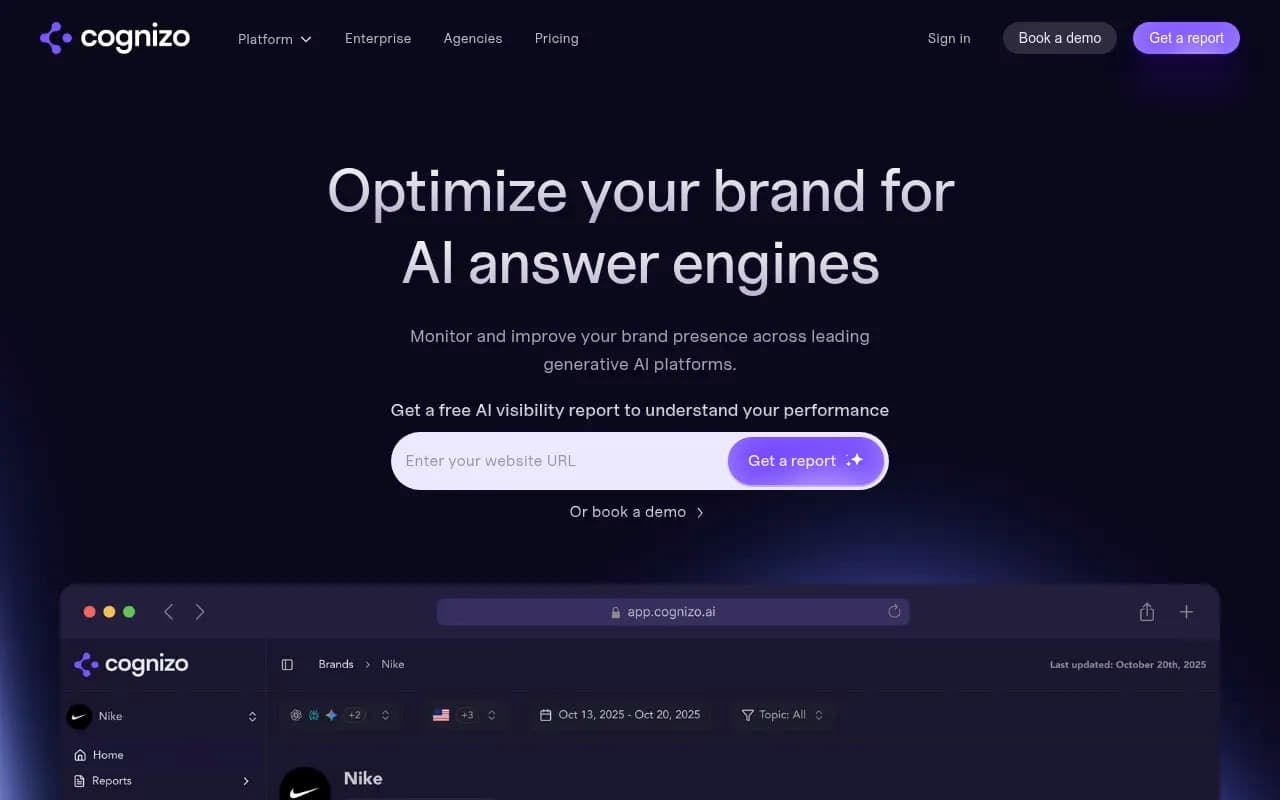
Cognizo is an Answer Engine Optimization (AEO) platform built for one job: tracking and improving how your brand shows up in AI-generated answers. When someone asks ChatGPT "best CRM tools" or Perplexity "top project management software," Cognizo tells you whether your brand gets mentioned, how often, what sentiment surrounds it, and where competitors are beating you. It monitors ChatGPT, Perplexity, Gemini, and Google AI Overviews, then helps you create content optimized to get cited by these models.
The platform targets marketing teams worried about being invisible in the new world of AI search. Traditional SEO gets you ranked on Google's results page. AEO gets you cited in the AI's actual answer.
Amplitude: Product analytics for growth
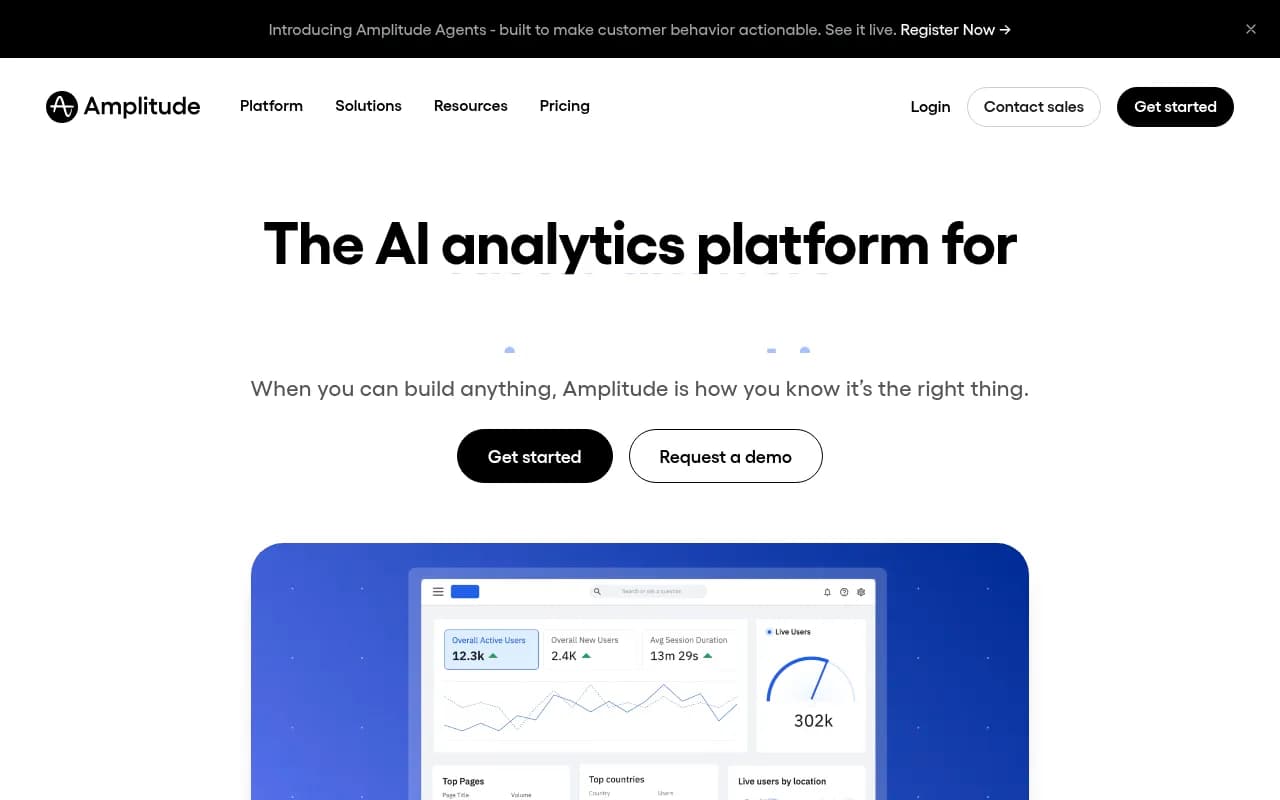
Amplitude is a digital analytics platform that tracks what users do inside your product. It answers questions like: Which features drive retention? Where do users drop off in the onboarding flow? What behavior predicts conversion? Teams use it to instrument events (button clicks, page views, purchases), build funnels, run cohort analysis, and A/B test product changes.
Amplitude is a category leader in product analytics -- 2,500+ reviews, used by Square, Walmart, Atlassian, NBC. It competes with Mixpanel, Heap, and Google Analytics 4 (for product teams). The platform includes experimentation tools, AI-powered insights, and audience segmentation for personalization.
Side-by-Side Comparison
| Feature | Cognizo | Amplitude |
|---|---|---|
| Primary use case | AI search visibility monitoring | Product analytics & user behavior tracking |
| What it tracks | Brand mentions in ChatGPT, Perplexity, Gemini, Google AI Overviews | User events, funnels, retention, conversion in your product |
| Starting price | $300/mo (350 prompts) | Free up to 10K MTUs, then $49/mo (300K MTUs) |
| Free tier | Free trial only | Yes -- 10K monthly tracked users |
| Target audience | Marketing teams, SEO teams, brand managers | Product managers, growth teams, data analysts |
| AI models monitored | 4+ (ChatGPT, Perplexity, Gemini, Google AI) | N/A |
| Content creation | Yes -- AI-optimized content generation | No |
| Event tracking | No | Yes -- unlimited custom events |
| A/B testing | No | Yes -- built-in experimentation |
| Competitor analysis | Yes -- visibility vs competitors in AI search | No |
| Integrations | Limited (newer platform) | 100+ integrations (Segment, mParticle, CDPs, warehouses) |
| Maturity | New (2024-2025 launch) | Established (2012, market leader) |
| Best for | Tracking AI citations and creating content that ranks in AI search | Understanding user behavior and optimizing product engagement |
What problem does each tool solve?
Cognizo: Be visible when AI answers questions
Cognizo exists because search is changing. People ask ChatGPT and Perplexity instead of Googling. If the AI doesn't cite your brand, you're invisible to a growing segment of buyers.
The platform monitors prompts (questions users ask AI models), tracks whether your brand appears in the response, analyzes sentiment, and compares you to competitors. It also identifies content gaps -- prompts where competitors get cited but you don't -- and generates AI-optimized articles to close those gaps.
Example workflow: You sell project management software. Cognizo shows that ChatGPT mentions Asana and Monday.com for "best project management tools for remote teams" but never mentions you. The platform flags this as a high-impact gap, then helps you create an article targeting that exact query. You publish it, and over time, AI models start citing it.
This is Answer Engine Optimization (AEO) -- the AI search equivalent of SEO.
Amplitude: Understand what users do in your product
Amplitude solves a different problem: you built a product, but you don't know what's working. Which features drive retention? Why do users churn? What's the conversion rate from signup to paid?
You instrument events ("user clicked upgrade button", "user completed onboarding step 3"), send them to Amplitude, then analyze patterns. The platform builds funnels (how many people go from step A to B to C), cohort reports (do users who activate feature X retain better?), and retention curves.
Example workflow: You notice 60% of trial users never activate a key feature. You build a funnel in Amplitude and see the drop-off happens at step 2 of onboarding. You redesign that step, run an A/B test in Amplitude's experimentation module, and measure whether the new flow improves activation.
This is product analytics -- understanding user behavior to drive growth.
Pricing comparison
| Plan | Cognizo | Amplitude |
|---|---|---|
| Free tier | Trial only | Up to 10K monthly tracked users (MTUs) |
| Starter | $300/mo (350 prompts, basic monitoring) | $49/mo (300K MTUs, core analytics) |
| Mid-tier | Custom (likely $500-1K+/mo for more prompts) | Growth plan (custom, typically $2K-10K+/year) |
| Enterprise | Custom | Custom (typically $10K-50K+/year) |
Cognizo's pricing is prompt-based. You define a set of queries to monitor (e.g. "best CRM tools", "top email marketing platforms"), and the platform tracks them across AI models. More prompts = higher cost.
Amplitude's pricing is user-based. A monthly tracked user (MTU) is anyone who triggers an event in your product that month. If you have 50K active users, you're in the $49/mo tier. If you have 5M active users, you're in enterprise pricing.
The models don't overlap because the tools measure different things. Cognizo tracks external AI search visibility. Amplitude tracks internal product usage.
Feature deep-dive
Monitoring and tracking
Cognizo monitors AI search engines. You input prompts (questions), and it queries ChatGPT, Perplexity, Gemini, and Google AI Overviews to see if your brand appears in the response. It tracks:
- Mention frequency (how often you're cited)
- Citation position (are you first, third, or buried?)
- Sentiment (positive, neutral, negative)
- Competitor visibility (who else gets mentioned)
The platform runs these checks on a schedule (daily or weekly) and alerts you to changes.
Amplitude monitors user behavior inside your product. You define events ("user signed up", "user clicked feature X"), and Amplitude captures them via SDK or API. It tracks:
- Event volumes (how many times X happened)
- User properties (who did X -- their plan, location, device)
- Session data (how long users spend in the product)
- Conversion funnels (how many users go from event A to B to C)
The platform updates in real-time as events stream in.
Verdict: Completely different tracking. Cognizo watches external AI platforms. Amplitude watches your own product.
Content creation and optimization
Cognizo includes an AI content generator. It identifies prompts where you're missing (competitors get cited, you don't), then drafts articles optimized to rank in AI search. The content is grounded in citation data and competitor analysis -- not generic SEO filler.
You review the draft, edit it, publish it on your site, and monitor whether AI models start citing it.
Amplitude has no content creation features. It's a data platform, not a content tool.
Verdict: Cognizo wins if you need content. Amplitude doesn't play in this space.
Analytics and insights
Cognizo provides visibility dashboards: which prompts you rank for, sentiment trends, competitor heatmaps, and gap analysis (where you're missing). The insights are specific to AI search.
Amplitude provides deep behavioral analytics: funnels, retention curves, cohort analysis, user paths, and predictive insights ("users who do X are 3x more likely to convert"). It also includes AI-powered anomaly detection and automated insights.
Amplitude's analytics are far more sophisticated because it's a mature platform built for data teams. Cognizo's analytics are narrower but purpose-built for AEO.
Verdict: Amplitude wins on analytics depth. Cognizo wins on AEO-specific insights.
Experimentation and testing
Cognizo doesn't do A/B testing. It's a monitoring and content platform.
Amplitude includes a full experimentation suite. You can run A/B tests, multivariate tests, and feature flags, then measure impact on conversion, retention, and revenue. The platform integrates with your product to randomly assign users to variants and track results.
Verdict: Amplitude wins. Cognizo doesn't compete here.
Integrations
Cognizo is a newer platform with limited integrations. It likely connects to Google Analytics and content management systems, but the ecosystem is small.
Amplitude integrates with 100+ tools: Segment, mParticle, Snowflake, Redshift, Salesforce, HubSpot, Braze, Iterable, and every major CDP and data warehouse. It's built to sit in the center of your data stack.
Verdict: Amplitude wins by a mile. Cognizo will need to build out integrations as it matures.
Ease of use
Cognizo is straightforward: add prompts, review dashboards, generate content. The learning curve is low because the feature set is focused.
Amplitude has a steeper learning curve. Setting up event tracking requires engineering work (instrumenting events, sending data via SDK). Building reports requires understanding funnels, cohorts, and retention metrics. Amplitude offers templates and AI assistance, but it's still a power tool for data-savvy teams.
Verdict: Cognizo is easier to get started. Amplitude requires more setup and expertise.
Pros and cons
Cognizo pros
- Purpose-built for AI search visibility -- tracks ChatGPT, Perplexity, Gemini, Google AI Overviews
- Identifies content gaps where competitors are cited but you're not
- Generates AI-optimized content to close those gaps
- Simpler learning curve than product analytics tools
- Addresses a real problem: brands being invisible in AI-generated answers
Cognizo cons
- Expensive starting point ($300/mo vs Amplitude's free tier)
- Newer platform with limited integrations and unproven track record
- Narrow use case -- only relevant if AI search visibility matters to your business
- No product analytics, experimentation, or user behavior tracking
- Pricing scales quickly if you need to monitor many prompts
Amplitude pros
- Market-leading product analytics with 2,500+ reviews and proven ROI (217% over 3 years per Forrester)
- Free tier up to 10K monthly tracked users -- generous for startups
- Deep analytics: funnels, cohorts, retention, user paths, predictive insights
- Built-in experimentation and A/B testing
- 100+ integrations with CDPs, warehouses, and marketing tools
- AI-powered insights and anomaly detection
Amplitude cons
- Steep learning curve -- requires engineering setup and analytics expertise
- Pricing can get expensive at scale (enterprise plans often $10K-50K+/year)
- Doesn't track external visibility (SEO, AI search, brand mentions)
- Overkill if you just need basic event tracking (Google Analytics 4 might suffice)
- No content creation or AEO features
Who should pick which tool?
Pick Cognizo if:
- You're a marketing team worried about AI search visibility
- You need to track whether ChatGPT, Perplexity, or Gemini cite your brand
- You want to identify content gaps and create articles that rank in AI search
- You're in a competitive category where AI recommendations drive buyer decisions (SaaS, ecommerce, B2B services)
- You have budget for a specialized AEO tool ($300+/mo)
Pick Amplitude if:
- You're a product team trying to understand user behavior
- You need to track events, build funnels, analyze retention, and run A/B tests
- You want deep analytics to optimize conversion and growth
- You're building a digital product (app, SaaS, ecommerce site) and need to instrument user actions
- You want a free tier to start or can scale into paid plans as you grow
Use both if:
- You're a growth-stage company with separate marketing and product teams
- Marketing uses Cognizo to track external AI visibility and create content
- Product uses Amplitude to track internal user behavior and optimize the product
- You have budget for specialized tools in each domain
If you're also looking to track how your brand shows up in AI search results more broadly, Promptwatch is worth considering -- it covers AI visibility monitoring across 10+ models and includes content gap analysis, crawler logs, and an AI writing agent to help you create content that actually gets cited.

Final verdict
Cognizo and Amplitude solve completely different problems. Cognizo is for marketing teams tracking AI search visibility. Amplitude is for product teams tracking user behavior.
If you're choosing between them, you're probably evaluating a broader marketing and analytics stack. The real question is: do you need AEO monitoring (Cognizo) or product analytics (Amplitude)? Most companies will eventually need both -- or tools like them -- because external visibility and internal product metrics are both critical.
For AI search visibility, Cognizo is a solid bet if you can afford the $300/mo entry point. For product analytics, Amplitude is the category leader with a free tier and proven ROI. Neither replaces the other.