Key Takeaways
- Cognizo starts at $300/mo with content generation built in; Analyze AI uses custom pricing and focuses on GA4 traffic attribution instead of content creation
- Cognizo covers 5 AI engines (ChatGPT, Perplexity, Gemini, Google AI Overviews, Claude); Analyze AI covers the same 5 plus Copilot for broader monitoring
- Analyze AI is the only platform that connects GA4 to show which AI engines drive actual traffic and conversions -- Cognizo tracks visibility but not downstream traffic attribution
- Cognizo includes an AI content writer that generates optimized articles from visibility gaps; Analyze AI gives you content recommendations but you write or outsource the content yourself
- Cognizo's Starter plan ($300/mo) tracks 350 prompts; Analyze AI pricing is opaque and requires a sales call
- If you need an all-in-one platform with content generation, Cognizo is the faster path. If you need to prove AI-driven ROI with traffic data, Analyze AI is built for that.
Overview
Cognizo
Cognizo
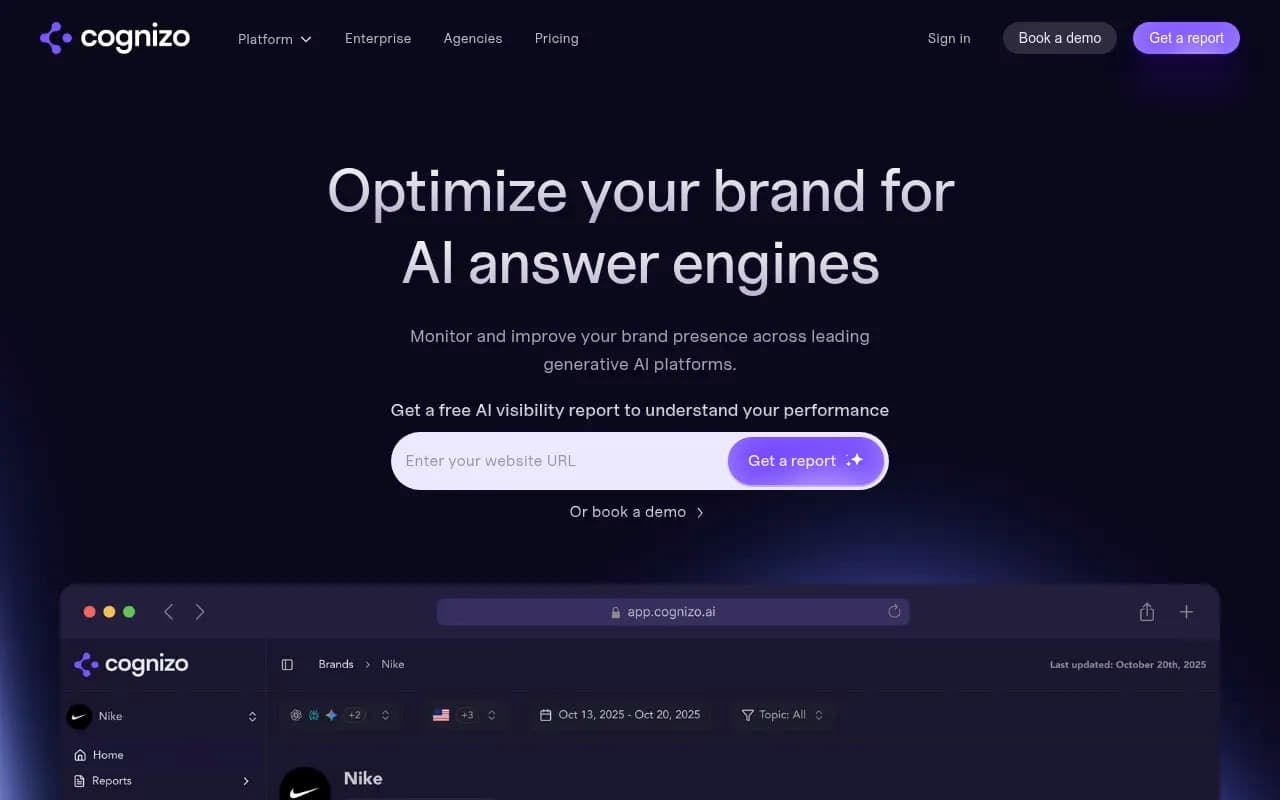
Cognizo positions itself as a complete Answer Engine Optimization (AEO) platform. You monitor brand visibility across ChatGPT, Perplexity, Gemini, Google AI Overviews, and Claude, then use the built-in content generator to create articles designed to increase citations. The pitch: discover what customers are asking AI, see where you're missing, and automate content creation to fill those gaps. Pricing starts at $300/mo for 350 prompts and basic monitoring.
Analyze AI
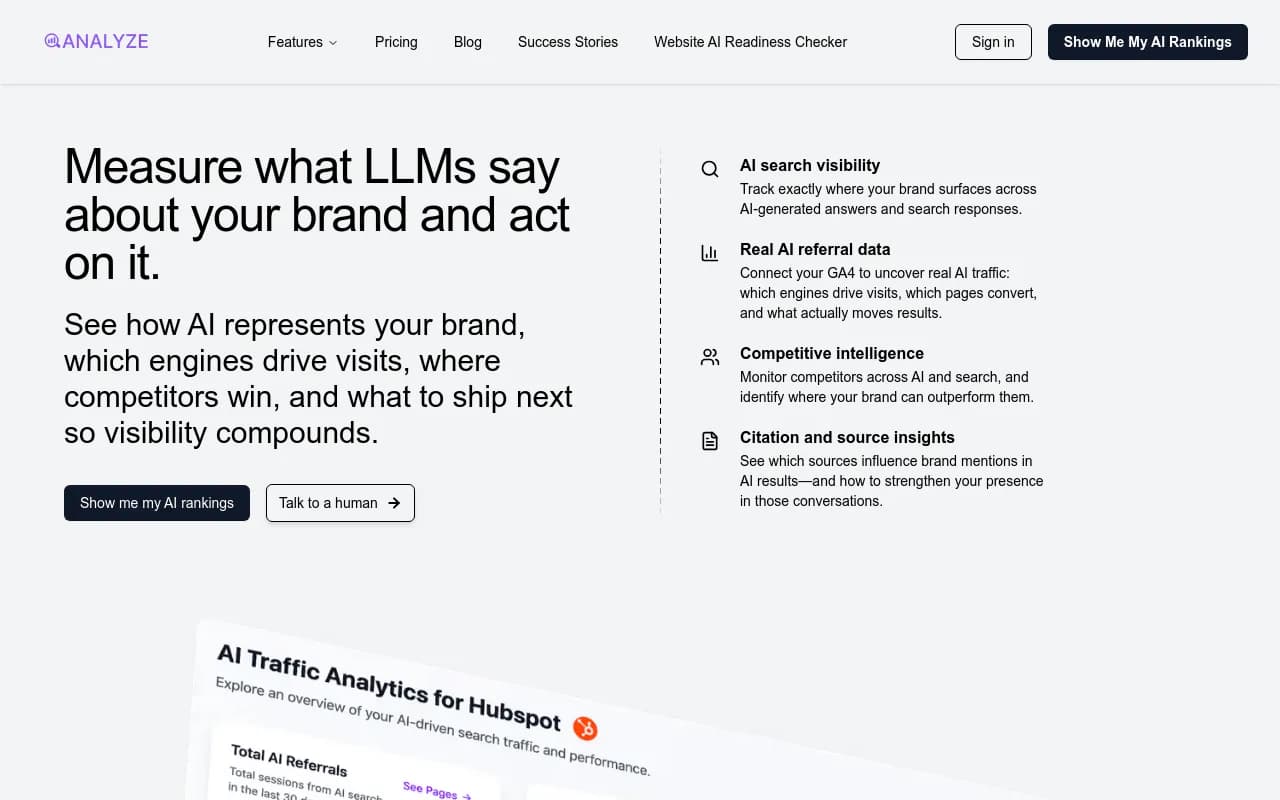
Analyze AI takes a different angle. It monitors the same core AI engines (plus Copilot) but the standout feature is GA4 integration -- you can see which AI engines send actual traffic to your site, which pages convert, and what drives revenue. The platform gives you content gap analysis and citation insights, but you're responsible for creating the content. Pricing is custom and requires a sales call.
Side-by-Side Comparison
| Feature | Cognizo | Analyze AI |
|---|---|---|
| Starting price | $300/mo (Starter) | Custom pricing |
| Free trial | Yes | Not specified |
| AI engines monitored | 5 (ChatGPT, Perplexity, Gemini, Google AI Overviews, Claude) | 6 (same 5 + Copilot) |
| Prompt tracking (Starter) | 350 prompts | Unknown (custom) |
| Content generation | Built-in AI writer | Recommendations only |
| GA4 traffic attribution | No | Yes |
| Sentiment tracking | Yes | Yes |
| Competitor monitoring | Yes | Yes |
| Citation analysis | Yes | Yes |
| AI crawler logs | Not mentioned | Not mentioned |
| Multi-language support | Not specified | Not specified |
| API access | Not mentioned | Not mentioned |
AI engine coverage
Cognizo
Covers five major AI engines: ChatGPT, Perplexity, Gemini, Google AI Overviews, and Claude. That's the core set most brands care about. Missing: Copilot, Meta AI, Grok, DeepSeek, Mistral. For most B2B and B2C brands, the five engines Cognizo monitors represent the bulk of AI search traffic, so the gap isn't critical unless you specifically need Copilot data.
Analyze AI
Adds Copilot to the same five-engine lineup. Copilot matters if you're targeting enterprise users who default to Microsoft's ecosystem. Beyond that, Analyze AI doesn't mention coverage for Meta AI, Grok, DeepSeek, or Mistral either.
Verdict: Analyze AI has a slight edge with Copilot support. If you're selling to enterprise IT buyers who live in Microsoft 365, that's a real advantage. For everyone else, the difference is marginal.
Content generation and optimization
Cognizo
The platform includes an AI content writer that generates articles, listicles, and comparison pages based on visibility gaps and citation data. You see where competitors are mentioned but you're not, then click a button to generate a draft. Cognizo claims the content is "AI-optimized" to increase citations, though it's unclear how much citation data actually informs the output versus generic SEO best practices.
The workflow: identify a content gap → generate a brief → draft content → publish. You can edit drafts before publishing. This is a real time-saver if you don't have a content team or agency on retainer.
Analyze AI
No built-in content generator. Instead, you get "content gap analysis" and "citation insights" -- the platform tells you which topics, entities, and sources to cover, but you write the content yourself or hand it off to a writer. Analyze AI surfaces "the specific citations, entities, and content gaps to influence model responses," which is useful input for a content brief, but you're still doing the heavy lifting.
Verdict: Cognizo wins if you want an all-in-one solution. Analyze AI wins if you already have a content process and just need data to inform it. The trade-off: Cognizo's AI-generated content might be generic and need heavy editing; Analyze AI's recommendations might be more strategic but require more work to execute.
If you're looking to track how your content performs in AI search and generate optimized articles at scale, Promptwatch offers a similar action loop -- it shows you content gaps with Answer Gap Analysis, then generates articles grounded in 880M+ citations and real prompt data. Worth considering if you want both monitoring and content generation with deeper citation intelligence.

Traffic attribution and ROI measurement
Cognizo
Tracks visibility metrics: how often your brand is mentioned, citation counts, sentiment scores, share of voice vs competitors. You can see trends over time and drill into specific prompts. What you can't see: whether any of this visibility translates to actual website traffic or conversions. Cognizo doesn't connect to Google Analytics or offer traffic attribution.
This is a blind spot. You're optimizing for citations, but you don't know if those citations drive clicks, sign-ups, or revenue. You're flying on faith that more visibility = better outcomes.
Analyze AI
The standout feature: GA4 integration. Analyze AI shows you which AI engines send traffic to your site, which pages they land on, and how those visitors convert. You can see that Perplexity drove 500 visits last month, 20% of them converted to trials, and the average deal size was $X. Or that ChatGPT sends traffic but it bounces at 80%.
This is the missing link in every other AI visibility platform. You're not just tracking vanity metrics -- you're tying AI visibility to pipeline and revenue. You can make budget decisions based on which engines actually drive results.
Verdict: Analyze AI wins decisively. If you need to justify AI visibility spend to a CFO or CMO, traffic attribution is non-negotiable. Cognizo gives you visibility data but no way to prove it matters.
Pricing comparison
| Plan | Cognizo | Analyze AI |
|---|---|---|
| Starter/Entry | $300/mo (350 prompts, basic monitoring, content generation) | Custom pricing (contact sales) |
| Mid-tier | Not specified | Custom pricing |
| Enterprise | Custom | Custom |
| Free trial | Yes | Not specified |
Cognizo's pricing is transparent: $300/mo gets you in the door with 350 prompts, monitoring across 5 AI engines, and access to the content generator. Higher tiers likely add more prompts, more users, and advanced features, but those prices aren't public.
Analyze AI hides all pricing behind a sales call. This is frustrating if you just want to know if the platform fits your budget. Custom pricing usually means "expensive" or "we'll charge what we think you can afford." For small teams or startups, this is a red flag.
Verdict: Cognizo wins on transparency. $300/mo is a clear entry point. Analyze AI's opaque pricing makes it hard to evaluate without committing to a demo.
Competitor monitoring and benchmarking
Cognizo
Tracks how you stack up against competitors across AI engines. You can see share of voice, which prompts competitors dominate, and sentiment comparisons. The platform surfaces "where you're missing" -- prompts where competitors are cited but you're not.
This is useful for identifying content gaps, but the competitive intelligence is limited to visibility metrics. You don't get deeper insights like which sources competitors are cited from or how their content is structured.
Analyze AI
Offers similar competitor tracking: monitor competitors across AI and search, see where they outperform you, and identify opportunities to close the gap. The platform also shows "which sources influence brand mentions" -- if a competitor is cited because they're mentioned in a specific Reddit thread or industry report, you can see that and target the same sources.
The GA4 integration extends to competitors indirectly: if you know a competitor is visible for a prompt, you can infer whether that visibility drives traffic by looking at your own traffic data for similar prompts.
Verdict: Analyze AI has a slight edge with source-level insights. Knowing which Reddit threads or articles drive citations is more actionable than just seeing that a competitor is mentioned more often.
User interface and ease of use
Neither platform has public screenshots or detailed UI walkthroughs, so this is based on website descriptions and positioning.
Cognizo
The website shows a dashboard with prompt metrics, content optimization tools, and workflow statuses ("Run workflow," "Generating brief," "Drafting content"). The content generation workflow seems streamlined -- you identify a gap, click a button, and get a draft. The interface appears designed for marketers who want to move fast without technical setup.
Analyze AI
The website emphasizes "Discover, Measure, Improve, Govern" as four core modules. The UI looks more analytical -- dashboards with rankings, sentiment trends, and competitive heatmaps. The GA4 integration probably requires some setup (connecting your Google Analytics account, configuring UTM parameters, etc.), which adds friction but unlocks deeper insights.
Verdict: Cognizo seems easier to get started with. Analyze AI requires more setup but rewards you with richer data.
Sentiment and reputation monitoring
Both platforms track sentiment -- whether AI engines portray your brand positively, negatively, or neutrally.
Cognizo
Monitors sentiment across prompts and AI engines. You can see sentiment trends over time and drill into specific prompts where sentiment is negative. The platform flags "where you're missing" but doesn't explicitly mention reputation risk alerts.
Analyze AI
Includes a "Govern" module specifically for reputation monitoring. You can set up alerts for "risk terms and reputational drift" -- if an AI engine starts associating your brand with negative topics, you get notified early. This is more proactive than Cognizo's sentiment tracking.
Verdict: Analyze AI's reputation risk alerts are a meaningful differentiator if you're in a regulated industry or have brand safety concerns.
Pros and cons
Cognizo pros
- Transparent pricing ($300/mo entry point)
- Built-in AI content generator saves time
- Free trial available
- Covers the 5 most important AI engines
- Streamlined workflow from gap identification to content creation
Cognizo cons
- No GA4 integration or traffic attribution
- Missing Copilot coverage
- AI-generated content quality is unknown (might need heavy editing)
- No visibility into which citations drive actual business outcomes
- Limited competitive intelligence (no source-level insights)
Analyze AI pros
- GA4 integration ties visibility to traffic, conversions, and revenue
- Covers 6 AI engines including Copilot
- Source-level citation insights (see which Reddit threads, articles, etc. drive mentions)
- Reputation risk alerts for proactive brand safety
- More analytical depth for data-driven teams
Analyze AI cons
- Opaque pricing (requires sales call)
- No built-in content generation (you do the writing)
- Steeper learning curve (GA4 setup, more complex dashboards)
- No free trial mentioned
- Higher barrier to entry for small teams or startups
Who should pick which tool
Pick Cognizo if:
- You're a small to mid-sized marketing team without a dedicated content team
- You want an all-in-one platform that monitors visibility and generates content
- You need to move fast and don't want to manage multiple tools
- You care about visibility metrics but don't need to prove ROI with traffic data (yet)
- You want transparent pricing and a free trial to test before committing
- You're targeting consumer or SMB audiences where ChatGPT, Perplexity, and Gemini are the main AI engines
Pick Analyze AI if:
- You need to justify AI visibility spend with traffic and conversion data
- You already have a content team or agency and just need strategic insights
- You're selling to enterprise buyers who use Copilot
- You have brand safety or reputation concerns and need proactive alerts
- You're comfortable with custom pricing and sales-led onboarding
- You want deeper competitive intelligence with source-level citation analysis
- You're a data-driven team that values analytical depth over ease of use
Final verdict
Cognizo and Analyze AI solve different problems.
Cognizo is the faster, simpler path if you want to start monitoring AI visibility and generating content without a big upfront investment. The $300/mo entry point is accessible, the content generator saves time, and the workflow is designed for speed. The downside: you're optimizing for visibility metrics without knowing if they drive business results. You're betting that more citations = more revenue, which might be true but you can't prove it.
Analyze AI is the more strategic choice if you need to tie AI visibility to outcomes. The GA4 integration is a game-changer -- you can see which AI engines drive traffic, which pages convert, and what actually moves the needle. The trade-off: you're doing more work (no content generator, more complex setup, opaque pricing), and you need a bigger budget.
If I had to pick one: Analyze AI for teams with budget and analytical maturity; Cognizo for teams that need to move fast and prove value quickly. Neither is a clear winner -- it depends on whether you value speed and simplicity (Cognizo) or depth and attribution (Analyze AI).