Key Takeaways
- Atomic AGI costs $99/mo per domain vs Cognizo's $300/mo starter plan -- Atomic is 3x cheaper for basic monitoring and includes traditional SEO analytics that Cognizo lacks entirely
- Cognizo tracks 4 AI engines (ChatGPT, Perplexity, Gemini, Google AI Overviews) while Atomic AGI tracks 5 (adds Claude) plus full Google Search Console integration
- Atomic AGI has a free tier with limited features; Cognizo requires paid plans but offers a free visibility report
- Cognizo is AI-search-only -- if you need traditional SEO data (rankings, backlinks, technical audits), you'll need a separate tool. Atomic AGI bundles both in one platform.
- Atomic AGI includes AI workflow automation (agents that execute SEO tasks) while Cognizo focuses on content brief generation and optimization
- Cognizo emphasizes content creation workflows with automated brief generation; Atomic AGI emphasizes analytics depth and task automation across both Google and AI search
Overview
Cognizo
Cognizo
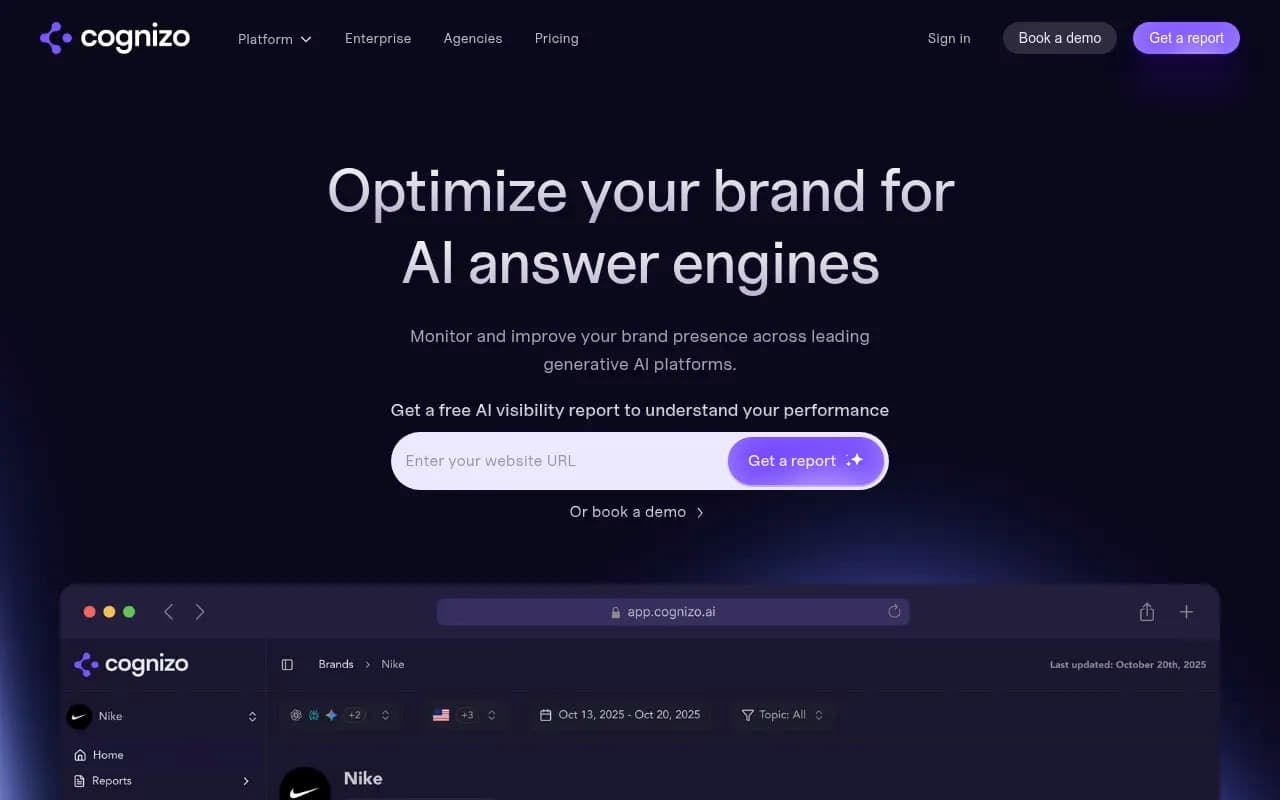
Cognizo is a pure Answer Engine Optimization (AEO) platform built for marketing teams who want to monitor and improve brand visibility in AI search engines. It tracks how ChatGPT, Perplexity, Gemini, and Google AI Overviews mention your brand, analyzes sentiment and citations, and helps you create content optimized for AI answers. The platform positions itself as a complete solution for the "new customer journey" where users ask AI for answers instead of clicking links.
Cognizo's core workflow: identify buyer questions, monitor your visibility and sentiment, generate AI-optimized content briefs, and measure AI-driven traffic to your site. It's designed for teams that want to treat AI search as a distinct channel with its own optimization playbook.
Atomic AGI
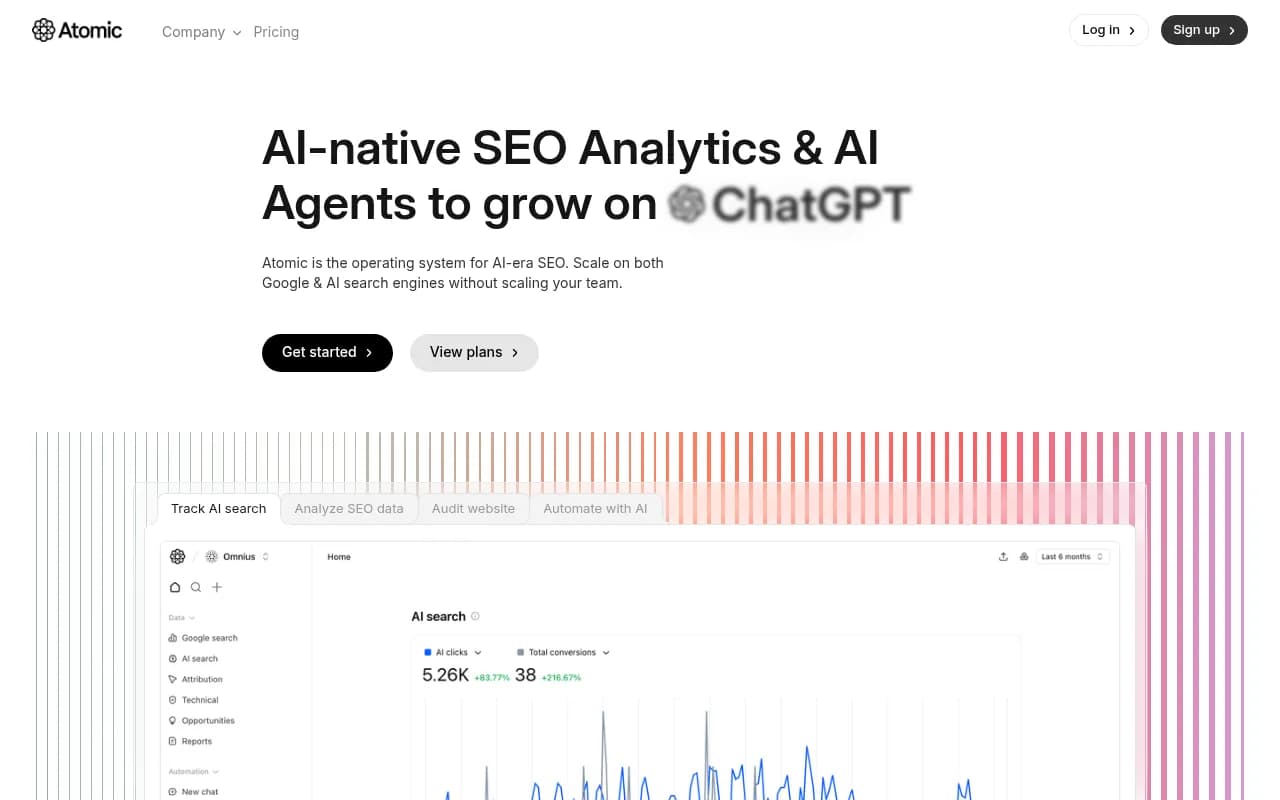
Atomic AGI takes a broader approach -- it's an all-in-one SEO platform that tracks both traditional Google search and AI search engines (ChatGPT, Perplexity, Gemini, Claude, Google AI Overviews). The pitch: you shouldn't need separate tools for Google SEO and AI search. Atomic combines deep analytics, technical site audits, rank tracking, and AI agents that automate repetitive SEO tasks.
Atomic's differentiator is workflow automation. Beyond showing you data, it includes AI agents that can execute tasks -- generating meta descriptions, fixing technical issues, building internal link structures, creating content outlines. It's built for teams that want to "scale organic growth without scaling headcount."
Side-by-Side Comparison
| Feature | Cognizo | Atomic AGI |
|---|---|---|
| Starting price | $300/mo (350 prompts) | $99/mo per domain |
| Free tier | No (free report only) | Yes (limited features) |
| AI engines tracked | ChatGPT, Perplexity, Gemini, Google AI Overviews | ChatGPT, Perplexity, Gemini, Claude, Google AI Overviews |
| Traditional SEO analytics | No | Yes (GSC integration, rank tracking, backlinks) |
| Technical site audits | No | Yes (crawling, Core Web Vitals, indexing issues) |
| Content creation | Automated brief generation | AI agents for outlines, meta descriptions, internal linking |
| Workflow automation | Content workflows | Multi-task AI agents (technical fixes, content, link building) |
| Sentiment analysis | Yes (AI mentions) | Not specified |
| Competitor tracking | Yes (AI visibility) | Yes (both Google and AI search) |
| AI traffic attribution | Yes (crawler logs, human traffic) | Yes (LLM referral tracking) |
| API access | Not specified | Yes |
| Team collaboration | Yes | Yes |
Platform focus and philosophy
Cognizo: AI search as a distinct channel
Cognizo treats AI search engines as a fundamentally different channel from traditional SEO. The platform is built around the idea that "customers today want answers, not links" -- so you need different content, different optimization tactics, and different metrics.
The interface is organized around answer engine insights: how often AI mentions your brand, what it says (sentiment), which competitors it recommends instead, and what questions you're missing. Content creation is central -- Cognizo analyzes millions of data points to generate briefs for articles that will get cited by AI models.
This focus means Cognizo doesn't try to be a traditional SEO tool. No rank tracking for Google keywords, no backlink analysis, no technical crawls. If you're doing Google SEO, you'll use Ahrefs or Semrush alongside Cognizo.
Atomic AGI: One platform for both worlds
Atomic AGI's philosophy is that Google and AI search aren't separate -- they're both organic channels you need to win. The platform bundles traditional SEO analytics (Google Search Console data, rank tracking, technical audits, backlink monitoring) with AI search tracking in one interface.
The bigger differentiator is automation. Atomic includes AI agents that don't just show you what's wrong -- they fix it. Need meta descriptions for 500 pages? The agent writes them. Internal linking structure broken? The agent builds a plan and can execute it. Content gaps vs competitors? The agent generates outlines.
This makes Atomic feel less like a monitoring dashboard and more like an operating system for SEO. The trade-off: it's more complex. Cognizo has a tighter, more focused interface because it does fewer things.
AI search tracking capabilities
Engine coverage
Cognizo tracks four AI engines: ChatGPT, Perplexity, Gemini, and Google AI Overviews. Atomic AGI tracks those same four plus Claude. Both platforms let you monitor how often your brand appears in AI responses, which pages get cited, and how you compare to competitors.
Neither platform currently tracks Meta AI, Grok, DeepSeek, or Mistral -- engines that Promptwatch covers if you need broader LLM monitoring.

Prompt libraries and question discovery
Cognizo emphasizes discovering "what billions of customers are asking AI." The platform surfaces buyer questions and shows you which ones you're visible for vs missing. This feeds directly into content brief generation.
Atomic AGI includes prompt tracking but positions it as one component of a broader analytics suite. The focus is less on question discovery and more on measuring performance across both Google queries and AI prompts.
Verdict: If your primary goal is understanding the AI search landscape and finding content gaps, Cognizo's question discovery feels more developed. If you want AI search data integrated with traditional keyword research, Atomic's unified view is cleaner.
Citation and sentiment analysis
Cognizo tracks not just whether you're mentioned but how -- positive, negative, or neutral sentiment in AI responses. You can see which competitors AI recommends alongside or instead of your brand.
Atomic AGI tracks citations and competitor mentions but doesn't explicitly highlight sentiment analysis as a core feature. The focus is more on traffic attribution and conversion tracking.
Verdict: Cognizo has a clearer edge on sentiment monitoring. If you're in reputation-sensitive industries (finance, healthcare, B2B SaaS), that matters.
Content creation and optimization
Cognizo's content workflow
Cognizo's content engine is built around automated brief generation. The platform analyzes AI responses, identifies gaps, and creates detailed content briefs designed to get your pages cited by AI models. You can see which topics have high impact, what type of content to create (owned vs earned), and track content through a workflow (researching → drafting → published).
The briefs are specific to AI optimization -- not generic SEO content. The goal is answers that AI models will pull from and cite, not just pages that rank in Google.
Atomic AGI's AI agents
Atomic AGI approaches content differently. Instead of generating briefs, it uses AI agents to automate specific tasks: writing meta descriptions, creating content outlines, building internal link structures, generating FAQ schema, fixing duplicate content issues.
The agents are task-specific and can execute changes, not just suggest them. For example, the internal linking agent can analyze your site structure, identify orphaned pages, and generate a linking plan with anchor text -- then you approve and it implements.
Verdict: Different philosophies. Cognizo is better if you want guided content creation workflows focused on AI search. Atomic AGI is better if you want automation across a wider range of SEO tasks (technical, on-page, content) for both Google and AI.
Traditional SEO capabilities
| Capability | Cognizo | Atomic AGI |
|---|---|---|
| Google rank tracking | ✗ | ✓ |
| Backlink analysis | ✗ | ✓ |
| Technical site audits | ✗ | ✓ (crawling, Core Web Vitals, indexability) |
| Google Search Console integration | ✗ | ✓ |
| Keyword research | ✗ | ✓ |
| Competitor SEO analysis | ✗ | ✓ |
This is the clearest difference. Cognizo doesn't do traditional SEO at all. If you need those capabilities, you'll pay for Ahrefs ($129/mo+), Semrush ($139/mo+), or another SEO suite on top of Cognizo's $300/mo.
Atomic AGI bundles everything. For $99/mo per domain, you get AI search tracking plus the full SEO analytics stack. If you're a small team or startup, that consolidation saves money and tool-switching headaches.
Traffic attribution and measurement
Cognizo's approach
Cognizo tracks two types of traffic: AI crawler activity (when ChatGPT, Perplexity, etc. crawl your site to gather information) and human traffic driven by AI recommendations. You can see which pages AI engines are reading and which pages are getting clicks from users who saw your brand in an AI answer.
This helps you connect AI visibility to actual business outcomes -- not just "we're mentioned more" but "AI mentions drove X visits and Y conversions."
Atomic AGI's approach
Atomic AGI tracks LLM referral traffic and attributes it to specific AI engines. The platform integrates with Google Analytics and can show you which AI search engines are driving traffic, what pages they're sending users to, and how that traffic converts.
The difference: Atomic also tracks traditional Google organic traffic in the same dashboard, so you can compare AI-driven traffic vs Google-driven traffic side-by-side.
Verdict: Both platforms handle AI traffic attribution. Atomic's advantage is the unified view across all organic channels. Cognizo's advantage is the focus on AI crawler behavior, which helps you understand how AI engines are discovering and using your content.
Pricing comparison
| Plan | Cognizo | Atomic AGI |
|---|---|---|
| Free tier | Free visibility report (one-time) | Yes (limited features, unclear limits) |
| Entry paid plan | $300/mo (Starter: 350 prompts, basic monitoring) | $99/mo per domain (includes AI + Google tracking, audits, agents) |
| Mid-tier | Not publicly listed | Not publicly listed |
| Enterprise | Custom pricing | Custom pricing |
| Annual discount | Not specified | Not specified |
Cognizo's $300/mo entry point is steep compared to Atomic's $99/mo. The question is whether Cognizo's AI-specific features justify the 3x price difference.
For a team that only cares about AI search and already has traditional SEO covered, Cognizo might make sense. For a team that needs both AI and Google analytics, Atomic AGI is dramatically cheaper -- you'd pay $300/mo for Cognizo plus another $129-$139/mo for Ahrefs or Semrush, vs $99/mo for Atomic all-in.
Neither platform lists detailed pricing tiers publicly, which suggests both expect you to book a demo and negotiate based on usage.
Workflow automation and AI agents
Cognizo's workflows
Cognizo's automation is content-focused. The platform identifies high-impact content opportunities, generates briefs, and tracks them through a workflow (research → draft → publish). You can see which pieces are in progress, assign tasks to team members, and measure impact after publication.
This is workflow management, not task automation. Cognizo doesn't write the content or make site changes -- it guides the process.
Atomic AGI's AI agents
Atomic AGI's agents actually execute tasks. Examples from their site:
- Meta description agent: analyzes pages missing descriptions, writes them based on content and target keywords, lets you approve and publish
- Internal linking agent: identifies orphaned pages, generates linking opportunities with anchor text, implements changes
- Content outline agent: analyzes top-ranking pages for a keyword, extracts common sections and topics, generates a competitive outline
- Technical SEO agent: crawls your site, identifies issues (broken links, slow pages, indexing problems), suggests fixes
These agents don't just tell you what to do -- they do it (with your approval). That's a different level of automation than Cognizo's content workflow tracking.
Verdict: If you want to automate repetitive SEO tasks (writing meta descriptions, fixing technical issues, building internal links), Atomic AGI's agents are a real time-saver. If you want guided content creation for AI search, Cognizo's workflows are more focused.
Integration and API access
Cognizo doesn't publicly list API access or integrations beyond basic traffic tracking. The platform appears to be a standalone tool.
Atomic AGI explicitly mentions API access and integrates with Google Search Console, Google Analytics, and other SEO data sources. This makes it easier to pull data into custom dashboards or connect to your existing marketing stack.
For agencies or larger teams that need to build custom reporting or automate data flows, Atomic's API is a clear advantage.
User interface and learning curve
Cognizo has a cleaner, more focused interface because it does fewer things. The dashboard is organized around AI answer engine insights, content opportunities, and traffic attribution. If you're new to AI search optimization, the narrower scope makes it easier to understand what you're looking at.
Atomic AGI's interface is more complex because it combines traditional SEO analytics with AI search tracking and automation tools. There's more to learn, more tabs to navigate, more data to interpret. The trade-off is power -- once you're up to speed, you can do more without switching tools.
Verdict: Cognizo is easier to onboard if you're focused purely on AI search. Atomic AGI has a steeper learning curve but rewards you with a more complete toolkit.
Pros and cons
Cognizo pros
- Laser focus on AI search optimization -- no feature bloat
- Strong content brief generation tied to AI citation data
- Sentiment analysis for brand mentions in AI responses
- Clear workflow tracking for content creation
- Designed specifically for the "AI answer" use case
Cognizo cons
- Expensive ($300/mo entry) compared to competitors
- No traditional SEO features -- you'll need a second tool for Google
- Tracks only 4 AI engines (missing Claude, Meta AI, Grok, DeepSeek)
- No API access mentioned
- No free tier (just a one-time report)
Atomic AGI pros
- Much cheaper ($99/mo vs $300/mo) for comparable AI tracking
- Bundles traditional SEO analytics (rank tracking, backlinks, audits) with AI search
- AI agents that automate tasks, not just suggest them
- Tracks 5 AI engines including Claude
- Free tier available
- API access for custom integrations
- One platform for both Google and AI search
Atomic AGI cons
- More complex interface -- steeper learning curve
- Less emphasis on content brief generation for AI search specifically
- Sentiment analysis not highlighted as a core feature
- Broader feature set means less depth in any single area
Who should pick Cognizo
Pick Cognizo if:
- You're a marketing team that wants to treat AI search as a dedicated channel with its own strategy
- You already have traditional SEO covered (Ahrefs, Semrush, etc.) and need a specialized AI search tool
- Content creation for AI citations is your primary goal
- You care deeply about sentiment analysis and how AI models talk about your brand
- You want a focused tool that does one thing well rather than a Swiss Army knife
- Budget isn't a constraint and you value specialization
Cognizo makes sense for larger marketing teams or agencies that can afford to add a specialized tool to their stack. If you're treating AI search as a strategic priority and want best-in-class content workflows for that channel, the $300/mo price is defensible.
Who should pick Atomic AGI
Pick Atomic AGI if:
- You're a small team or startup that needs both traditional SEO and AI search tracking in one platform
- You want to consolidate tools and reduce costs (one $99/mo platform vs multiple subscriptions)
- Workflow automation and AI agents appeal to you -- you want tasks executed, not just insights
- You need technical SEO audits, rank tracking, and backlink analysis alongside AI search monitoring
- You want API access for custom reporting or integrations
- You prefer a free tier to test before committing
Atomic AGI is the better value for teams that need comprehensive organic growth capabilities. The bundled approach saves money and reduces context-switching between tools. The automation features help smaller teams punch above their weight.
Final verdict
Cognizo and Atomic AGI solve different problems. Cognizo is a specialist -- it does AI search optimization deeply and expects you to handle Google SEO elsewhere. Atomic AGI is a generalist -- it covers both Google and AI search in one platform with a focus on automation.
The decision comes down to your team's needs and budget. If you're a well-funded marketing team that wants best-in-class AI search content workflows and already pays for Ahrefs or Semrush, Cognizo's focus is worth the premium. If you're a smaller team that needs to cover all organic channels without multiple subscriptions, Atomic AGI delivers more value per dollar.
For most teams, Atomic AGI's $99/mo all-in-one approach beats paying $300/mo for Cognizo plus another $129-$139/mo for traditional SEO tools. The 3x price difference is hard to justify unless AI search is your only priority.