Key Takeaways
- Pricing gap is massive: Ceyo starts at $49/mo while Cognizo starts at $300/mo -- that's a 6x difference for entry-level plans
- Cognizo includes content creation: Built-in AI content generation and optimization tools; Ceyo is monitoring-only
- Ceyo covers more AI models: Tracks ChatGPT, Gemini, Claude, and Perplexity; Cognizo adds Google AI Overviews but the core set is similar
- Prompt volume differs significantly: Cognizo's Starter plan includes 350 prompts; Ceyo's Core plan details aren't public but pricing suggests a smaller allocation
- Content workflow is the dividing line: If you need help creating AI-optimized content, Cognizo justifies the premium. If you just want visibility data, Ceyo's price is hard to beat.
- Both lack advanced features: Neither platform offers AI crawler logs, Reddit/YouTube tracking, or ChatGPT Shopping monitoring that more comprehensive platforms provide
Overview
Cognizo
Cognizo
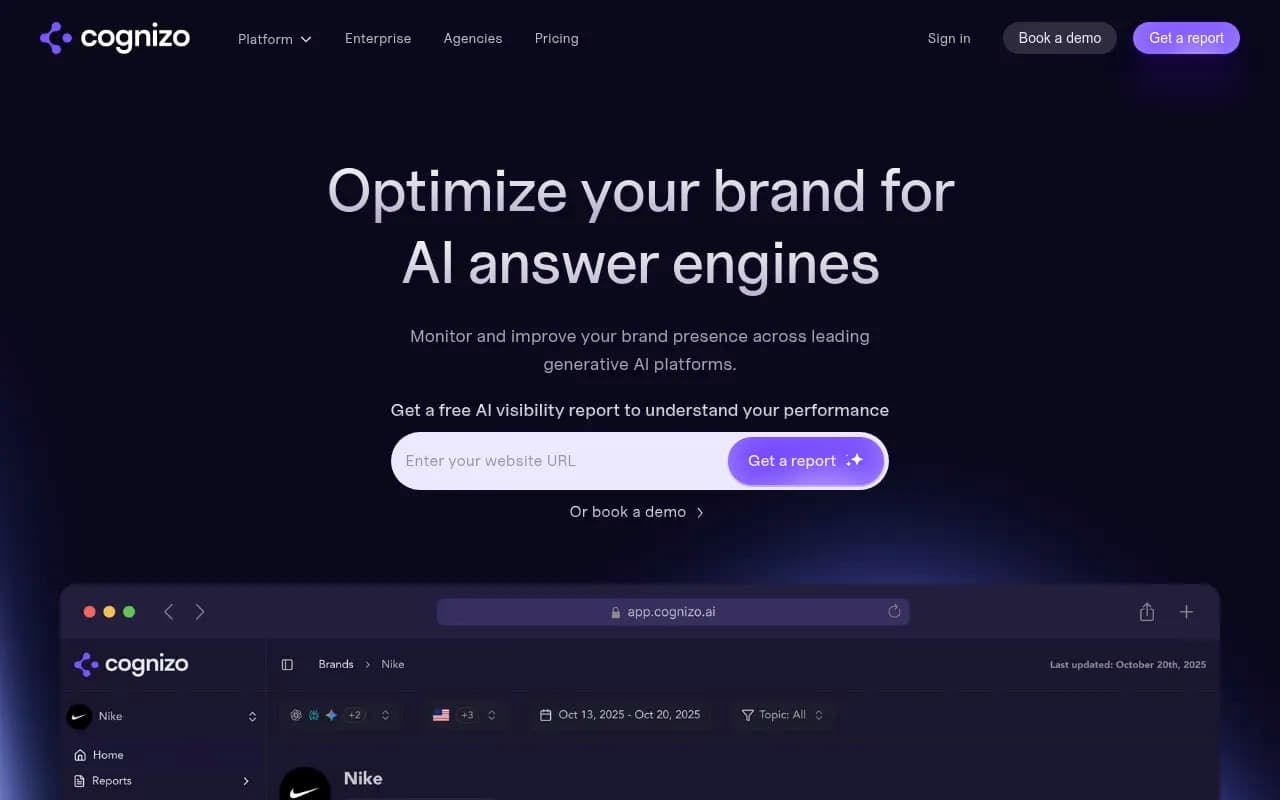
Cognizo positions itself as a complete Answer Engine Optimization (AEO) platform. Beyond tracking how your brand shows up in AI responses, it includes content creation tools that generate AI-optimized articles based on visibility gaps. The platform monitors ChatGPT, Perplexity, Gemini, and Google AI Overviews, with a focus on turning insights into action through automated content workflows. Pricing starts at $300/mo for 350 prompts and basic monitoring.
Ceyo
Ceyo
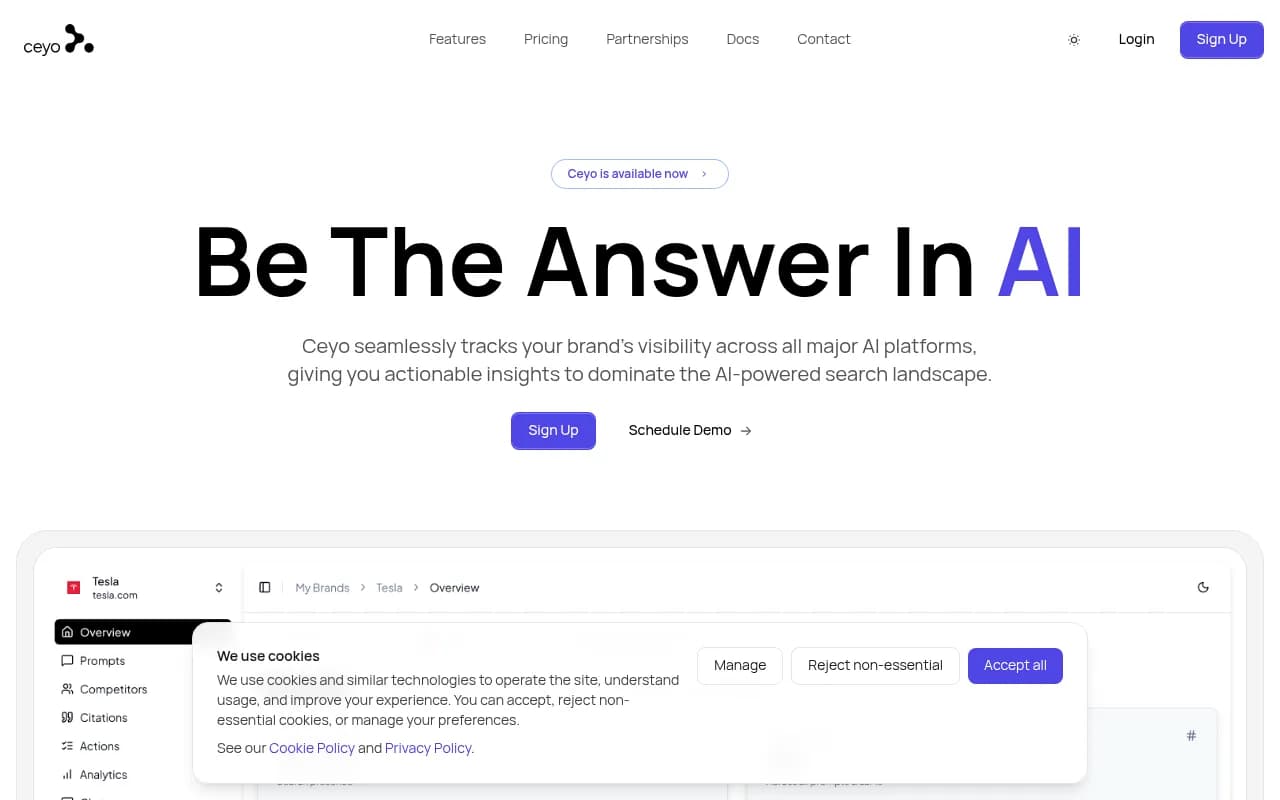
Ceyo takes a simpler approach: track your brand's visibility across ChatGPT, Gemini, Claude, and Perplexity without the content generation layer. The platform emphasizes prompt analytics, sentiment tracking, and competitor comparisons. At $49/mo for the Core plan, it's positioned as an affordable entry point for brands that want AI visibility data but plan to handle content optimization separately.
Side-by-Side Comparison
| Feature | Cognizo | Ceyo |
|---|---|---|
| Starting price | $300/mo | $49/mo |
| Free trial | Yes | Not specified |
| AI models tracked | ChatGPT, Perplexity, Gemini, Google AI Overviews | ChatGPT, Gemini, Claude, Perplexity |
| Prompts included (starter) | 350 | Not disclosed |
| Content generation | ✓ Built-in AI writer | ✗ Monitoring only |
| Sentiment analysis | ✓ | ✓ |
| Competitor tracking | ✓ | ✓ |
| Citation tracking | ✓ | ✓ |
| AI traffic measurement | ✓ Tracks AI-driven site visits | ✗ Not mentioned |
| Content optimization | ✓ Automated workflows | ✗ |
| Multi-language support | Not specified | Not specified |
| API access | Not specified | Not specified |
Pricing comparison
| Plan | Cognizo | Ceyo |
|---|---|---|
| Entry tier | $300/mo (Starter, 350 prompts) | $49/mo (Core) |
| Mid tier | Not disclosed | Standard (price not public) |
| Enterprise | Custom pricing | Custom pricing |
| Annual discount | Not specified | Available |
| Free trial | Yes | Not specified |
The pricing difference is the first thing you'll notice. Cognizo's $300/mo entry point is 6x higher than Ceyo's $49/mo. That premium buys you content creation tools and AI traffic measurement -- features Ceyo doesn't offer. If you're a small team just starting to track AI visibility, Ceyo's price is easier to justify. If you need help creating content that actually improves your visibility, Cognizo's higher cost might pay for itself.
Feature deep-dive
Monitoring capabilities
Both platforms cover the core AI models that matter: ChatGPT, Perplexity, and Gemini. Cognizo adds Google AI Overviews, which is useful if you're tracking traditional Google search alongside AI search. Ceyo includes Claude, which Cognizo doesn't explicitly mention.
Neither platform tracks newer models like DeepSeek, Grok, or Meta AI. Neither offers AI crawler log analysis to see when AI bots visit your website. If you need comprehensive multi-model tracking or want to monitor AI crawlers hitting your site, both platforms fall short -- you'd need something like Promptwatch for that level of coverage.

Verdict: Tie. Both cover the major models with minor differences in coverage.
Prompt analytics and insights
Cognizo's Starter plan includes 350 prompts. The platform shows visibility percentages, sentiment, citations, and competitor mentions for each prompt. You can see which queries drive your brand's presence and where you're missing entirely.
Ceyo's interface (based on their website screenshots) shows similar metrics: visibility percentage, sentiment, average position, impact level, and competing brands. The table view looks clean and scannable. Prompt volume for the $49/mo plan isn't disclosed, which makes it hard to compare directly.
Both platforms lack prompt volume estimates and difficulty scoring -- features that help you prioritize which prompts are actually worth optimizing for. You're flying blind on whether a prompt gets 100 searches per month or 100,000.
Verdict: Cognizo wins on transparency (you know you're getting 350 prompts). Ceyo's lack of disclosed limits is a red flag.
Content creation and optimization
This is where the platforms diverge completely.
Cognizo includes an AI content writer that generates articles optimized for AI search engines. The workflow: identify visibility gaps → generate content briefs → draft AI-optimized content → publish. The platform automates this loop, which is the main justification for the $300/mo price tag. You're not just monitoring -- you're creating content that should improve your visibility scores.
Ceyo offers none of this. It's a monitoring dashboard. You get the data, then you're on your own to create content. For some teams, that's fine -- you already have writers or an agency. For others, it's a gap.
Neither platform matches the depth of content gap analysis you'd get from a platform like Promptwatch, which shows exactly which prompts competitors rank for but you don't, then generates content grounded in 880M+ citations analyzed. But Cognizo at least attempts to close the loop from insight to action.
Verdict: Cognizo wins if you need content help. Ceyo wins if you don't and just want cheap monitoring.
Traffic attribution and measurement
Cognizo explicitly mentions measuring "AI-driven traffic" -- tracking how AI interactions with your site translate to human visitors. This is critical for proving ROI. If you can't connect visibility improvements to actual traffic or revenue, you're optimizing in the dark.
Ceyo doesn't mention traffic attribution at all. You can see your visibility scores change, but you won't know if that's driving real business outcomes.
For proper traffic attribution (code snippet, Google Search Console integration, or server log analysis), you'd need a more advanced platform. But Cognizo at least acknowledges this matters.
Verdict: Cognizo wins. Traffic measurement is table stakes for proving ROI.
Competitor analysis
Both platforms show which competitors appear alongside your brand in AI responses. Ceyo's interface shows brand logos and names for each prompt. Cognizo offers similar competitor visibility tracking.
Neither platform offers competitor heatmaps (visual comparisons of your visibility vs competitors across all prompts) or detailed competitor content analysis. You can see who's mentioned, but not why they're winning or what content they have that you don't.
Verdict: Tie. Both offer basic competitor tracking without deep analysis.
Sentiment tracking
Both platforms track sentiment (positive, neutral, negative) for brand mentions. This is useful for reputation monitoring -- if AI models are saying negative things about your brand, you need to know.
Neither platform offers sentiment trend analysis over time or alerts when sentiment shifts dramatically. The data is there, but the actionability is limited.
Verdict: Tie. Both check the sentiment box without going deeper.
User interface and ease of use
Ceyo's screenshots show a clean, table-based interface. Prompt data is presented in rows with clear columns for visibility, sentiment, impact, and competing brands. It looks straightforward -- you could onboard a team member in minutes.
Cognizo's dashboard (from their website) shows a more complex interface with content workflow stages, brief generation, and drafting tools. More features means more complexity. The learning curve is steeper, but you're getting more functionality.
Verdict: Ceyo wins for simplicity. Cognizo wins for power users who need content tools.
Support and documentation
Neither platform publicly shares details about support channels, response times, or documentation quality. Cognizo offers a free trial and demo bookings, which suggests some level of onboarding support. Ceyo offers demo scheduling but doesn't mention a free trial.
Without user reviews or public support documentation, this is hard to evaluate.
Verdict: Insufficient data to compare.
Pros and cons
Cognizo pros
- Built-in content generation saves time and potentially justifies the higher price
- Tracks AI-driven traffic to prove ROI
- 350 prompts included in Starter plan (transparent limits)
- Free trial available to test before committing
- Covers Google AI Overviews in addition to core AI models
Cognizo cons
- $300/mo starting price is steep for small teams or individuals
- No AI crawler logs or Reddit/YouTube tracking
- Doesn't track newer models like DeepSeek, Grok, or Meta AI
- Content quality depends on the AI writer -- may still need human editing
- Higher tiers and pricing not publicly disclosed
Ceyo pros
- $49/mo entry price is accessible for bootstrapped teams
- Clean, simple interface focused on core metrics
- Tracks Claude (which Cognizo doesn't explicitly mention)
- Annual billing option for additional savings
- Lower commitment for teams just exploring AI visibility
Ceyo cons
- Monitoring-only -- no content creation or optimization tools
- Prompt limits not disclosed for Core plan
- No traffic attribution or ROI measurement
- Missing advanced features like crawler logs, Reddit tracking, ChatGPT Shopping
- Free trial availability unclear
- Limited public information about support and documentation
Who should pick which tool
Choose Cognizo if:
- You need help creating AI-optimized content, not just monitoring data
- You have budget ($300+/mo) and want an all-in-one platform
- Tracking AI-driven traffic and proving ROI matters to your team
- You're willing to invest in a platform that attempts to close the loop from insight to action
- You want transparent prompt limits (350 included in Starter)
Choose Ceyo if:
- You're on a tight budget and $49/mo is your ceiling
- You already have content creation handled (in-house writers or agency)
- You just need visibility data and competitor tracking
- You prefer a simple, focused tool over a complex platform
- You want to track Claude specifically
Consider alternatives if:
- You need comprehensive AI model coverage (10+ models including DeepSeek, Grok, Meta AI)
- You want AI crawler logs to see when bots visit your site
- You need Reddit and YouTube tracking (where AI models source recommendations)
- You want prompt volume estimates and difficulty scoring to prioritize efforts
- You need deep content gap analysis showing exactly what competitors have that you don't
For teams serious about AI visibility who need the full stack -- monitoring, content gap analysis, AI-optimized content generation, crawler logs, and traffic attribution -- platforms like Promptwatch offer more comprehensive coverage at competitive pricing ($99-$579/mo depending on scale).
Final verdict
Cognizo and Ceyo serve different audiences. Ceyo is the budget-friendly monitoring dashboard for teams that just want visibility data. Cognizo is the premium platform for teams that need content creation baked in.
The 6x price difference ($49 vs $300) is justified only if you'll actually use Cognizo's content generation tools. If you're just going to look at the data and create content separately anyway, paying $300/mo for features you won't use is wasteful. Ceyo gives you 80% of the monitoring value at 16% of the cost.
But if you're a small team without dedicated content resources, Cognizo's AI writer could save you 10-20 hours per month. At that point, the $250/mo premium pays for itself.
The real question: do either of these platforms give you enough to actually move the needle on AI visibility? Both lack advanced features (crawler logs, Reddit/YouTube tracking, prompt intelligence, deep content gap analysis) that separate monitoring from optimization. You'll get data, but you might still struggle to turn that data into meaningful improvements.
Bottom line: Ceyo wins on price. Cognizo wins on features. Neither is a complete AI visibility solution, but both are solid starting points depending on your budget and whether you need content help.