Key Takeaways
- GeoGen is AI-only, Nightwatch is SEO-first: GeoGen focuses exclusively on tracking visibility in ChatGPT, Perplexity, Gemini, and other AI engines. Nightwatch is a traditional rank tracker that added AI monitoring as a secondary feature.
- Pricing is comparable at entry level: GeoGen starts at €20/mo, Nightwatch at $24/mo. Both offer annual discounts (20% for GeoGen, unspecified for Nightwatch).
- Nightwatch has broader search coverage: If you need both traditional Google/Bing rank tracking AND AI visibility monitoring in one platform, Nightwatch is the only option here.
- GeoGen has more AI-specific features: Purpose-built for GEO with competitor analysis, brand mention tracking, and optimization recommendations tailored to AI engines.
- Nightwatch offers real-time rank updates: Their "high-frequency" tracking refreshes critical keywords on demand, which GeoGen doesn't advertise.
- Free trial availability: Nightwatch has a 14-day trial; GeoGen doesn't clearly advertise one but offers demos.
Overview: Two different approaches to AI visibility
GeoGen: Pure-play GEO platform
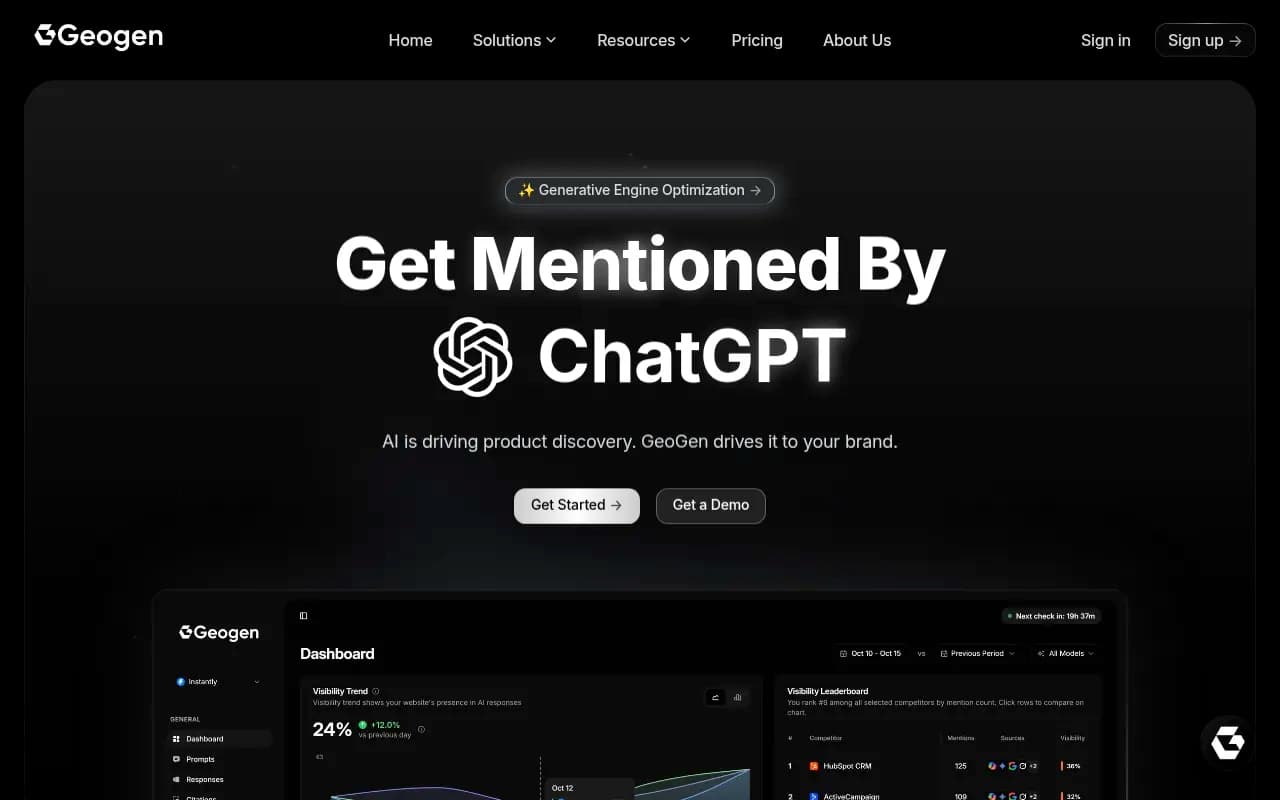
GeoGen positions itself as a dedicated Generative Engine Optimization platform. It tracks how your brand appears in responses from ChatGPT, Perplexity, Gemini, Grok, and Microsoft Copilot. The focus is narrow: no traditional SEO, no Google rank tracking -- just AI search engines. You get brand mention monitoring, competitor rankings in AI responses, and recommendations to improve your visibility in LLM outputs. The interface is clean and the pricing starts low (€20/mo for the Micro plan), making it accessible for small brands dipping their toes into AI visibility.
The platform is best for companies that care specifically about how they show up when people ask ChatGPT or Perplexity for recommendations. If you're a SaaS tool, a local business, or a brand that gets discovered through conversational search, GeoGen gives you the data to see where you're mentioned and where you're invisible.
Nightwatch: SEO tracker with AI add-on
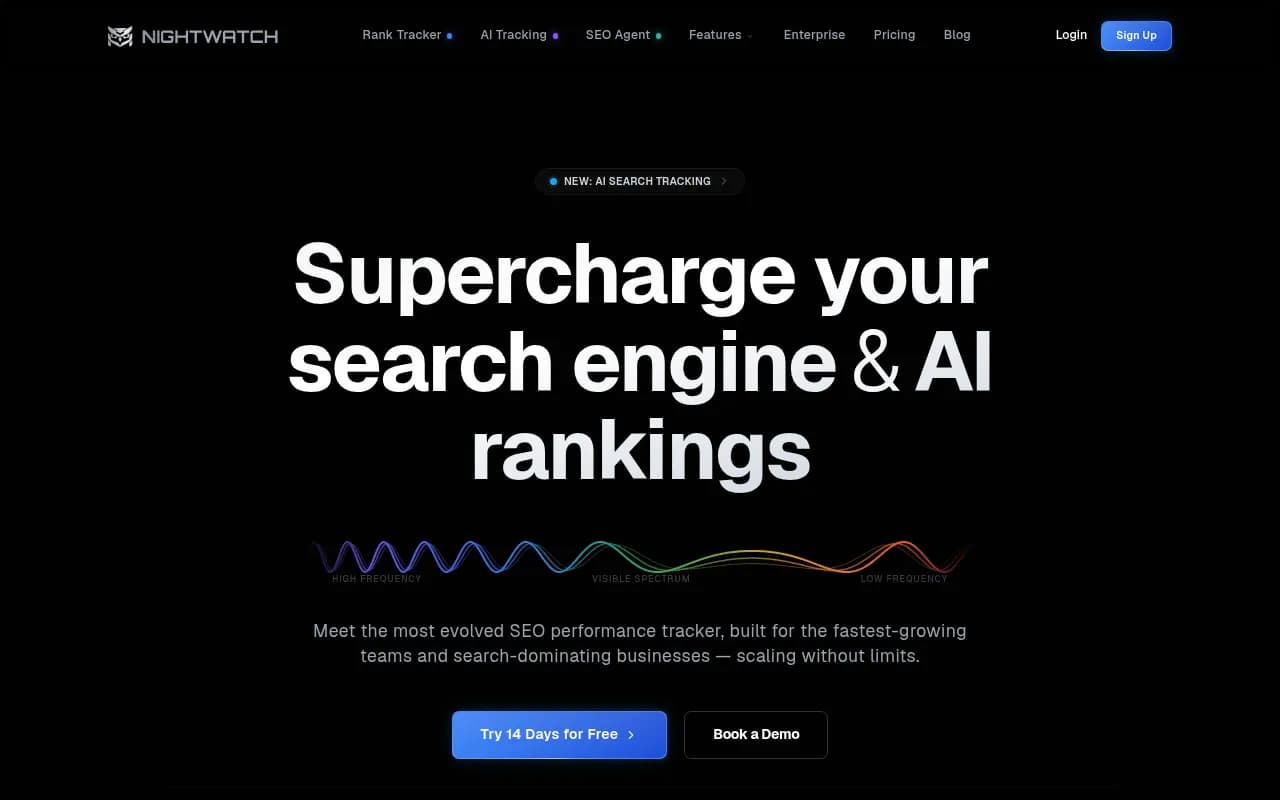
Nightwatch is a full-featured SEO rank tracker that's been around for years. It tracks Google, Bing, Yahoo, DuckDuckGo rankings with high precision (107,000+ locations, real-time updates, accurate local tracking). In 2025-2026, they added AI tracking to cover ChatGPT, Gemini, Claude, and Perplexity. The pitch is "complete SEO spectrum coverage" -- one platform for both traditional search rankings and the new wave of AI visibility.
The AI tracking feels like an extension of their core product rather than the main event. You get unified dashboards that show your Google rankings alongside your AI mentions, which is useful if you're running a comprehensive search strategy. Nightwatch also includes site audits, keyword research, Looker Studio integration, and an "SEO Agent" for workflow automation. It's a broader toolkit, but the AI piece is less specialized than GeoGen's.
Side-by-side comparison
| Feature | GeoGen | Nightwatch |
|---|---|---|
| Primary focus | AI search engines only | Traditional SEO + AI add-on |
| AI engines tracked | ChatGPT, Perplexity, Gemini, Grok, Copilot | ChatGPT, Gemini, Claude, Perplexity |
| Traditional search tracking | ❌ None | ✅ Google, Bing, Yahoo, DuckDuckGo |
| Starting price | €20/mo (Micro) | $24/mo (Starter) |
| Free trial | Not advertised (demo available) | ✅ 14 days |
| Annual discount | 20% | Available (amount not specified) |
| Competitor analysis | ✅ AI competitor rankings | ✅ Traditional + AI competitors |
| Real-time updates | Not advertised | ✅ On-demand keyword refresh |
| Site audit | ❌ | ✅ |
| Keyword research | ❌ | ✅ |
| Prompt research | Not specified | ✅ |
| Reporting integrations | Not specified | ✅ Looker Studio |
| Target audience | Small-mid brands focused on AI visibility | SEO teams needing unified search + AI tracking |
Head-to-head feature breakdown
AI engine coverage
GeoGen explicitly tracks ChatGPT, Perplexity, Gemini, Grok, and Microsoft Copilot. That's five AI engines with a focus on the ones driving product discovery and brand recommendations.
Nightwatch covers ChatGPT, Gemini, Claude, and Perplexity. Four engines, but notably includes Claude (which GeoGen doesn't list) and skips Grok and Copilot. The coverage is solid but feels like it's playing catch-up to pure GEO platforms.
Verdict: GeoGen has slightly broader AI coverage with Grok and Copilot. Nightwatch includes Claude, which is a meaningful addition. If you care about Copilot (important for enterprise users), GeoGen wins. If Claude visibility matters (growing in developer/technical audiences), Nightwatch has you covered.
Traditional search tracking
GeoGen doesn't do this at all. It's not in their scope.
Nightwatch is built for it. You get accurate daily rankings across Google, Bing, Yahoo, and DuckDuckGo, with 107,000+ location options (down to zip code level). Real-time updates let you refresh critical keywords on demand. This is their bread and butter.
Verdict: If you need traditional SEO rank tracking, Nightwatch is the only choice here. GeoGen is irrelevant for this use case.
Brand mention tracking in AI responses
GeoGen's core feature. You see where your brand is mentioned in AI-generated responses, how you rank against competitors, and get recommendations to improve visibility. The interface is designed around this workflow.
Nightwatch has added AI tracking but it's integrated into their broader SEO dashboard. You can see AI performance metrics alongside traditional rankings, which is useful for unified reporting but less specialized.
Verdict: GeoGen is more purpose-built for this. If your primary goal is understanding and improving AI brand mentions, GeoGen's focus gives it an edge. Nightwatch is better if you want AI data as part of a larger SEO picture.
Competitor analysis
GeoGen includes competitor rankings in AI responses. You can see which brands are being recommended instead of yours and where you're losing visibility.
Nightwatch offers competitor tracking across both traditional search and AI engines. You get a broader view of competitive positioning.
Verdict: Nightwatch has more comprehensive competitor analysis if you care about traditional search. GeoGen's competitor features are narrower but more focused on the AI visibility question.
Reporting and integrations
GeoGen's reporting capabilities aren't detailed on their website. The focus seems to be on in-app dashboards.
Nightwatch has robust reporting with Looker Studio integration, custom dashboards, and automated reports. You can pull data into your existing analytics stack.
Verdict: Nightwatch wins on reporting flexibility and integrations. GeoGen may have solid dashboards but doesn't advertise the same level of export/integration options.
Ease of use and onboarding
GeoGen's website and positioning suggest a simpler, more focused tool. Fewer features means less complexity.
Nightwatch is a full SEO suite with site audits, keyword research, rank tracking, AI monitoring, and more. More powerful but steeper learning curve.
Verdict: GeoGen is likely easier to get started with if you just want AI visibility tracking. Nightwatch requires more setup but gives you more tools.
Real-time and on-demand tracking
GeoGen doesn't advertise real-time or on-demand updates. Likely runs on a scheduled refresh cycle.
Nightwatch explicitly offers real-time updates and on-demand keyword refreshes. You can check critical keywords instantly when you need fresh data.
Verdict: Nightwatch has a clear advantage here. Real-time tracking is valuable when you're monitoring the impact of content changes or PR events.
Additional SEO features
GeoGen: None. It's AI visibility only.
Nightwatch: Site audit, keyword research, prompt research, search simulator, SEO Agent (workflow automation). It's a full SEO platform.
Verdict: Nightwatch is the obvious choice if you need a comprehensive SEO toolkit. GeoGen is a single-purpose tool.
Pricing comparison
| Plan | GeoGen | Nightwatch |
|---|---|---|
| Entry tier | €20/mo (Micro) | $24/mo (Starter) |
| Mid tier | Not specified on website | $59/mo (Optimize) |
| High tier | €399/mo (Pro) | Custom (Enterprise) |
| Annual discount | 20% | Available |
| Free trial | Not advertised | 14 days |
| Custom enterprise | ✅ Available | ✅ Available |
GeoGen's pricing is slightly lower at the entry level (€20 vs $24), but the gap is minimal. Both platforms offer custom enterprise pricing for larger teams. Nightwatch's 14-day free trial is a meaningful advantage for testing before committing.
The bigger question is what you get at each tier. GeoGen's tiers likely scale on number of prompts tracked, competitors monitored, and AI engines covered. Nightwatch's tiers scale on keywords tracked, sites monitored, and feature access (AI tracking may be gated to higher tiers -- their website doesn't specify).
Pros and cons
GeoGen pros
- Laser-focused on AI search visibility -- no feature bloat
- Covers Grok and Copilot, which some competitors skip
- Lower entry price (€20/mo)
- Purpose-built interface for GEO workflows
- Good for small-mid brands that only care about AI mentions
GeoGen cons
- No traditional SEO tracking at all
- Limited reporting/integration options advertised
- No free trial clearly advertised
- Smaller feature set overall
- Less mature platform (newer entrant)
Nightwatch pros
- Unified platform for traditional SEO + AI tracking
- Real-time, on-demand keyword updates
- 14-day free trial to test before buying
- Robust reporting with Looker Studio integration
- Includes site audit, keyword research, prompt research
- 107,000+ location tracking for local SEO
- Mature platform with established user base
Nightwatch cons
- AI tracking feels like an add-on, not the core product
- Doesn't track Grok or Copilot (yet)
- More complex interface due to broader feature set
- Higher learning curve for teams that only want AI visibility
- Pricing for AI-only use case may not be competitive
Who should pick which tool
Choose GeoGen if:
- You only care about AI search visibility and don't need traditional SEO tracking
- You want a simple, focused tool without extra features
- You're a small brand or startup testing AI visibility for the first time
- Tracking Grok or Copilot is important for your audience
- You prefer a lower entry price and don't mind skipping a free trial
Choose Nightwatch if:
- You need both traditional Google/Bing rank tracking AND AI visibility in one platform
- You want real-time, on-demand keyword updates
- You need robust reporting and integrations (Looker Studio, etc.)
- You're running a comprehensive SEO strategy and want AI data as part of it
- You want to test with a free trial before committing
- You need site audits, keyword research, and other SEO tools alongside tracking
Consider Promptwatch if: You want to go beyond monitoring and actually optimize your AI visibility with content gap analysis, AI-generated articles, and crawler log insights. Promptwatch tracks 10 AI engines (including all the ones GeoGen and Nightwatch cover), but the real difference is the action loop -- it shows you what content is missing, helps you create it, and tracks the results. Worth exploring if you're serious about improving AI search rankings, not just watching them.

Final verdict
Nightwatch is the better choice for most teams because it gives you both traditional SEO and AI tracking in one platform. The real-time updates, free trial, and mature feature set make it a safer bet. If you're already doing SEO and want to add AI visibility monitoring, Nightwatch is the obvious pick.
GeoGen makes sense for a narrow use case: small brands or startups that only care about AI mentions and want the simplest possible tool. The lower price and AI-only focus are appealing, but you're giving up a lot of flexibility and features.
For serious AI visibility optimization, both platforms are monitoring-only solutions. They show you the data but don't help you fix the gaps. That's where platforms like Promptwatch come in -- showing you what's missing and helping you create content that actually ranks in AI search results. But if you just need basic tracking, Nightwatch's unified approach beats GeoGen's narrow scope for most use cases.