Key Takeaways
- Orchly costs more but does more: GeoGen starts at €20/mo for basic tracking; Orchly starts at $49/mo but includes AI content agents that write and publish optimized articles automatically
- GeoGen is monitoring-focused: You get visibility dashboards and recommendations, but you're on your own for creating content. Orchly closes the loop with automated content creation and publishing.
- Model coverage differs slightly: Both track ChatGPT, Perplexity, and Gemini. Orchly adds Claude; GeoGen mentions Grok and Copilot. Neither matches enterprise platforms covering 10+ models.
- Orchly handles traditional SEO too: It tracks Google organic rankings alongside AI search visibility. GeoGen is purely AI-focused (GEO).
- Free trial advantage: Orchly offers 14 days free; GeoGen doesn't mention a trial period on their site.
- Best for different needs: Pick GeoGen if you just want affordable AI mention tracking. Pick Orchly if you want tracking + content automation in one platform.
Overview: Two approaches to AI visibility
Both GeoGen and Orchly help brands track how they show up in AI search engines like ChatGPT and Perplexity. The core difference: GeoGen is a monitoring dashboard that tells you where you stand. Orchly is a content operations platform that monitors visibility and helps you create the content to improve it.
GeoGen: AI visibility tracking
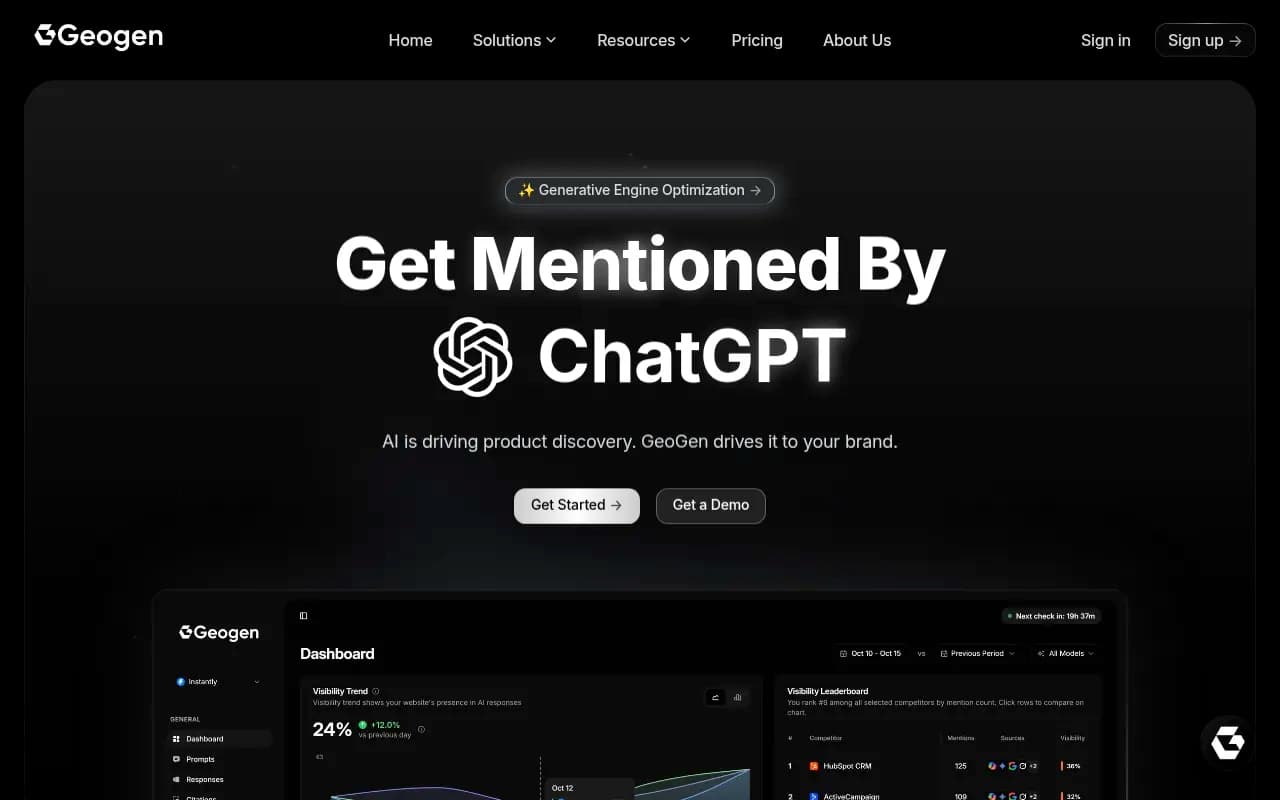
GeoGen positions itself as a Generative Engine Optimization (GEO) platform. You connect your brand, define queries, and GeoGen tracks whether ChatGPT, Gemini, Perplexity, Grok, and Microsoft Copilot mention you. The dashboard shows competitor rankings and gives recommendations to improve your AI search presence. It's built for small to mid-sized brands that want to understand their AI visibility without a massive budget.
Pricing runs from €20/mo (Micro) to €399/mo (Pro), with custom enterprise options. Annual billing gets you 20% off.
Orchly: AI visibility + content automation

Orchly takes a broader swing. It tracks AI search visibility across ChatGPT, Claude, Perplexity, and Google AI products -- but it also tracks traditional Google organic rankings. The bigger difference: Orchly includes AI content agents that research, write, optimize, and publish SEO/AEO-ready articles on autopilot (with human oversight). You're not just monitoring; you're actively creating content designed to rank.
Pricing starts at $49/mo (Essential) and goes to $125/mo (Pro), with enterprise custom pricing. You get a 14-day free trial and 25% off annual plans.
Side-by-side comparison
| Feature | GeoGen | Orchly |
|---|---|---|
| Starting price | €20/mo (Micro) | $49/mo (Essential) |
| Free trial | Not mentioned | 14 days |
| Annual discount | 20% | 25% |
| AI models tracked | ChatGPT, Gemini, Perplexity, Grok, Copilot | ChatGPT, Claude, Perplexity, Gemini, Google AI |
| Google SEO tracking | No (AI-only) | Yes |
| Content generation | No | Yes (AI agents) |
| Auto-publishing | No | Yes |
| Competitor analysis | Yes | Yes |
| Technical SEO fixes | No | Yes |
| Structured data optimization | Not mentioned | Yes |
| White-label reports | Not mentioned | Yes |
| Target audience | Small-mid brands, basic tracking | Marketing teams, content ops |
Pricing breakdown
| Plan | GeoGen | Orchly |
|---|---|---|
| Entry tier | €20/mo (Micro) | $49/mo (Essential) |
| Mid tier | Not specified | $125/mo (Pro) |
| Top tier | €399/mo (Pro) | Custom (Enterprise) |
| Free trial | None listed | 14 days |
| Annual savings | 20% | 25% |
GeoGen is cheaper upfront if you just want basic AI visibility tracking. Orchly costs more but bundles content creation and SEO tracking into the price.
AI model coverage
GeoGen explicitly lists ChatGPT, Gemini, Perplexity, Grok, and Microsoft Copilot. That's five models, covering the major consumer-facing AI search engines.
Orchly mentions ChatGPT, Claude, Perplexity, Gemini, and "Google AI products" (likely AI Overviews). That's also around five models, with Claude being the standout addition.
Neither platform appears to track the full range of 10+ models that enterprise tools monitor (DeepSeek, Mistral, Meta AI, etc.). If you need exhaustive coverage across every LLM, you'll want something more comprehensive -- tools like Promptwatch track 10 different AI models and offer deeper optimization features like crawler logs and content gap analysis.

Verdict: Roughly tied on model count. GeoGen has Grok and Copilot; Orchly has Claude. Pick based on which models matter most to your audience.
Content creation and optimization
This is where the platforms diverge sharply.
GeoGen gives you visibility data and recommendations. You see where you're mentioned, where competitors rank, and what you should improve. But you're on your own to actually create or update content. It's a monitoring tool, not a content tool.
Orchly includes AI content agents that handle research, writing, refreshing, and publishing. The platform analyzes SEO and AEO opportunities, then generates structured, factual content trained on your data (not generic AI filler). You can auto-schedule publishing or keep a human in the loop. It also optimizes existing content with structured data, NLP keywords, internal/external links, and rich formatting.
Orchly's content engine covers 150+ optimization factors and handles technical SEO fixes (crawl issues, schema gaps, indexing). GeoGen doesn't touch any of this.
Verdict: Orchly wins decisively if content creation matters. GeoGen is purely a tracker.
Traditional SEO vs AI-only focus
GeoGen is laser-focused on Generative Engine Optimization (GEO). You track AI search engines, period. No Google organic rankings, no traditional SEO metrics.
Orchly tracks both Google organic visibility and AI search visibility in one dashboard. You see how you rank in traditional search results alongside how AI models cite you. The platform also handles technical SEO (crawl errors, schema, indexing) and on-page optimization.
If you care about traditional SEO at all, Orchly is the only option here. If you're purely focused on AI search and don't want SEO noise, GeoGen's narrow focus might feel cleaner.
Verdict: Orchly for teams managing both SEO and AEO. GeoGen for AI-only tracking.
Competitor analysis and benchmarking
Both platforms let you track competitors. GeoGen shows competitor rankings in AI search results so you can benchmark your visibility. Orchly does the same, with real-time AI visibility comparisons.
Neither platform appears to offer the depth of competitor analysis you'd get from tools that show exactly which pages competitors get cited for, or which Reddit threads and YouTube videos influence AI recommendations. That level of granularity requires more advanced platforms.
Verdict: Tied. Both offer basic competitor benchmarking.
Reporting and white-label features
Orchly explicitly mentions white-label reports and shareable audits. If you're an agency or need client-facing deliverables, that's built in.
GeoGen doesn't mention white-label reporting on their site. You get dashboards for internal use, but it's unclear if you can rebrand reports for clients.
Verdict: Orchly wins for agencies and client reporting.
Ease of use and setup
Both platforms are SaaS tools with web dashboards. GeoGen's interface (based on screenshots) looks clean and focused -- you define queries, connect your brand, and start tracking. It's straightforward if you just want visibility data.
Orchly has more moving parts because it handles content creation, SEO tracking, and AI visibility in one platform. The learning curve is steeper, but you get more functionality. The "Action Center" tries to surface what you should focus on next, which helps cut through the complexity.
Verdict: GeoGen is simpler. Orchly is more powerful but requires more setup.
Pros and cons
GeoGen pros
- Cheapest entry point (€20/mo)
- Focused purely on AI search visibility (no feature bloat)
- Tracks Grok and Copilot (models Orchly doesn't mention)
- Clean, straightforward interface
GeoGen cons
- No content creation or optimization tools
- No traditional SEO tracking
- No free trial mentioned
- Smaller annual discount (20% vs 25%)
- Limited to monitoring -- you have to fix things yourself
Orchly pros
- AI content agents write and publish optimized articles automatically
- Tracks both Google SEO and AI search visibility
- 14-day free trial
- White-label reporting for agencies
- Technical SEO fixes and 150+ optimization factors
- 25% annual discount
Orchly cons
- Higher starting price ($49/mo vs €20/mo)
- More complex platform (steeper learning curve)
- Doesn't explicitly mention Grok or Copilot tracking
Who should pick which tool
Pick GeoGen if:
- You only care about AI search visibility (not traditional SEO)
- You have a small budget and just need basic tracking
- You're comfortable creating and optimizing content yourself
- You want a simple, focused tool without extra features
- Grok or Copilot visibility matters to your audience
Pick Orchly if:
- You want tracking and automated content creation in one platform
- You manage both traditional SEO and AI search visibility
- You need white-label reports for clients or stakeholders
- You want technical SEO fixes and optimization handled automatically
- You value a free trial before committing
- You're willing to pay more for a more complete solution
Consider alternatives if:
- You need tracking across 10+ AI models (ChatGPT, Claude, Perplexity, Gemini, DeepSeek, Grok, Mistral, Meta AI, Copilot, etc.)
- You want crawler logs showing how AI models access your site
- You need content gap analysis showing exactly which prompts competitors rank for but you don't
- You want citation-level tracking (which specific pages get cited, by which models, how often)
For those deeper needs, platforms like Promptwatch offer more comprehensive monitoring, content gap analysis, and optimization tools built on 880M+ citations analyzed.
Final verdict
GeoGen and Orchly solve different problems. GeoGen is a monitoring dashboard: affordable, focused, and good at showing you where you stand in AI search. Orchly is a content operations platform: more expensive, but it tracks visibility and helps you create the content to improve it.
If you just want to know whether ChatGPT mentions your brand, GeoGen gets you there for €20/mo. If you want to track visibility, generate optimized content, and handle traditional SEO in one platform, Orchly justifies the higher price.
The real question: do you want a tracker, or do you want a tracker plus a content engine? That's the choice here.