Key Takeaways
- Promptmonitor is cheaper at entry level ($29/mo vs €20/mo ≈ $22/mo) but GeoGen offers more aggressive pricing tiers up to €399/mo for power users
- Both are monitoring-only dashboards -- neither helps you create content or fix visibility gaps, just shows you the data
- GeoGen has stronger competitor analysis with detailed ranking comparisons and visibility score breakdowns
- Promptmonitor offers a free 7-day trial with no credit card required, making it easier to test before committing
- Neither tracks AI crawler logs or provides prompt intelligence (volume estimates, difficulty scores, query fan-outs)
- For actual optimization (not just monitoring), you need a platform that closes the loop from insight to action -- tools like Promptwatch combine tracking with content gap analysis and AI-powered content generation

Overview: Two monitoring tools with different strengths
GeoGen
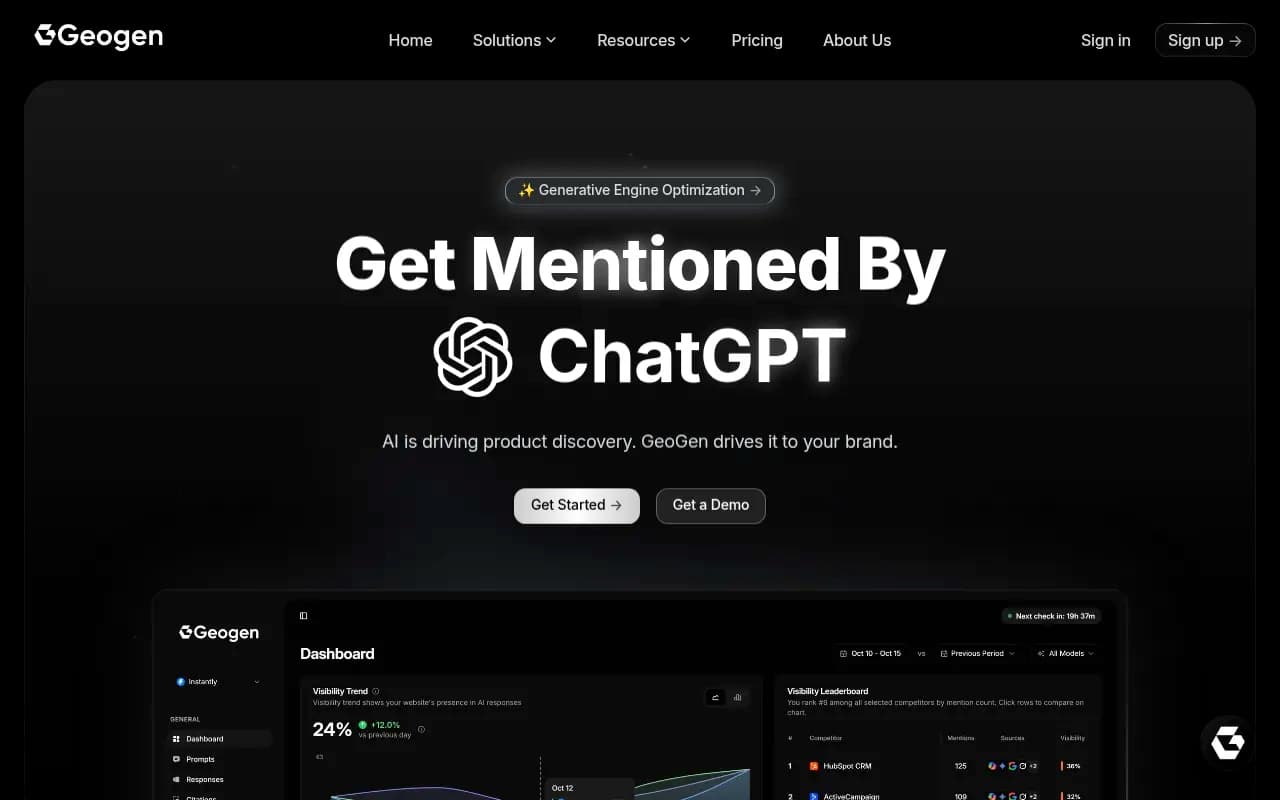
GeoGen positions itself as a Generative Engine Optimization platform for tracking brand visibility across ChatGPT, Perplexity, Gemini, Grok, and Microsoft Copilot. The dashboard shows visibility scores, competitor rankings, and source analysis. Pricing runs from €20/mo (Micro) to €399/mo (Pro) with 20% off annual billing. They list clients like CloudBlast, GdprWise, ProxyScrape, and TextBroker.
The interface emphasizes comparative analytics -- you see how your visibility stacks up against competitors over time, which LLMs mention you most often, and what sources AI models cite when they do mention you.
Promptmonitor
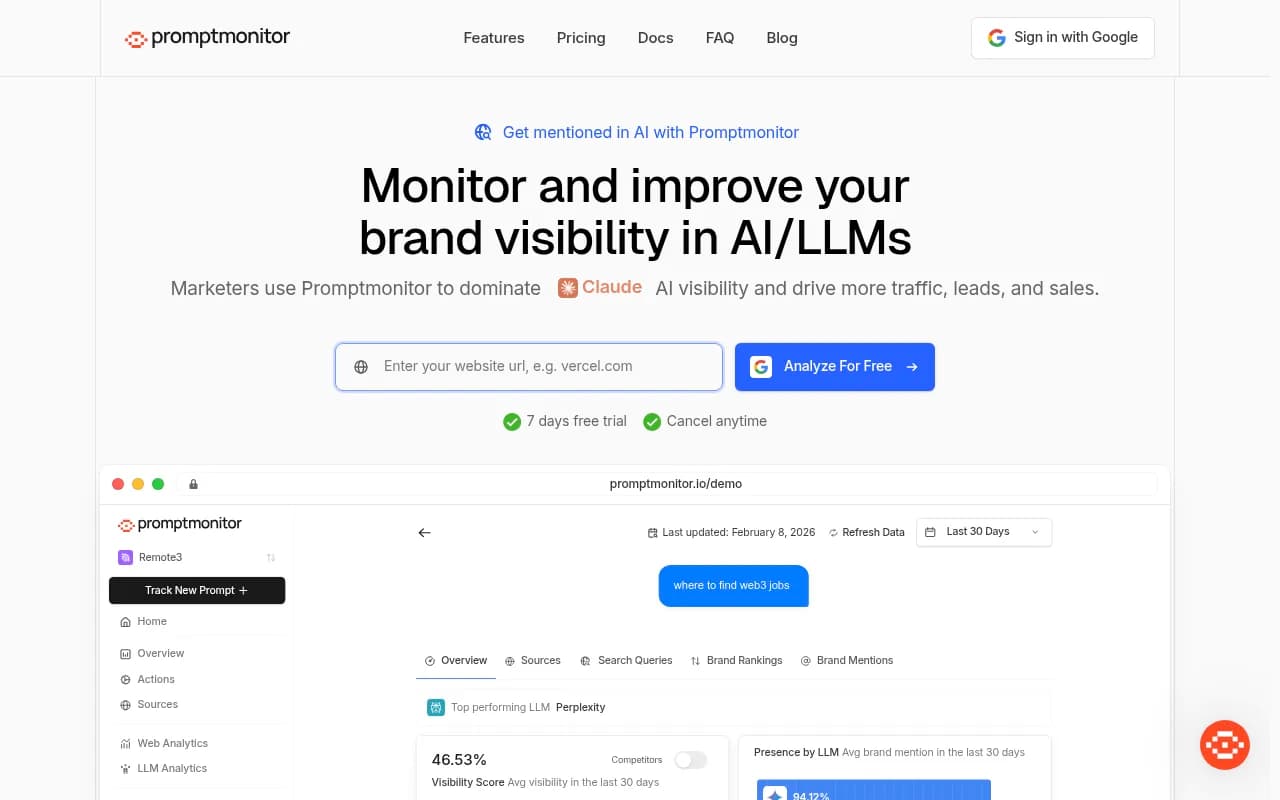
Promptmonitor takes a simpler approach: track brand mentions across ChatGPT, Claude, Gemini, and Perplexity, see which sources get cited, and monitor visibility trends. Pricing starts at $29/mo (Starter) and goes to $129/mo (Pro) before custom agency plans. They offer a 7-day free trial with no credit card required.
Their public demo shows a clean interface with visibility scores, presence-by-LLM breakdowns, and timeline graphs showing mention consistency. The focus is on answering "are we mentioned?" rather than "how do we get mentioned more?"
Side-by-side comparison
| Feature | GeoGen | Promptmonitor |
|---|---|---|
| Starting price | €20/mo (~$22/mo) | $29/mo |
| Free trial | Not publicly listed | 7 days, no credit card |
| LLM coverage | ChatGPT, Gemini, Perplexity, Grok, Copilot | ChatGPT, Claude, Gemini, Perplexity |
| Competitor tracking | ✓ Detailed rankings & scores | ✓ Basic presence tracking |
| Source analysis | ✓ Shows cited sources | ✓ Shows cited sources |
| Visibility scoring | ✓ Proprietary score | ✓ Presence + consistency score |
| AI crawler logs | ✗ Not available | ✗ Not available |
| Content gap analysis | ✗ Not available | ✗ Not available |
| AI content generation | ✗ Not available | ✗ Not available |
| Prompt intelligence | ✗ Not available | ✗ Not available |
| Reddit/YouTube tracking | ✗ Not available | ✗ Not available |
| Traffic attribution | ✗ Not available | ✗ Not available |
| API access | Not publicly listed | Not publicly listed |
| Annual discount | 20% off | Not publicly listed |
| Agency plans | ✓ Custom pricing | ✓ Custom pricing |
Pricing breakdown
| Plan | GeoGen | Promptmonitor |
|---|---|---|
| Entry tier | €20/mo (Micro) | $29/mo (Starter) |
| Mid tier | Not publicly listed | $39/mo (Growth) |
| Pro tier | €399/mo (Pro) | $129/mo (Pro) |
| Enterprise | Custom pricing | Custom agency pricing |
| Free trial | Not specified | 7 days, no credit card |
| Annual discount | 20% off | Not specified |
GeoGen's pricing is more aggressive at the high end (€399/mo suggests features for larger brands or agencies), while Promptmonitor keeps public pricing lower and pushes custom quotes for agency needs.
Feature deep-dive
LLM coverage
GeoGen explicitly lists ChatGPT, Gemini, Perplexity, Grok, and Microsoft Copilot on their homepage. Promptmonitor covers ChatGPT, Claude, Gemini, and Perplexity. Neither provides exact details on model versions (e.g. GPT-4o vs GPT-4, Claude 3.5 Sonnet vs Claude 3 Opus) or how often they refresh data.
Both miss newer entrants like DeepSeek, Meta AI (Llama-based), and Mistral. If you need comprehensive coverage across 10+ AI models, you're looking at a platform like Promptwatch.
Verdict: GeoGen has a slight edge with Grok and Copilot, but both cover the core four LLMs most brands care about.
Competitor analysis
GeoGen's dashboard screenshots show detailed competitor visibility scores, ranking positions, and trend comparisons. You can see exactly how your brand stacks up against 3-5 competitors over time, which is useful for benchmarking.
Promptmonitor's public demo shows a "Competitors" section with basic presence data but less granular ranking detail. You see whether competitors are mentioned, but not as much comparative scoring.
Verdict: GeoGen wins on competitor depth. If you're tracking against specific rivals, GeoGen gives you more actionable comparison data.
Source tracking
Both platforms show which URLs, domains, or sources AI models cite when they mention your brand. This is table stakes for any AI visibility tool -- you need to know whether ChatGPT is pulling from your own website, a review site, Reddit, a competitor's blog, etc.
Neither platform appears to offer Reddit-specific or YouTube-specific tracking modules (surfacing discussions that influence AI recommendations), which is a gap if those channels matter to your brand.
Verdict: Tie. Both do basic source tracking, neither goes deep on social/community sources.
Visibility scoring methodology
GeoGen uses a proprietary visibility score that factors in mention frequency, ranking position, and cross-model consistency. Promptmonitor calculates visibility as "presence + cross model brand mention consistency" -- essentially, are you mentioned, and are you mentioned consistently across LLMs?
Both scores are useful for tracking trends over time, but neither is standardized across the industry. You can't compare a GeoGen score to a Promptmonitor score directly.
Verdict: Tie. Both offer scoring, both are proprietary black boxes. Pick based on which dashboard you find clearer.
Optimization and content creation
This is where both platforms fall short. GeoGen and Promptmonitor tell you where you're invisible, but they don't help you fix it. You see the data, then you're on your own to figure out what content to create, which prompts to target, or how to optimize existing pages.
Neither offers:
- Content gap analysis (which prompts competitors rank for but you don't)
- AI writing agents to generate optimized articles
- Prompt intelligence (volume estimates, difficulty scores, query fan-outs)
- Recommendations on what to publish or update
If you want to close the loop from insight to action, you need a platform that combines monitoring with optimization. Promptwatch, for example, shows you the gaps and generates content to fill them, grounded in 880M+ citations analyzed.
Verdict: Both lose. These are dashboards, not optimization platforms.
AI crawler logs
Neither GeoGen nor Promptmonitor tracks AI crawler activity. You won't see:
- Which AI bots (ChatGPT, Claude, Perplexity crawlers) are hitting your site
- What pages they're reading
- How often they return
- Errors or indexing issues
This is a critical blind spot. If ChatGPT never crawls your site, you'll never get cited -- and you won't know why. Crawler logs tell you whether AI models can even see your content.
Verdict: Both lose. If crawler visibility matters, look elsewhere.
Ease of use
Promptmonitor's public demo shows a clean, straightforward interface. You set up prompts to track, see visibility scores, and drill into sources. The learning curve looks minimal.
GeoGen's screenshots suggest a more data-dense dashboard with competitor overlays and multi-metric views. Slightly steeper learning curve, but more power-user features.
Verdict: Promptmonitor is easier for beginners. GeoGen rewards users who want deeper analytics.
Trial and onboarding
Promptmonitor offers a 7-day free trial with no credit card required, which lowers the barrier to testing. GeoGen doesn't publicly list trial terms -- you likely need to contact sales or sign up to find out.
Verdict: Promptmonitor wins on trial accessibility.
Pros and cons
GeoGen pros
- More detailed competitor ranking analysis
- Broader LLM coverage (includes Grok, Copilot)
- Higher-tier plans suggest more robust features for power users
- 20% annual discount clearly stated
GeoGen cons
- No public free trial details
- Monitoring-only -- no content creation or gap analysis
- No AI crawler logs or prompt intelligence
- Pricing in euros may complicate budgeting for US-based teams
Promptmonitor pros
- 7-day free trial, no credit card required
- Lower starting price ($29/mo vs ~$22/mo, but more transparent)
- Clean, beginner-friendly interface
- Includes Claude coverage (GeoGen doesn't list it)
Promptmonitor cons
- Less detailed competitor analysis
- Monitoring-only -- no optimization features
- No AI crawler logs or content gap tools
- Smaller LLM coverage (missing Grok, Copilot)
Who should pick which tool
Pick GeoGen if:
- You need detailed competitor benchmarking and ranking comparisons
- You want coverage of Grok and Microsoft Copilot in addition to the core LLMs
- You're willing to pay more for a data-dense dashboard
- You're comfortable reaching out to sales for trial access
Pick Promptmonitor if:
- You want a simple, low-friction way to start tracking AI mentions (7-day free trial)
- You prefer a cleaner, less overwhelming interface
- You need Claude coverage specifically
- You're budget-conscious and want the lowest entry price
Pick neither if:
- You need more than monitoring -- content gap analysis, AI writing tools, prompt intelligence, crawler logs
- You want to actually improve your AI visibility, not just track it
- You need comprehensive coverage across 10+ AI models including DeepSeek, Meta AI, Mistral
- You want traffic attribution to connect AI visibility to revenue
In that case, look at platforms like Promptwatch that combine tracking with optimization and content generation.
Final verdict
GeoGen and Promptmonitor are both competent monitoring dashboards. GeoGen edges ahead on competitor analysis and LLM breadth; Promptmonitor wins on ease of entry and trial accessibility. But both share the same fundamental limitation: they show you the problem without helping you solve it.
If you just need a visibility scorecard and you're happy doing the optimization work yourself, Promptmonitor's $29/mo entry point and free trial make it the safer first step. If you're serious about competitor benchmarking and willing to invest more, GeoGen's analytics depth is worth the higher price.
But if you want a platform that actually moves the needle -- one that identifies content gaps, generates optimized articles, tracks AI crawler activity, and connects visibility to traffic -- you need more than a monitoring tool. You need an optimization platform that closes the loop from insight to action.