Key Takeaways
- Qwairy covers 2x more AI engines (10 vs 5) including Claude, Mistral, DeepSeek, and both API + UI tracking for ChatGPT and Perplexity
- GeoGen is 60% cheaper at entry level (€20/mo vs €49/mo) but Qwairy offers 100 free credits to start
- Qwairy is action-oriented with Content Studio, citation source analysis, and content gap identification -- GeoGen is monitoring-focused
- GeoGen is simpler and better for small brands who just want basic visibility tracking without complexity
- Qwairy serves 2,000+ brands including TotalEnergies and Match Group -- GeoGen lists smaller clients
- For serious AI visibility work, Qwairy wins -- for budget-conscious basic tracking, GeoGen works
Overview: Two approaches to AI visibility
GeoGen: Budget-friendly monitoring
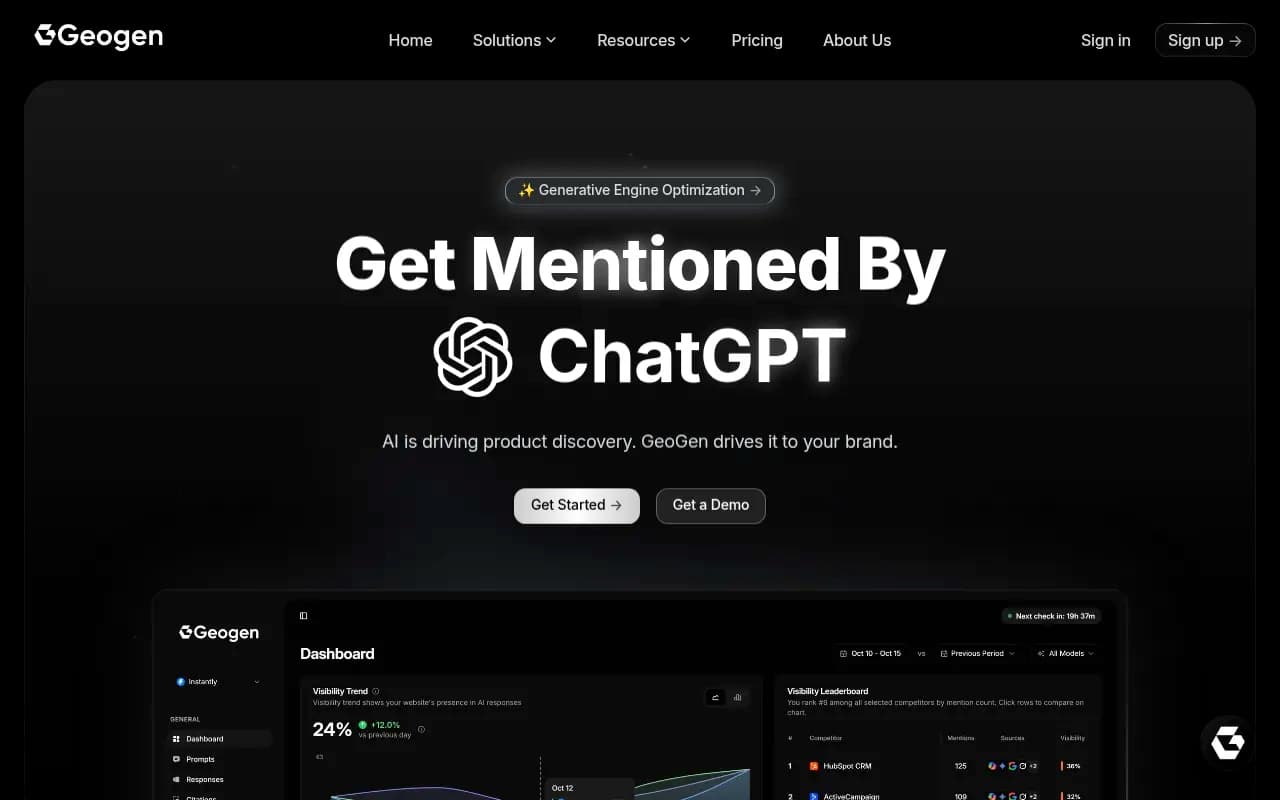
GeoGen positions itself as an accessible entry point into Generative Engine Optimization. Starting at €20/mo, it tracks how your brand appears across ChatGPT, Perplexity, Gemini, Grok, and Microsoft Copilot. The pitch is straightforward: see where AI mentions you, track competitors, get basic recommendations. It's aimed at small to mid-sized brands who want to dip their toes into AI visibility without a big commitment.
The platform focuses on the essentials -- brand mention tracking, competitor rankings, and dashboards showing your AI search presence. No free tier, but the Micro plan at €20/mo makes it one of the cheapest ways to start monitoring AI engines.
Qwairy: Full-stack GEO platform

Qwairy takes a different approach. It's built around five integrated modules: Visibility (tracking), Insights (analysis), Strategy (content recommendations), Technical (site diagnostics), and Analytics (crawler data). The goal isn't just showing you where you're mentioned -- it's helping you fix the gaps.
With 2,000+ brands including TotalEnergies and Match Group using it, Qwairy covers 10 AI engines (adding Claude, Mistral, DeepSeek, Google AI Mode, and tracking both API and UI for ChatGPT/Perplexity). The freemium model gives you 100 credits to test it, then paid plans start at €49/mo.
The citation source breakdown is detailed -- you see exactly which domains, pages, and content types (commercial, media, blog, forum) AI engines cite, plus your position and share across providers.
Side-by-side comparison
| Feature | GeoGen | Qwairy |
|---|---|---|
| Starting price | €20/mo (Micro) | €49/mo (Starter) |
| Free tier | No | Yes (100 credits) |
| AI engines covered | 5 (ChatGPT, Perplexity, Gemini, Grok, Copilot) | 10 (adds Claude, Mistral, DeepSeek, Google AI Overview, Google AI Mode) |
| API + UI tracking | Not specified | Yes (ChatGPT, Perplexity, Gemini, Grok) |
| Citation source analysis | Basic | Detailed (domain, page, type, position, share) |
| Competitor tracking | Yes (rankings) | Yes (compare, mentions, gap analysis) |
| Content recommendations | Basic | Advanced (Content Studio, opportunities) |
| Technical diagnostics | No | Yes (site diagnostics module) |
| Crawler analytics | No | Yes (track AI crawler behavior) |
| Referrer analytics | No | Yes |
| Google Search Console integration | No | Yes |
| Bing Webmaster Tools integration | No | Yes |
| Sentiment analysis | No | Yes |
| Query fan-out | No | Yes |
| Social signals tracking | No | Yes |
| Shopping results monitoring | No | Yes |
| Team management | Not specified | Yes |
| Annual discount | 20% | Not specified |
| Target audience | Small to mid-sized brands | Brands and agencies of all sizes |
Pricing breakdown
| Plan | GeoGen | Qwairy |
|---|---|---|
| Free tier | None | 100 credits |
| Entry plan | €20/mo (Micro) | €49/mo (Starter) |
| Mid-tier | Not disclosed | ~€300-500/mo (Growth, estimated) |
| Top plan | €399/mo (Pro) | Custom (Enterprise) |
| Annual discount | 20% | Not specified |
| Credit card required | Yes | No (for free tier) |
GeoGen's pricing is transparent up to the Pro level at €399/mo, then enterprise pricing is custom. Qwairy shows Starter at €49/mo but doesn't publicly list Growth plan pricing -- likely in the €300-500 range based on typical SaaS scaling.
For a brand just starting out, GeoGen's €20/mo entry point is hard to beat. But Qwairy's 100 free credits let you test before committing, which GeoGen doesn't offer.
AI engine coverage
This is where the gap widens.
GeoGen covers:
- ChatGPT
- Perplexity
- Gemini
- Grok
- Microsoft Copilot
That's 5 engines. Fine for basic monitoring, but you're missing some big ones.
Qwairy covers:
- ChatGPT (API + UI)
- Perplexity (API + UI)
- Gemini (API + UI)
- Grok (API + UI)
- Claude (API)
- Mistral (API)
- DeepSeek (API)
- Microsoft Copilot (UI)
- Google AI Overview (API)
- Google AI Mode (UI)
That's 10 engines, and Qwairy tracks both the API and user interface for several of them. Why does this matter? Because AI engines sometimes give different answers via API vs UI, and you want to see both.
Claude is a glaring omission from GeoGen. It's one of the top LLMs, widely used for research and recommendations. Missing DeepSeek and Mistral is less critical but still a gap. Google AI Overview and AI Mode are separate products with different behaviors -- Qwairy tracks both, GeoGen doesn't specify.
If comprehensive coverage matters to you, Qwairy wins this round easily.
Citation and source analysis
Both platforms show you where AI engines are getting their information, but the depth differs.
GeoGen provides brand mention tracking and shows you're being cited, but the citation analysis is basic. You see that you're mentioned, you see competitor mentions, you get a sense of your visibility.
Qwairy breaks it down:
- 124 sources citing Nike (in their example dashboard)
- 2.8k pages across those sources
- Source type breakdown: Commercial (32.6%), Media (27.9%), Blog (20.9%), Institutional (9.3%), Forum (5.8%), Other (3.5%)
- Per-source metrics: Domain, page count, relationship (your site, direct competitor, etc.), average position, share percentage, which providers cite it
This level of detail tells you not just "you're mentioned" but "here's exactly where, how often, in what context, and by which AI engines." That's the difference between a report and actionable intelligence.
If you want to know which competitor domains are eating your lunch in AI search, Qwairy shows you. If you want to see that forums are driving 5.8% of citations and maybe you should engage there, Qwairy shows you. GeoGen gives you the overview but not the breakdown.
Content and strategy features
GeoGen provides "recommendations to improve your AI search presence." That's vague. The website doesn't detail what those recommendations look like or how actionable they are.
Qwairy has an entire Strategy module:
- Content Studio: Create content optimized for AI search
- Content Opportunities: See gaps where competitors are visible but you're not
- Google Search Console integration: Connect traditional SEO data
- Bing Webmaster Tools integration: Same for Bing
- Backlink Opportunities: Identify where to build links for AI visibility
- Brand Perception: Track how AI describes your brand
- Content Optimization: Specific recommendations for existing pages
- Action Center: Prioritized to-do list
This is the difference between "here's what's happening" and "here's what to do about it." If you're serious about improving your AI visibility, you need the second one.
Worth noting: if you're looking for an even more action-oriented platform that closes the loop from gap analysis to content generation to tracking results, Promptwatch is worth checking out.

Insights and analytics
GeoGen focuses on visibility dashboards. You see your mentions, competitor rankings, trends over time. It's monitoring.
Qwairy's Insights module includes:
- Sentiment Analysis: How AI engines describe you (positive, neutral, negative)
- Query Fan-Out: See how one prompt branches into related queries
- Social Signals: Track social media discussions influencing AI
- Shopping Results: Monitor product recommendations in ChatGPT Shopping, etc.
- Local Businesses: Track local search visibility in AI
- Ads Monitoring: See if competitors are running AI-targeted ads
The Query Fan-Out feature is particularly useful. One prompt like "best running shoes" might fan out into "best running shoes for marathons," "best budget running shoes," "best running shoes for flat feet," etc. Seeing that map helps you understand the full opportunity space.
Sentiment analysis tells you if AI engines are framing you positively or negatively. If ChatGPT consistently describes your brand as "expensive" or "complicated," you know you have a perception problem to fix.
GeoGen doesn't offer these depth features. It's visibility tracking, not insight generation.
Technical and crawler analytics
GeoGen doesn't mention technical diagnostics or crawler tracking.
Qwairy includes:
- Technical Analysis: Site diagnostics for AI crawlability
- Crawler Analytics: See which AI crawlers are hitting your site, when, and what they're reading
- Referrer Analytics: Track traffic coming from AI engines
- Page Performance: See which pages AI engines cite most
Crawler analytics matter because if ChatGPT's crawler can't access your content, you won't get cited. Seeing crawler errors, frequency, and behavior helps you fix indexing issues before they hurt your visibility.
Referrer analytics close the loop -- you can see if AI visibility is actually driving traffic to your site. Most GEO platforms (including GeoGen) don't offer this.
Competitor tracking
Both platforms track competitors, but the implementation differs.
GeoGen shows competitor rankings -- who's mentioned alongside you, who's ranking higher, trends over time. It's comparative visibility tracking.
Qwairy adds:
- Competitor Compare: Side-by-side visibility comparison
- Competitor Mentions: See exactly which prompts mention competitors
- Gap Analysis: Identify prompts where competitors are visible but you're not
The gap analysis is the key. It's not enough to know "Adidas is mentioned more than us." You need to know "Adidas is mentioned for these 47 prompts where we're invisible, and here's what content we're missing."
That's the difference between a report and a roadmap.
Ease of use and setup
GeoGen markets itself as simple and accessible. The website is clean, the pitch is straightforward, the pricing is transparent. For a small brand that just wants to start tracking, the barrier to entry is low.
Qwairy has more complexity because it does more. Five modules, dozens of features, integrations with GSC and Bing Webmaster Tools. The learning curve is steeper, but you get more power.
Qwairy's 2-minute setup claim and 100 free credits make it easy to test. GeoGen requires payment upfront (no free tier), so you're committing before you see the platform.
If you want simple monitoring, GeoGen is easier. If you want a full GEO stack, Qwairy's complexity is the price of capability.
Customer base and trust signals
GeoGen lists clients like CloudBlast, GdprWise, ProxyScrape, and TextBroker. These are smaller B2B SaaS companies and service providers. Respectable, but not household names.
Qwairy lists TotalEnergies (major energy company), Air Transat (airline), Match Group (owns Tinder, Match.com, Hinge), Fortuneo (bank), IZI by EDF (energy services), Meilleurtaux.com (financial comparison), and Agicap (finance software). These are larger, more recognizable brands.
The client list suggests Qwairy is winning deals with bigger companies that need enterprise-grade GEO. GeoGen is serving smaller companies that need basic tracking.
Neither is wrong -- it's just different market segments.
Pros and cons
GeoGen pros
- Cheapest entry point (€20/mo)
- Simple, focused on core tracking
- 20% annual discount
- Good for small brands on a budget
- Covers the 5 most popular AI engines
GeoGen cons
- No free tier to test before buying
- Only 5 AI engines (missing Claude, Mistral, DeepSeek, etc.)
- Basic citation analysis
- Limited content strategy features
- No technical diagnostics or crawler tracking
- No referrer analytics to measure traffic impact
- Smaller customer base suggests less enterprise traction
Qwairy pros
- 100 free credits to test before paying
- Covers 10 AI engines including Claude, Mistral, DeepSeek
- Detailed citation source analysis (domain, page, type, position, share)
- Full Strategy module with Content Studio and gap analysis
- Technical diagnostics and crawler analytics
- Referrer analytics to track actual traffic
- Sentiment analysis and query fan-out
- Integrates with Google Search Console and Bing Webmaster Tools
- Trusted by 2,000+ brands including major enterprises
- Five integrated modules for end-to-end GEO
Qwairy cons
- Higher starting price (€49/mo vs €20/mo)
- More complex -- steeper learning curve
- Growth plan pricing not publicly disclosed
- Might be overkill for very small brands who just want basic tracking
Who should pick which
Pick GeoGen if:
- You're a small business or solopreneur with a tight budget
- You just want to see if AI engines mention you at all
- You don't need deep analytics or content strategy tools
- You're only concerned with the 5 major AI engines (ChatGPT, Perplexity, Gemini, Grok, Copilot)
- You want something simple without a learning curve
- €20/mo is your max budget for AI visibility tracking
Pick Qwairy if:
- You're serious about improving AI visibility, not just tracking it
- You want to see exactly which content gaps are hurting you
- You need coverage of Claude, Mistral, DeepSeek, and other emerging LLMs
- You want detailed citation analysis to understand where AI gets its information
- You need technical diagnostics and crawler tracking
- You want to measure actual traffic from AI engines (referrer analytics)
- You're willing to pay more for actionable insights and content tools
- You're an agency managing multiple brands or an enterprise with a real GEO strategy
Final verdict
Qwairy is the better platform for anyone serious about AI visibility. It covers 2x more AI engines, provides detailed citation analysis, includes content strategy tools, and actually helps you fix visibility gaps instead of just reporting them. The 100 free credits let you test it risk-free.
GeoGen is a budget-friendly option for small brands who just want basic tracking and can't justify €49/mo. It does what it says -- monitors your brand across major AI engines -- but it won't help you much beyond that.
If you're choosing between these two, ask yourself: do I just want to know where I stand, or do I want to improve where I stand? If it's the first, GeoGen works. If it's the second, Qwairy is worth the extra cost.
For most businesses, AI visibility is too important to settle for basic monitoring. The brands winning in AI search are the ones using platforms that help them take action -- and that's Qwairy's core advantage.