Key Takeaways
- Glowtify is a full marketing operating system for e-commerce teams that handles strategy, content creation, campaign planning, and multi-channel publishing. Gauge is a specialized AI visibility tracker that monitors brand mentions in ChatGPT, Claude, Perplexity, and other LLMs.
- Price difference is substantial: Gauge starts at $95/mo while Glowtify starts at $449/mo. You're paying for completely different scopes -- Gauge is monitoring-focused, Glowtify is execution-focused.
- E-commerce integration: Glowtify connects directly to Shopify, Klaviyo, Meta, and Google Analytics for campaign execution. Gauge doesn't integrate with e-commerce platforms -- it tracks AI search results.
- Content creation: Glowtify generates social posts, emails, blog content, and ad copy. Gauge identifies what content is missing but doesn't create it for you.
- Use case overlap is minimal: If you're running day-to-day marketing campaigns, you need Glowtify. If you're tracking AI search visibility, you need Gauge. They're not alternatives to each other.
- Best combo approach: E-commerce brands serious about both traditional marketing and AI visibility often run both tools -- Glowtify for campaign execution, Gauge for AI search monitoring.
Overview: Two tools solving different problems
Glowtify: Marketing command center for e-commerce
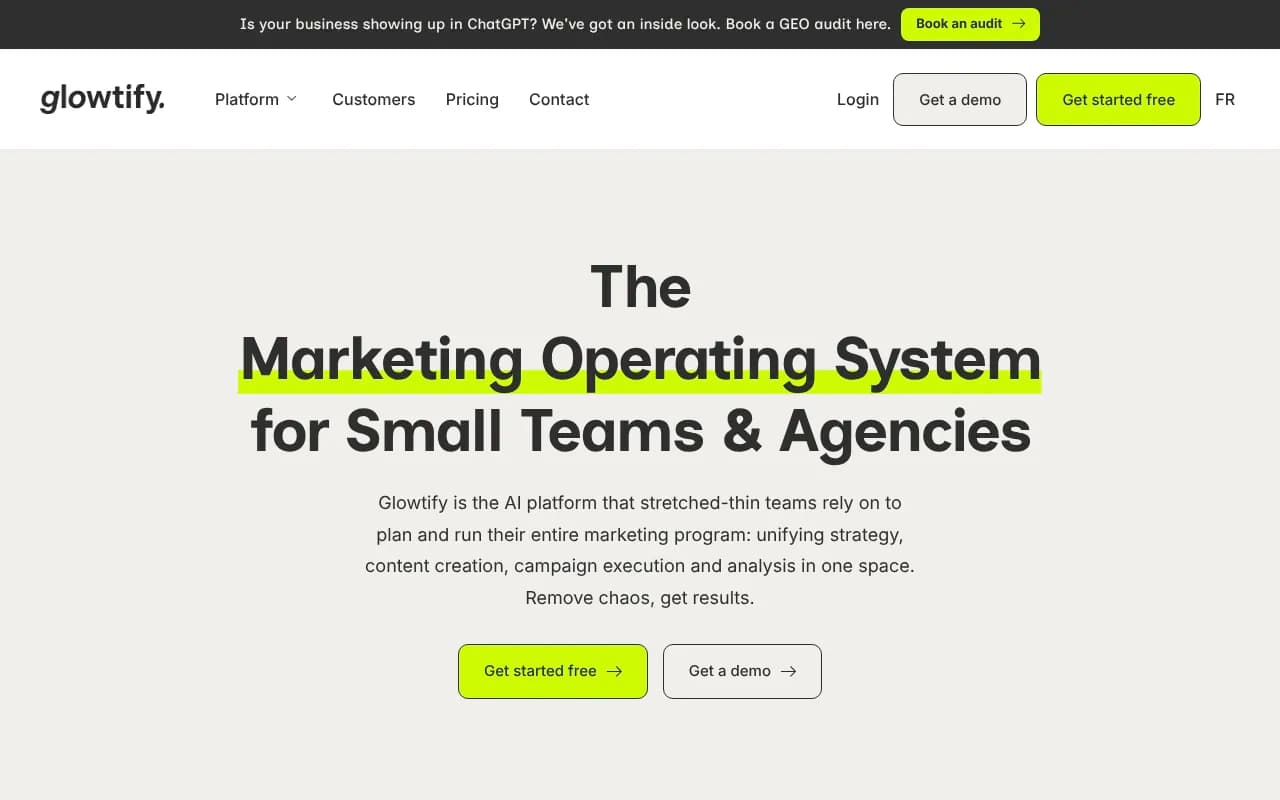
Glowtify positions itself as an AI-powered marketing operating system built specifically for small e-commerce teams and agencies. It's designed to replace the chaos of juggling multiple tools by centralizing strategy, planning, content creation, and campaign execution in one workspace. The platform covers email marketing, social media, blog content, SEO, and paid ads -- with direct integrations to Shopify, Klaviyo, Meta, and Google Analytics.
The value proposition is speed and consolidation. Glowtify claims customers achieve 4x faster marketing operations and 3x better performance with the same resources. It's aimed at stretched-thin teams that need to plan and execute multi-channel campaigns without hiring more people or managing a sprawling tool stack.
Gauge: AI search visibility tracker
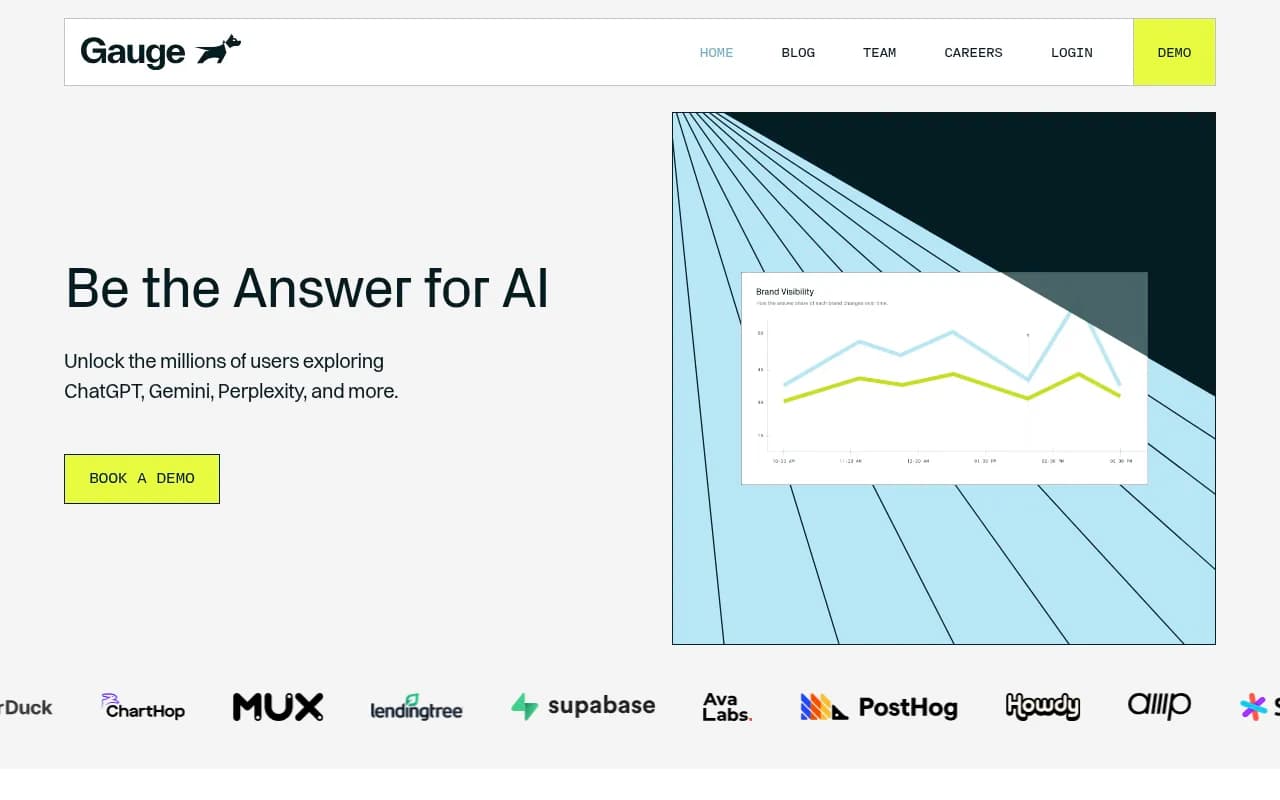
Gauge takes a completely different angle. It's a specialized platform for monitoring how your brand shows up in AI search engines -- ChatGPT, Claude, Gemini, Perplexity, and other LLMs. The tool tracks brand mentions, analyzes which content gets cited, identifies gaps in your AI visibility, and provides recommendations to improve your presence in generative AI search results.
Gauge is part of the emerging Generative Engine Optimization (GEO) category. It's designed for marketing teams and agencies that recognize AI search is becoming a major discovery channel and want to track and optimize their visibility there. Unlike Glowtify, Gauge doesn't create or publish content -- it monitors and analyzes.
Side-by-side comparison
| Feature | Glowtify | Gauge |
|---|---|---|
| Primary use case | Full marketing campaign execution | AI search visibility tracking |
| Starting price | $449/mo | $95/mo (annual billing) |
| Free trial | Yes | Not specified |
| Content creation | AI-generated social, email, blog, ads | No (analysis only) |
| Campaign planning | Full calendar and workflow management | Not applicable |
| Publishing capabilities | Direct publishing to social, email, blog | No publishing |
| E-commerce integrations | Shopify, Klaviyo, Meta, Google Analytics | None |
| AI engine monitoring | Not applicable | ChatGPT, Claude, Gemini, Perplexity, others |
| Citation analysis | Not applicable | Yes |
| Content gap identification | Campaign suggestions based on performance | Content gaps for AI visibility |
| Collaboration features | Feedback, approvals, team workspace | Not specified |
| Performance tracking | Campaign metrics across channels | AI mention metrics |
| Target audience | E-commerce teams, agencies | Marketing teams, agencies tracking AI presence |
Head-to-head feature breakdown
Core purpose and positioning
Glowtify is a marketing execution platform. You use it to plan campaigns, generate content, get approvals, and publish across channels. It's designed to replace or consolidate tools like Hootsuite, Mailchimp, and various content planning apps.
Gauge is a monitoring and analytics platform. You use it to see how AI engines are representing your brand, which content they're citing, and where you're invisible. It's designed to complement your existing marketing stack by adding AI search visibility tracking.
These tools don't compete. One executes campaigns, the other tracks a specific visibility channel.
Content creation and generation
Glowtify includes AI content generation across multiple formats: social media posts, email campaigns, blog articles, and ad copy. The AI learns your brand voice and pulls from your connected data sources (Shopify product catalog, past campaign performance, audience insights) to generate on-brand content. You can refine drafts, gather team feedback, and publish directly from the platform.
Gauge doesn't create content. It analyzes which content AI engines are citing and identifies gaps -- topics or angles where competitors are visible but you're not. You'd need to create that content elsewhere (or use a tool like Glowtify to generate it).
Verdict: Glowtify wins decisively on content creation. Gauge isn't trying to compete here.
Campaign planning and execution
Glowtify offers a full campaign planning workspace with a dynamic content calendar. It maps campaigns across email, social, blog, and SEO, recommends what to promote based on performance data, and handles scheduling and publishing. The platform includes approval workflows, team collaboration features, and performance tracking for each campaign.
Gauge doesn't handle campaign planning or execution at all. It's purely a visibility monitoring tool.
Verdict: Glowtify is the only option if you need campaign management.
AI search visibility and optimization
Glowtify doesn't track AI search engines. It focuses on traditional marketing channels (email, social, blog, paid ads) and their performance metrics.
Gauge is built specifically for this. It monitors how your brand appears in ChatGPT, Claude, Gemini, Perplexity, and other LLMs. It tracks mention frequency, citation patterns, competitor visibility, and provides actionable recommendations to improve your AI search presence. This is the entire product.
Verdict: Gauge is the only option for AI search visibility tracking.
If tracking AI search visibility is important to you, tools like Promptwatch offer a more comprehensive approach -- not just monitoring but also content gap analysis, AI content generation, and optimization tools to actually improve your visibility. Worth considering if you want to go beyond tracking.

Integrations and ecosystem
Glowtify integrates with e-commerce and marketing platforms: Shopify (product catalog, orders, customer data), Klaviyo (email campaigns), Meta (ad publishing), Google Analytics (traffic and conversion tracking). These integrations feed data into Glowtify's AI for smarter campaign recommendations and allow direct publishing from the platform.
Gauge doesn't integrate with marketing or e-commerce platforms. It connects to AI search engines to pull mention data and citation patterns. The integration focus is completely different.
Verdict: Glowtify for e-commerce and marketing tool integrations, Gauge for AI engine data.
Collaboration and workflow
Glowtify includes team collaboration features: shared workspace, feedback and comment threads, approval workflows, and role-based access. It's designed for teams and agencies managing multiple campaigns and clients.
Gauge's collaboration features aren't detailed on their site. The focus is on visibility data and analytics rather than workflow management.
Verdict: Glowtify is built for team collaboration, Gauge is more of an analytics dashboard.
Performance tracking and analytics
Glowtify tracks campaign performance across the channels it manages: email open rates and clicks, social engagement, blog traffic, ad performance, and conversion metrics pulled from Google Analytics and Shopify. The platform uses this data to recommend optimizations and future campaign ideas.
Gauge tracks AI search visibility metrics: how often your brand is mentioned, which content gets cited, competitor visibility comparisons, and trends over time. It's a completely different set of metrics focused on AI search rather than campaign performance.
Verdict: Different metrics for different purposes. Glowtify for campaign ROI, Gauge for AI visibility.
Ease of use and setup
Glowtify emphasizes quick setup and ease of use. The platform guides you through defining your marketing foundation (goals, brand voice, connected tools) and then generates a starting content calendar. Customer testimonials highlight time savings and reduced complexity.
Gauge's setup process isn't detailed, but as a monitoring tool it likely requires defining your brand, competitors, and the queries you want to track. Less complex than setting up a full marketing OS.
Verdict: Both claim ease of use, but Gauge has a simpler scope so likely faster to get running.
Target audience and ideal customer
Glowtify explicitly targets small e-commerce teams (stores under $100K to over $100K revenue) and agencies managing e-commerce clients. The pricing tiers and feature set are built around e-commerce use cases.
Gauge targets marketing teams and agencies that care about AI search visibility. It's not e-commerce-specific -- any brand that wants to track how they appear in ChatGPT and other LLMs could use it.
Verdict: Glowtify for e-commerce, Gauge for anyone tracking AI visibility.
Pricing comparison
| Plan | Glowtify | Gauge |
|---|---|---|
| Entry tier | $449/mo (Startup, <$100K revenue stores) | $95/mo (annual billing) |
| Mid tier | $899/mo (Growth, >$100K revenue stores) | $399/mo (Growth plan) |
| Enterprise | Custom pricing | Custom pricing |
| Free trial | Yes | Not specified |
| Annual discount | Yes | Yes (required for $95/mo entry price) |
The pricing difference reflects the scope difference. Glowtify is 4-5x more expensive at the entry level because it's a full marketing execution platform. Gauge is a specialized monitoring tool with a much narrower focus.
If you're comparing these two on price alone, you're probably asking the wrong question. The real question is whether you need campaign execution (Glowtify) or AI visibility tracking (Gauge) or both.
Pros and cons
Glowtify pros
- All-in-one marketing workspace reduces tool sprawl
- AI content generation across multiple formats (social, email, blog, ads)
- Direct integrations with Shopify, Klaviyo, Meta, Google Analytics
- Campaign planning and publishing in one place
- Team collaboration and approval workflows built in
- E-commerce-specific features and pricing tiers
- Customer testimonials show real time savings (4x faster operations)
Glowtify cons
- Expensive compared to point solutions ($449-$899/mo)
- Locked into their ecosystem once you centralize everything
- No AI search visibility tracking
- May be overkill if you only need one or two marketing channels
- Pricing jumps significantly between tiers
Gauge pros
- Specialized focus on AI search visibility (ChatGPT, Claude, Perplexity, etc.)
- Much lower price point ($95/mo entry)
- Identifies content gaps for AI optimization
- Tracks competitor visibility in AI search
- Emerging category with growing importance
Gauge cons
- Doesn't create or publish content -- monitoring only
- No e-commerce integrations
- No campaign management features
- Narrower use case than a full marketing platform
- AI search visibility is still an emerging channel with uncertain ROI for many brands
Who should pick which tool
Choose Glowtify if you:
- Run an e-commerce store or agency managing e-commerce clients
- Need to plan, create, and execute multi-channel marketing campaigns
- Want to consolidate email, social, blog, and ad management in one platform
- Have a small team stretched across too many marketing tools
- Value AI content generation for faster campaign creation
- Need team collaboration and approval workflows
- Care more about campaign execution than AI search visibility
Choose Gauge if you:
- Want to track how your brand appears in ChatGPT, Claude, Perplexity, and other AI search engines
- Already have campaign execution tools but lack AI visibility tracking
- Need to monitor competitor presence in AI search results
- Want to identify content gaps for AI optimization
- Have budget for a specialized monitoring tool ($95-$399/mo)
- Believe AI search will be a significant traffic channel for your brand
Choose both if you:
- Run a serious e-commerce brand with budget for both execution and AI visibility
- Want comprehensive coverage of traditional marketing channels (Glowtify) plus emerging AI search (Gauge)
- Have the resources to act on insights from both platforms
- See AI search as a strategic channel worth dedicated tracking
Final verdict
Glowtify and Gauge aren't competitors. They solve completely different problems for different stages of the marketing workflow.
Glowtify is a marketing operating system for e-commerce teams that need to plan, create, and execute campaigns across email, social, blog, and ads. It's expensive ($449-$899/mo) but replaces multiple tools and includes AI content generation, team collaboration, and direct publishing. If you're an e-commerce brand drowning in marketing tools and need to consolidate, Glowtify makes sense.
Gauge is a specialized AI visibility tracker that monitors how your brand shows up in ChatGPT, Claude, Perplexity, and other LLMs. It's much cheaper ($95-$399/mo) but has a narrow focus: tracking and analyzing AI search presence. If you care about AI search visibility and want data on where you're visible vs invisible, Gauge delivers that.
The real decision isn't Glowtify vs Gauge -- it's whether you need campaign execution, AI visibility tracking, or both. Most e-commerce teams will get more immediate value from Glowtify because it handles day-to-day marketing work. Gauge is for brands that recognize AI search as a strategic channel and want to track their presence there.
If you're serious about both, run them together. Glowtify handles your campaigns, Gauge tracks your AI visibility. They're complementary, not competing.