Glowtify Review 2026
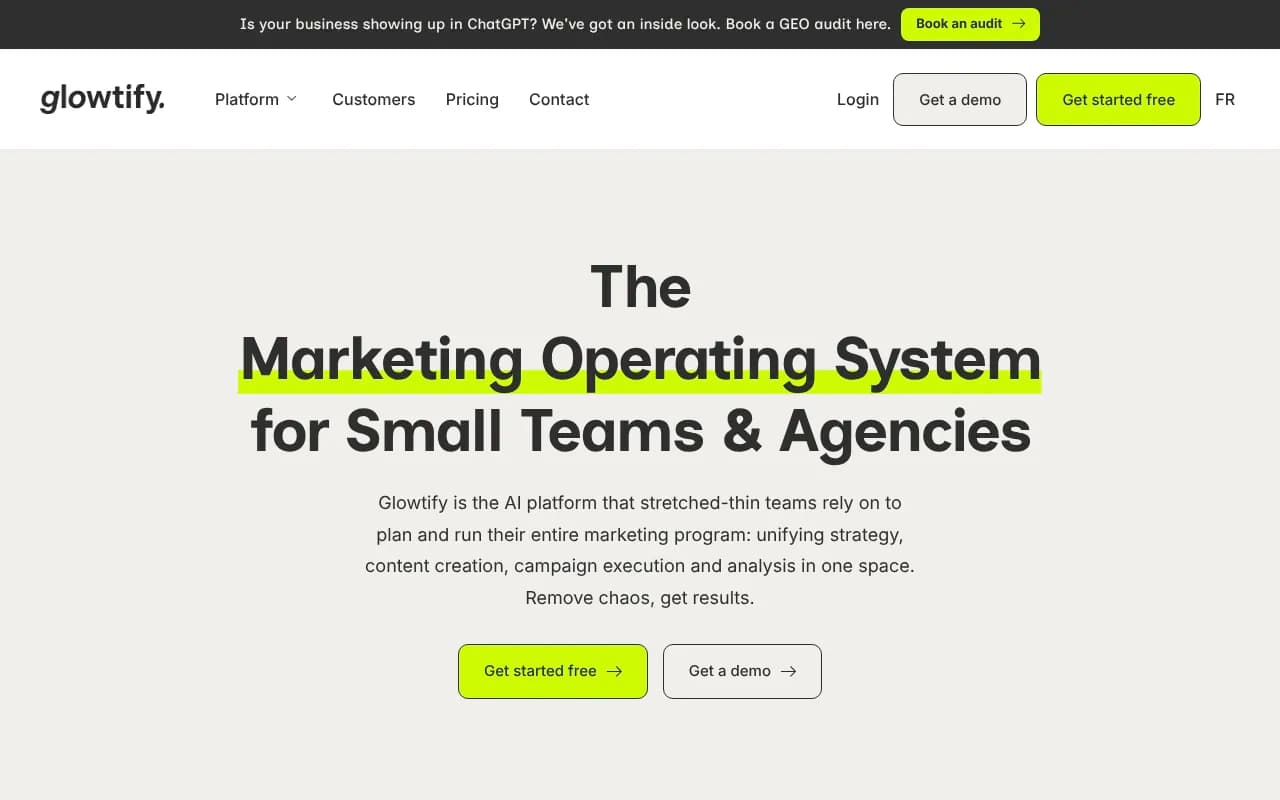
Glowtify is an AI-powered marketing operating system that helps small e-commerce teams and agencies plan, create, and execute multi-channel campaigns from one workspace. It combines strategy, content generation, campaign planning, and publishing for email, social, blog, and ads — with built-in collaboration, performance tracking, and integrations with Shopify, Klaviyo, Meta, Google Analytics, and more.
Key takeaways
- All-in-one marketing workspace: Glowtify unifies strategy, planning, content creation, and publishing for email, social, blog, and ads in a single platform — no more juggling 10+ tools
- AI content generation at scale: Customers report 4x faster marketing operations and 80% automated content creation, with teams publishing 19+ email newsletters per month
- E-commerce focus: Built specifically for Shopify stores and DTC brands, with integrations for Klaviyo, Meta Ads, Google Analytics, SEMrush, and other e-commerce tools
- Pricing starts high: $449/month for the Startup plan (stores under $100K revenue), $899/month for Growth — significantly more expensive than standalone tools like Buffer, Mailchimp, or Canva
- Limited to organic + email: No native paid ad creation or management beyond Meta Ads integration — you'll still need separate tools for Google Ads, TikTok Ads creative, or programmatic campaigns
Glowtify is a marketing operating system built for small e-commerce teams and agencies that are tired of context-switching between a dozen different tools. It's an AI-native platform that handles everything from strategic planning and content ideation to campaign execution and performance tracking — all in one workspace. The company raised $3.4M in seed funding in November 2025 and serves 1,500+ e-commerce businesses, primarily Shopify stores and DTC brands.
The core pitch: instead of using separate tools for email (Klaviyo), social scheduling (Buffer), content creation (Canva), project management (Asana), and analytics (Google Analytics), you do it all in Glowtify. The platform connects to your existing tools (Shopify, Meta, Google Analytics, SEMrush, Klaviyo, Mailchimp) to pull in data, then uses AI to generate campaign ideas, write content, and automate publishing across channels.
Glowtify is a Canadian company (Montreal-based) founded by Marc Allard. It's positioned as a marketing co-pilot for teams of 1-15 people who need to punch above their weight — the solo marketer at a $2M Shopify store, the two-person marketing team at a growing DTC brand, or the agency managing 10 e-commerce clients.
Key features
Brand foundation setup: Glowtify starts by building a structured brand profile — target audience, unique selling proposition, SEO foundation, competitors, brand voice, and "marketable moments" (seasonal campaigns, product launches, etc.). This isn't just a static document. The platform uses this foundation to inform every piece of content it generates, so your AI-written Instagram captions and email subject lines stay on-brand. You can define multiple audience personas, set tone-of-voice guidelines, and upload brand assets. This foundation feeds into the AI content engine and ensures consistency across channels.
AI campaign builder: The platform generates full multi-channel campaign plans based on your goals and calendar. You tell it "Black Friday sale, November 24-27" and it maps out a campaign across email (announcement, reminder, last-chance sequence), social posts (Instagram, Facebook, TikTok), blog content, and website updates (homepage banner, product page copy). Each campaign includes suggested content, publishing dates, and channel-specific variations. You can customize the AI-generated plan, assign tasks to team members, and track status (draft, in review, approved, published). This is where Glowtify differs from tools like CoSchedule or Asana — it doesn't just organize your work, it generates the work.
Content calendar and planning: A visual calendar view shows all your campaigns, posts, and tasks across channels. You can drag-and-drop to reschedule, filter by channel (email, social, blog, ads), and see what's live vs. in progress. The calendar integrates with your connected channels, so published posts show actual performance metrics (engagement, clicks, conversions). Glowtify also suggests content ideas based on your brand profile, past performance, and industry benchmarks — "Your engagement is 20% higher on Tuesdays, consider posting product tutorials then."
AI content generation: This is the core of the platform. Glowtify writes email newsletters, social media posts, blog articles, ad copy, and website content using AI trained on your brand voice and audience. You give it a prompt ("Write an email announcing our new winter collection"), it generates a draft with subject line, body copy, and CTA. You can regenerate, edit, or refine with follow-up prompts ("Make it more playful" or "Add urgency"). The AI pulls in product data from Shopify, past campaign performance, and SEO keywords from SEMrush to make content more relevant. Customers report using this to automate 60-80% of their content creation — one case study (Peppermint Cycling) publishes 19+ email newsletters per month with one marketer.
Omnichannel publishing: Once content is approved, you publish directly from Glowtify to connected channels. Email goes to Klaviyo or Mailchimp, social posts to Instagram/Facebook/LinkedIn/TikTok, blog posts to WordPress, and website updates to Shopify. You can schedule posts, publish immediately, or save as drafts. The platform tracks what's live and pulls in performance data (open rates, engagement, clicks) so you can see results without logging into each tool. This is the "one-click omnichannel" promise — instead of copying content into 5 different platforms, you publish once from Glowtify.
Collaboration and approvals: Built-in workflows for teams and agencies. You can assign tasks ("Write Instagram post for Product X"), leave feedback on drafts, request changes, and approve content before it goes live. Each campaign has a status tracker (ideation, draft, review, approved, published) and comment threads. Agencies use this to manage client approvals without email chains or Slack threads. Unlimited users on all plans, so you can invite freelancers, designers, or clients without extra cost.
Performance tracking and benchmarks: Glowtify pulls in analytics from Google Analytics, Meta, Shopify, and email platforms to show campaign performance. You see open rates, click-through rates, conversions, and revenue attributed to each campaign. The platform also provides industry benchmarks — "Your email open rate is 22%, industry average is 18%" — so you know where you stand. One case study (Girl Crush) credits Glowtify's benchmarking with helping them increase conversion rate from 2.2% to 2.8% by identifying underperforming content and optimizing messaging.
SEO and keyword research: Integration with SEMrush pulls in keyword data, search volume, and ranking opportunities. Glowtify uses this to suggest blog topics, optimize product descriptions, and identify content gaps. The platform also automates product SEO — one customer (Brume) automated 60% of their product page optimization using Glowtify's AI to rewrite titles, descriptions, and meta tags based on keyword research.
Market research and competitor analysis: The platform pulls in competitor data (traffic, keywords, social engagement) and uses it to inform your strategy. You can see what's working for competitors and get AI-generated recommendations for how to differentiate. This is less robust than dedicated competitive intelligence tools like Semrush or Ahrefs, but it's useful for quick insights without leaving the platform.
Who is it for
Glowtify is built for small e-commerce marketing teams — typically 1-5 people managing a Shopify store or DTC brand doing $100K-$10M in annual revenue. The ideal user is a solo marketer or small team that's stretched thin, juggling email, social, content, and ads without the budget for a full marketing stack or agency.
Specific personas:
Solo marketers at growing Shopify stores: You're the only marketing person at a $1-5M e-commerce brand. You need to run email campaigns, post on Instagram/Facebook/TikTok, write blog content, manage Meta Ads, and track performance — but you don't have time to learn and manage 10 different tools. Glowtify gives you one workspace to plan, create, and publish everything, with AI doing the heavy lifting on content creation. You're trading tool complexity for a higher monthly cost ($449-899/month vs. $50-200/month for separate tools), but you're buying back 10-20 hours per week.
Small marketing teams at DTC brands (2-5 people): You have a content creator, a social media manager, and maybe a freelance designer. You're spending too much time on coordination — Slack threads about what to post, email chains for approvals, manual copying of content between tools. Glowtify centralizes planning, creation, and approvals so everyone works from the same source of truth. The collaboration features (task assignment, status tracking, comment threads) replace project management tools like Asana or Monday.com.
E-commerce agencies managing multiple clients: You're running marketing for 5-20 Shopify stores. You need a scalable way to plan campaigns, generate content, and get client approvals without drowning in admin work. Glowtify's unlimited users and multi-brand support (you can manage multiple stores in one account) make it viable for agencies. The AI content generation helps you scale output without hiring more writers. Several case studies feature agencies using Glowtify to manage 10+ clients with 2-3 team members.
Who should NOT use Glowtify: If you're a B2B SaaS company, service business, or non-e-commerce brand, Glowtify isn't built for you. The platform is deeply integrated with Shopify, Klaviyo, and e-commerce analytics — it assumes you're selling physical products online. If you're a large enterprise with a 20+ person marketing team, you'll outgrow Glowtify's capabilities (no advanced workflow automation, limited reporting, no multi-brand hierarchy). If you're a solopreneur or side project with <$50K revenue, the $449/month entry price is too high — you're better off with free/cheap tools like Mailchimp, Buffer, and Canva.
Integrations and ecosystem
Glowtify integrates with the core e-commerce marketing stack:
E-commerce platforms: Shopify (deep integration — pulls product data, inventory, sales, customer segments). This is the primary platform Glowtify is built for. No native WooCommerce, BigCommerce, or Magento support as of early 2026.
Email marketing: Klaviyo (primary integration), Mailchimp, Cyber Impact. You can create and schedule email campaigns in Glowtify, then publish directly to these platforms. Performance data (opens, clicks, conversions) syncs back to Glowtify.
Social media: Instagram, Facebook, LinkedIn, TikTok. You can schedule and publish posts, track engagement, and pull in analytics. No native support for Twitter/X, Pinterest, or YouTube as of early 2026.
Advertising: Meta Ads (Facebook/Instagram). You can create ad copy and creative in Glowtify, then push to Meta Ads Manager. No native Google Ads, TikTok Ads, or programmatic ad support.
Analytics: Google Analytics (GA4), Shopify Analytics. Glowtify pulls in traffic, conversions, and revenue data to attribute performance to campaigns.
SEO and research: SEMrush integration for keyword research, competitor analysis, and ranking tracking. This is used to inform content strategy and optimize product pages.
Content management: WordPress (for blog publishing). You can write blog posts in Glowtify and publish directly to WordPress sites.
No API or developer platform: Glowtify does not offer a public API or developer tools as of early 2026. You can't build custom integrations or export data programmatically. This limits flexibility for agencies or brands with custom workflows.
No Zapier or Make.com integration: Unlike tools like Airtable or Notion, Glowtify doesn't connect to automation platforms. You can't trigger workflows based on Glowtify events or sync data to other tools.
Pricing and value
Glowtify uses revenue-based pricing tiers:
Startup plan: $449/month (or $4,308/year with annual billing)
- For stores with <$100K annual revenue
- 1 user included
- Email support
- All core features: campaign planning, AI content generation, omnichannel publishing, performance tracking, integrations
- Unlimited campaigns and content
Growth plan: $899/month (or $8,748/year with annual billing)
- For stores with >$100K annual revenue
- Unlimited users
- Dedicated e-commerce expert (onboarding and ongoing support)
- All Startup features plus priority support
Add-ons (pricing not disclosed on website, contact sales):
- Acquisition strategy consulting
- Content strategy development
- SEO keyword strategy
- Ads management and monthly reporting
- Website tracking and audit
- Monthly design templates
- Website maintenance and support
- Video content creation
These add-ons are essentially agency services — Glowtify will do the work for you rather than just providing the platform.
Free trial: The website mentions "Get started free" but doesn't specify trial length or limitations. Likely a 14-day trial based on standard SaaS practices.
How pricing compares: Glowtify is significantly more expensive than standalone tools. A typical e-commerce marketing stack might cost:
- Klaviyo: $20-100/month (depending on list size)
- Buffer or Later: $15-50/month for social scheduling
- Canva Pro: $13/month for design
- Asana or Monday.com: $10-25/month for project management
- SEMrush: $130/month for SEO
Total: $188-318/month for separate tools vs. $449-899/month for Glowtify.
You're paying a premium for consolidation and AI content generation. The value proposition is time savings — if Glowtify saves you 10-20 hours per month (which customers claim it does), the ROI is there for teams where time is more expensive than tools. For a $2M/year Shopify store with one marketer making $60K/year ($30/hour), saving 15 hours/month = $450/month in labor cost, which justifies the Startup plan.
But for smaller stores (<$500K revenue) or side projects, the math doesn't work. You're better off with cheaper tools and more manual work.
Strengths and limitations
Strengths:
Consolidation: The biggest win is reducing tool sprawl. Instead of logging into Klaviyo, Buffer, Canva, Asana, and Google Analytics every day, you work in one platform. This saves time and reduces context-switching fatigue.
AI content generation at scale: Customers consistently report 3-4x faster content creation. The AI writes on-brand email newsletters, social posts, and blog articles that need minimal editing. This is the core value — you're buying back hours of writing time every week.
E-commerce-specific: Unlike generic marketing tools, Glowtify is built for Shopify stores. It pulls in product data, sales trends, and customer segments to make content more relevant. The SEO features are tailored to product pages and category optimization.
Collaboration features: Built-in task assignment, approvals, and status tracking replace project management tools. Agencies and small teams can coordinate work without Slack threads or email chains.
Unlimited users: Most SaaS tools charge per seat. Glowtify includes unlimited users on all plans, which is a big cost saver for agencies or teams with freelancers.
Limitations:
High price point: $449/month is steep for small stores. You need to be doing $500K+ in revenue for this to make financial sense. Competitors like Hootsuite ($99/month), Mailchimp ($20-100/month), or Canva Pro ($13/month) are much cheaper if you're willing to use multiple tools.
Limited to organic + email: Glowtify handles email, social, blog, and basic Meta Ads integration — but it's not a full-stack marketing platform. You'll still need separate tools for Google Ads, TikTok Ads creative, SMS marketing (Postscript, Attentive), affiliate programs, or influencer outreach. The "omnichannel" claim is overstated — it's really "multi-channel organic + email."
No API or Zapier: You can't build custom integrations or automate workflows outside of Glowtify. This limits flexibility for power users or agencies with custom tech stacks.
Shopify-only: If you're on WooCommerce, BigCommerce, or a custom platform, Glowtify won't work for you. The deep Shopify integration is a strength for Shopify users but a dealbreaker for everyone else.
AI content quality varies: Like all AI writing tools, output quality depends on how well you've set up your brand profile and how specific your prompts are. Some users report needing significant editing on AI-generated content, especially for nuanced or technical topics. This isn't unique to Glowtify — it's a limitation of current AI writing models — but it means you can't fully automate content creation.
Limited reporting and analytics: Glowtify pulls in basic performance metrics (opens, clicks, engagement, conversions) but doesn't offer advanced reporting, attribution modeling, or custom dashboards. If you need deep analytics, you'll still use Google Analytics, Shopify Analytics, or a BI tool like Looker Studio.
Bottom line
Glowtify is a strong fit for small e-commerce teams (1-5 people) at Shopify stores doing $500K-$10M in annual revenue who are drowning in tool complexity and need to scale content output without hiring. If you're the solo marketer juggling email, social, blog, and ads — and you're spending 10+ hours per week on content creation and coordination — Glowtify will save you time and sanity. The AI content generation and omnichannel publishing are genuinely useful, and the consolidation benefit is real.
But the $449-899/month price point is a barrier for smaller stores, and the platform's limitations (Shopify-only, no API, limited paid ad support) mean it's not a true all-in-one solution. You'll still need separate tools for Google Ads, SMS, or advanced analytics.
Best use case in one sentence: A 2-person marketing team at a $2M Shopify store that wants to publish 4x more content without hiring a writer or juggling 10 different tools.
Tags:
Frequently asked questions
What is Glowtify?
How much does Glowtify cost?
Who is Glowtify for?
What are the main features of Glowtify?
Does Glowtify work with platforms other than Shopify?
Is there a free plan or trial?
Similar and alternative tools to Glowtify