Key takeaways
- These tools solve fundamentally different problems. Goodie AI monitors brand visibility across AI models (ChatGPT, Gemini, Perplexity, etc.). AlsoAsked extracts People Also Ask questions from Google for content and SEO research. Comparing them head-to-head only makes sense if you're deciding where to spend a limited research budget.
- AlsoAsked is dramatically more affordable. Plans start at $12/month with a free tier. Goodie AI has no public pricing and requires a custom quote -- a reliable signal of enterprise-level costs.
- If your goal is understanding how your brand shows up when someone asks ChatGPT "what's the best X?", Goodie AI is relevant. AlsoAsked won't help with that at all.
- If your goal is mapping what questions real users ask around a topic so you can build content that ranks, AlsoAsked is the right tool. Goodie AI doesn't do traditional keyword or question research.
- AlsoAsked has a self-serve model with instant access. Goodie AI requires a demo call before you can touch the product.
- For teams doing both AI visibility monitoring and traditional SEO content research, these tools are complementary rather than competing.
Overview
Goodie AI
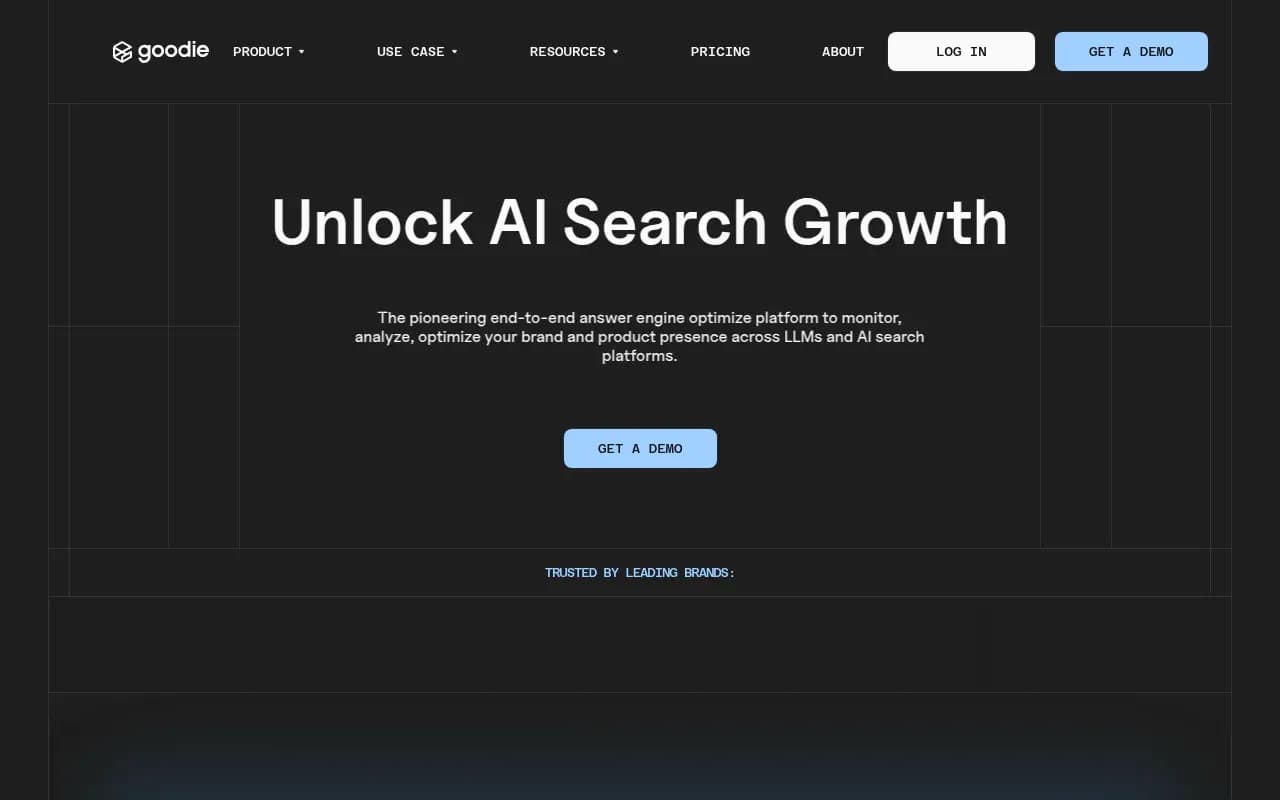
Goodie AI (marketed as "Goodie") is an enterprise-focused AEO (Answer Engine Optimization) platform that tracks how brands appear across 11 AI models: ChatGPT, Gemini, Perplexity, Claude, Grok, Meta AI, Microsoft Copilot, DeepSeek, Google AI Overviews, Google AI Mode, and Amazon Rufus. The Rufus inclusion is notable -- most competitors ignore Amazon's AI shopping assistant entirely.
The platform positions itself around a four-stage loop: Research (understand prompts and visibility opportunities), Monitor (track mentions, citations, sentiment), Action (identify gaps and execute improvements), and Measure (connect visibility to business outcomes). That's a reasonable framework, though how well each stage is actually built out is harder to verify without public pricing or a self-serve trial.
Goodie is clearly built for larger organizations. There's no self-serve plan, no public pricing page, and no free trial. You book a demo, talk to sales, and get a custom quote. That works fine for enterprise procurement processes, but it's a real barrier for smaller teams or anyone who wants to evaluate the tool quickly.
AlsoAsked
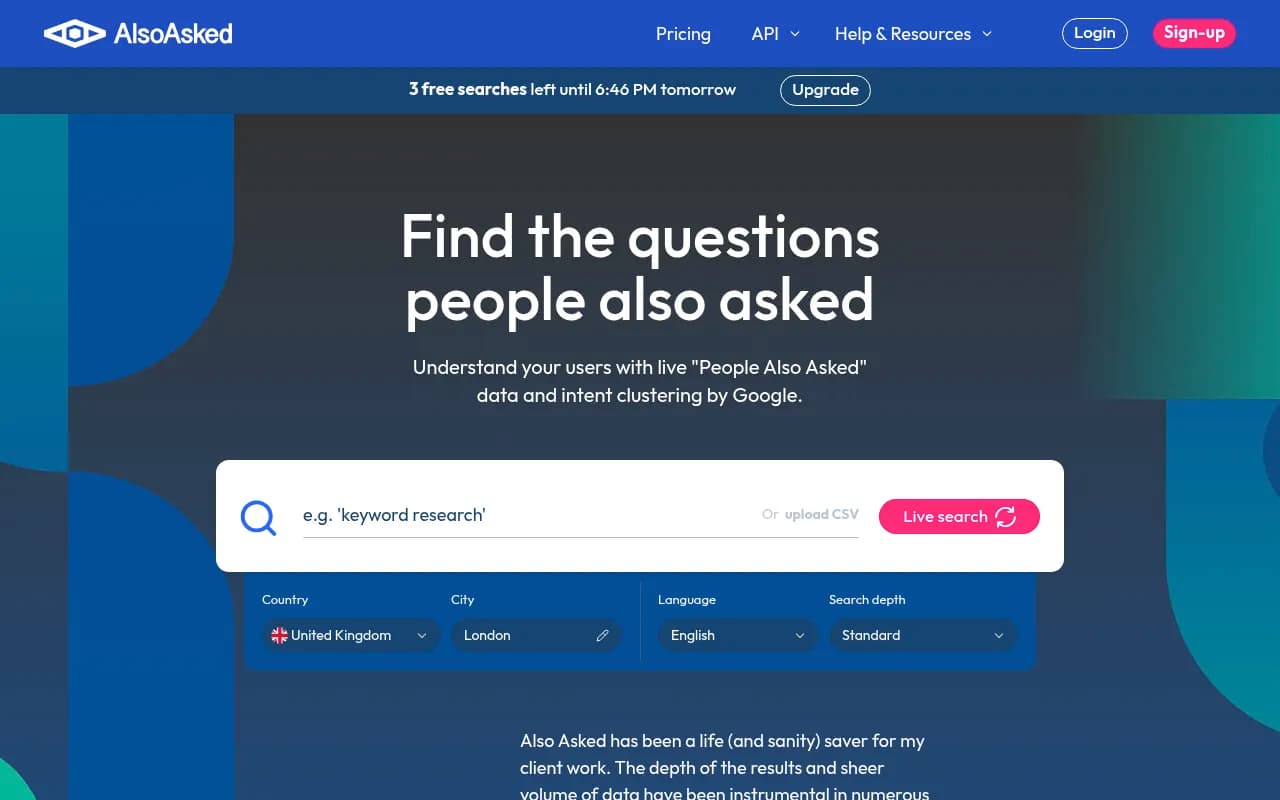
AlsoAsked is a focused, well-executed tool that does one thing: pull real-time People Also Ask (PAA) data from Google and organize it into visual question trees. You enter a search term, pick a country and language, and get back a structured map of related questions that Google surfaces for that query.
The depth is genuinely impressive. A single "deep dive" search can return 150+ questions. The tool covers 130+ countries with city-level geo-targeting, supports bulk uploads of up to 1,000 terms at once, and has an API for teams that want to integrate PAA data into their own workflows. It's been around long enough to have a solid reputation among SEO practitioners and content strategists.
The AI angle AlsoAsked leans into is that PAA questions reveal conversational intent -- the same kind of intent that drives AI search queries. That's a fair point, though it's worth being clear: AlsoAsked doesn't monitor AI models or track brand citations. It's a Google data tool.
Side-by-side comparison
| Feature | Goodie AI | AlsoAsked |
|---|---|---|
| Primary use case | AI model brand visibility monitoring | Google PAA question research |
| Free tier | No | Yes (10 credits) |
| Self-serve access | No (demo required) | Yes |
| Starting price | Custom/quote | $12/month |
| AI models tracked | 11 (ChatGPT, Gemini, Perplexity, Claude, Grok, Meta AI, Copilot, DeepSeek, AI Overviews, AI Mode, Rufus) | None |
| Google PAA data | No | Yes (real-time) |
| Geo-targeting | Yes | Yes (130+ countries, city-level) |
| Competitor monitoring | Yes | No |
| Citation tracking | Yes | No |
| Sentiment analysis | Yes | No |
| Content gap analysis | Yes (AI-focused) | Yes (question-based) |
| API access | Not publicly confirmed | Yes (Pro plan and above) |
| Bulk search | Not publicly confirmed | Yes (up to 1,000 terms) |
| Target audience | Enterprise brands, large agencies | SEO teams, content creators, agencies |
| Amazon Rufus tracking | Yes | No |
Head-to-head feature deep-dive
Core purpose and use case fit
This is where the comparison gets a bit awkward, because these tools aren't really competing for the same job.
Goodie AI answers: "Is my brand being recommended by AI models when users ask relevant questions?" It tracks mentions, citations, sentiment, and competitive share across LLMs. That's a genuinely new category of monitoring that didn't exist three years ago.
AlsoAsked answers: "What questions are people asking around this topic on Google?" It maps the PAA ecosystem to help you understand search intent and find content opportunities. That's a well-established SEO research workflow.
The only real overlap is in content gap analysis. Goodie AI can show you which AI prompts your competitors appear in but you don't. AlsoAsked can show you which questions your content isn't answering. Both outputs can inform a content strategy, but they're pulling from completely different data sources.
Verdict: Neither tool replaces the other. If you're choosing between them because you have budget for one, the question is really "what's my bigger problem right now -- AI search visibility or traditional SEO content gaps?"
Data sources and coverage
| Dimension | Goodie AI | AlsoAsked |
|---|---|---|
| Data source | Live queries to 11 AI models | Real-time Google PAA data |
| Geographic coverage | Multi-region (specifics not public) | 130+ countries, city-level |
| Language support | Not publicly specified | Multiple languages |
| Freshness | Live/near-real-time monitoring | Real-time |
| Amazon coverage | Yes (Rufus) | No |
| Historical data | Yes (trend tracking) | Limited |
Goodie AI's 11-model coverage is broad, and the Amazon Rufus inclusion is a real differentiator for e-commerce brands. AlsoAsked's geographic depth is exceptional for a tool at its price point -- city-level targeting for 130+ countries is more granular than most enterprise SEO tools offer.
Verdict: Different data entirely. Goodie AI wins on AI model breadth; AlsoAsked wins on geographic granularity.
Content and SEO workflow integration
AlsoAsked fits naturally into a content planning workflow. You research a topic, get a tree of related questions, identify gaps in your existing content, and brief writers. The visual question maps are easy to share with non-technical stakeholders. The bulk upload feature means you can process an entire content calendar's worth of topics in one session.
Goodie AI's content angle is more about identifying which AI prompts you're missing from, then presumably creating content to address those gaps. The "Action" stage of their loop references optimizing "owned and earned assets," but the specifics of how that works aren't publicly documented in detail.
Verdict: AlsoAsked has a clearer, more immediate content workflow. Goodie AI's content optimization capabilities are harder to evaluate without access to the platform.
Monitoring and tracking
This is Goodie AI's home turf. It tracks brand mentions, citation frequency, sentiment, and competitive share across 11 AI models. The Measure stage claims to connect visibility to business outcomes -- attribution that links AI citations to actual traffic or conversions. That's a meaningful capability if it works as described.
AlsoAsked doesn't do any monitoring. It's a research tool, not a tracking platform. You run searches when you need data; there's no ongoing monitoring or alerting.
Verdict: Goodie AI wins decisively. AlsoAsked doesn't compete here.
Pricing and accessibility
This is where the gap is most stark.
AlsoAsked is transparent, affordable, and self-serve. You can start for free, upgrade when you need more credits, and cancel anytime. The Agency plan at $99/month with API access is genuinely good value for what it includes.
Goodie AI has no public pricing. "Custom/quote-based" typically means the cost is calibrated to enterprise budgets -- think thousands per month, not hundreds. There's also no way to try the product without going through a sales process, which is a real friction point for teams that want to evaluate tools independently.
Verdict: AlsoAsked wins on accessibility and price transparency. Goodie AI may be worth the cost for enterprise teams, but you won't know what that cost is until you've had multiple sales conversations.
Ease of getting started
AlsoAsked: Sign up, get 10 free credits, run your first search in under two minutes. The interface is clean and the output is immediately useful.
Goodie AI: Fill out a contact form, book a demo, wait for a sales call, get a proposal, negotiate pricing, onboard. That process could take weeks.
Verdict: AlsoAsked by a wide margin. This isn't a criticism of Goodie AI specifically -- enterprise SaaS often works this way -- but it's a real practical difference.
Reporting and export
AlsoAsked lets you export question trees as images or CSV files, which makes it easy to share findings with clients or drop data into a spreadsheet. The API (Pro plan and above) opens up more sophisticated integrations.
Goodie AI's reporting capabilities aren't publicly documented in detail, but the platform claims to offer attribution and ROI measurement, which implies some form of dashboard and export functionality.
Verdict: AlsoAsked's export options are well-documented and practical. Goodie AI's reporting depth is harder to assess without access.
Pricing comparison
| Plan | Goodie AI | AlsoAsked |
|---|---|---|
| Free | No | Yes (10 credits) |
| Entry | Custom quote | $12/mo (Basic, 100 credits) |
| Mid-tier | Custom quote | $23/mo (Lite, 300 credits) |
| Pro | Custom quote | $49/mo (Pro, 1,000 credits + API) |
| Agency/Enterprise | Custom quote | $99/mo (Agency, 3,000 credits) |
AlsoAsked credits are consumed per search. A standard search uses 1 credit; deep-dive searches use more. The credit model is straightforward once you understand your typical usage patterns.
Goodie AI's pricing is entirely opaque. Based on comparable enterprise AI visibility platforms, expect costs in the range of $1,000-$5,000+/month, but that's an estimate -- you'd need to go through their sales process to get an actual number.
Pros and cons
Goodie AI
Pros:
- Tracks 11 AI models including Amazon Rufus, which most competitors skip
- Full monitoring loop: research, monitor, action, measure
- Sentiment analysis and competitive share tracking
- Claims attribution from AI visibility to business outcomes
- Trusted by recognizable enterprise brands (Dermalogica, Rathbones, Skylum)
Cons:
- No public pricing -- requires a sales conversation to get started
- No free trial or self-serve access
- Feature depth is hard to verify independently without platform access
- Overkill (and likely too expensive) for small teams or individual practitioners
- Limited public documentation on how the "Action" stage actually works
AlsoAsked
Pros:
- Free tier available, paid plans start at $12/month
- Instant self-serve access -- no sales call required
- Exceptional geographic depth (130+ countries, city-level)
- Returns 150+ questions per deep-dive search
- Bulk upload for up to 1,000 terms at once
- API available on Pro plan and above
- Clean, shareable visual output
- Well-established reputation in the SEO community
Cons:
- Doesn't track AI model visibility at all
- No competitor monitoring or brand mention tracking
- No ongoing monitoring -- purely a research tool
- Credit model can get expensive for heavy users
- Limited to Google's PAA data (no Bing, no AI-native data)
Who should pick which tool
Pick Goodie AI if:
- You're an enterprise brand or large agency that needs to monitor how your brand appears in AI search results
- Amazon Rufus visibility matters to your business (e-commerce brands especially)
- You need competitive intelligence on AI model citations and sentiment
- You have budget for an enterprise platform and a procurement process to match
- Your primary concern is AI search visibility, not traditional SEO content research
Pick AlsoAsked if:
- You're a content strategist, SEO consultant, or copywriter who needs to understand search intent
- You want to map question clusters to inform content briefs, topic clusters, or FAQ sections
- You need geo-specific question data for international SEO work
- You're working with a limited budget and need immediate, self-serve access
- You want to improve AI visibility indirectly by creating content that answers the questions AI models pull from
Pick both if:
- You have the budget and want to cover both angles: use AlsoAsked for content research and question mapping, use Goodie AI to track whether that content is actually getting cited by AI models
It's worth noting that if AI search visibility is a priority, Promptwatch is another platform worth evaluating -- it combines brand monitoring across 10+ AI models with built-in content gap analysis and an AI writing agent that generates content specifically engineered to get cited by ChatGPT, Claude, and Perplexity.

Final verdict
Goodie AI and AlsoAsked are tools for different jobs, and the "vs" framing only makes sense if you're choosing where to spend a limited research budget. Goodie AI is an enterprise AI visibility platform with no self-serve access and no public pricing. AlsoAsked is an affordable, well-built question research tool that anyone can start using today for $12/month.
For most practitioners reading this: start with AlsoAsked. It's accessible, proven, and immediately useful for content strategy. If you're at an enterprise brand where AI model visibility is a board-level concern and budget isn't the constraint, Goodie AI is worth a demo call -- just go in knowing you won't get a price until you've had several conversations.