Key takeaways
- Goodie AI and Bardeen are not competitors. One monitors AI search visibility; the other scrapes and enriches sales leads. If you landed here expecting a feature-for-feature fight, the honest answer is: pick based on what problem you're actually solving.
- Bardeen has a free plan and self-serve pricing starting at $10/month. Goodie AI requires a demo call and custom quote — no public pricing at all.
- Goodie AI tracks brand mentions and citations across 11 AI models (ChatGPT, Gemini, Perplexity, Amazon Rufus, etc.). Bardeen has no AI search monitoring capabilities.
- Bardeen is built for sales teams who need to source leads from any website, verify contact info, and qualify prospects with AI. Goodie AI has no lead generation or CRM features.
- If you're a marketing or SEO team trying to understand how AI engines represent your brand, Goodie AI is the relevant tool. If you're in sales ops or growth, Bardeen is the relevant tool.
- Neither tool does what the other does. The real question isn't "which is better" — it's "which problem do I have?"
Overview
Goodie AI
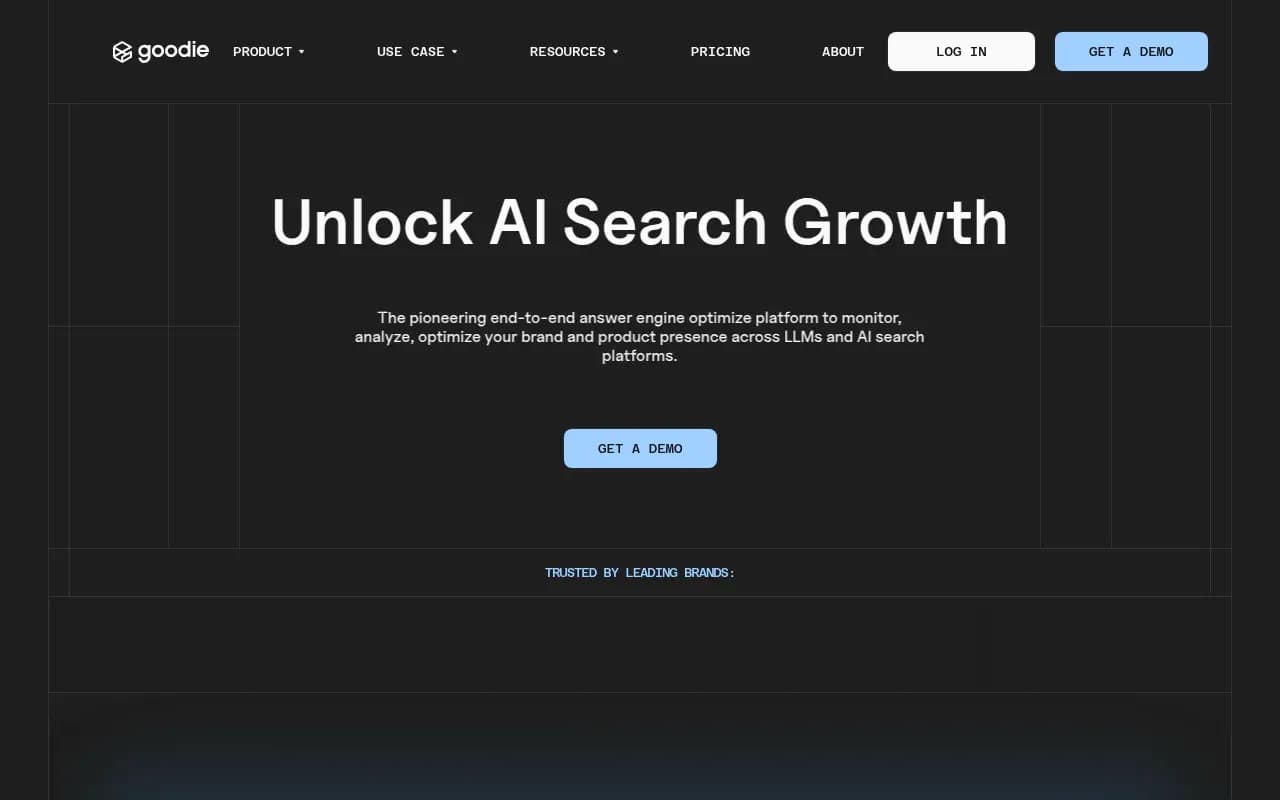
Goodie AI (higoodie.com) positions itself as an end-to-end AEO (Answer Engine Optimization) platform. The pitch is a four-stage closed loop: research customer prompts, monitor brand visibility across AI models, take action on optimization gaps, and measure ROI through attribution. It tracks 11 AI models including ChatGPT, Gemini, Perplexity, Google AI Overviews, Claude, Grok, Meta AI, Amazon Rufus, Copilot, and DeepSeek. The client list includes brands like Dermalogica and Skylum, which suggests a mid-market to enterprise focus. There's no self-serve option — you book a demo and get a custom quote.
Bardeen
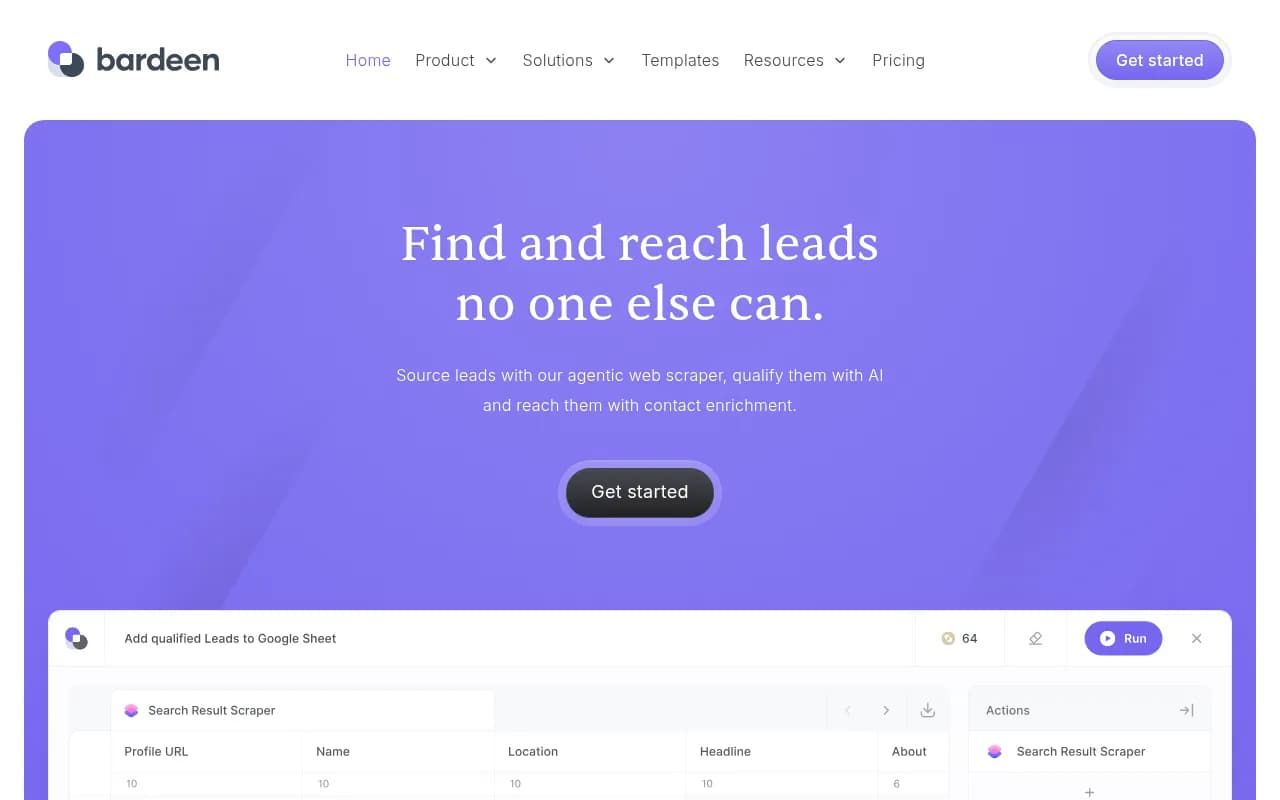
Bardeen (bardeen.ai) is a sales automation and lead intelligence tool. The core workflow: scrape leads from any website using an agentic browser-based scraper, enrich those leads with verified contact info, qualify them using AI against your ideal customer profile, and export to your CRM or spreadsheet. It's built for sales reps, growth teams, and solopreneurs who spend too much time manually researching prospects. There's a free tier, and paid plans are genuinely affordable at $10-25/month per user.
Side-by-side comparison
| Feature | Goodie AI | Bardeen |
|---|---|---|
| Primary use case | AI search visibility & AEO monitoring | Lead scraping, enrichment & qualification |
| Target user | Marketing teams, SEO, brand managers | Sales teams, growth, solopreneurs |
| Free plan | No | Yes |
| Pricing model | Custom quote only | Self-serve, $10-25/mo per user |
| AI model tracking | 11 models (ChatGPT, Gemini, Perplexity, etc.) | None |
| Web scraping | No | Yes (agentic, any website) |
| Contact enrichment | No | Yes (verified emails & phone) |
| Lead qualification | No | Yes (AI-driven ICP matching) |
| Brand mention monitoring | Yes | No |
| Citation tracking | Yes | No |
| Competitor visibility analysis | Yes | No |
| CRM/spreadsheet export | No | Yes (Google Sheets, Airtable, Notion, CSV) |
| Amazon Rufus tracking | Yes | No |
| Content optimization | Partial (gap analysis) | No |
| API access | Not publicly documented | Yes |
| Self-serve signup | No (demo required) | Yes |
Head-to-head feature deep-dive
Core purpose
This is where the comparison gets awkward, because these tools genuinely don't compete. Goodie AI answers the question: "How visible is my brand when someone asks an AI chatbot about my product category?" Bardeen answers: "How do I find and contact 500 qualified leads this week without doing it manually?"
A marketing director at a consumer brand might care deeply about Goodie AI's data. A sales development rep at a B2B SaaS company would find Bardeen far more useful. The overlap is essentially zero.
Verdict: Pick based on your job function, not feature comparisons.
AI model coverage
Goodie AI tracks 11 AI models: ChatGPT, Gemini, Perplexity, Google AI Overviews, Google AI Mode, Claude, Grok, Meta AI, Amazon Rufus, Copilot, and DeepSeek. The Amazon Rufus inclusion is notable — it's the only e-commerce AI assistant on the list, which makes Goodie AI more relevant for retail and consumer brands than most competitors in this space.
Bardeen uses AI internally (for lead qualification and web search), but it doesn't monitor AI models or track brand citations. It's a consumer of AI, not a monitor of it.
Verdict: Goodie AI wins on AI coverage — but Bardeen isn't trying to compete here.
Lead generation and sales features
Bardeen's scraper can pull structured data from any website — LinkedIn, directories, job boards, company pages, wherever your prospects live. The agentic approach means it can navigate pages, handle pagination, and extract data without you writing code. Contact enrichment then layers in verified emails and phone numbers. The AI qualification step lets you describe your ideal customer profile in plain language and have Bardeen score and filter leads automatically.
Goodie AI has none of this. It's not a sales tool.
Verdict: Bardeen wins, by default.
Monitoring and analytics
Goodie AI's monitoring covers brand mentions, citation frequency, sentiment, and competitive share of voice across its 11 tracked models. The "Research" phase includes prompt volume patterns and visibility opportunities — essentially helping you understand which questions your customers are asking AI engines and whether your brand shows up in the answers.
Bardeen has no monitoring or analytics in this sense. It generates data (scraped leads) rather than analyzing how your brand is perceived.
Verdict: Goodie AI wins, by default.
Pricing and accessibility
This is where the gap is most concrete. Bardeen has a free plan, transparent self-serve pricing, and you can be up and running in minutes. Goodie AI requires a demo call and custom pricing negotiation — which isn't inherently bad (enterprise tools often work this way), but it means you can't evaluate the actual cost without talking to a salesperson first.
For smaller teams or individuals, Bardeen's accessibility is a genuine advantage. For enterprise brands with procurement processes, Goodie AI's custom model may be fine.
Verdict: Bardeen is significantly more accessible. Goodie AI's pricing opacity is a friction point for anyone not already in an enterprise buying cycle.
Content optimization and action
Goodie AI claims an "Action" phase in its closed loop — identifying optimization gaps and executing improvements across owned and earned assets. The website is light on specifics about what this looks like in practice, which makes it hard to evaluate. It's positioned as more than just monitoring, but the depth of content generation or optimization tooling isn't clearly documented publicly.
Bardeen doesn't do content optimization at all.
If content optimization for AI search is your priority, it's worth looking at platforms that are more explicit about their capabilities here. Promptwatch is one that's specific about this: it includes an AI writing agent that generates content grounded in citation data, plus answer gap analysis that shows exactly which prompts competitors rank for but you don't.

Verdict: Goodie AI has some optimization features, but the specifics are unclear from public information. Bardeen doesn't play here.
Integrations and export
Bardeen exports to Google Sheets, Airtable, Notion, and CSV out of the box, with CRM integrations for sales workflows. The API is available for custom workflows.
Goodie AI's integration story isn't publicly documented in detail. Enterprise platforms in this space typically offer some form of reporting export or API, but specifics require a demo conversation.
Verdict: Bardeen has clearer, more accessible integrations for its use case.
Pricing comparison
| Plan | Goodie AI | Bardeen |
|---|---|---|
| Free | No | Yes (limited credits) |
| Starter/Professional | Custom quote | $10/mo per user |
| Business | Custom quote | $25/mo per user |
| Enterprise | Custom quote | Custom pricing |
| Enrichment credits | Not disclosed | Sold separately |
| Annual discount | Not disclosed | Available |
Bardeen's pricing is transparent and low enough that individuals can justify it. Goodie AI's custom-only model means you're committing to a sales process before you know the number.
Pros and cons
Goodie AI
Pros:
- Tracks 11 AI models including Amazon Rufus (rare for this category)
- Claims a full closed loop: research, monitor, action, measure
- Built for enterprise brands with real attribution goals
- Competitive share of voice and citation tracking in one platform
Cons:
- No public pricing — requires a demo before you know what you're buying
- No free trial or self-serve access
- Content optimization features aren't well-documented publicly
- No lead generation, CRM, or sales features
- Smaller public client list compared to some competitors
Bardeen
Pros:
- Free plan available, self-serve signup
- Genuinely affordable at $10-25/month per user
- Agentic scraper works on any website without code
- AI qualification is a real time-saver for sales teams
- Clean export options (Sheets, Airtable, Notion, CSV)
- Large template library to get started fast
Cons:
- No AI search monitoring or brand visibility features
- Enrichment credits are sold separately, which can add up
- Not built for marketing, SEO, or brand teams
- Collaboration features have been cited as limited by some users
- No content optimization capabilities
Who should pick which tool
Pick Goodie AI if:
- You're a marketing or SEO team trying to understand your brand's presence in AI search results
- You need to track citations and mentions across ChatGPT, Gemini, Perplexity, and similar platforms
- You sell consumer products and want Amazon Rufus visibility data
- You're at an enterprise brand with budget for a custom platform and a clear AEO strategy
Pick Bardeen if:
- You're in sales, growth, or business development and need leads fast
- You want to scrape prospect data from LinkedIn, directories, or any website without writing code
- You need verified contact info (emails, phone numbers) for outreach
- You're a solopreneur or small team that needs affordable, self-serve automation
- You want to qualify leads against an ICP without manually reviewing each one
Pick neither if:
- You need a tool that does both AI visibility monitoring and sales automation — no single tool does both well right now
- You're looking for traditional SEO analytics (neither tool covers this)
Final verdict
Goodie AI and Bardeen are solving different problems for different people. Comparing them directly is a bit like comparing a brand tracker to a CRM — the category overlap is minimal. If you're a marketer asking "how does AI search see my brand?", Goodie AI is the relevant conversation. If you're a sales rep asking "how do I find and contact 500 qualified prospects this week?", Bardeen is your answer. The only reason someone might be choosing between them is if they're evaluating a broad "AI tools" budget — in which case, the decision should come down entirely to which problem is more urgent for your team right now.