Key Takeaways
- Pricing gap is massive: Gumshoe starts at $0.10 per conversation with a free tier (3 reports), while Bluefish requires custom enterprise quotes estimated at $4,000+/month -- a 40,000x difference in entry cost
- Gumshoe wins for small teams and agencies: Pay-as-you-go model means you only spend when you need data, perfect for project-based work or testing AI visibility without commitment
- Bluefish is Fortune 500-only: Built for enterprise scale with custom audiences, infosec reviews, and dedicated success managers -- overkill (and unaffordable) for most businesses
- Both lack optimization features: Neither platform offers content generation, crawler logs, or the action-oriented tools found in comprehensive GEO platforms like Promptwatch
- Model coverage is similar: Both track ChatGPT, Gemini, and Perplexity, though neither covers the full range of AI models (Claude, Meta AI, Grok, DeepSeek, Mistral, Copilot)
- Bluefish adds commerce tracking: Unique focus on agentic commerce channels, but this only matters if you're selling products through AI recommendations
Overview: Two very different approaches to AI visibility
Gumshoe AI
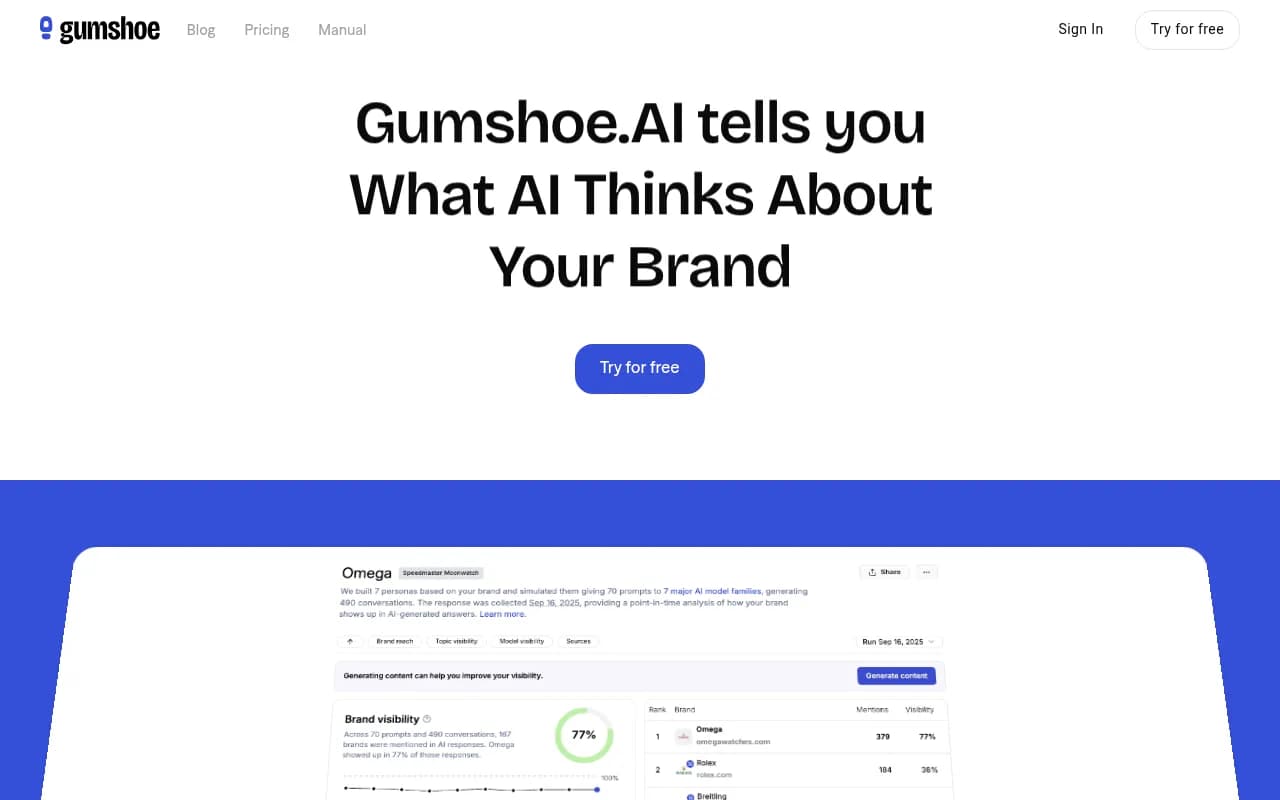
Gumshoe AI positions itself as the accessible entry point for AI search monitoring. You get persona-based tracking across ChatGPT, Gemini, and Perplexity with straightforward pay-per-report pricing. The pitch: see what AI thinks about your brand without signing a contract or committing to monthly fees.
The platform focuses on visibility metrics -- how often you're mentioned, how you rank against competitors, which topics trigger your brand name, and what sources AI models cite. It's monitoring-first, which means you get data but limited help acting on it.
Bluefish AI
Bluefish AI targets the opposite end of the market. This is the platform Fortune 500 brands use when they need custom audiences, tailored prompt sets, and white-glove service. The website name-drops enterprise clients and emphasizes "depth and control" over generic datasets.
Bluefish adds agentic commerce tracking (monitoring how your products show up in AI shopping recommendations) and promises to help marketers understand how AI "thinks" -- not just what it says. The trade-off: you need an enterprise budget and the patience for a sales process.
Side-by-side comparison
| Feature | Gumshoe AI | Bluefish AI |
|---|---|---|
| Starting price | Free (3 reports), then $0.10/conversation | Custom quote (~$4,000+/month) |
| Free tier | ✓ Yes (3 report runs) | ✗ No |
| Self-service signup | ✓ Yes | ✗ No (sales demo required) |
| AI models tracked | ChatGPT, Gemini, Perplexity | ChatGPT, Gemini, Perplexity, AI commerce channels |
| Persona-based tracking | ✓ Yes | ✓ Yes (custom audiences) |
| Competitor benchmarking | ✓ Yes | ✓ Yes |
| Content generation | Basic AI-assisted generation | ✗ No |
| Crawler logs | ✗ No | ✗ No |
| Citation analysis | ✓ Top cited sources | ✓ Deep source analysis |
| Scheduled reports | ✓ Yes (paid plans) | ✓ Yes |
| API access | ✗ No (standard plans) | ✓ Yes (enterprise) |
| Commerce tracking | ✗ No | ✓ Yes (agentic commerce) |
| Target customer | SMBs, agencies, marketers | Fortune 500, enterprise teams |
Pricing: The 40,000x difference
This is where the comparison gets stark.
| Plan | Gumshoe AI | Bluefish AI |
|---|---|---|
| Free tier | 3 report runs | None |
| Entry price | $0.10 per conversation | ~$4,000+/month (estimated) |
| Mid-tier | Pay as you go (scales with usage) | Custom enterprise pricing |
| Enterprise | Custom (volume discounts available) | Custom (dedicated success manager, APIs) |
| Annual commitment | None required | Likely required |
Gumshoe's model is refreshingly simple: you pay ten cents every time you run a conversation through the platform. Run 100 conversations in a month? That's $10. Run 1,000? $100. The free tier lets you test the platform with three report runs before spending anything.
Bluefish doesn't publish pricing. Based on their enterprise positioning and feature set, expect quotes starting around $4,000/month -- possibly much higher depending on scale and customization. This isn't a platform you casually try out.
For context, if you're also tracking how AI search engines crawl your website and want content optimization tools to actually improve your visibility, Promptwatch sits in the middle at $99-579/month with transparent pricing and self-service signup.

User interface and workflow
Gumshoe AI: Straightforward dashboards
Gumshoe's interface centers on report runs. You define your brand, competitors, topics, and personas, then generate a report that shows:
- Brand visibility scores across models
- Competitive ranking for each topic
- Persona-specific performance (how often different buyer types see your brand)
- Topic visibility breakdown
- Model-by-model comparison
- Top cited sources
The workflow is: configure → run report → analyze results → repeat. Storage integrations let you export data to your own systems. The platform doesn't try to be fancy -- it gives you the numbers and gets out of the way.
Bluefish AI: Enterprise complexity
Bluefish emphasizes "depth and control" which translates to more configuration options and customization. You get:
- Custom audience definitions (not just generic personas)
- Tailored prompt sets specific to your market
- Deep performance analytics with custom segmentation
- Automated optimization workflows
- Collections feature for measuring campaign ROI in AI channels
The interface is built for teams that need to slice data multiple ways and integrate with existing marketing stacks. Expect a steeper learning curve and more time spent in setup.
Model coverage and tracking depth
Both platforms track the big three: ChatGPT, Gemini, and Perplexity. Neither covers the full landscape of AI models (Claude, Meta AI, Grok, DeepSeek, Mistral, Copilot are all missing).
Gumshoe AI treats each model equally -- you see visibility scores and rankings across all three with no obvious prioritization.
Bluefish AI adds agentic commerce tracking, which means monitoring product recommendations and shopping-related AI responses. If you're an e-commerce brand or sell physical products, this matters. For B2B SaaS or service businesses, it's irrelevant.
Neither platform matches the 10+ model coverage you'd get from more comprehensive tools, but they cover the models most people care about first.
Persona and audience targeting
Gumshoe AI: Predefined personas
Gumshoe lets you track performance across different buyer personas. You define who these personas are (job titles, industries, use cases) and the platform shows how often each persona type sees your brand mentioned.
This is useful for understanding whether you're visible to decision-makers vs. end users, or whether you show up more for technical buyers vs. business buyers. The personas are relatively straightforward -- you're not building complex psychographic profiles.
Bluefish AI: Custom audiences
Bluefish emphasizes custom audiences as a differentiator. Instead of generic personas, you can define highly specific audience segments that match your actual customer base.
The platform positions this as critical for competitive markets where "generic datasets aren't enough." In practice, this means more setup work but potentially more relevant insights if you have well-defined customer segments.
Content optimization and generation
Gumshoe AI includes basic AI-assisted content generation in paid plans. The feature is mentioned but not detailed on their site -- expect lightweight suggestions rather than full content creation.
Bluefish AI doesn't offer content generation at all. The platform is monitoring and analytics-focused.
Both platforms fall short here compared to action-oriented GEO tools. If you want to actually create content that ranks in AI search (not just track what's happening), you need a platform with content gap analysis and AI writing capabilities built in.
Competitive intelligence
Both platforms offer competitor benchmarking, but with different approaches.
Gumshoe AI lets you add competitors to your reports and see side-by-side rankings across topics and models. You get a straightforward view of who's winning for each prompt and by how much.
Bluefish AI positions competitive analysis as deeper and more nuanced -- understanding not just who ranks but why, with source analysis and influence metrics. The actual difference in practice is unclear without hands-on access.
Reporting and data export
Gumshoe AI
- Scheduled reports (paid plans)
- Storage integrations for exporting data
- Trend tracking over time
- Team sharing capabilities
- No API access on standard plans
Bluefish AI
- Custom reporting frameworks
- Advanced segmentation and filtering
- API access (enterprise plans)
- Integration with marketing stacks
- Automated workflows
- Collections feature for campaign measurement
Bluefish clearly wins on data flexibility and integration options, but you're paying for that complexity.
What's missing from both platforms
Neither Gumshoe nor Bluefish offers:
- Crawler logs: You can't see when AI models visit your website or what pages they read
- Content gap analysis: No systematic way to identify which prompts competitors rank for but you don't
- Prompt intelligence: No volume estimates or difficulty scores to prioritize which prompts to target
- Multi-language tracking: Limited or no support for non-English AI responses
- Reddit/YouTube insights: No tracking of discussions that influence AI recommendations
- Full model coverage: Missing Claude, Meta AI, Grok, DeepSeek, Mistral, Copilot
These are table-stakes features in comprehensive GEO platforms but absent here.
Pros and cons
Gumshoe AI pros
- Incredibly low barrier to entry ($0.10/conversation, 3 free reports)
- No contracts or monthly commitments
- Perfect for project-based work or occasional monitoring
- Straightforward interface and workflow
- Persona-based tracking included
- Good for agencies managing multiple clients
Gumshoe AI cons
- Limited model coverage (only 3 AI engines)
- No crawler logs or content gap analysis
- Basic content generation capabilities
- No API access on standard plans
- Costs can add up quickly if you run many reports
- Monitoring-only -- doesn't help you fix visibility problems
Bluefish AI pros
- Built for enterprise scale and complexity
- Custom audiences and tailored prompts
- Agentic commerce tracking for product brands
- Deep analytics and segmentation
- API access and marketing stack integrations
- Dedicated success management
- Passes enterprise infosec reviews
Bluefish AI cons
- Prohibitively expensive for most businesses ($4,000+/month estimated)
- No transparent pricing or self-service signup
- Requires sales demo and likely annual commitment
- No content generation or optimization tools
- Still limited to 3 core AI models
- Overkill for small teams or simple monitoring needs
- No crawler logs or prompt intelligence
Who should pick which tool
Choose Gumshoe AI if you:
- Run a small marketing team, agency, or solo consultancy
- Need occasional AI visibility checks without ongoing costs
- Want to test AI monitoring before committing budget
- Manage multiple clients and need flexible per-project pricing
- Care more about quick insights than deep customization
- Have a limited budget (under $500/month for monitoring)
- Don't need API access or complex integrations
Choose Bluefish AI if you:
- Work at a Fortune 500 company with enterprise marketing budget
- Need custom audiences that match your specific customer segments
- Sell products and care about AI commerce recommendations
- Require white-glove service and dedicated support
- Have complex integration requirements with existing marketing tools
- Need to pass rigorous infosec reviews
- Can commit to $4,000+/month in monitoring spend
Choose neither if you:
- Want content optimization and generation tools, not just monitoring
- Need crawler logs to see how AI models access your website
- Want content gap analysis to identify missing topics
- Need coverage of more than 3 AI models
- Want prompt volume data and difficulty scoring
- Need Reddit and YouTube influence tracking
For those use cases, look at comprehensive GEO platforms that combine monitoring with optimization and content creation capabilities.
Final verdict
Gumshoe AI and Bluefish AI serve completely different markets and shouldn't really be compared head-to-head.
Gumshoe wins for 95% of businesses. The pay-per-report model is smart, the pricing is transparent, and you can start monitoring AI visibility today for free. It's not comprehensive, but it gives you the core visibility metrics without the enterprise price tag or sales process.
Bluefish is purpose-built for Fortune 500 brands that need custom everything and have the budget to match. If you're not spending six figures on marketing tools already, Bluefish isn't for you.
The bigger issue: both platforms are monitoring-only. They show you the problem but don't help you fix it. You see that competitors rank higher, but you don't get content gap analysis showing exactly what's missing from your site. You see low visibility scores, but you don't get tools to create content that AI models will actually cite.
If you want to move beyond monitoring into optimization -- tracking AI crawler behavior, identifying content gaps, generating articles that rank in AI search, and measuring the traffic impact -- you need a platform that closes the loop between visibility data and action.