Key Takeaways
- Ceyo costs $49/mo minimum with unlimited tracking, while Gumshoe charges $0.10 per conversation -- Gumshoe is cheaper if you run fewer than 490 reports monthly, but costs spiral fast at scale
- Ceyo tracks 4 AI models (ChatGPT, Gemini, Claude, Perplexity) vs Gumshoe's 3 (ChatGPT, Gemini, Perplexity) -- Claude coverage matters if you care about Anthropic's growing search presence
- Gumshoe offers 3 free reports to test the platform; Ceyo has no free tier but includes scheduled reports and trend tracking in the base plan
- Both platforms focus on monitoring only -- neither includes content gap analysis or AI content generation tools to actually fix visibility problems
- Ceyo provides more granular prompt analytics with sentiment scoring and impact metrics; Gumshoe emphasizes persona-based tracking and competitive benchmarking
- If you're serious about improving AI visibility (not just tracking it), tools like Promptwatch go further by showing you what content to create and helping you generate it
Overview
Gumshoe AI

Gumshoe AI is a straightforward brand monitoring tool for AI search engines. It tracks how often your brand shows up in ChatGPT, Gemini, and Perplexity responses across topics and personas you define. The pitch is simple: pay only for what you use at $0.10 per conversation, with 3 free reports to start. You get visibility metrics, competitive rankings, and cited source data to understand where your brand stands. The interface is clean, the setup is fast, and the pricing model works well for occasional monitoring or small-scale tracking.
What Gumshoe doesn't do: help you fix the problems it uncovers. It shows you the gaps but leaves you to figure out the content strategy, optimization tactics, and execution on your own.
Ceyo
Ceyo
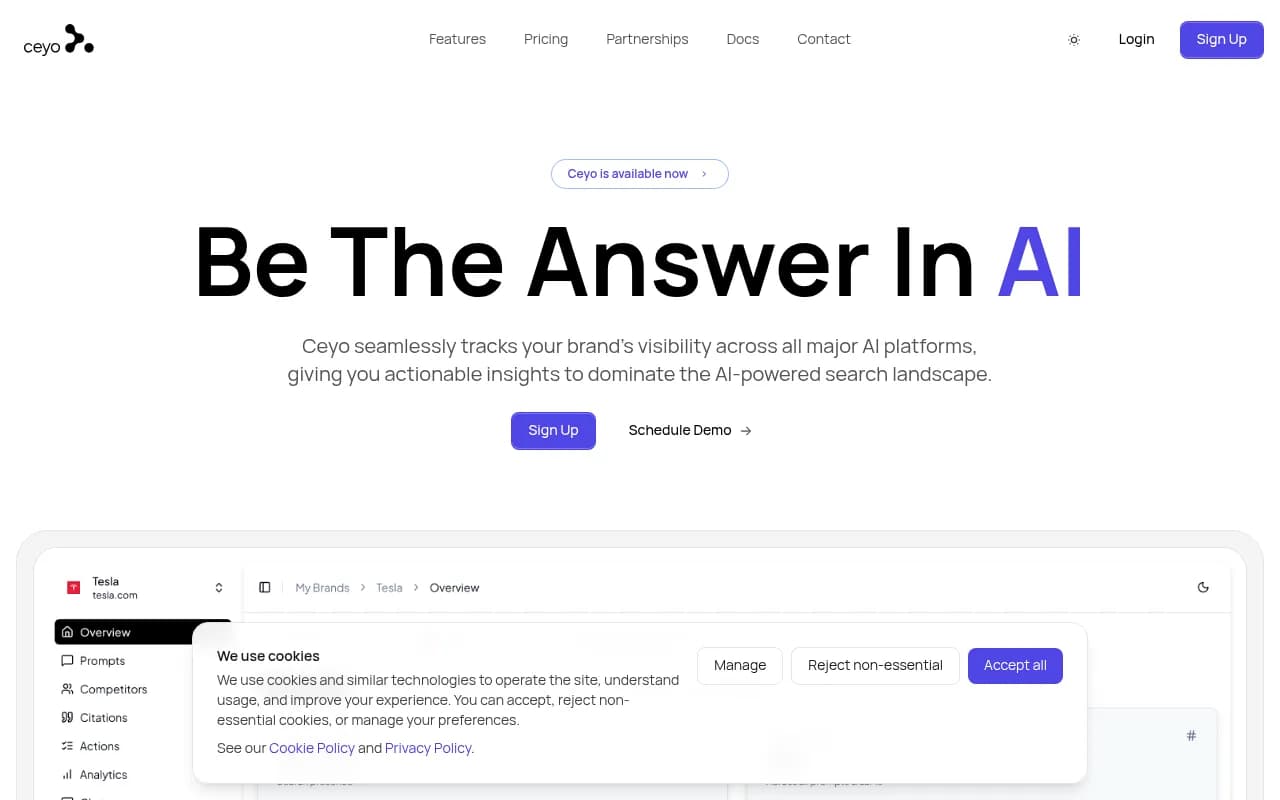
Ceyo positions itself as a full GEO (Generative Engine Optimization) platform for tracking brand visibility across ChatGPT, Gemini, Claude, and Perplexity. It monitors thousands of prompts, tracks sentiment and brand mentions, and delivers actionable insights through a dashboard that emphasizes prompt analytics and competitive intelligence. The $49/mo starting price includes scheduled reports, trend tracking, and AI-assisted content recommendations -- features Gumshoe gates behind usage costs.
Ceyo adds Claude to the mix, which matters if you're targeting Anthropic's user base or want comprehensive coverage across all major LLMs. The platform leans into analytics depth with impact scoring, sentiment analysis, and category breakdowns. But like Gumshoe, it's fundamentally a monitoring tool -- it tells you what's happening, not how to change it.
Side-by-side comparison
| Feature | Gumshoe AI | Ceyo |
|---|---|---|
| Pricing model | Pay-per-report ($0.10/conversation) | Subscription ($49/mo minimum) |
| Free tier | 3 free reports | None |
| AI models tracked | ChatGPT, Gemini, Perplexity (3) | ChatGPT, Gemini, Claude, Perplexity (4) |
| Scheduled reports | Paid feature | Included in base plan |
| Trend tracking | Paid feature | Included in base plan |
| Persona-based tracking | ✓ Core feature | Limited |
| Sentiment analysis | Basic | Detailed with impact scoring |
| Competitive benchmarking | ✓ | ✓ |
| Cited sources tracking | ✓ | ✓ |
| Content recommendations | AI-assisted (paid) | AI-assisted (included) |
| Content generation | ✗ | ✗ |
| API access | Enterprise only | Enterprise tier |
| Volume discounts | No | Enterprise tier |
| Best for | Occasional monitoring, budget-conscious teams | Regular tracking, teams wanting deeper analytics |
Pricing comparison
| Plan | Gumshoe AI | Ceyo |
|---|---|---|
| Free/Trial | 3 free reports | None |
| Entry tier | $0.10/conversation (pay as you go) | $49/mo (Core plan) |
| Mid tier | Same rate, scales with usage | Standard plan (pricing not public) |
| Enterprise | Custom pricing, volume discounts | Custom pricing |
| Annual discount | Not mentioned | Available |
| Break-even point | ~490 reports/mo = $49 | Unlimited reports at $49/mo |
The pricing math is straightforward. If you run fewer than 490 reports monthly, Gumshoe is cheaper. If you run 500+ reports, Ceyo's flat subscription saves money. At 1,000 reports per month, Gumshoe costs $100 vs Ceyo's $49. At 5,000 reports, Gumshoe hits $500 while Ceyo stays at $49 (or whatever their Standard tier costs).
Gumshoe's pay-per-use model feels safe when you're testing or tracking sporadically. Ceyo's subscription makes sense when monitoring becomes a regular workflow.
AI model coverage
Ceyo tracks four AI models: ChatGPT, Gemini, Claude, and Perplexity. Gumshoe tracks three: ChatGPT, Gemini, and Perplexity. The missing piece is Claude.
Does Claude matter? Depends on your audience. Claude (Anthropic) has grown fast in 2025-2026, especially among technical users, researchers, and teams that prioritize safety and accuracy. If your customers use Claude for product research or recommendations, you need visibility there. If your audience skews toward mainstream consumer search (ChatGPT, Gemini) or research-heavy queries (Perplexity), the gap matters less.
Both platforms miss several other AI models that are gaining traction: Grok (X's AI), DeepSeek (popular in Asia), Meta AI (integrated into Facebook/Instagram/WhatsApp), Mistral, and Copilot. If comprehensive coverage across all LLMs is critical, neither Gumshoe nor Ceyo delivers. Promptwatch monitors 10+ AI models including all of the above, plus Google AI Overviews and ChatGPT Shopping.

Prompt analytics and insights
Ceyo's dashboard emphasizes granular prompt-level data: visibility percentage, sentiment (positive/neutral/negative), average ranking, impact score, competing brands, category, and geography. You can see which prompts drive high visibility vs which ones bury your brand on page two. The sentiment tracking helps you spot where AI models are recommending you positively vs neutrally mentioning you vs ignoring you entirely.
Gumshoe focuses on persona-based tracking and topic visibility. You define buyer personas (e.g. "enterprise IT decision-maker" or "small business owner") and see how your brand performs across those segments. The competitive rank feature shows where you stand vs competitors across topics and models. Cited sources data reveals which pages or domains AI models pull from when mentioning your brand.
Both approaches have merit. Ceyo's prompt-level analytics work well if you want to optimize specific queries or understand sentiment trends. Gumshoe's persona lens works well if your marketing strategy is organized around buyer segments and you want to track visibility by audience type.
What both platforms lack: volume estimates and difficulty scoring for prompts. You can see how visible you are for a given query, but not how many people are actually asking that query or how hard it would be to improve your ranking. Prompt intelligence -- knowing which queries are high-value and winnable -- is a gap in both tools.
Competitive benchmarking
Both Gumshoe and Ceyo let you track competitors alongside your own brand. You define a set of competitors, and the platform shows how often each brand appears in AI responses for the same prompts.
Gumshoe presents competitive data as rankings across topics and models. You can see "We rank #3 for project management tools in ChatGPT, behind Asana and Monday." The interface is clean and the comparisons are easy to scan.
Ceyo's competitive view shows up in the prompt analytics table -- each row lists which brands appeared in the response for that query. You can filter by competitor to see where they're beating you or where you're winning. The sentiment and impact columns add context: it's not just about appearing, it's about appearing positively and in high-impact positions.
Neither platform offers heatmaps or visual comparisons that make it easy to spot patterns across hundreds of prompts. If you're tracking 50+ competitors across 500+ prompts, the data gets overwhelming fast. This is where more advanced platforms shine -- visual competitive intelligence that surfaces insights without drowning you in tables.
Content recommendations and optimization
Gumshoe includes "AI-assisted content generation" as a paid feature. The website doesn't detail what this means, but the implication is that the tool suggests content ideas or generates drafts based on visibility gaps. You'd need to test it to know how useful the output is.
Ceyo includes "AI-assisted content generation" in the base plan and promises "actionable insights to improve your AI presence." Again, specifics are thin. The website mentions "optimization recommendations" but doesn't show examples or explain the methodology.
Here's the reality: both platforms are monitoring tools first, optimization tools second. They can tell you where you're invisible and maybe suggest topics to cover, but they don't have the infrastructure to do deep content gap analysis or generate citation-optimized content at scale.
If you want to move from monitoring to action -- finding exactly which prompts competitors rank for that you don't, analyzing 880M+ citations to understand what content AI models prefer, and generating articles engineered to get cited -- you need a platform built for that workflow. Promptwatch's Answer Gap Analysis shows the specific content your site is missing, and the built-in AI writing agent creates articles grounded in real citation data and prompt volumes. That's the difference between a tracker and an optimization platform.
Scheduled reports and trend tracking
Ceyo includes scheduled reports and trend tracking in the $49/mo base plan. You can set up weekly or monthly reports that run automatically and track how your visibility changes over time. This is table stakes for a monitoring tool -- you shouldn't have to manually trigger reports every week.
Gumshoe gates scheduled reports and trend tracking behind usage costs. Every scheduled report costs $0.10 per conversation. If you want weekly reports across 10 personas and 5 topics (50 conversations), that's $5/week or $20/month just for automation. Add in ad-hoc reports and you're quickly past Ceyo's $49 flat rate.
The pay-per-use model punishes regular monitoring, which is the whole point of a visibility tracking tool. Ceyo's subscription makes more sense if you're treating AI visibility as an ongoing discipline rather than a one-time audit.
Storage integrations and team collaboration
Both platforms mention team sharing and storage integrations, but details are sparse. Gumshoe lists "storage integrations" as a feature in the free tier, suggesting you can export data to Google Sheets, Notion, or similar tools. Ceyo doesn't specify integrations on the public website.
Neither platform emphasizes collaboration features like role-based access, commenting, or shared dashboards. If you're working with a team or agency, you'll want to confirm what's actually supported before committing.
What's missing from both platforms
Gumshoe and Ceyo are monitoring-only tools. They show you where you stand but leave the hard work -- figuring out what to do about it -- entirely to you. Here's what neither platform offers:
- AI crawler logs: You can't see which AI models are actually crawling your website, which pages they're reading, or whether they're encountering errors. This is critical for diagnosing indexing issues.
- Content gap analysis: No systematic way to identify which prompts competitors rank for that you don't, or what specific content you're missing.
- Citation analysis: Limited insight into which types of content (Reddit threads, YouTube videos, blog posts, product pages) AI models prefer to cite.
- Prompt intelligence: No volume estimates or difficulty scores to help you prioritize which prompts to target.
- Traffic attribution: No way to connect AI visibility to actual website traffic or revenue.
- Multi-language and multi-region tracking: Both platforms seem US/English-focused without clear support for other languages or geographies.
If you're serious about AI visibility as a growth channel -- not just a vanity metric -- you need tools that close the loop from monitoring to optimization to measurement.
Pros and cons
Gumshoe AI pros
- Pay-per-use pricing is genuinely cheap for occasional monitoring (3-50 reports/month)
- 3 free reports let you test before spending
- Persona-based tracking aligns well with audience-segmented marketing strategies
- Clean interface, fast setup
- Competitive benchmarking is straightforward and easy to understand
Gumshoe AI cons
- Pricing becomes expensive fast at scale (500+ reports/month)
- Scheduled reports and trend tracking cost extra, defeating the purpose of ongoing monitoring
- Only tracks 3 AI models (missing Claude and others)
- No content gap analysis or optimization tools beyond basic recommendations
- No AI crawler logs or traffic attribution
- Limited prompt intelligence (no volume or difficulty data)
Ceyo pros
- Flat $49/mo pricing makes sense for regular monitoring (500+ reports/month)
- Tracks 4 AI models including Claude
- Scheduled reports and trend tracking included in base plan
- Detailed sentiment analysis and impact scoring
- AI-assisted content recommendations included (not gated behind usage costs)
- Prompt-level analytics are more granular than Gumshoe's
Ceyo cons
- No free tier or trial (you pay $49 upfront to test)
- Still a monitoring-only tool without deep optimization capabilities
- Pricing for Standard and Enterprise tiers not public
- Limited persona-based tracking compared to Gumshoe
- No AI crawler logs, content gap analysis, or traffic attribution
- Missing several AI models (Grok, DeepSeek, Meta AI, Mistral, Copilot)
Who should pick which tool
Pick Gumshoe AI if:
- You're doing occasional audits or spot-checks (fewer than 100 reports/month)
- You want to test AI visibility tracking without committing to a subscription
- Your marketing strategy is organized around buyer personas and you want visibility by segment
- You don't need Claude coverage
- You're comfortable with manual report triggering and don't need automation
Pick Ceyo if:
- You're monitoring AI visibility regularly (500+ reports/month)
- You want scheduled reports and trend tracking without usage fees
- Claude coverage matters for your audience
- You value detailed sentiment analysis and prompt-level impact scoring
- You want AI-assisted content recommendations included in the base plan
- You're willing to pay $49/mo upfront without a free trial
Consider a different platform if:
- You need comprehensive AI model coverage (10+ LLMs including Grok, DeepSeek, Meta AI, Copilot)
- You want to move beyond monitoring to actual optimization -- content gap analysis, citation intelligence, AI content generation
- You need AI crawler logs to diagnose indexing issues
- You want to connect AI visibility to website traffic and revenue
- You're tracking AI visibility across multiple languages or regions
- You need Reddit and YouTube tracking (both influence AI recommendations heavily)
Final verdict
Ceyo wins on value for teams doing regular monitoring. The $49/mo flat rate with scheduled reports, trend tracking, and AI-assisted recommendations beats Gumshoe's pay-per-use model once you cross ~490 reports monthly. The Claude coverage and deeper prompt analytics add meaningful value.
Gumshoe wins on flexibility for occasional users. If you're auditing AI visibility quarterly or testing the waters, paying $0.10 per report with 3 free trials is a better deal than committing to $49/mo. The persona-based tracking is also more intuitive if your marketing is organized that way.
But here's the bigger issue: both platforms are monitoring-only tools in a space that demands optimization. Knowing you're invisible for 200 prompts is useful. Knowing exactly what content to create to fix it, then having tools to generate that content, then tracking the results -- that's the workflow that actually moves the needle. Gumshoe and Ceyo show you the problem but leave you stuck on the solution.
For most teams, AI visibility tracking is a means to an end, not the end itself. The question isn't "Should I pick Gumshoe or Ceyo?" -- it's "Do I need a monitoring tool or an optimization platform?" If you're serious about ranking in AI search, look for platforms that close the loop from gap analysis to content creation to measurement. That's where the ROI lives.