Key Takeaways
- Pricing model: Gumshoe AI uses pay-per-report pricing ($0.10/conversation) with 3 free reports -- better for occasional checks. Gauge requires monthly subscription from $95/mo -- better for continuous monitoring.
- Model coverage: Gauge tracks 7 AI engines (ChatGPT, Claude, Gemini, Perplexity, Copilot, AI Mode, AI Overviews). Gumshoe AI covers 3 (ChatGPT, Gemini, Perplexity).
- Optimization focus: Gauge provides actionable recommendations for onsite/offsite improvements and content gap analysis. Gumshoe AI focuses primarily on visibility tracking with basic recommendations.
- Best for agencies: Gauge offers dedicated success managers and custom integrations at Enterprise tier. Gumshoe AI's pay-as-you-go model works for agencies running spot checks across multiple clients.
- Content generation: Gauge includes AI-assisted content generation as part of the platform. Gumshoe AI mentions this feature but details are limited.
- Entry barrier: Gumshoe AI wins on accessibility -- try 3 reports free, then pay only when you run more. Gauge requires $95/mo minimum commitment.
Overview
Gumshoe AI
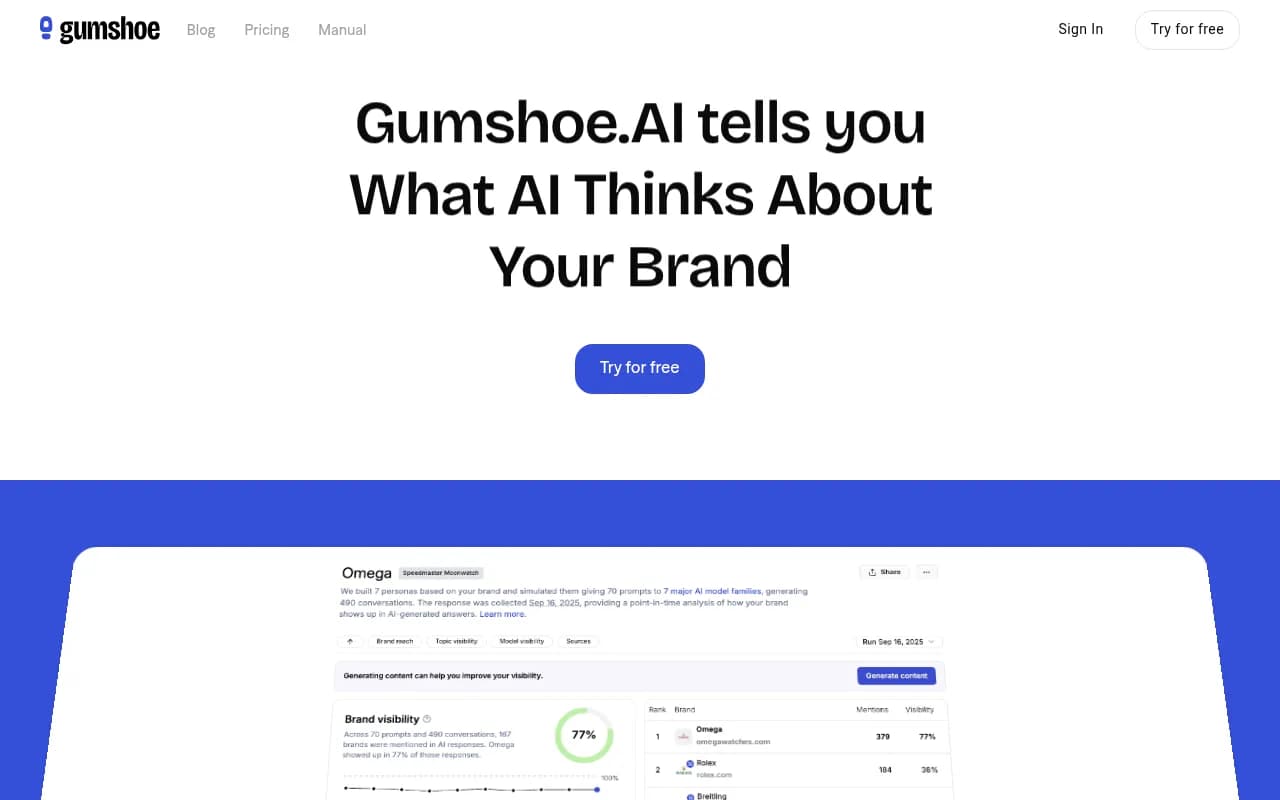
Gumshoe AI positions itself as a straightforward brand monitoring tool for AI search. You define your brand, pick relevant topics and personas, then run reports to see how often ChatGPT, Gemini, and Perplexity mention you. The pay-per-conversation model ($0.10 each) means you're not locked into a subscription -- useful if you're testing the waters or only need periodic snapshots. The platform tracks competitive rank, persona visibility, topic coverage, and cited sources. It's built for marketers who want to understand their AI presence without committing to ongoing monitoring.
Gauge
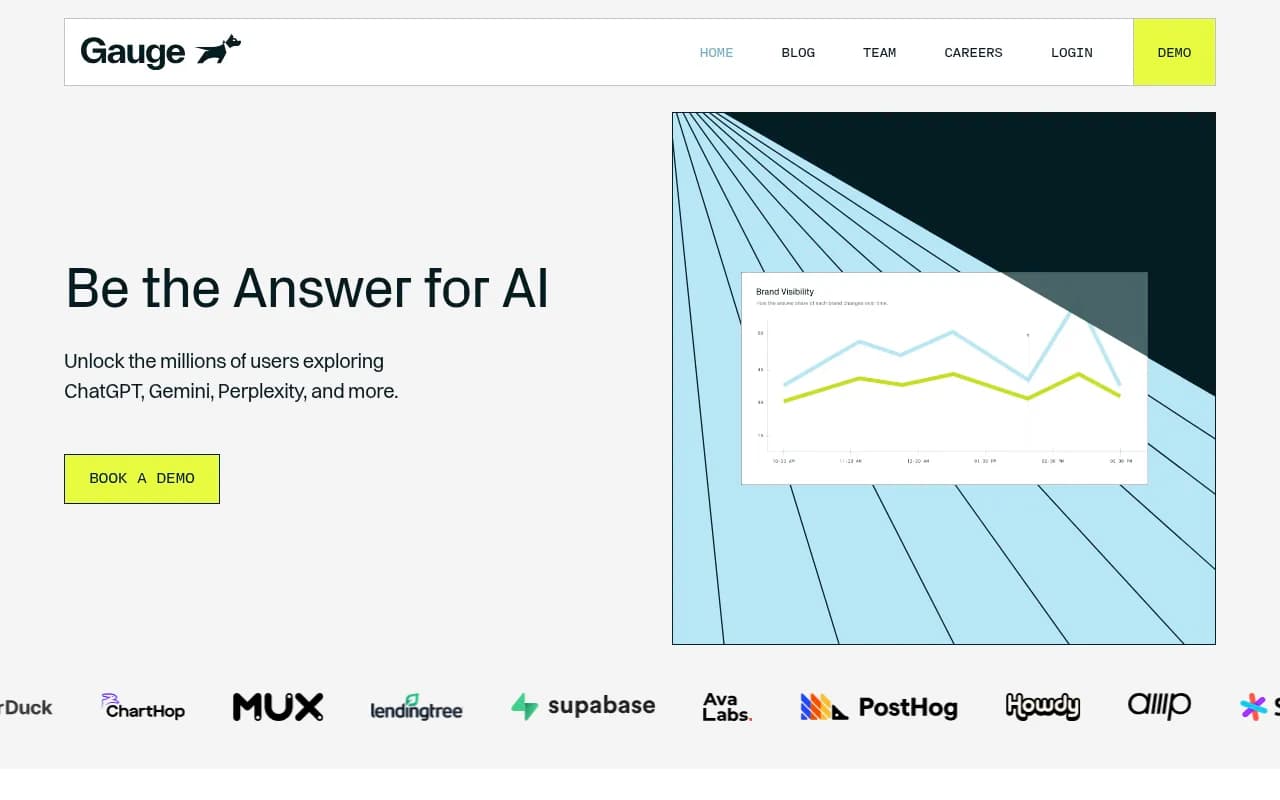
Gauge takes a more comprehensive approach to AI visibility. It monitors 7 AI engines (adding Claude, Copilot, AI Mode, and AI Overviews to the mix) and frames itself as a complete optimization toolkit rather than just a tracker. The platform analyzes citation patterns, identifies content gaps, and provides specific recommendations for improving your presence. Gauge is subscription-based starting at $95/mo with annual billing, targeting teams that need continuous monitoring and actionable insights to close visibility gaps. The Growth plan at $399/mo adds volume and features for larger teams or agencies.
Side-by-side comparison
| Feature | Gumshoe AI | Gauge |
|---|---|---|
| Pricing model | Pay-per-report ($0.10/conversation) | Monthly subscription ($95-$399+/mo) |
| Free tier | 3 free reports | No free tier |
| AI engines tracked | 3 (ChatGPT, Gemini, Perplexity) | 7 (ChatGPT, Claude, Gemini, Perplexity, Copilot, AI Mode, AI Overviews) |
| Persona tracking | ✓ | ✓ |
| Competitive benchmarking | ✓ | ✓ |
| Citation analysis | Top cited sources | Deep citation pattern analysis |
| Content gap identification | Limited | ✓ Core feature |
| Optimization recommendations | Basic | Onsite + offsite recommendations |
| Scheduled reports | ✓ (Pay-as-you-go tier) | ✓ |
| Trend tracking | ✓ (Pay-as-you-go tier) | ✓ |
| AI content generation | Mentioned | ✓ Built-in |
| Storage integrations | ✓ | Not specified |
| API access | Not specified | ✓ (Enterprise) |
| Dedicated support | Standard | Success manager (Enterprise) |
Model coverage and tracking depth
Gauge covers more ground. It tracks ChatGPT, Claude, Gemini, Perplexity, Copilot, Google AI Mode, and Google AI Overviews -- 7 engines total. This matters because different audiences use different tools. Someone researching B2B software might lean on Perplexity, while a consumer shopping query hits ChatGPT or AI Overviews. Missing Claude or Copilot means blind spots in your visibility picture.
Gumshoe AI monitors ChatGPT, Gemini, and Perplexity. That's the big three for consumer-facing queries, but you're missing enterprise-focused models (Claude is huge in B2B) and Google's AI Mode/Overviews integration. For brands that care primarily about consumer search, this might be enough. For B2B companies or anyone targeting technical audiences, the gap hurts.
Both platforms let you define personas and topics to simulate real user queries. Gumshoe AI explicitly highlights persona-based tracking as a core feature. Gauge does this too but frames it as part of a broader optimization workflow rather than the main selling point.
Verdict: Gauge wins on coverage. The 4 additional models aren't nice-to-haves -- they're significant visibility channels you can't afford to ignore if you're serious about AI search presence.
Pricing and cost structure
Gumshoe AI's pay-per-report model is unusual in this space. You get 3 free reports to test the platform, then pay $0.10 per conversation after that. A "conversation" means one query run across all tracked models and personas. If you're running 100 queries per month, that's $10. If you're running 1,000, it's $100. The math works in your favor for light usage or periodic audits. For continuous monitoring with hundreds of tracked queries, costs add up fast.
Gauge uses standard SaaS pricing. The entry plan is $95/mo with annual billing (likely $114/mo monthly). Growth tier is $399/mo. Enterprise is custom pricing. You're paying for the platform regardless of how many queries you run, which makes sense if you need always-on monitoring. The $95/mo floor is higher than Gumshoe AI's cost for casual users but cheaper than running 950+ conversations per month on Gumshoe's pay-as-you-go model.
| Plan | Gumshoe AI | Gauge |
|---|---|---|
| Free | 3 reports | None |
| Entry tier | $0.10/conversation (pay-as-you-go) | $95/mo (annual billing) |
| Mid tier | Same pay-per-use model | $399/mo (Growth plan) |
| Enterprise | Custom | Custom |
| Break-even point | ~950 conversations/mo = $95 | Unlimited queries at $95/mo |
If you're running fewer than 950 conversations per month, Gumshoe AI is cheaper. Above that, Gauge's flat rate wins. The real question is whether you need continuous monitoring (Gauge) or periodic snapshots (Gumshoe AI).
Verdict: Gumshoe AI for light users and agencies doing spot checks across multiple clients. Gauge for teams that need ongoing visibility tracking and can justify the monthly spend.
Optimization and actionable insights
This is where the platforms diverge most sharply. Gumshoe AI is primarily a visibility dashboard. You see how often your brand is mentioned, which sources are cited, how you rank against competitors, and how different personas respond. The platform mentions "optimization recommendations" and "AI-assisted content generation" in the pay-as-you-go tier, but details are sparse. The focus is on showing you the data, not necessarily telling you what to do about it.
Gauge positions itself as an optimization platform first, tracker second. The three-step workflow -- Track, Understand, Act -- puts equal weight on analysis and recommendations. Gauge identifies content gaps (topics where competitors are cited but you're not), analyzes which of your pages are being cited and which are ignored, and provides specific onsite and offsite recommendations. The platform includes AI-assisted content generation to help you fill those gaps. This is the "complete toolkit" pitch -- not just monitoring but active improvement.
For teams that already know how to optimize for AI search and just need visibility data, Gumshoe AI's lighter touch might be fine. For teams that need guidance on what to fix and how to fix it, Gauge's recommendation engine is the core value.
If you're also looking to track how your brand shows up in AI search results with even deeper optimization capabilities, Promptwatch takes this a step further with Answer Gap Analysis that shows exactly which prompts competitors rank for but you don't, plus an AI writing agent that generates content grounded in 880M+ citations to help you close those gaps.

Verdict: Gauge for teams that want actionable next steps. Gumshoe AI for teams that just need the visibility data and will figure out optimization internally.
Reporting and trend tracking
Both platforms offer scheduled reports and trend tracking, but the implementation differs. Gumshoe AI includes these features in the pay-as-you-go tier -- you can set up recurring reports and track how your visibility changes over time. The storage integrations (mentioned on their site) suggest you can export data to your own analytics stack.
Gauge includes scheduled reports and trend tracking as standard features across all plans. The platform's focus on continuous monitoring means trend data is baked into the core experience. You're not just seeing a snapshot -- you're seeing how your visibility evolves as you make changes.
The difference is philosophical. Gumshoe AI treats reports as discrete events you trigger when needed. Gauge treats monitoring as an always-on process with historical context.
Verdict: Tie. Both handle this competently, but the choice depends on whether you want event-driven reporting (Gumshoe AI) or continuous monitoring (Gauge).
Enterprise and agency features
Gauge's Enterprise tier includes volume-based discounts, dedicated success managers, custom integrations, and API access. The "expert help to design and implement" line suggests hands-on onboarding and strategy consulting. This is built for agencies managing multiple clients or large brands with complex needs.
Gumshoe AI doesn't explicitly break out an Enterprise tier on their pricing page, but they do offer custom pricing for "those with complex needs." The pay-per-conversation model actually works well for agencies running audits across many clients -- you're not paying for seats or monthly minimums, just the reports you actually run. The storage integrations hint at API or export capabilities, but specifics aren't public.
Verdict: Gauge for enterprise buyers who want white-glove service and custom integrations. Gumshoe AI for agencies that prefer flexible, usage-based pricing without long-term commitments.
User experience and learning curve
Gumshoe AI's interface is straightforward. You define your brand, add competitors, pick topics and personas, then run reports. The results show visibility scores, competitive rank, cited sources, and model-by-model breakdowns. It's designed to be self-service with minimal setup.
Gauge's interface is more complex because it does more. You're not just running reports -- you're analyzing citation patterns, identifying gaps, reviewing recommendations, and potentially generating content. The learning curve is steeper, but the payoff is a more complete picture of your AI presence and what to do about it.
Neither platform is difficult to use, but Gumshoe AI is faster to get started. Gauge requires more time to understand the full feature set.
Verdict: Gumshoe AI for quick setup and immediate results. Gauge if you're willing to invest time learning the platform in exchange for deeper insights.
Pros and cons
Gumshoe AI pros
- Pay-per-report pricing -- no wasted spend on unused subscriptions
- 3 free reports to test the platform before committing
- Simple, focused interface for visibility tracking
- Persona-based tracking to simulate different buyer types
- Storage integrations for exporting data
- Good fit for agencies doing periodic audits across multiple clients
Gumshoe AI cons
- Only 3 AI engines tracked (missing Claude, Copilot, AI Mode, AI Overviews)
- Limited optimization guidance -- mostly just shows you the data
- Pay-per-use model gets expensive above ~950 conversations/month
- Content generation feature mentioned but not well documented
- No dedicated enterprise support tier
Gauge pros
- Tracks 7 AI engines including Claude, Copilot, and Google AI products
- Deep content gap analysis shows exactly where you're invisible
- Actionable onsite and offsite recommendations
- AI-assisted content generation built into the platform
- Flat monthly pricing makes costs predictable for heavy users
- Enterprise tier with dedicated success managers and custom integrations
- Positions itself as a complete optimization toolkit, not just a tracker
Gauge cons
- No free tier -- $95/mo minimum commitment
- Higher upfront cost for light users or occasional monitoring
- More complex interface with a steeper learning curve
- Overkill if you only need basic visibility tracking
Who should pick which tool
Pick Gumshoe AI if you:
- Need occasional visibility snapshots rather than continuous monitoring
- Want to test AI search tracking without committing to a subscription
- Run an agency and need flexible, per-client pricing
- Only care about ChatGPT, Gemini, and Perplexity (the consumer-focused big three)
- Have internal optimization expertise and just need the raw visibility data
- Run fewer than 950 conversations per month
Pick Gauge if you:
- Need continuous, always-on monitoring of your AI presence
- Want actionable recommendations on how to improve visibility, not just data
- Care about Claude, Copilot, AI Mode, and AI Overviews in addition to the big three
- Need content gap analysis to identify where competitors are cited but you're not
- Want AI-assisted content generation to help fill those gaps
- Run a larger team or agency that can justify $95-$399/mo for comprehensive tracking
- Value dedicated support and custom integrations (Enterprise tier)
Final verdict
Gumshoe AI is a visibility tracker. Gauge is an optimization platform. That's the core difference.
If you're just starting to think about AI search presence and want to understand where you stand without a big commitment, Gumshoe AI's 3 free reports and pay-per-use model make it easy to dip your toes in. The limited model coverage (3 engines) and lighter optimization features mean you'll eventually outgrow it if AI visibility becomes a priority, but it's a solid entry point.
If you're serious about improving your AI search presence and need both the data and the roadmap for fixing gaps, Gauge is the better choice. The 7-engine coverage, content gap analysis, and built-in recommendations justify the higher price for teams that treat AI visibility as a strategic initiative rather than a curiosity. The $95/mo entry point is reasonable for what you get, and the Growth/Enterprise tiers scale with larger teams.
For most marketing teams in 2026, AI search visibility isn't optional anymore -- it's a core channel. That makes Gauge's optimization-first approach more valuable than Gumshoe AI's tracking-only model, even at 10x the cost for heavy users. But if you're an agency running spot checks or a small brand testing the waters, Gumshoe AI's flexibility and low barrier to entry still have a place.