Key Takeaways
- Pricing model: Gumshoe uses pay-per-conversation ($0.10/report) with 3 free reports, while GeoGen charges monthly subscriptions starting at €20/mo -- Gumshoe is cheaper for occasional monitoring, GeoGen wins for continuous tracking
- LLM coverage: GeoGen monitors 5 AI engines (ChatGPT, Perplexity, Gemini, Grok, Copilot) vs Gumshoe's 3 (ChatGPT, Perplexity, Gemini) -- GeoGen gives broader visibility
- Persona tracking: Gumshoe specializes in persona-based insights with human-like buyer journey tracking, while GeoGen offers basic persona support -- Gumshoe is stronger here
- Optimization features: GeoGen includes content recommendations and GEO improvement suggestions, Gumshoe focuses primarily on monitoring with AI-assisted content generation on paid plans
- Best for: Gumshoe suits brands doing quarterly audits or testing AI visibility on a budget; GeoGen fits teams that need ongoing monitoring and actionable optimization guidance
- Enterprise readiness: GeoGen offers custom integrations, APIs, and volume discounts; Gumshoe's enterprise tier exists but details are limited
Overview
Gumshoe AI

Gumshoe AI positions itself as a conversation-level AI search monitoring tool. The core idea: instead of tracking generic keywords, it builds realistic buyer personas and shows you who sees your brand recommendations and in what context. You define personas (like "CMO at a B2B SaaS company" or "small business owner looking for accounting software"), run reports to see how ChatGPT, Gemini, and Perplexity respond to those personas' questions, and track whether your brand gets mentioned.
The pricing is usage-based -- you pay $0.10 per conversation report, with your first 3 reports free. This makes it accessible for brands that want to dip their toes into AI visibility tracking without committing to a monthly subscription. The downside: if you're running hundreds of reports monthly, costs add up fast.
GeoGen
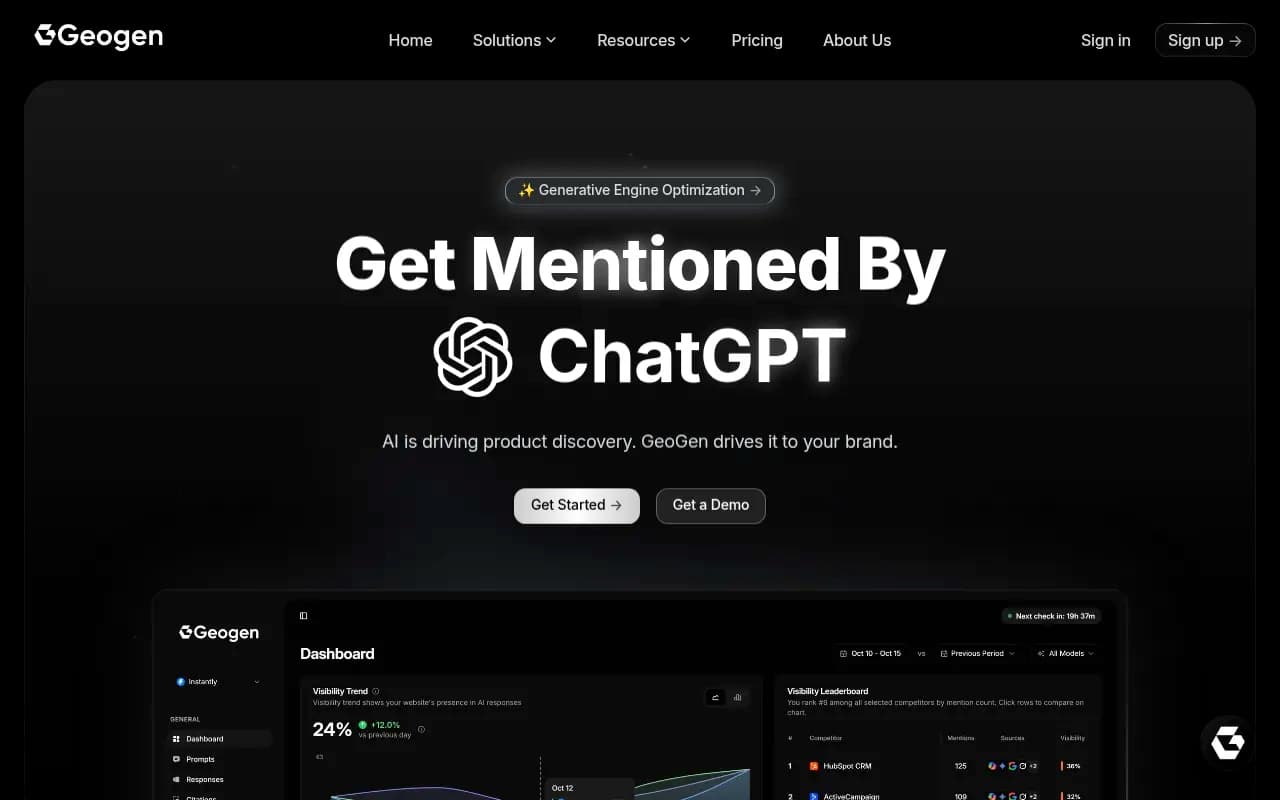
GeoGen takes a subscription-based approach to Generative Engine Optimization. It monitors your brand across ChatGPT, Perplexity, Gemini, Grok, and Microsoft Copilot, tracking mentions, competitor rankings, and citation sources. The platform emphasizes actionable insights -- not just "here's where you're mentioned" but "here's what to fix to get mentioned more."
Pricing starts at €20/mo for the Micro plan and scales to €399/mo for Pro, with custom enterprise pricing available. Annual billing gets you a 20% discount. Unlike Gumshoe's pay-per-report model, GeoGen's flat monthly fee makes sense if you're monitoring continuously or running reports weekly.
Side-by-side comparison
| Feature | Gumshoe AI | GeoGen |
|---|---|---|
| Pricing model | Pay-per-report ($0.10/conversation) | Monthly subscription (€20-€399/mo) |
| Free tier | 3 free reports | No free tier |
| AI engines monitored | ChatGPT, Gemini, Perplexity (3) | ChatGPT, Gemini, Perplexity, Grok, Copilot (5) |
| Persona tracking | Advanced (human-like buyer journeys) | Basic persona support |
| Competitor benchmarking | ✓ | ✓ |
| Citation source analysis | ✓ | ✓ |
| Scheduled reports | ✓ (paid plans) | ✓ |
| Content optimization | AI-assisted generation (paid) | GEO improvement recommendations |
| API access | Not mentioned | ✓ (Enterprise) |
| Storage integrations | ✓ | Not mentioned |
| Volume discounts | No | ✓ (Enterprise) |
| Annual billing discount | No | 20% off |
Pricing breakdown
| Plan | Gumshoe AI | GeoGen |
|---|---|---|
| Free/Trial | 3 free report runs | No free tier |
| Entry tier | $0.10/conversation (usage-based) | €20/mo (Micro) |
| Mid tier | Same pay-as-you-go rate | ~€100-200/mo (Growth, estimated) |
| Pro tier | Same pay-as-you-go rate | €399/mo (Pro) |
| Enterprise | Custom pricing | Custom pricing |
| Cost for 100 reports/mo | $10 | €20-€399 (depending on plan limits) |
| Cost for 1000 reports/mo | $100 | €399 or custom |
The math is straightforward: if you're running fewer than 200 reports per month, Gumshoe is cheaper. Beyond that, GeoGen's flat subscription becomes more economical. But pricing isn't the whole story -- you also need to consider what you get for that money.
LLM coverage and monitoring depth
GeoGen monitors five AI engines: ChatGPT, Perplexity, Gemini, Grok, and Microsoft Copilot. Gumshoe covers three: ChatGPT, Perplexity, and Gemini. That's a meaningful gap. Grok (X's AI) and Copilot (Microsoft's AI integrated into Bing and Office) are increasingly relevant for brand visibility, especially if your audience skews toward enterprise users or X power users.
Both platforms track brand mentions, competitor rankings, and citation sources. Both let you define topics and see how often your brand appears in responses. The core monitoring mechanics are similar -- the difference is breadth of coverage.
If you're only worried about the big three (ChatGPT, Perplexity, Gemini), Gumshoe covers you. If you want comprehensive visibility across the AI search landscape, GeoGen's extra two engines matter.
Neither platform currently monitors Claude (Anthropic), DeepSeek, Meta AI, or Google AI Overviews -- gaps that tools like Promptwatch fill if you need truly comprehensive coverage across 10+ AI models.

Persona tracking and buyer journey insights
This is where Gumshoe shines. The platform is built around persona-based tracking -- you create detailed buyer personas (job title, industry, pain points, buying stage) and see how AI engines respond to questions those personas would ask. The idea: generic keyword tracking misses the nuance of how real people interact with AI search. A CMO researching marketing automation tools asks different questions than a marketing coordinator, and AI engines give different recommendations.
Gumshoe's persona system lets you map out these differences. You can track visibility across different buyer stages (awareness, consideration, decision) and see where your brand shows up or disappears. This is genuinely useful for B2B brands with complex buyer journeys.
GeoGen offers persona support, but it's not the core focus. You can filter reports by persona, but the platform doesn't build the same rich, journey-based insights. GeoGen is more about broad visibility tracking -- "Are we mentioned for these topics?" -- than persona-specific analysis.
Verdict: If persona-level insights are critical to your strategy, Gumshoe is the better pick. If you just need to know whether your brand is visible at all, GeoGen's simpler approach works fine.
Content optimization and actionable recommendations
GeoGen positions itself as an optimization platform, not just a monitoring dashboard. The platform analyzes why competitors rank higher and suggests content improvements to boost your visibility. These recommendations are based on citation patterns -- if AI engines consistently cite certain types of content (listicles, comparison pages, how-to guides), GeoGen flags that and suggests you create similar content.
Gumshoe includes "optimization recommendations" and "AI-assisted content generation" on paid plans, but the website doesn't detail what these features actually do. Based on the positioning, it seems more focused on identifying gaps ("You're not mentioned for this persona/topic") than prescribing specific fixes.
GeoGen also emphasizes "Generative Engine Optimization" as a discipline -- the platform is designed around the idea that you need to actively optimize for AI search, not just monitor it. That philosophy shows up in the feature set.
Verdict: If you want actionable next steps ("Create this type of content to improve visibility"), GeoGen delivers more. If you're comfortable interpreting data and deciding on your own strategy, Gumshoe's monitoring-first approach is fine.
Reporting and automation
Both platforms support scheduled reports. GeoGen includes this on all paid plans; Gumshoe gates it behind the pay-as-you-go tier (so not available on the free 3-report trial).
Gumshoe offers storage integrations -- presumably meaning you can export reports to Google Drive, Dropbox, or similar. GeoGen doesn't mention storage integrations but does offer API access on enterprise plans, which is more flexible if you're building custom dashboards or feeding data into other systems.
Neither platform has the real-time crawler log monitoring or traffic attribution features that more advanced GEO platforms offer. You're getting periodic snapshots ("Run a report to see current visibility") rather than continuous, live tracking.
Team collaboration and enterprise features
Gumshoe mentions "Share with your team" as a feature, suggesting some level of multi-user access. Details are sparse.
GeoGen's enterprise tier includes dedicated success managers, custom integrations, APIs, and volume-based discounts. This is a more fleshed-out enterprise offering. If you're an agency managing multiple clients or a large brand with complex needs, GeoGen's enterprise tier looks more robust.
Both platforms offer custom enterprise pricing, so if you're spending five figures annually on AI visibility tracking, you'll want to talk to sales for either tool.
User experience and ease of use
Based on the website copy and positioning, Gumshoe seems designed for simplicity. The pay-per-report model means you're not locked into a subscription, and the persona-first interface is intuitive if you're used to thinking about buyer journeys.
GeoGen's dashboard screenshots show a more data-dense interface with charts, competitor heatmaps, and multi-model comparisons. It's not overwhelming, but there's more to digest. If you're a data-driven marketer who wants to slice visibility metrics every which way, that's a plus. If you just want a quick answer ("Are we mentioned or not?"), it might feel like overkill.
Neither platform has a steep learning curve. You're not dealing with complex prompt engineering or technical setup -- both are built for marketers, not developers.
Pros and cons
Gumshoe AI pros
- Pay-per-report pricing is budget-friendly for occasional monitoring
- 3 free reports let you test before spending
- Persona-based tracking is genuinely differentiated and useful for B2B
- Storage integrations make it easy to archive reports
- No monthly commitment -- pay only when you need data
Gumshoe AI cons
- Only 3 AI engines monitored (missing Grok and Copilot)
- Costs scale linearly -- expensive if you're running hundreds of reports monthly
- Optimization features are vague and seem secondary to monitoring
- Enterprise tier details are unclear
- No API access mentioned
GeoGen pros
- Monitors 5 AI engines including Grok and Copilot
- Flat monthly pricing is predictable and cheaper at scale
- Content optimization recommendations are actionable
- API access available for enterprise customers
- 20% discount on annual billing
- More robust enterprise features (dedicated success manager, custom integrations)
GeoGen cons
- No free tier -- you're committing to at least €20/mo to try it
- Persona tracking is less sophisticated than Gumshoe's
- Pricing tiers aren't fully transparent (Growth tier pricing not listed)
- Less focused on buyer journey insights
Who should choose Gumshoe AI
Pick Gumshoe if:
- You're a B2B marketer who thinks in terms of buyer personas and want persona-level visibility insights
- You need occasional AI visibility audits (quarterly or monthly) rather than continuous monitoring
- You're on a tight budget and want to test AI search tracking without a subscription commitment
- You only care about the big three AI engines (ChatGPT, Perplexity, Gemini)
- You want a simple, focused tool that does one thing well
Gumshoe makes sense for smaller brands, consultants, or agencies doing periodic audits for clients. The pay-per-report model is perfect for "I need to check this once a month" use cases.
Who should choose GeoGen
Pick GeoGen if:
- You need continuous, ongoing AI visibility monitoring with scheduled reports
- You want coverage across 5 AI engines including Grok and Copilot
- You're running dozens or hundreds of reports monthly and need predictable costs
- You want actionable content optimization recommendations, not just monitoring data
- You're an agency or enterprise that needs API access, custom integrations, or volume discounts
- You value annual billing discounts and are ready to commit for 12 months
GeoGen fits teams that treat AI search optimization as an ongoing discipline, not a one-off audit. If you're serious about improving your AI visibility over time, the subscription model and optimization focus make more sense.
Final verdict
These tools serve different use cases despite overlapping on core monitoring features. Gumshoe is the budget-friendly, persona-focused option for occasional audits. GeoGen is the continuous monitoring and optimization platform for teams that need broader coverage and actionable recommendations.
If you're just starting to explore AI visibility and want to understand the landscape without spending much, start with Gumshoe's 3 free reports. If you're past the exploration phase and ready to actively optimize your AI search presence, GeoGen's subscription model and optimization features will serve you better.
One sentence summary: Gumshoe wins on persona insights and budget flexibility; GeoGen wins on LLM coverage, continuous monitoring, and optimization guidance.