Key Takeaways
- Promptwatch is an optimization platform, Promptmonitor is a monitoring dashboard -- Promptwatch includes content gap analysis, AI content generation, and crawler logs to help you fix visibility issues. Promptmonitor shows you data but leaves you to figure out what to do next.
- Promptwatch tracks 10 AI models vs Promptmonitor's 8 -- Promptwatch adds DeepSeek and Copilot coverage that Promptmonitor lacks, plus more granular tracking options.
- Promptwatch's pricing starts at $99/mo (Essential) vs Promptmonitor's $29/mo (Starter) -- but you get what you pay for. Promptwatch includes 50 prompts and 5 AI-generated articles on the base plan. Promptmonitor's $29 plan caps you at 10 prompts with no content creation.
- Only Promptwatch offers AI crawler logs -- see exactly when ChatGPT, Claude, and Perplexity crawl your site, which pages they read, and errors they encounter. Promptmonitor has no crawler visibility.
- Promptwatch processes 1.1 billion citations and prompts -- its recommendations are grounded in real data from 6,700+ brands. Promptmonitor's smaller dataset means less reliable insights.
- Both offer free trials -- Promptwatch gives you 7 days, Promptmonitor also 7 days. Test both if you're on the fence.
Overview
Promptwatch: End-to-end AI visibility optimization

Promptwatch is the market-leading Generative Engine Optimization (GEO) platform used by 6,700+ brands including Booking.com, Center Parcs, and Yelp. It's built around a complete action loop: find content gaps (Answer Gap Analysis shows which prompts competitors rank for but you don't), create optimized content (built-in AI writing agent generates articles grounded in 880M+ citations), and track results (page-level visibility scores, traffic attribution via code snippet or GSC integration).
What sets Promptwatch apart is that it doesn't stop at showing you dashboards. It tells you exactly what content is missing from your site, then helps you create it. The platform monitors 10 AI models (ChatGPT, Claude, Perplexity, Gemini, Google AI Overviews, Meta AI, DeepSeek, Grok, Mistral, Copilot), tracks real AI crawler logs, surfaces Reddit and YouTube discussions that influence AI recommendations, and provides prompt intelligence with volume estimates and difficulty scores.
Promptwatch is a Dutch company (Promptwatch B.V.) with data featured in the Wall Street Journal, Yahoo Finance, and Axios. In a 2026 comparison of 12 GEO platforms, it was the only tool rated as a "Leader" across all categories.
Promptmonitor: Basic AI visibility monitoring
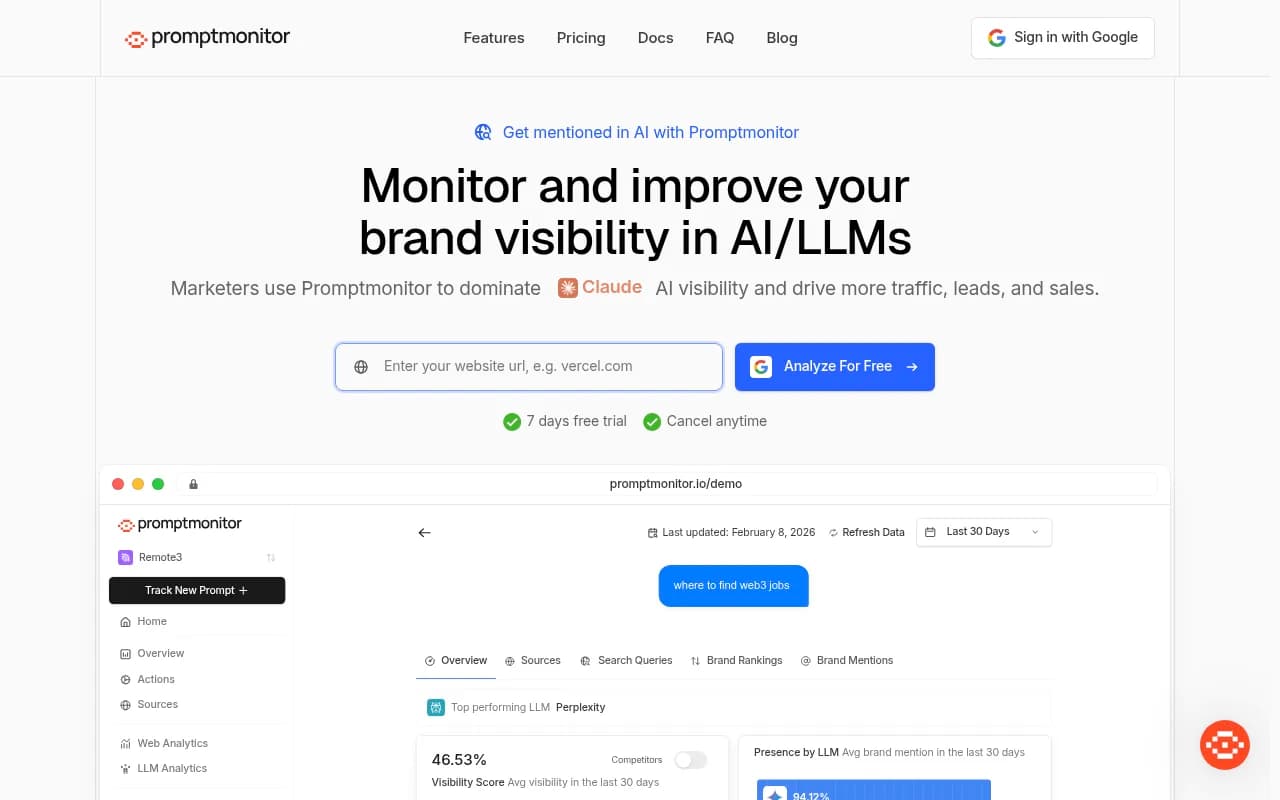
Promptmonitor is a simplified AI visibility tracker that monitors brand mentions across ChatGPT, Claude, Gemini, and other LLMs. It offers basic monitoring dashboards, source tracking, and visibility scoring across 8 AI models. The interface is clean and the pricing is lower than most competitors, starting at $29/mo.
But here's what it doesn't do: no AI crawler logs, no content gap analysis, no prompt intelligence (volume/difficulty data), no content generation, no Reddit or YouTube tracking, no ChatGPT Shopping monitoring. You see when your brand is mentioned and which sources AI models cite, but you're on your own to figure out why you're not ranking and what to create next.
Promptmonitor works if you just want a dashboard to check periodically. It doesn't work if you need to actively improve your AI visibility.
Side-by-Side Comparison
| Feature | Promptwatch | Promptmonitor |
|---|---|---|
| AI models tracked | 10 (ChatGPT, Claude, Perplexity, Gemini, Google AI Overviews, Meta AI, DeepSeek, Grok, Mistral, Copilot) | 8 (ChatGPT, Claude, Perplexity, Gemini, Google AI Overviews, Meta AI, Grok, Mistral) |
| AI crawler logs | Yes -- real-time logs of AI crawlers hitting your site | No |
| Content gap analysis | Yes -- shows which prompts competitors rank for but you don't | No |
| AI content generation | Yes -- built-in writing agent creates optimized articles | No |
| Prompt intelligence | Yes -- volume estimates, difficulty scores, query fan-outs | No |
| Reddit & YouTube tracking | Yes -- surfaces discussions influencing AI recommendations | No |
| ChatGPT Shopping tracking | Yes -- monitors product recommendations and shopping carousels | No |
| Traffic attribution | Yes -- code snippet, GSC integration, or server log analysis | Basic web analytics |
| Citation database | 1.1 billion citations and prompts processed | Smaller dataset (not disclosed) |
| Multi-language support | Yes -- any language, any region, customizable personas | Yes -- basic multi-language |
| Free trial | 7 days | 7 days |
| Starting price | $99/mo (Essential: 1 site, 50 prompts, 5 articles) | $29/mo (Starter: 1 site, 10 prompts) |
| Mid-tier price | $249/mo (Professional: 2 sites, 150 prompts, 15 articles, crawler logs) | $39/mo (Growth: 1 site, 50 prompts) |
| API access | Yes | Limited |
| Looker Studio integration | Yes | No |
| Target audience | Marketing teams, SEO teams, agencies needing optimization | Small teams wanting basic monitoring |
Head-to-head feature deep-dive
Monitoring capabilities
Promptwatch tracks 10 AI models including DeepSeek and Copilot, which Promptmonitor doesn't cover. Both platforms let you define custom prompts and track how often your brand appears in responses. Both show visibility scores over time and let you compare against competitors.
The difference: Promptwatch's tracking is more granular. You can set up state/city-level tracking (Professional plan and above), customize personas to match how your actual customers prompt, and see query fan-outs that show how one prompt branches into sub-queries. Promptmonitor's tracking is straightforward but less flexible -- you define a prompt, it checks it daily, you see a chart.
Promptwatch also tracks ChatGPT Shopping recommendations, which is critical if you sell products. Promptmonitor doesn't monitor shopping carousels at all.
Verdict: Promptwatch wins on depth and coverage. Promptmonitor is adequate for basic brand mention tracking.
Content optimization and gap analysis
This is where the platforms diverge completely.
Promptwatch includes Answer Gap Analysis, which compares your site against competitors and shows exactly which prompts they're visible for but you're not. It surfaces the specific topics, angles, and questions AI models want answers to but can't find on your site. Then the built-in AI writing agent generates articles, listicles, and comparisons grounded in real citation data (880M+ citations analyzed), prompt volumes, persona targeting, and competitor analysis. You're not just seeing gaps -- you're filling them.
Promptmonitor has none of this. It shows you visibility scores and source citations, but it doesn't tell you what content is missing or help you create it. You're looking at dashboards and then switching to Google Docs or your CMS to figure out what to write.
Verdict: Promptwatch is the only platform here that actually helps you improve. Promptmonitor is monitoring-only.
AI crawler logs and indexing
Promptwatch provides real-time logs of AI crawlers (ChatGPT, Claude, Perplexity, etc.) hitting your website. You see which pages they read, how often they return, errors they encounter (404s, timeouts), and whether they're successfully indexing your content. This is critical for diagnosing why AI models aren't citing your pages -- maybe they can't access them, maybe they're hitting rate limits, maybe your robots.txt is blocking them.
Promptmonitor has no crawler log visibility. You have no idea if AI models are even reading your site.
Verdict: Promptwatch wins by default. This feature doesn't exist in Promptmonitor.
Source and citation analysis
Both platforms show which sources AI models cite when they mention your brand or competitors. You see the specific URLs, domains, and content types (corporate pages, news articles, Reddit threads, YouTube videos) that influence AI responses.
Promptwatch's citation analysis is more detailed. It categorizes sources (corporate, organic, news), shows traffic estimates for each cited page, tracks position changes over time, and surfaces Reddit and YouTube discussions that directly influence recommendations. The platform has analyzed 1.1 billion citations, so its recommendations are grounded in real patterns.
Promptmonitor shows source lists but with less context. You see which domains are cited, but you don't get traffic estimates, position tracking, or the Reddit/YouTube layer.
Verdict: Promptwatch provides richer citation intelligence. Promptmonitor covers the basics.
Prompt intelligence and prioritization
Promptwatch includes volume estimates and difficulty scores for each prompt, plus query fan-outs that show how one prompt branches into sub-queries. This helps you prioritize high-value, winnable prompts instead of guessing. You can see which prompts have high search volume but low competition, or which prompts are trending up.
Promptmonitor doesn't provide prompt volume data or difficulty scoring. You define prompts manually and track them, but you have no data-driven way to prioritize which prompts matter most.
Verdict: Promptwatch gives you the data to make smart decisions. Promptmonitor leaves you guessing.
Competitor analysis
Both platforms let you add competitors and compare visibility scores. Promptwatch shows competitor heatmaps across LLMs, so you can see who's winning for each prompt and why. It also includes the Answer Gap Analysis mentioned earlier, which directly compares your content coverage against competitors.
Promptmonitor shows competitor visibility scores and lets you compare trends over time, but it doesn't break down why competitors are winning or what content they have that you don't.
Verdict: Promptwatch provides actionable competitor insights. Promptmonitor shows you the scoreboard but not the playbook.
Traffic attribution and ROI tracking
Promptwatch offers three ways to connect AI visibility to actual traffic: a code snippet you add to your site, Google Search Console integration, or server log analysis. You can see which visitors came from AI models, which pages they landed on, and track conversions. This closes the loop between visibility and revenue.
Promptmonitor includes basic web analytics but doesn't have the same depth of traffic attribution. You can see some visitor data, but it's not as tightly integrated with the AI visibility tracking.
Verdict: Promptwatch makes it easier to prove ROI. Promptmonitor's analytics are more limited.
Integrations and API
Promptwatch integrates with Looker Studio for custom reporting and provides a full API for building custom workflows. You can export data, automate tasks, and plug Promptwatch into your existing marketing stack.
Promptmonitor has limited API access and no Looker Studio integration. You're mostly working within the Promptmonitor dashboard.
Verdict: Promptwatch is more flexible for teams with custom reporting needs. Promptmonitor is a standalone tool.
Pricing comparison
| Plan | Promptwatch | Promptmonitor |
|---|---|---|
| Free trial | 7 days | 7 days |
| Starter/Essential | $99/mo (1 site, 50 prompts, 5 AI articles, basic tracking) | $29/mo (1 site, 10 prompts, no content generation) |
| Growth/Professional | $249/mo (2 sites, 150 prompts, 15 AI articles, crawler logs, state/city tracking) | $39/mo (1 site, 50 prompts, unlimited team seats) |
| Pro/Business | $579/mo (5 sites, 350 prompts, 30 AI articles, full feature set) | $129/mo (3 sites, 150 prompts, priority support) |
| Agency/Enterprise | Custom pricing | Custom pricing |
| Annual discount | Yes | Not disclosed |
Promptmonitor is significantly cheaper at the entry level. $29/mo vs $99/mo is a big gap. But look at what you're getting: Promptmonitor's Starter plan caps you at 10 prompts with no content creation, no crawler logs, no gap analysis. Promptwatch's Essential plan includes 50 prompts and 5 AI-generated articles per month, plus the full optimization toolkit.
The value gap widens at higher tiers. Promptwatch's Professional plan ($249/mo) includes crawler logs, state/city tracking, and 15 AI articles. Promptmonitor's Growth plan ($39/mo) just increases the prompt limit to 50 -- still no content generation, still no crawler logs.
If you're a small business that only wants to check a few prompts occasionally, Promptmonitor's pricing is attractive. If you're serious about improving your AI visibility and need tools to actually do something about it, Promptwatch delivers more value per dollar.
Pros and cons
Promptwatch pros
- Complete optimization platform, not just monitoring -- includes content gap analysis, AI content generation, and crawler logs
- Tracks 10 AI models including DeepSeek and Copilot
- 1.1 billion citations and prompts analyzed -- recommendations grounded in real data
- AI crawler logs show exactly when and how AI models access your site
- Prompt intelligence with volume estimates and difficulty scores
- Reddit and YouTube tracking surfaces discussions influencing AI recommendations
- ChatGPT Shopping monitoring for product recommendations
- Traffic attribution connects visibility to actual revenue
- Looker Studio integration and full API for custom workflows
- Used by 6,700+ brands including Booking.com and Center Parcs
- Data featured in Wall Street Journal, Yahoo Finance, Axios
Promptwatch cons
- Higher starting price ($99/mo vs $29/mo)
- Steeper learning curve due to more features
- May be overkill for very small businesses that only want basic monitoring
Promptmonitor pros
- Much lower starting price ($29/mo)
- Clean, simple interface -- easy to get started
- Tracks 8 major AI models
- Unlimited team seats on Growth plan ($39/mo)
- Basic visibility tracking and source analysis work fine
- 7-day free trial
Promptmonitor cons
- No content gap analysis -- doesn't tell you what's missing
- No AI content generation -- you're on your own to create optimized content
- No AI crawler logs -- no visibility into whether AI models can access your site
- No prompt intelligence (volume/difficulty data)
- No Reddit or YouTube tracking
- No ChatGPT Shopping monitoring
- Smaller citation database means less reliable insights
- Limited API access and no Looker Studio integration
- Doesn't track DeepSeek or Copilot
Who should pick which tool
Pick Promptwatch if:
- You need to actively improve your AI visibility, not just monitor it
- You want content gap analysis and AI-generated articles to fill those gaps
- You need AI crawler logs to diagnose indexing issues
- You're tracking competitors and want actionable insights on how to beat them
- You need prompt intelligence (volume/difficulty data) to prioritize your efforts
- You want Reddit and YouTube tracking to understand what influences AI recommendations
- You sell products and need ChatGPT Shopping monitoring
- You need traffic attribution to prove ROI
- You have a marketing or SEO team that will use the platform regularly
- You're willing to pay more for a complete optimization toolkit
Pick Promptmonitor if:
- You only need basic brand mention monitoring
- Your budget is tight and $29-39/mo is your ceiling
- You're comfortable creating your own content strategy without gap analysis
- You don't need AI crawler logs or prompt intelligence
- You're a small business or solopreneur just starting with AI visibility
- You want a simple dashboard to check periodically, not a daily optimization tool
- You're okay with a monitoring-only platform that doesn't help you take action
Final verdict
Promptwatch is the better platform for anyone serious about AI visibility. It's the only tool here that actually helps you improve, not just watch. The content gap analysis shows you exactly what's missing, the AI writing agent helps you create it, and the crawler logs ensure AI models can access your content. Promptmonitor is cheaper, but it's a monitoring dashboard that leaves you stuck after showing you the data.
If you're choosing between these two, the decision comes down to whether you want a tool that helps you take action or just shows you charts. Promptwatch is an optimization platform. Promptmonitor is a tracker. The price difference reflects that gap.
For most marketing teams, SEO teams, and agencies, Promptwatch is worth the extra cost. You're not just buying data -- you're buying the tools to fix the problems the data reveals. Promptmonitor works if you're on a tight budget and only need basic monitoring, but you'll hit its limits quickly if you're trying to actually move the needle on AI visibility.