Key takeaways
- XFunnel was acquired by HubSpot in 2026, making it part of the HubSpot ecosystem -- if you're already a HubSpot customer, this integration could be a deciding factor
- Both platforms require custom enterprise pricing with no public rates or free trials, putting them out of reach for most small businesses and startups
- XFunnel has a stronger enterprise customer base (Wix, Monday.com, LastPass, Getty Images) and longer track record in the GEO space
- Ansehn emphasizes content recommendations and "AI-generated content actions" more explicitly than XFunnel, which focuses on measurement and analysis
- Neither platform offers the full action loop (find gaps → generate content → track results) that platforms like Promptwatch provide -- they're primarily monitoring tools
- If you need transparent pricing, a free trial, or self-serve onboarding, you'll need to look at alternatives -- both XFunnel and Ansehn are sales-driven enterprise products
Overview
XFunnel
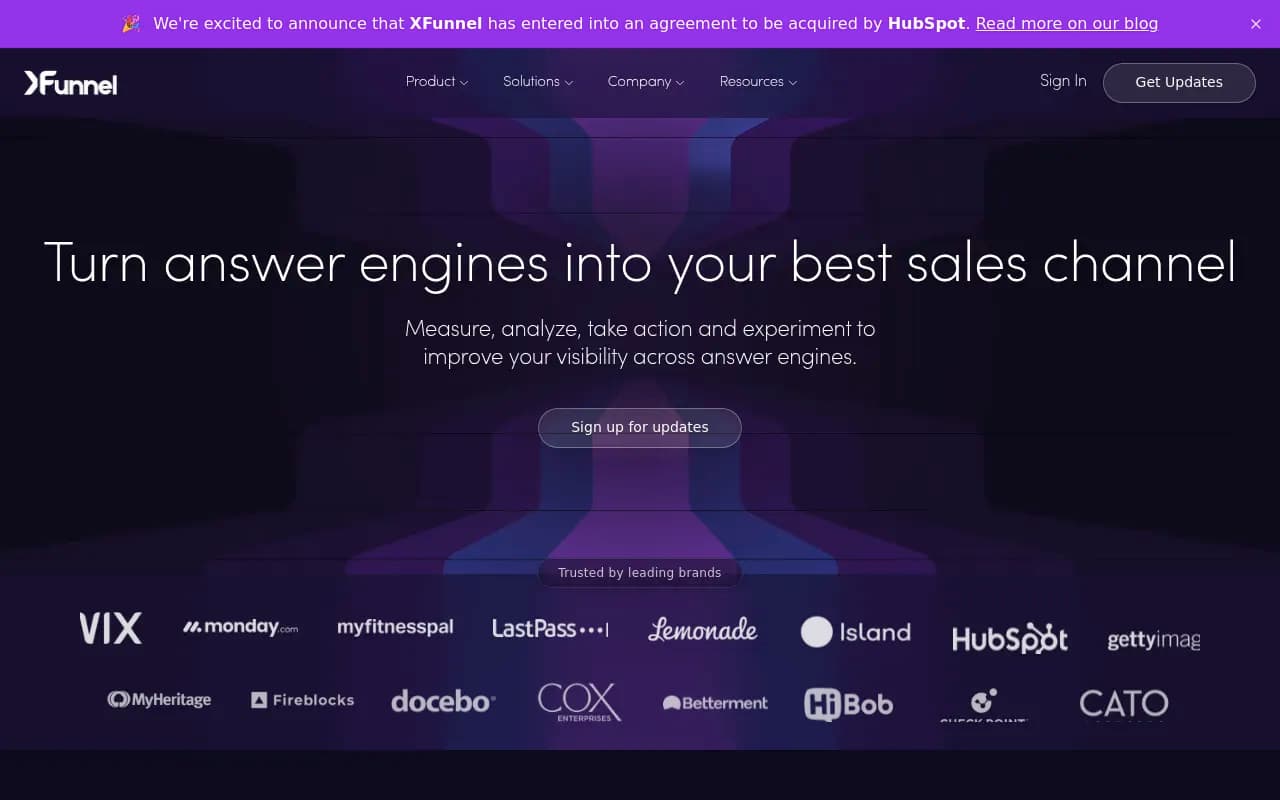
XFunnel is a generative engine optimization platform that helps marketing teams track and improve brand visibility across AI-powered search engines. The company made headlines in early 2026 when it announced an acquisition agreement with HubSpot, signaling the growing importance of AI search visibility in the marketing stack. XFunnel's customer roster includes major brands like Wix, Monday.com, MyFitnessPal, LastPass, Lemonade, Getty Images, and Cato Networks. The platform positions itself as a tool for measuring, analyzing, and experimenting with AI search presence, with a focus on turning "answer engines into your best sales channel."
Ansehn
Ansehn
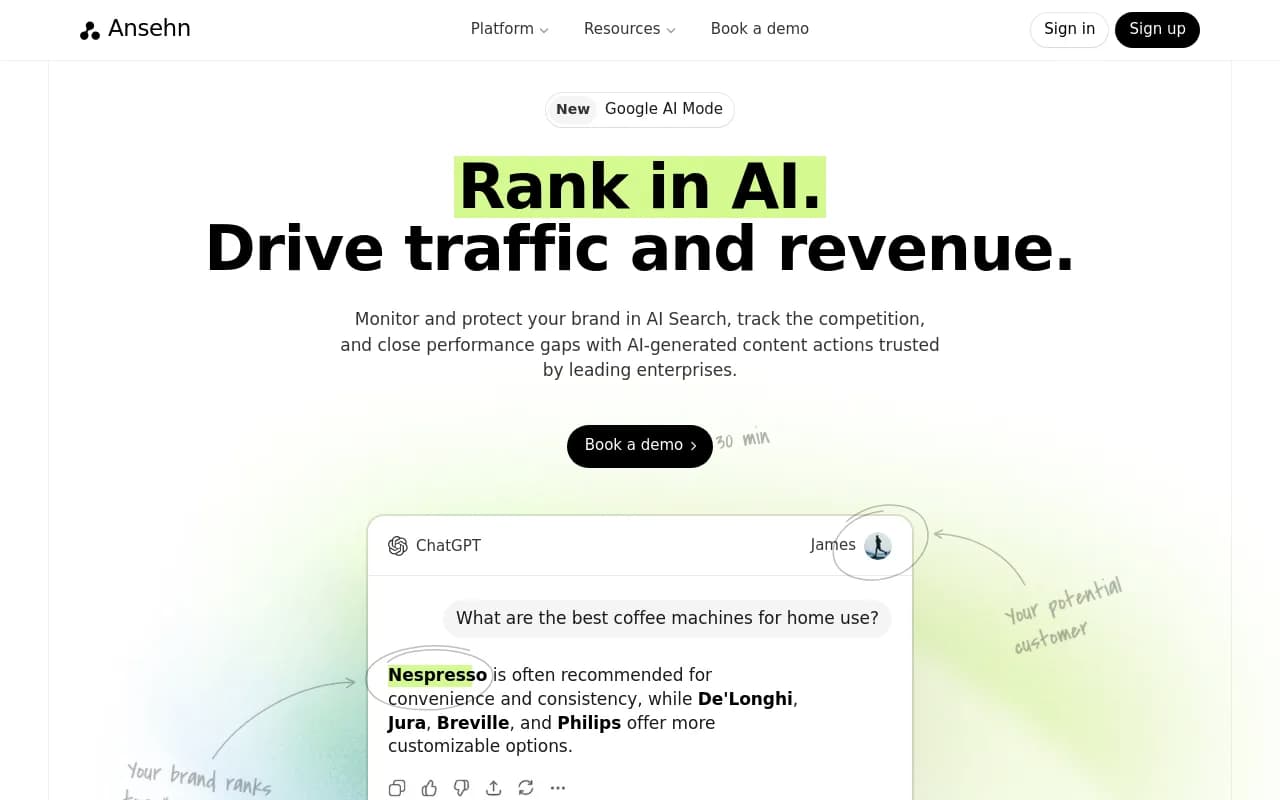
Ansehn is an AI search visibility platform that monitors how brands appear in AI-generated results across ChatGPT, Perplexity, Google AI Mode, and Claude. Built for marketing teams and agencies managing GEO/AEO for B2B and B2C brands, Ansehn emphasizes three core capabilities: measuring rankings in AI search, understanding what drives those rankings, and improving performance through content recommendations. The platform works with enterprise clients including Bosch, Quirion, Zutacore, Pixum, and Aurubis. Ansehn's messaging focuses heavily on the shift from traditional Google search to AI-powered search, positioning itself as the tool to help brands adapt to this change.
Side-by-side comparison
| Feature | XFunnel | Ansehn |
|---|---|---|
| Pricing model | Custom enterprise (contact sales) | Custom enterprise (demo required) |
| Free trial | No | No |
| Self-serve signup | No | No |
| AI models tracked | ChatGPT, Perplexity, Claude, Google AI (exact list not public) | ChatGPT, Perplexity, Claude, Google AI Mode |
| HubSpot integration | Native (acquired by HubSpot) | Not mentioned |
| Content generation | Not mentioned | "AI-generated content actions" |
| Competitor benchmarking | Yes (implied by features) | Yes (explicitly mentioned) |
| Enterprise customers | Wix, Monday.com, LastPass, Getty Images, MyFitnessPal, Lemonade | Bosch, Quirion, Zutacore, Pixum, Aurubis |
| Company status | Acquired by HubSpot (2026) | Independent |
| Target audience | Enterprise marketing teams | Enterprise marketing teams, agencies |
| API access | Not disclosed | Mentioned in docs |
| Public documentation | Limited | Comprehensive docs site |
Head-to-head feature analysis
Enterprise positioning and customer base
XFunnel has the stronger enterprise pedigree. Their customer list reads like a who's who of B2B SaaS and consumer tech: Wix, Monday.com, LastPass, Getty Images, MyFitnessPal, Lemonade, Fireblocks, Checkpoint, Cato Networks. These are brands with serious marketing budgets and complex go-to-market motions. The HubSpot acquisition reinforces this positioning -- HubSpot doesn't buy tools for small businesses, they buy tools their enterprise customers need.
Ansehn's customer base skews more European and industrial: Bosch, Aurubis, Pixum, Quirion. Still enterprise, but a different flavor. The inclusion of "agencies" in Ansehn's target audience description suggests they might be more flexible on deal structure and multi-client setups, but neither platform publicly details agency-specific features.
Verdict: XFunnel has the more impressive customer roster and the HubSpot backing. If brand recognition and ecosystem integration matter to you, XFunnel wins here.
AI model coverage
Both platforms cover the core AI search engines that matter in 2026: ChatGPT, Perplexity, Claude, and Google AI. Ansehn specifically calls out "Google AI Mode" tracking, which is the conversational AI search experience Google rolled out. XFunnel's website is less specific about exact model coverage.
Neither platform publicly lists whether they track Gemini, Meta AI, DeepSeek, Grok, Mistral, or Copilot. This is a notable gap compared to platforms like Promptwatch, which monitors 10 AI models including those less common ones.

Verdict: Tie. Both cover the essentials, neither is transparent about the full list. If you need comprehensive multi-model coverage including emerging AI engines, you'll need to ask both vendors directly or consider a platform with public model coverage details.
Measurement and analytics
XFunnel's homepage emphasizes "measure, analyze, take action and experiment" with a focus on turning AI search into a sales channel. They talk about tracking citations and discovering relevant search questions. The testimonial from Cato Networks' Inbound Marketing Team Lead suggests the platform is used daily by marketing teams for ongoing monitoring.
Ansehn breaks their value prop into three steps: Measure (rank in AI search), Understand (what drives AI search), and Improve (grow with AI search). They explicitly mention tracking rankings, benchmarking competitors, and getting content recommendations. The platform shows your brand's ranking position in AI responses and tracks when that position changes.
Both platforms appear to offer similar core measurement capabilities: tracking when your brand appears in AI responses, monitoring competitor mentions, and analyzing citation patterns. The difference is in how they present it. XFunnel feels more experimental and hypothesis-driven. Ansehn feels more structured around rank tracking.
Verdict: Slight edge to Ansehn for clearer articulation of what you're actually measuring (rankings, competitor benchmarks). XFunnel's messaging is more abstract.
Content optimization and recommendations
This is where the platforms diverge more clearly.
Ansehn explicitly mentions "AI-generated content actions" and content recommendations to improve visibility. Their three-step framework ends with "Improve" and growing with AI search, suggesting they provide actionable guidance on what content to create or optimize.
XFunnel's website focuses more on measurement and experimentation. They mention discovering relevant search questions and taking action, but don't explicitly call out content generation or recommendations as a feature. The emphasis is on understanding performance and running experiments.
Neither platform appears to offer the full content creation loop that Promptwatch provides -- where you can identify content gaps, generate optimized articles with a built-in AI writing agent, and track the results. Both XFunnel and Ansehn seem to stop at recommendations rather than execution.
Verdict: Ansehn has a clearer content optimization story, but neither platform is a true content generation tool. If you want to go from insight to published content without switching tools, you need a platform with built-in content creation.
Integration and ecosystem
XFunnel's acquisition by HubSpot is the elephant in the room. If you're a HubSpot customer, XFunnel will likely integrate natively with your CRM, marketing automation, and reporting. The announcement mentions this integration specifically. For HubSpot shops, this is a massive advantage -- one less tool to manage, unified reporting, shared customer data.
Ansehn mentions API access in their documentation site, suggesting they're built for custom integrations. But there's no mention of pre-built connectors to marketing platforms, CRMs, or analytics tools. You're likely building those integrations yourself or working with their team.
Verdict: XFunnel wins decisively if you're in the HubSpot ecosystem. Ansehn is the better choice if you need API flexibility and aren't tied to a specific marketing platform.
Pricing and accessibility
Both platforms use custom enterprise pricing with no public rate cards. XFunnel says "contact sales." Ansehn says "book a demo." Neither offers a free trial, free tier, or self-serve signup.
This pricing model locks out small businesses, startups, and anyone who wants to test before committing. It's a deliberate choice -- both platforms are going after enterprise deals where the sales cycle involves multiple stakeholders and custom contracts.
If you're a solo marketer, a small agency, or a startup, you're not the target customer for either platform. You need something with transparent pricing and self-serve onboarding.
Verdict: Tie. Both are enterprise-only with opaque pricing. If you need accessible pricing, look at alternatives like Promptwatch ($99-579/month with clear tiers) or other GEO tools with public pricing.
Documentation and support
Ansehn has a public documentation site (docs.ansehn.com) with comprehensive guides and API reference. This suggests a more developer-friendly approach and self-service support resources.
XFunnel's website doesn't prominently feature documentation or help resources. The focus is on the sales process and customer testimonials. Support likely comes through dedicated account management given the enterprise positioning.
Verdict: Ansehn for transparency and self-service resources. XFunnel for white-glove enterprise support (implied by their customer base and pricing model).
Pricing comparison
Neither platform publishes pricing, so there's no table to show here. Both require custom quotes.
Based on their enterprise positioning and customer base, expect both platforms to start at several thousand dollars per month. These are not $99/month tools. The HubSpot acquisition likely means XFunnel pricing will eventually be bundled into HubSpot's enterprise tiers.
If you need transparent pricing:
| Platform | Starting price | What you get |
|---|---|---|
| Promptwatch | $99/month | 1 site, 50 prompts, 5 AI-generated articles, basic tracking |
| Promptwatch Professional | $249/month | 2 sites, 150 prompts, 15 articles, crawler logs, multi-region |
| Promptwatch Business | $579/month | 5 sites, 350 prompts, 30 articles, full feature set |
Pros and cons
XFunnel pros
- Strong enterprise customer base with recognizable brands
- HubSpot acquisition means long-term platform stability and integration
- Proven track record in the GEO space (longer than most competitors)
- Focus on experimentation and hypothesis testing appeals to data-driven teams
- Daily usage by marketing teams suggests good UX and workflow integration
XFunnel cons
- No public pricing or free trial makes evaluation difficult
- Limited transparency about exact AI models tracked
- Content optimization capabilities unclear from public materials
- HubSpot acquisition could mean feature changes or pricing increases
- Not accessible to small businesses or startups
Ansehn pros
- Clear three-step framework (Measure, Understand, Improve) is easy to grasp
- Explicit focus on content recommendations and optimization actions
- Public documentation site suggests developer-friendly approach
- API access for custom integrations
- Mentions agency use cases, potentially more flexible for multi-client setups
Ansehn cons
- Smaller, less recognizable customer base compared to XFunnel
- No public pricing or free trial
- Independent company means less certain long-term roadmap vs HubSpot-backed XFunnel
- Limited information about exact feature set on public website
- No clear differentiation from other GEO monitoring tools
Who should choose which platform
Choose XFunnel if:
- You're already a HubSpot customer and want native integration
- You have an enterprise marketing budget (think $5k+/month)
- Brand recognition and customer references matter to your buying process
- You want a platform backed by a major marketing software company
- Your team is comfortable with sales-driven procurement and custom contracts
Choose Ansehn if:
- You need API access and custom integration flexibility
- You want clearer documentation and self-service resources
- You're managing multiple clients as an agency (potentially)
- You prefer an independent vendor over a HubSpot-owned tool
- You want explicit content optimization recommendations, not just measurement
Choose neither if:
- You're a small business, startup, or solo marketer without enterprise budget
- You want transparent pricing and a free trial before committing
- You need self-serve signup and onboarding
- You want a platform that generates content, not just recommends it
- You need comprehensive multi-model tracking (10+ AI engines)
In those cases, look at platforms like Promptwatch that offer transparent pricing, free trials, and the full action loop from gap analysis to content generation to tracking.
Final verdict
XFunnel edges out Ansehn for most enterprise buyers, primarily because of the HubSpot acquisition and stronger customer base. If you're in the HubSpot ecosystem, this is a no-brainer -- native integration and shared data will save you countless hours of manual work.
Ansehn is the better choice if you need API flexibility, prefer independent vendors, or want more explicit content optimization guidance. Their documentation and developer focus suggest a more technical, self-service approach even within the enterprise sales model.
But here's the reality: both platforms are monitoring tools that stop short of actually helping you create the content AI engines want to cite. They'll tell you where you're invisible and what your competitors are doing, but then you're on your own to fix it. For most marketing teams, that's not enough. You need a platform that closes the loop -- one that identifies content gaps, generates optimized articles based on real citation data, and tracks the results. That's the difference between a dashboard and an optimization platform.