Key Takeaways
- XFunnel is now part of HubSpot (acquisition announced 2026) and uses custom enterprise pricing with no public tiers. Ceyo has transparent pricing starting at $49/mo, making it far more accessible for smaller teams and agencies.
- Ceyo is built for agencies and multi-brand tracking with clear Pro plans for managing multiple clients. XFunnel targets large in-house marketing teams and enterprise accounts.
- Both track the big four LLMs (ChatGPT, Gemini, Claude, Perplexity), but Ceyo emphasizes real-time daily updates and prompt-level analytics. XFunnel's post-acquisition roadmap and feature set are less transparent.
- XFunnel's HubSpot integration is a major selling point if you're already deep in the HubSpot ecosystem. Ceyo is platform-agnostic and focuses purely on AI visibility tracking.
- Ceyo shows pricing and features upfront. XFunnel requires a sales call and custom quote, which adds friction for teams that want to evaluate quickly.
- If you need to get started fast without enterprise budgets, Ceyo is the clear winner. If you're a HubSpot customer with enterprise needs and budget, XFunnel's integration story might justify the sales process.
XFunnel overview

XFunnel is a generative engine optimization (GEO) platform designed for marketing teams who want to track and improve brand visibility across AI-powered search engines. The platform monitors how brands appear in responses from ChatGPT, Gemini, Claude, Perplexity, and other LLMs.
In 2026, XFunnel announced it entered into an agreement to be acquired by HubSpot. This changes the game: XFunnel is no longer a standalone startup but part of a major marketing automation ecosystem. The acquisition brings tighter integration with HubSpot's CRM and marketing tools, but also means the platform's future direction is now tied to HubSpot's roadmap.
XFunnel's client list includes heavy hitters like Wix, Monday.com, MyFitnessPal, LastPass, Lemonade, Getty Images, and others. It's clearly positioned as an enterprise tool for large marketing teams with serious budgets. Pricing is custom (contact sales), and there's no free tier or publicly listed plans.
The platform emphasizes measuring, analyzing, and experimenting to improve visibility across answer engines. It tracks citations, discovers relevant search questions, and helps teams optimize for AI-generated results. Post-acquisition, the HubSpot integration is the headline feature -- if you're already using HubSpot for marketing automation, XFunnel becomes a natural extension.
Ceyo overview
Ceyo
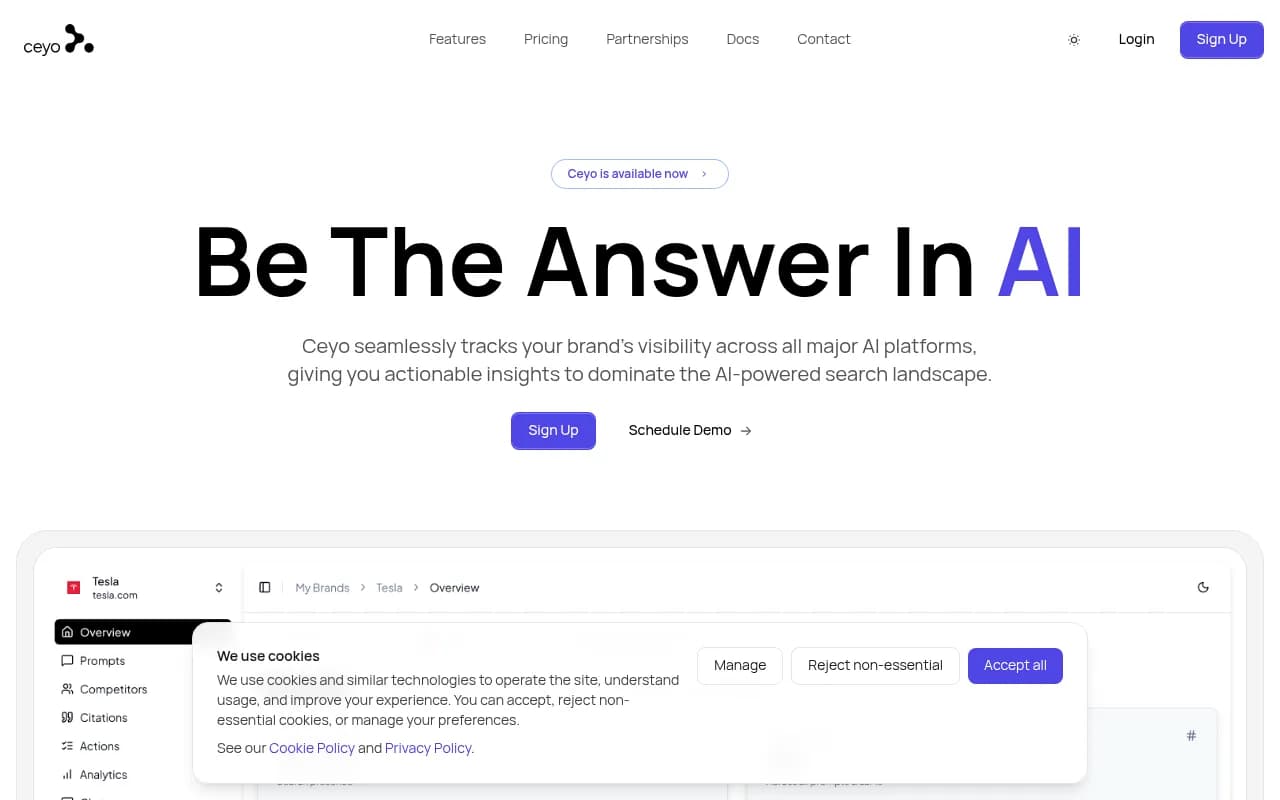
Ceyo is an AI visibility monitoring platform built for agencies, SEO teams, and brand managers who need to track how their brands appear in ChatGPT, Gemini, Claude, and Perplexity. It monitors brand mentions, sentiment, and competitive positioning across thousands of prompts with daily updates.
Unlike XFunnel, Ceyo has transparent pricing: Core plan at $49/mo for 1 brand, Pro plans from $89-199/mo for multiple brands and advanced features, and custom enterprise pricing for larger needs. This makes it accessible to smaller teams, agencies managing multiple clients, and anyone who doesn't want to go through a lengthy enterprise sales process.
Ceyo emphasizes prompt-level analytics -- you can see exactly which queries drive your brand's presence in LLM responses, track visibility percentages, sentiment (positive/neutral/negative), average position, and impact scores. The platform is explicitly built for agencies, with multi-brand tracking baked into the Pro tiers.
The interface shows detailed tables of prompts, visibility scores, sentiment, brands mentioned, categories, and geographic targeting. It's designed for teams that need to monitor AI visibility at scale and report results to clients or stakeholders. Ceyo is platform-agnostic -- it doesn't tie into a specific CRM or marketing stack, which gives it flexibility but also means you won't get deep workflow integrations like XFunnel's HubSpot connection.
Side-by-side comparison
| Feature | XFunnel | Ceyo |
|---|---|---|
| Pricing | Custom enterprise (contact sales) | From $49/mo (Core), Pro $89-199/mo, Enterprise custom |
| Free tier | No | No |
| Target audience | Enterprise marketing teams, HubSpot users | Agencies, SEO teams, brand managers, smaller teams |
| LLM coverage | ChatGPT, Gemini, Claude, Perplexity (exact coverage unclear post-acquisition) | ChatGPT, Gemini, Claude, Perplexity (explicitly listed) |
| Multi-brand tracking | Yes (enterprise accounts) | Yes (Pro plans, built for agencies) |
| Pricing transparency | None (sales-driven) | Full transparency, public pricing tiers |
| HubSpot integration | Deep integration (post-acquisition) | No native integration |
| Prompt analytics | Yes (citation tracking, search questions) | Yes (detailed prompt-level visibility, sentiment, impact scores) |
| Real-time updates | Not specified | Daily updates |
| Sentiment analysis | Not specified | Yes (positive/neutral/negative per prompt) |
| Geographic targeting | Not specified | Yes (visible in prompt tables) |
| Ease of onboarding | Requires sales demo and custom quote | Sign up directly, choose a plan |
| Best for | Large teams already using HubSpot, enterprise budgets | Agencies, multi-client tracking, teams needing fast access |
Pricing comparison
| Plan | XFunnel | Ceyo |
|---|---|---|
| Entry-level | Custom (contact sales) | $49/mo (Core, 1 brand) |
| Mid-tier | Custom (contact sales) | $89-199/mo (Pro, multiple brands) |
| Enterprise | Custom (contact sales) | Custom pricing |
| Free trial | Not publicly offered | Not specified |
| Pricing model | Sales-driven, no public tiers | Transparent tiers + custom enterprise |
XFunnel's lack of public pricing is a major friction point. If you're a small team or agency trying to evaluate tools, you can't even see what it costs without going through a sales process. Ceyo's transparent pricing makes it easy to budget and decide.
For context: Ceyo's $49/mo entry point is accessible for solo consultants or small brands. The Pro plans ($89-199/mo) are competitive for agencies managing 3-10 client brands. XFunnel's enterprise-only model means you're likely looking at thousands per month, which only makes sense if you're a large company with a dedicated GEO budget.
Feature deep-dive
LLM coverage and tracking
Both platforms track the big four: ChatGPT, Gemini, Claude, and Perplexity. These are the LLMs that matter most for brand visibility in 2026.
XFunnel's website mentions "AI-powered search engines" and "answer engines" but doesn't break down exact model coverage post-acquisition. The HubSpot deal likely means the platform will align with HubSpot's priorities, which could expand or narrow coverage depending on what HubSpot's enterprise customers need.
Ceyo explicitly lists ChatGPT, Gemini, Claude, and Perplexity on its homepage and emphasizes daily updates. The platform shows real-time tracking across thousands of prompts, with visibility percentages and sentiment scores per LLM. If you need to know exactly which models you're monitoring and how often they're checked, Ceyo is more transparent.
Verdict: Ceyo wins on transparency. XFunnel's coverage is solid but less clearly documented.
Prompt analytics and insights
XFunnel focuses on citation tracking and discovering relevant search questions. The platform helps teams understand which queries drive brand visibility and optimize content for AI-generated results. Post-acquisition, the HubSpot integration means you can tie AI visibility data back to CRM records, campaigns, and attribution models.
Ceyo goes deep on prompt-level analytics. You get tables showing:
- Prompt text
- Visibility percentage (how often your brand appears)
- Sentiment (positive/neutral/negative)
- Average position
- Impact score (relevance, volume, intent)
- Competing brands mentioned
- Category and geographic targeting
This level of detail is built for agencies and SEO teams who need to report on specific prompts and track changes over time. You can see exactly which queries are working and which need optimization.
Verdict: Ceyo has more granular prompt analytics. XFunnel's strength is tying visibility data into broader marketing workflows via HubSpot.
Multi-brand and agency features
XFunnel serves enterprise clients with multiple brands (Wix, Monday.com, etc.), but it's not explicitly built for agencies managing external clients. The platform is designed for in-house marketing teams at large companies.
Ceyo is explicitly built for agencies. The Pro plans ($89-199/mo) include multi-brand tracking, and the interface is designed for managing multiple client accounts. If you're an agency tracking AI visibility for 5-10 clients, Ceyo's pricing and feature set make sense. XFunnel's enterprise model doesn't fit the agency use case as cleanly.
Verdict: Ceyo is the clear winner for agencies. XFunnel is better for large in-house teams.
HubSpot integration
This is XFunnel's killer feature post-acquisition. If you're already using HubSpot for CRM, marketing automation, and attribution, XFunnel plugs directly into that ecosystem. You can connect AI visibility data to contact records, campaigns, and revenue attribution.
Ceyo doesn't have a HubSpot integration (or any native CRM integration). It's a standalone AI visibility platform. You can export data and build custom integrations via API if needed, but there's no out-of-the-box workflow connection.
Verdict: If you're a HubSpot customer, XFunnel's integration is a major advantage. If you're not, it's irrelevant.
Ease of onboarding
XFunnel requires contacting sales for a demo and custom quote. This adds friction. If you're a small team or agency trying to evaluate tools quickly, the sales-driven process is a barrier.
Ceyo has a "Sign Up" button on the homepage and transparent pricing tiers. You can evaluate the platform, choose a plan, and start tracking without talking to a sales rep. This is a huge advantage for teams that want to move fast.
Verdict: Ceyo is far easier to onboard. XFunnel's sales process is standard for enterprise tools but slows down evaluation.
Sentiment and competitive analysis
XFunnel mentions tracking citations and brand visibility but doesn't explicitly detail sentiment analysis or competitive positioning features on the public website.
Ceyo shows sentiment scores (positive/neutral/negative) for each prompt and lists competing brands mentioned in the same LLM responses. This is valuable for understanding not just whether you're visible, but how you're positioned relative to competitors.
Verdict: Ceyo has more visible sentiment and competitive analysis features.
Who should choose XFunnel
Pick XFunnel if:
- You're already using HubSpot and want AI visibility data integrated into your CRM and marketing workflows
- You're a large enterprise with a dedicated GEO budget and need a platform that can scale across multiple brands and teams
- You value the credibility and support of a HubSpot-backed platform
- You're comfortable with a sales-driven process and custom pricing
- You need a platform that can tie AI visibility to revenue attribution and campaign performance
XFunnel makes sense for companies like Wix, Monday.com, or Getty Images -- large marketing teams with enterprise budgets who want a tightly integrated solution.
Who should choose Ceyo
Pick Ceyo if:
- You're an agency managing multiple client brands and need transparent, scalable pricing
- You want to get started quickly without a sales process
- You need detailed prompt-level analytics with sentiment and competitive positioning
- You're not tied to HubSpot and want a platform-agnostic AI visibility tool
- You're a smaller team or startup that can't justify enterprise pricing
- You value pricing transparency and want to know exactly what you're paying before committing
Ceyo is built for agencies, SEO teams, and brand managers who need AI visibility tracking without enterprise complexity.
Promptwatch as a complement
If you're evaluating XFunnel or Ceyo and want to go beyond monitoring into actual optimization, Promptwatch is worth knowing about. While XFunnel and Ceyo focus on tracking visibility and sentiment, Promptwatch closes the loop by showing you what content is missing and helping you create it.

Promptwatch's Answer Gap Analysis identifies exactly which prompts competitors rank for but you don't, then its AI writing agent generates content grounded in 880M+ citations to fill those gaps. You also get AI crawler logs (see which LLMs are reading your site), Reddit/YouTube tracking, and ChatGPT Shopping monitoring -- capabilities neither XFunnel nor Ceyo offer. If you're serious about improving AI visibility, not just measuring it, Promptwatch complements either platform.
Pros and cons
XFunnel pros
- Deep HubSpot integration ties AI visibility to CRM and marketing workflows
- Enterprise-grade platform trusted by major brands (Wix, Monday.com, Getty Images)
- HubSpot backing provides credibility and long-term support
- Built for large marketing teams with complex needs
XFunnel cons
- No public pricing -- requires sales call and custom quote
- Not built for agencies managing multiple external clients
- Post-acquisition roadmap tied to HubSpot's priorities, not standalone innovation
- Higher barrier to entry for smaller teams
Ceyo pros
- Transparent pricing starting at $49/mo makes it accessible
- Built explicitly for agencies with multi-brand tracking
- Detailed prompt-level analytics with sentiment and competitive positioning
- Easy onboarding -- sign up and start without a sales process
- Daily updates and real-time tracking across four major LLMs
Ceyo cons
- No HubSpot or CRM integrations out of the box
- Less enterprise credibility compared to XFunnel's client roster
- Smaller team and platform (less established than XFunnel pre-acquisition)
- Limited public information on API and advanced integrations
Final verdict
Ceyo wins for agencies, smaller teams, and anyone who values transparent pricing and fast onboarding. At $49-199/mo, it's accessible and purpose-built for multi-client tracking with detailed prompt analytics.
XFunnel wins for large enterprises already using HubSpot who need AI visibility data integrated into their CRM and marketing stack. The HubSpot acquisition makes it a natural fit for companies already invested in that ecosystem, but the custom pricing and sales-driven process make it a poor fit for smaller teams or agencies.
If you're choosing between these two in 2026: ask yourself whether you need HubSpot integration and have enterprise budget (XFunnel), or whether you need transparent pricing and agency-friendly features (Ceyo). For most teams reading this, Ceyo is the more practical choice.