Key Takeaways
- XFunnel is enterprise-only with custom pricing and HubSpot integration (acquired 2024), while LLM Pulse offers transparent pricing from €49/mo with a 14-day free trial -- if you need to see pricing before talking to sales, LLM Pulse wins
- LLM Pulse tracks 10+ AI models (ChatGPT, Perplexity, Gemini, Google AI Mode, DeepSeek, Grok, Claude, Copilot, Meta AI, AI Overviews) with clear model coverage listed publicly; XFunnel's exact model list isn't public but focuses on major answer engines
- Setup speed differs dramatically: LLM Pulse advertises 2-minute setup with immediate trial access, while XFunnel requires contacting sales and going through an enterprise onboarding process
- Both platforms track citations, sentiment, and share of voice, but LLM Pulse emphasizes weekly prompt tracking and competitor benchmarking, while XFunnel highlights conversion optimization and HubSpot workflow integration
- Customer base reveals positioning: XFunnel serves major enterprises (Wix, Monday.com, LastPass, Getty Images), while LLM Pulse serves 500+ brands including Swiss Marketplace Group and Voicemod -- a mix of enterprise and mid-market
- If you're choosing based on transparency and speed to value, pick LLM Pulse. If you're a large enterprise already using HubSpot and need deep integration, XFunnel might be worth the sales conversation.
XFunnel overview
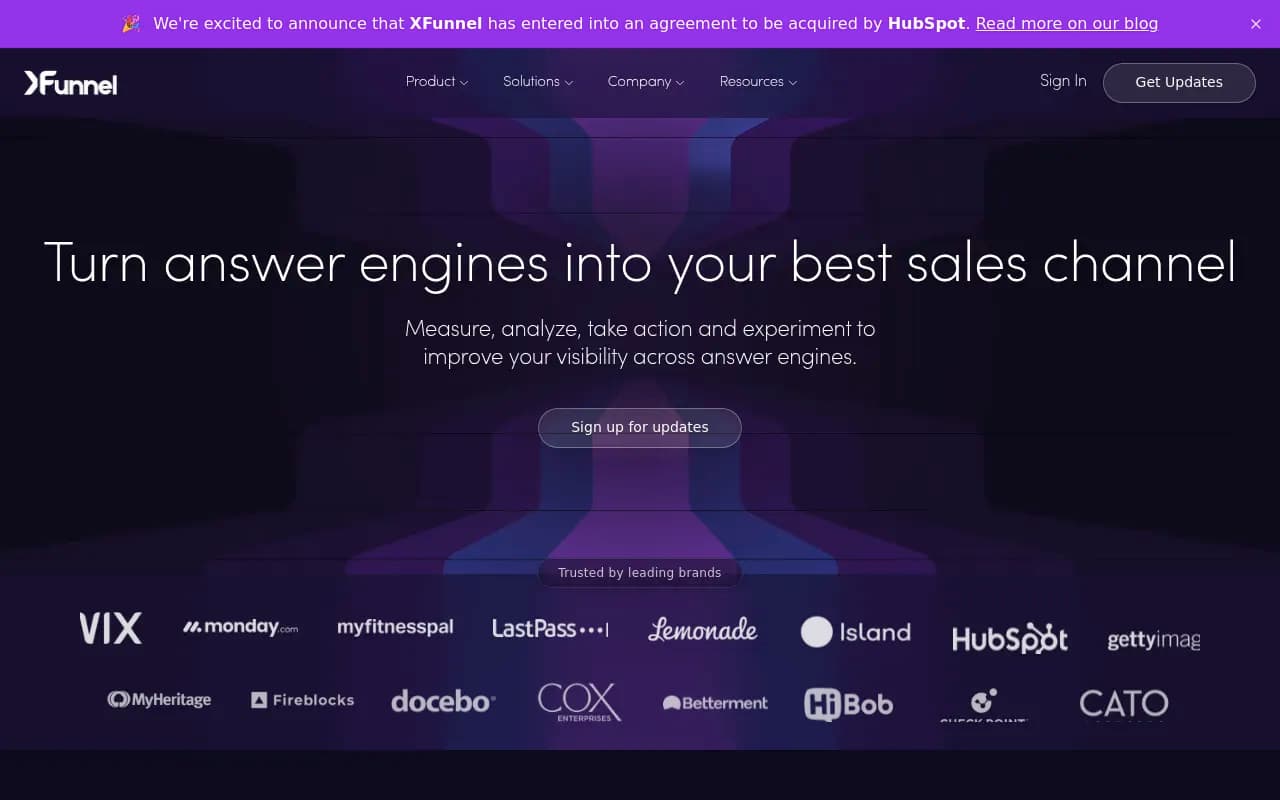
XFunnel positions itself as a generative engine optimization platform for marketing teams. The big news: HubSpot acquired XFunnel in 2024, which means the platform is now part of HubSpot's ecosystem. This matters if you're already a HubSpot customer -- you get native integration with your existing workflows.
The platform focuses on helping brands "turn answer engines into your best sales channel" by measuring, analyzing, and optimizing visibility across AI-powered search. Customer logos include heavy hitters like Wix, Monday.com, MyFitnessPal, LastPass, Lemonade, Getty Images, and Fireblocks. This is clearly an enterprise play.
Pricing is custom -- no public rates. You contact sales, go through discovery, and get a quote tailored to your organization. This is standard for enterprise software but means you can't quickly evaluate cost vs. value without a sales conversation.
LLM Pulse overview
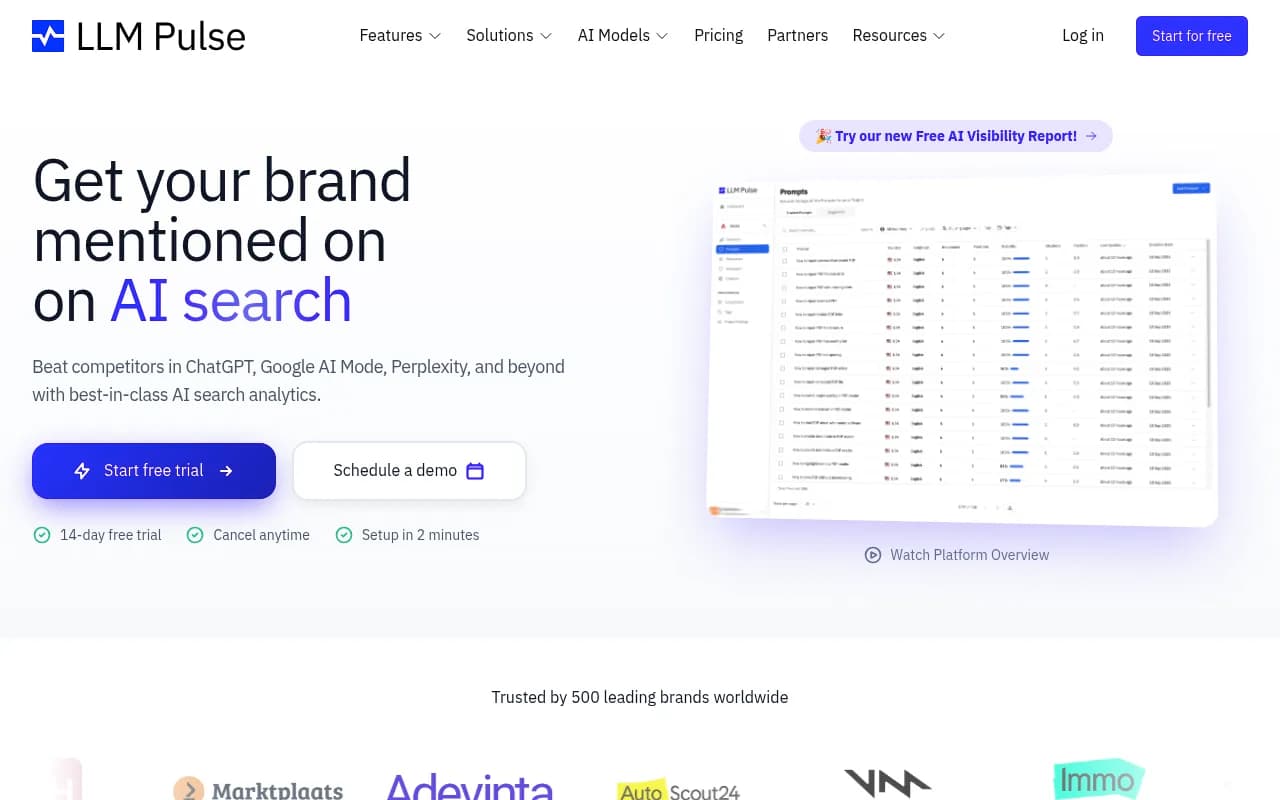
LLM Pulse calls itself "your radar in the world of generative AI" and tracks how AI models mention your brand across ChatGPT, Perplexity, Gemini, Google AI Mode, and more. The platform monitors key prompts weekly, analyzes citations and sentiment, benchmarks you against competitors, and provides content recommendations to improve your AI search presence.
The customer base is 500+ brands including Swiss Marketplace Group and Voicemod. This is a broader mix than XFunnel's enterprise-only roster -- LLM Pulse serves SMBs, mid-market, and enterprise.
Pricing is transparent: €49/mo (Starter), €99/mo (Growth), €299/mo (Scale). Annual billing saves 17%. There's a 14-day free trial with no credit card required and advertised 2-minute setup. This is a very different go-to-market approach than XFunnel's enterprise sales model.
Side-by-side comparison
| Feature | XFunnel | LLM Pulse |
|---|---|---|
| Pricing model | Custom enterprise (contact sales) | Transparent: €49-€299/mo |
| Free trial | Not advertised | 14 days, no credit card |
| Setup time | Enterprise onboarding | 2 minutes (advertised) |
| AI models tracked | Not publicly listed | 10+ (ChatGPT, Perplexity, Gemini, Google AI Mode, AI Overviews, DeepSeek, Grok, Claude, Copilot, Meta AI) |
| Citation tracking | ✓ | ✓ |
| Sentiment analysis | ✓ | ✓ |
| Competitor benchmarking | ✓ | ✓ |
| Content recommendations | ✓ (experimentation focus) | ✓ (AI-powered) |
| HubSpot integration | ✓ (native, post-acquisition) | Not mentioned |
| Prompt tracking frequency | Not specified | Weekly |
| Target customer | Enterprise marketing teams | SMB to enterprise (500+ brands) |
| Public customer logos | Wix, Monday.com, LastPass, Getty Images, Lemonade, MyFitnessPal | Swiss Marketplace Group, Voicemod, 500+ total |
| Acquisition status | Acquired by HubSpot (2024) | Independent |
Pricing: transparent vs. enterprise sales
This is the sharpest difference between the two platforms.
LLM Pulse shows you exactly what you'll pay:
- Starter: €49/mo
- Growth: €99/mo
- Scale: €299/mo
- Annual billing: 17% discount
- Free trial: 14 days, no credit card
You can sign up, start tracking, and decide if it's worth the money without talking to anyone. For a small team or a marketing manager who needs to move fast, this is a huge advantage.
XFunnel uses custom enterprise pricing. No public rates. You fill out a form, schedule a demo, go through discovery calls, and eventually get a quote. This is standard for enterprise software targeting large organizations, but it means:
- You can't quickly compare cost vs. budget
- Smaller teams might not even get a response if they're below XFunnel's target deal size
- The sales cycle adds weeks or months before you can start tracking
If you're at a large company with budget and a formal procurement process, XFunnel's model is fine. If you're a growth-stage startup or a mid-market team that needs to move fast, LLM Pulse's transparent pricing is a better fit.
AI model coverage: LLM Pulse lists them, XFunnel doesn't
LLM Pulse explicitly tracks 10+ AI models:
- ChatGPT
- Perplexity
- Gemini
- Google AI Mode
- AI Overviews
- DeepSeek (Enterprise tier)
- Grok (Enterprise tier)
- Claude (Enterprise tier)
- Copilot (Enterprise tier)
- Meta AI (Enterprise tier)
This is clearly listed on their website with model logos. You know exactly what you're tracking.
XFunnel's website says it helps you "improve your visibility across AI-powered search engines" and "answer engines" but doesn't list specific models. The focus is on "AI platforms" and "answer engines" in general. This might mean they track the same models as LLM Pulse, or it might mean they focus on a smaller set. You'd need to ask during the sales process.
For a buyer, this lack of transparency is frustrating. If you're specifically trying to track ChatGPT and Perplexity, LLM Pulse gives you certainty. XFunnel requires a demo to find out.
Features: both track citations and sentiment, different optimization approaches
Both platforms cover the core GEO workflow:
- Track what AI models say about your brand
- Analyze citations, sentiment, and share of voice
- Benchmark against competitors
- Get recommendations to improve visibility
LLM Pulse's approach:
- Weekly prompt tracking (you define the prompts that matter to your business)
- Citation analysis showing which sources AI trusts
- Visibility score and citation rate metrics
- AI-powered content recommendations
- Detailed response tracking so you see the exact words AI uses
XFunnel's approach:
- Emphasis on "conversion across AI platforms" (not just visibility, but turning AI traffic into customers)
- HubSpot integration for workflow automation post-acquisition
- Experimentation features to test what improves visibility
- Focus on "turning answer engines into your best sales channel"
The difference: LLM Pulse feels more focused on monitoring and content optimization. XFunnel feels more focused on conversion and sales funnel integration, especially now that it's part of HubSpot.
If you're a content team trying to improve how AI describes your brand, LLM Pulse's weekly tracking and content recs are directly useful. If you're a demand gen team trying to convert AI referral traffic into pipeline, XFunnel's HubSpot integration and conversion focus might be more valuable.
Setup and onboarding: 2 minutes vs. enterprise sales cycle
LLM Pulse advertises "Setup in 2 minutes" and a 14-day free trial with no credit card. You sign up, define your prompts, and start tracking. This is a self-service model.
XFunnel requires contacting sales. You schedule a demo, go through discovery, get a custom quote, sign a contract, and then onboard. This could take weeks or months depending on your organization's procurement process.
For a marketing manager who needs to start tracking AI visibility this week, LLM Pulse is the only option. For an enterprise with a formal vendor evaluation process, XFunnel's sales-led approach is normal.
HubSpot integration: XFunnel's unique advantage
XFunnel was acquired by HubSpot in 2024. This means native integration with HubSpot's CRM, marketing automation, and sales tools. If you're already a HubSpot customer, this is a big deal:
- Track AI referral traffic in HubSpot
- Attribute pipeline and revenue to AI visibility improvements
- Automate workflows based on AI mention triggers
- Unified reporting across traditional marketing and AI search
LLM Pulse doesn't mention HubSpot integration. If you're heavily invested in HubSpot and want AI visibility tracking inside that ecosystem, XFunnel is the only option here.
If you're not a HubSpot customer, this advantage disappears.
Customer base: enterprise vs. broad market
XFunnel's customer logos are all large, well-known brands: Wix, Monday.com, MyFitnessPal, LastPass, Lemonade, Getty Images, Fireblocks, Checkpoint, Cato Networks. These are enterprise customers with big marketing budgets.
LLM Pulse serves 500+ brands including Swiss Marketplace Group and Voicemod. The "500+ brands" number suggests a broader customer base -- not just enterprise, but also mid-market and growth-stage companies.
This reflects the pricing model. XFunnel's custom enterprise pricing filters for large customers. LLM Pulse's €49/mo entry point lets smaller teams get started.
Tracking frequency and prompt management
LLM Pulse explicitly tracks prompts weekly. You define the questions that matter to your business, and the platform checks how AI models answer them every week. This gives you a time-series view of how your visibility changes.
XFunnel doesn't specify tracking frequency on their public website. You'd need to ask during the sales process.
For a buyer, weekly tracking is a clear, understandable cadence. You can see trends over time and measure the impact of content changes. XFunnel might offer the same thing, but the lack of public information makes it harder to evaluate.
Content optimization: recommendations vs. experimentation
Both platforms help you improve your AI visibility, but the approach differs.
LLM Pulse provides "AI-powered content recommendations" to improve how you appear in LLM responses. The platform analyzes which sources AI cites and suggests content changes to increase your citation rate. This is a content-first approach.
XFunnel emphasizes "experimentation" -- testing different approaches to see what improves visibility and conversion. The HubSpot integration suggests a more workflow-oriented approach: track what works, automate it, measure pipeline impact.
If you're a content marketer trying to get cited more often, LLM Pulse's recommendations are directly actionable. If you're a growth marketer trying to optimize the entire funnel from AI mention to closed deal, XFunnel's experimentation and HubSpot integration might be more valuable.
Worth noting: if you're looking for a platform that goes beyond monitoring to actually help you create content that ranks in AI search, Promptwatch takes a different angle. It shows you exactly which prompts competitors are visible for but you're not (Answer Gap Analysis), then uses an AI writing agent to generate articles grounded in 880M+ citations analyzed. LLM Pulse and XFunnel both focus on tracking and recommendations; Promptwatch focuses on the full loop from gap analysis to content creation to tracking results.

Transparency: public information vs. sales-gated details
LLM Pulse's website tells you:
- Exact pricing for each tier
- Which AI models are tracked
- How often prompts are checked (weekly)
- What features are included
- How long the free trial lasts
- How quickly you can set up (2 minutes)
XFunnel's website tells you:
- Customer logos
- High-level value proposition ("turn answer engines into your best sales channel")
- That it was acquired by HubSpot
- That you need to contact sales for pricing
For a buyer doing initial research, LLM Pulse gives you enough information to make a decision. XFunnel requires a sales conversation to answer basic questions like "what does this cost?" and "which AI models do you track?"
If you value transparency and want to evaluate tools quickly, LLM Pulse wins. If you're comfortable with enterprise sales processes and want a custom solution, XFunnel's approach is standard.
Pros and cons
XFunnel pros:
- HubSpot integration (native, post-acquisition) for customers already in that ecosystem
- Enterprise-grade platform used by major brands (Wix, Monday.com, LastPass)
- Focus on conversion and sales funnel optimization, not just visibility tracking
- Likely offers white-glove onboarding and dedicated support for enterprise customers
XFunnel cons:
- No public pricing -- you can't evaluate cost without a sales conversation
- No free trial advertised -- can't test before committing
- AI model coverage not publicly listed -- you don't know what you're tracking until you ask
- Enterprise sales cycle adds weeks or months before you can start using the platform
- Likely out of reach for small teams or startups due to custom pricing model
LLM Pulse pros:
- Transparent pricing starting at €49/mo -- you know exactly what it costs
- 14-day free trial with no credit card -- test before you buy
- 2-minute setup -- start tracking immediately
- 10+ AI models clearly listed (ChatGPT, Perplexity, Gemini, Google AI Mode, etc.)
- Weekly prompt tracking with clear cadence
- Serves 500+ brands from SMB to enterprise -- not just large companies
LLM Pulse cons:
- No HubSpot integration mentioned -- if you're a HubSpot customer, you're missing that workflow automation
- Less emphasis on conversion optimization compared to XFunnel's sales funnel focus
- Smaller brand recognition compared to XFunnel's enterprise customer logos
- Some advanced features (DeepSeek, Grok, Claude, Copilot, Meta AI) require Enterprise tier
Who should pick XFunnel
Pick XFunnel if:
- You're an enterprise marketing team at a large company (1000+ employees)
- You're already a HubSpot customer and want native integration with your existing workflows
- You have budget for custom enterprise software and a formal procurement process
- You care more about converting AI referral traffic into pipeline than just tracking visibility
- You're comfortable with a sales-led buying process and multi-week evaluation cycles
- You want white-glove onboarding and dedicated support (likely included in enterprise contracts)
Who should pick LLM Pulse
Pick LLM Pulse if:
- You're a small to mid-sized team (or a large company that wants to move fast)
- You need to see pricing before talking to sales
- You want to test the platform with a free trial before committing
- You need to start tracking AI visibility this week, not next quarter
- You want clear visibility into which AI models you're tracking (ChatGPT, Perplexity, Gemini, etc.)
- You're focused on content optimization and improving how AI describes your brand
- You're not a HubSpot customer (or don't need deep CRM integration)
Final verdict
These platforms serve different markets. XFunnel is an enterprise GEO platform with HubSpot integration and custom pricing. LLM Pulse is a transparent, self-service AI visibility tracker with a 14-day free trial and pricing from €49/mo.
If you're a large enterprise already using HubSpot and you want AI visibility tracking integrated into your existing sales and marketing workflows, XFunnel is worth the sales conversation. The HubSpot acquisition means you get native integration that LLM Pulse can't match.
If you're anyone else -- a startup, a mid-market company, a large company that wants to move fast, or a team that values transparency -- LLM Pulse is the better choice. You can sign up today, start tracking in 2 minutes, and decide if it's worth the money after a 14-day trial. No sales calls, no custom quotes, no waiting.
The pricing transparency alone makes LLM Pulse the default recommendation for most teams. XFunnel's enterprise-only approach limits it to a narrow segment of large HubSpot customers with formal procurement processes.