Key Takeaways
- XFunnel is pure GEO, Nightwatch is unified SEO + AI: XFunnel tracks only AI search visibility across platforms like ChatGPT and Perplexity. Nightwatch combines traditional search rankings with AI tracking in one dashboard, eliminating the need for separate tools.
- Pricing transparency differs dramatically: Nightwatch starts at $24/mo with clear tiered pricing and a 14-day trial. XFunnel requires contacting sales for custom enterprise pricing, making it less accessible for smaller teams.
- XFunnel is now part of HubSpot: Announced in 2025, XFunnel entered an agreement to be acquired by HubSpot, which means future roadmap and integration will likely center on the HubSpot ecosystem.
- Nightwatch offers real-time rank tracking: Nightwatch refreshes critical keywords on demand and tracks 107,000+ locations down to zip code level. XFunnel focuses on AI citation tracking and experimentation rather than real-time traditional search data.
- Both lack built-in content generation: Neither platform creates optimized content for you -- they show you where you're visible (or invisible) but don't close the loop with content creation. If you need that, Promptwatch fills the gap with AI content generation grounded in citation data.
- Choose XFunnel if: You're an enterprise team already in the HubSpot ecosystem, you only care about AI search visibility, and you have budget for custom pricing.
- Choose Nightwatch if: You want one tool for both traditional SEO and AI tracking, you need transparent pricing and a free trial, or you're a growing team that can't justify separate platforms.
Overview
XFunnel: Enterprise GEO platform (now HubSpot)
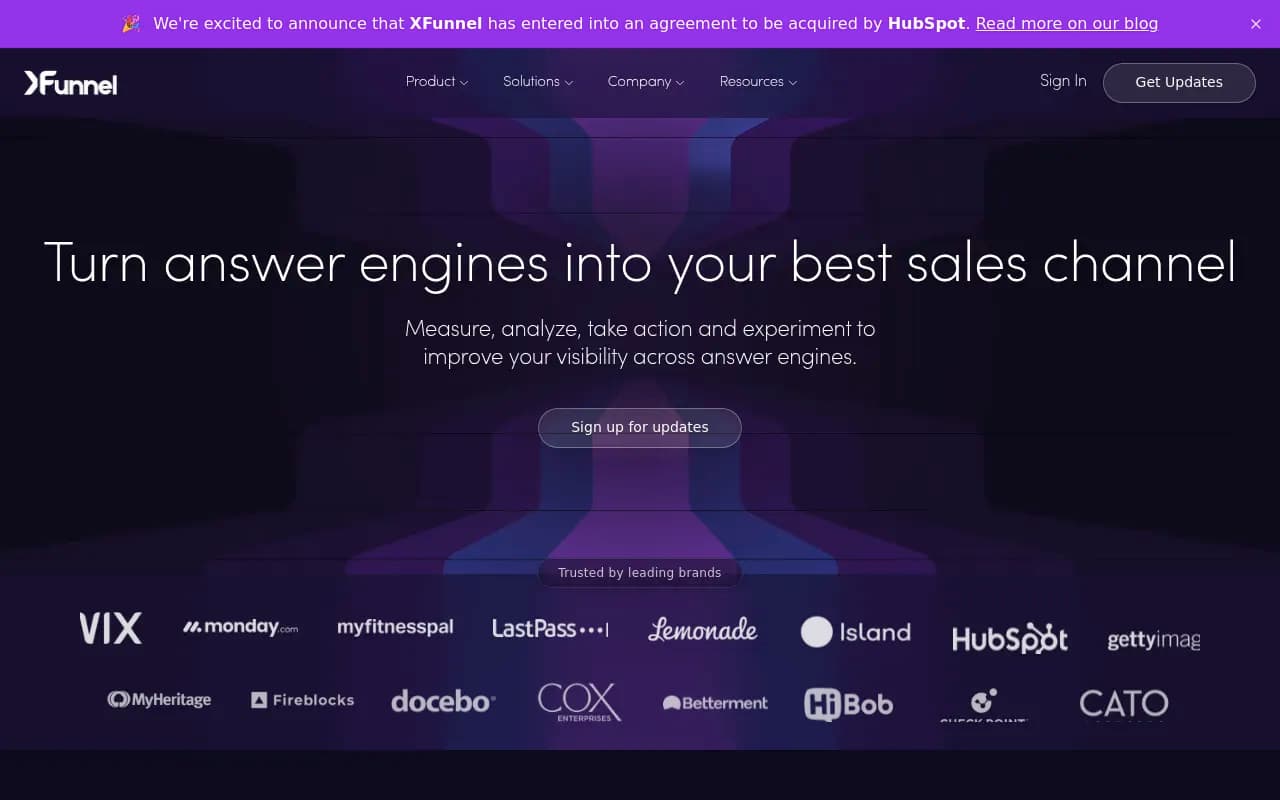
XFunnel positions itself as a generative engine optimization platform built for marketing teams. The core pitch: measure your brand's visibility across AI-powered search engines, analyze what's working, and run experiments to improve citation rates. In late 2025, XFunnel announced it had entered an agreement to be acquired by HubSpot, which signals a shift toward deeper integration with HubSpot's marketing suite.
The platform tracks citations across major AI models (ChatGPT, Gemini, Claude, Perplexity), helps you discover relevant search questions, and provides analytics to understand where your brand shows up in AI-generated answers. It's used by enterprise brands like Wix, Monday.com, MyFitnessPal, and LastPass -- companies with significant marketing budgets and complex visibility needs.
XFunnel doesn't publish pricing on its website. You contact sales for a custom quote, which typically means enterprise-level contracts.
Nightwatch: Unified search + AI tracking
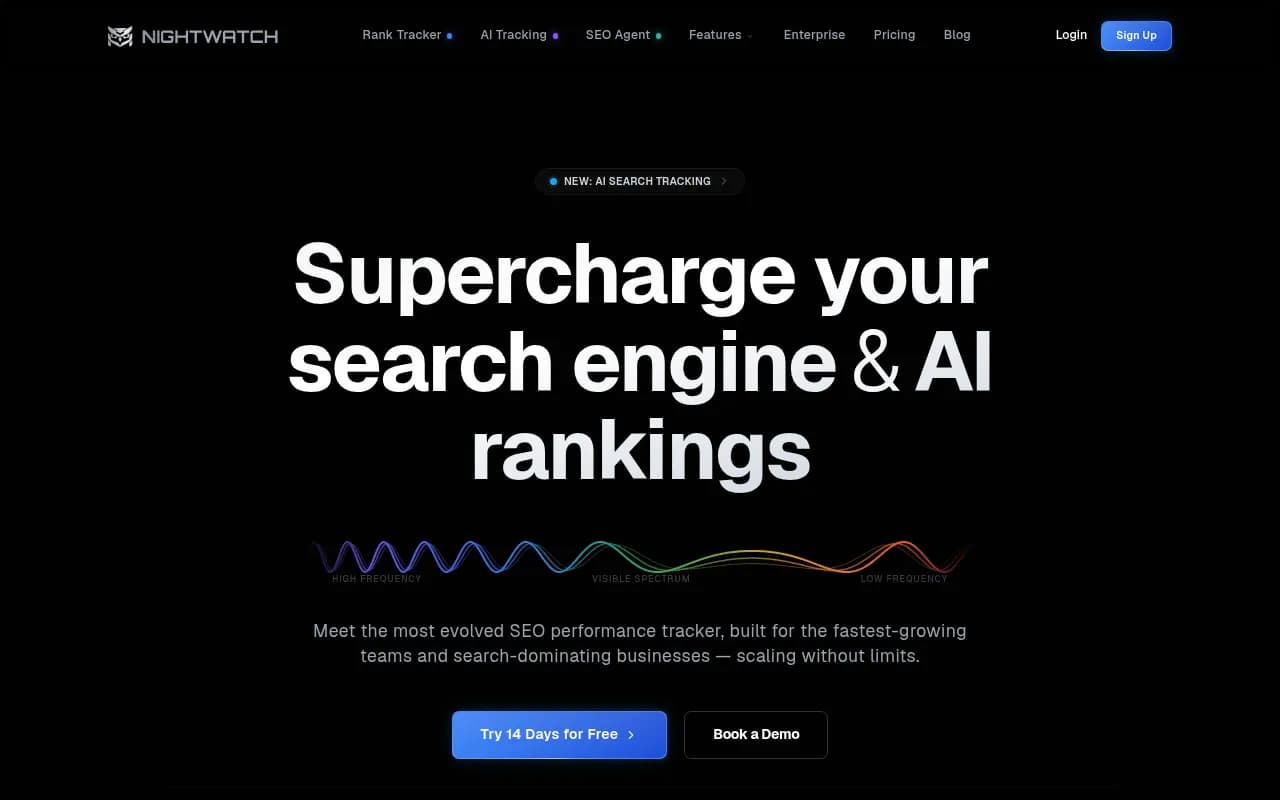
Nightwatch takes a different approach: it's a unified platform that tracks both traditional search engine rankings and AI search visibility in one dashboard. The idea is that you shouldn't need separate tools to monitor Google rankings and ChatGPT citations -- you need complete visibility across the entire search spectrum.
The platform covers traditional search engines (Google, Bing, Yahoo, DuckDuckGo) plus AI models (ChatGPT, Gemini, Claude, Perplexity). It offers real-time rank tracking, keyword research, prompt research, site audits, and an SEO Agent feature to automate workflow. Nightwatch emphasizes data accuracy and high-frequency updates -- you can refresh critical keywords on demand and track rankings down to zip code level across 107,000+ locations.
Pricing is transparent: Starter at $24/mo, Optimize at $59/mo, and custom Enterprise plans. There's a 14-day free trial, no credit card required.
Side-by-side comparison
| Feature | XFunnel | Nightwatch |
|---|---|---|
| Primary focus | AI search visibility only | Traditional SEO + AI search unified |
| AI models tracked | ChatGPT, Gemini, Claude, Perplexity | ChatGPT, Gemini, Claude, Perplexity |
| Traditional search | Not covered | Google, Bing, Yahoo, DuckDuckGo |
| Starting price | Custom (contact sales) | $24/mo (Starter plan) |
| Free trial | Not advertised | 14 days, no credit card |
| Real-time updates | Not specified | Yes, on-demand keyword refresh |
| Location tracking | Not specified | 107,000+ locations, zip code level |
| Keyword research | Discover relevant questions | Yes, plus prompt research |
| Site audit | No | Yes |
| Reporting | Analytics dashboard | Customizable dashboards, Looker Studio integration |
| Automation | Experimentation framework | SEO Agent for workflow automation |
| Target audience | Enterprise marketing teams | Growing teams, agencies, data-obsessed marketers |
| Parent company | HubSpot (acquisition announced 2025) | Independent |
Head-to-head feature breakdown
Platform focus and philosophy
XFunnel is laser-focused on generative engine optimization. It doesn't try to be an all-in-one SEO tool -- it's built exclusively for tracking and improving your brand's visibility in AI-generated answers. The workflow is: measure where you show up in AI responses, analyze patterns, test hypotheses, and iterate. This narrow focus makes sense for teams that already have traditional SEO covered and just need to layer on AI visibility.
Nightwatch argues that splitting your search monitoring across multiple tools is inefficient. Why pay for Ahrefs or Semrush for traditional rankings, then add a separate GEO tool for AI tracking? Nightwatch unifies both in one platform, giving you a complete picture of search performance -- traditional and AI -- in a single dashboard. The trade-off: it's not as deep on pure GEO features as a specialized tool, but it covers more ground overall.
Verdict: If you only care about AI search and already have traditional SEO handled, XFunnel's focus is an advantage. If you want one tool for everything, Nightwatch eliminates tool sprawl.
AI model coverage
Both platforms track the major AI models that matter in 2026: ChatGPT, Google Gemini, Claude, and Perplexity. Neither covers every niche AI model (DeepSeek, Grok, Mistral, Meta AI), but they hit the platforms that drive the most traffic and citations.
XFunnel's website emphasizes "answer engines" broadly but doesn't break down exactly which models are covered or how frequently they're checked. Nightwatch explicitly lists ChatGPT, Gemini, Claude, and Perplexity on its feature page.
Neither platform appears to track AI shopping features (like ChatGPT Shopping) or Reddit/YouTube influence on AI responses -- areas where tools like Promptwatch go deeper.

Verdict: Tie on core AI model coverage. Both hit the essentials. If you need broader AI model coverage (10+ models including DeepSeek, Grok, Mistral) or want to track Reddit/YouTube influence, you'll need a more comprehensive GEO platform.
Traditional search engine tracking
This is the clearest difference. XFunnel doesn't track traditional search engines at all -- it's AI-only. Nightwatch covers Google, Bing, Yahoo, and DuckDuckGo with daily rank tracking, real-time updates on demand, and location tracking down to zip code level across 107,000+ locations.
Nightwatch's traditional SEO features include:
- Daily keyword rank tracking with historical data
- Search visibility scoring
- Click potential estimates
- Keyword distribution analysis
- Competitor rank tracking
- SERP feature tracking
If you're running a modern SEO program, you need visibility into both traditional search and AI search. Most traffic still comes from Google in 2026, even as AI search grows. Nightwatch lets you monitor both channels without switching tools.
Verdict: Nightwatch wins decisively if you need traditional search tracking. XFunnel isn't even playing in this category.
Pricing and accessibility
| Plan | XFunnel | Nightwatch |
|---|---|---|
| Entry tier | Custom pricing (contact sales) | $24/mo (Starter) |
| Mid tier | Custom pricing | $59/mo (Optimize) |
| Enterprise | Custom pricing | Custom pricing |
| Free trial | Not advertised | 14 days, no credit card required |
| Pricing transparency | None -- must contact sales | Full pricing published on website |
XFunnel's lack of published pricing is a red flag for smaller teams. "Contact sales" almost always means enterprise-level contracts -- likely $500+/mo minimum, possibly much higher. The client list (Wix, Monday.com, Getty Images) confirms this is an enterprise tool.
Nightwatch's transparent pricing makes it accessible to growing teams and agencies. $24/mo gets you started, $59/mo is reasonable for a small marketing team, and you can test it free for 14 days before committing. The pricing page shows exactly what you get at each tier.
Verdict: Nightwatch is dramatically more accessible. XFunnel is enterprise-only.
Data accuracy and update frequency
Nightwatch makes a big deal about data accuracy, claiming most tools "approximate data to save costs" while Nightwatch is "engineered for precision." The platform offers:
- Real-time keyword updates on demand
- High-frequency tracking (not just daily snapshots)
- Precise localization (107,000+ locations, zip code level)
- Direct API access to search engines (not scraped data)
XFunnel doesn't publish specifics about update frequency or data collection methodology. The website emphasizes "measure, analyze, take action, experiment" but doesn't detail how often data refreshes or how accurate the citation tracking is.
For traditional search, Nightwatch's claims are verifiable -- you can test rank accuracy yourself. For AI search, both platforms are tracking a moving target (AI models change their responses constantly), so "accuracy" is harder to define.
Verdict: Nightwatch provides more transparency about data quality and offers real-time updates. XFunnel's methodology is unclear.
Reporting and integrations
Nightwatch offers:
- Customizable dashboards with pinned metrics
- Looker Studio integration for custom reports
- White-label reporting for agencies
- API access for custom integrations
XFunnel provides:
- Analytics dashboard for citation tracking
- Experimentation framework to test optimization strategies
- Likely HubSpot integration (given the acquisition)
Nightwatch's Looker Studio integration is a standout feature -- you can pull rank data into Google's free BI tool and build custom reports for clients or stakeholders. XFunnel's HubSpot integration (once finalized) could be powerful for teams already using HubSpot for marketing automation, CRM, and content management.
Verdict: Nightwatch wins on flexibility and third-party integrations. XFunnel will likely win for HubSpot users once the acquisition closes.
Content optimization and workflow
Neither platform generates content for you. XFunnel helps you understand where you're visible in AI search and run experiments to improve it, but you still need to create the content yourself. Nightwatch includes an "SEO Agent" feature to automate workflow and provides prompt research to understand what queries drive AI visibility, but again, you're writing the content.
This is where both platforms leave a gap. Tracking visibility is step one. Creating content that actually ranks in AI search is step two. Tools like Promptwatch close this loop with AI content generation grounded in real citation data -- you see the gap, then generate optimized content to fill it.
Verdict: Tie. Both platforms are monitoring tools, not content creation tools.
Target audience and use cases
XFunnel is built for:
- Enterprise marketing teams with dedicated GEO budgets
- Brands already using HubSpot (especially after acquisition)
- Companies that only care about AI search visibility
- Teams with resources to run structured experiments
Nightwatch is built for:
- Growing marketing teams that need both SEO and AI tracking
- Agencies managing multiple clients
- Data-driven marketers who want one unified dashboard
- Teams that need transparent pricing and a free trial
Verdict: Different audiences. XFunnel is enterprise-focused and HubSpot-aligned. Nightwatch is accessible to a wider range of team sizes.
Pricing comparison
| Plan | XFunnel | Nightwatch |
|---|---|---|
| Starter/Entry | Not available | $24/mo |
| Mid-tier | Not available | $59/mo (Optimize) |
| Enterprise | Custom (contact sales) | Custom (contact sales) |
| Free trial | Not advertised | 14 days, no credit card |
| Annual discount | Unknown | Likely available |
| Minimum commitment | Unknown (likely annual contract) | Month-to-month available |
XFunnel's lack of published pricing makes direct comparison impossible, but the enterprise client list and "contact sales" model suggest pricing is significantly higher than Nightwatch's entry tiers. If you're a small team or agency, Nightwatch is the only realistic option. If you're an enterprise brand with a six-figure marketing budget, XFunnel's pricing is probably not a barrier.
Pros and cons
XFunnel pros
- Laser focus on AI search visibility -- no feature bloat
- Trusted by major enterprise brands (Wix, Monday.com, MyFitnessPal)
- Experimentation framework for testing optimization strategies
- HubSpot integration coming (if you're in that ecosystem)
- Likely strong support and onboarding for enterprise clients
XFunnel cons
- No published pricing -- enterprise budgets only
- No traditional search tracking (you need a separate SEO tool)
- No free trial advertised
- Limited transparency about data methodology and update frequency
- Future roadmap tied to HubSpot's priorities (could be good or bad)
Nightwatch pros
- Unified platform for traditional SEO + AI search (no tool sprawl)
- Transparent pricing starting at $24/mo
- 14-day free trial, no credit card required
- Real-time rank updates and high-frequency tracking
- Looker Studio integration for custom reporting
- Precise location tracking (107,000+ locations, zip code level)
- SEO Agent for workflow automation
Nightwatch cons
- Not as deep on pure GEO features as a specialized tool
- Smaller brand (less enterprise credibility vs HubSpot-backed XFunnel)
- AI tracking is newer -- platform originally built for traditional SEO
- No content generation features
Who should choose which tool
Choose XFunnel if:
- You're an enterprise marketing team with a dedicated GEO budget
- You already use HubSpot and want tight integration
- You only care about AI search visibility (traditional SEO is handled elsewhere)
- You have resources to run structured experiments and iterate on optimization
- You're comfortable with custom pricing and annual contracts
Choose Nightwatch if:
- You want one tool for both traditional SEO and AI search tracking
- You're a growing team or agency that needs transparent, accessible pricing
- You need a free trial to test before committing
- You want real-time rank updates and precise location tracking
- You need Looker Studio integration for client reporting
- You're not locked into the HubSpot ecosystem
Consider Promptwatch if:
- You need deeper AI model coverage (10+ models including DeepSeek, Grok, Mistral)
- You want to track Reddit and YouTube influence on AI responses
- You need content gap analysis that shows exactly what's missing from your site
- You want AI content generation to actually create optimized articles, not just track visibility
- You need crawler logs to see how AI models are discovering your content
Final verdict
XFunnel and Nightwatch solve different problems. XFunnel is a pure-play GEO platform for enterprise teams that only care about AI search visibility and are likely already in the HubSpot ecosystem. Nightwatch is a unified SEO + AI tracking tool for teams that want complete search visibility in one dashboard without paying for multiple platforms.
If you're a small to mid-sized team, Nightwatch is the obvious choice -- transparent pricing, free trial, and you get both traditional SEO and AI tracking. If you're an enterprise brand with a big marketing budget and you're already using HubSpot, XFunnel makes sense once the acquisition integration is complete.
The bigger question: do you just need monitoring, or do you need optimization? Both platforms show you where you're visible (or invisible), but neither helps you create content that ranks. That's where the real work happens. Tracking is step one. Creating optimized content is step two. Make sure you have a plan for both.