Key takeaways
- Pricing gap is massive: Omnia starts at €63/month with transparent pricing and a free trial. XFunnel requires enterprise sales contact with custom pricing, putting it out of reach for most small to mid-sized teams.
- XFunnel is now part of HubSpot: The 2024 acquisition means XFunnel will likely integrate deeply into HubSpot's ecosystem, making it the obvious pick if you're already a HubSpot customer. But it also signals a shift toward enterprise-only positioning.
- Omnia focuses on actionable insights: Beyond just showing you where you rank, Omnia translates tracking data into a concrete roadmap with content creation and SEO tasks. XFunnel emphasizes measurement and experimentation but doesn't detail optimization workflows as clearly.
- Both cover the same AI engines: ChatGPT, Perplexity, Gemini, and Copilot are monitored by both platforms. The core tracking capabilities are similar -- the real differences are in pricing, accessibility, and how they help you act on the data.
- Customer base tells the story: XFunnel's client list includes Wix, Monday.com, LastPass, and Getty Images -- big enterprise brands. Omnia's customers are more mid-market (Exoticca, Ironhack, Pleo). That's not a quality judgment, just a signal of who each platform is built for.
XFunnel overview
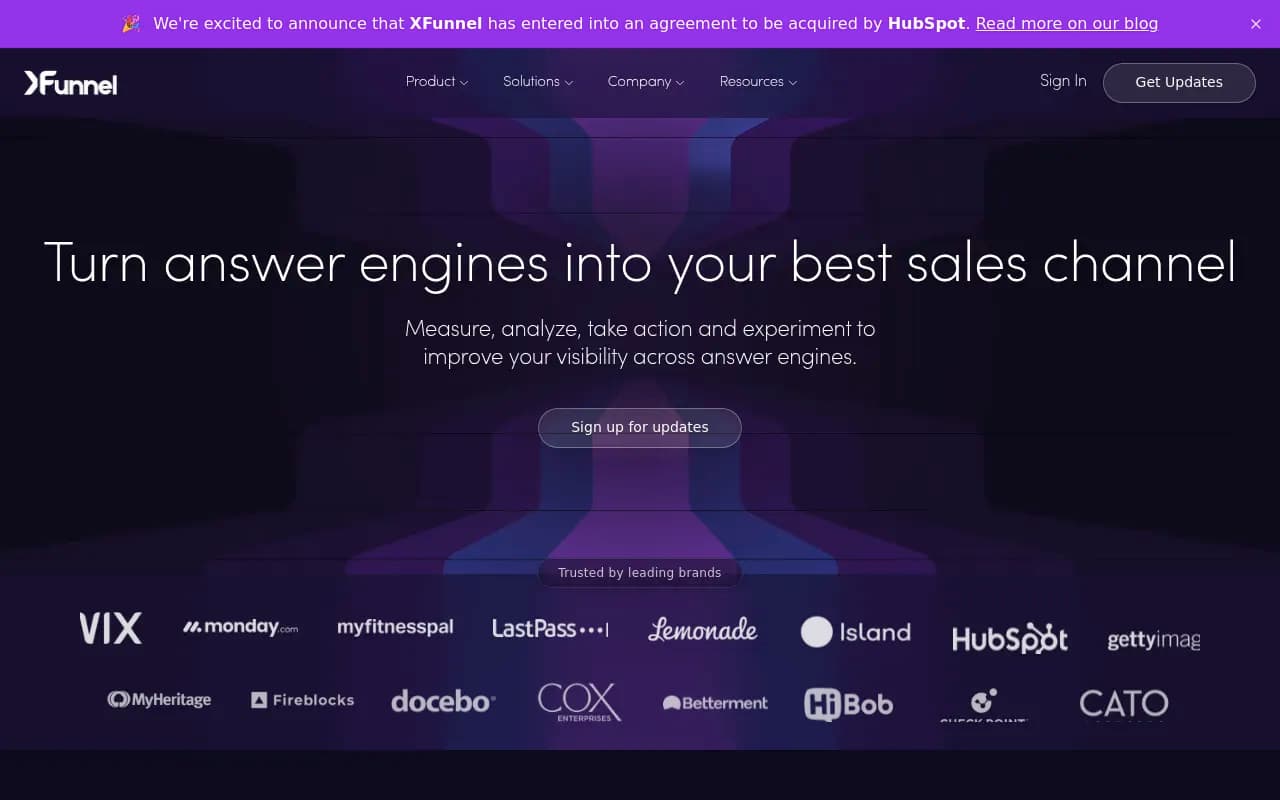
XFunnel positions itself as a generative engine optimization platform for marketing teams who want to track and improve brand visibility across AI-powered search engines. The big news: HubSpot acquired XFunnel in 2024, which changes the trajectory entirely. What was once a standalone GEO tool is now becoming part of HubSpot's broader marketing suite.
The platform focuses on helping you measure, analyze, and experiment with your AI search presence. You can track citations, discover relevant search questions, and optimize for AI-generated results. The customer roster is impressive -- Wix, Monday.com, MyFitnessPal, LastPass, Lemonade, Getty Images. These are not small companies testing a new tool. They're enterprise brands with serious marketing budgets.
Pricing is custom and enterprise-focused. There's no public pricing page, no self-service signup. You contact sales, they scope your needs, you get a quote. That's standard for enterprise software, but it immediately puts XFunnel out of reach for smaller teams or anyone who wants to test the waters without a sales call.
Omnia overview

Omnia takes a more practical, accessible approach. It's built for SEO and marketing teams who want to monitor how their brand shows up in AI engines like ChatGPT, Perplexity, Gemini, and Microsoft Copilot. The pitch is straightforward: see the real questions people ask AI, see your brand through AI's eyes, and act on your data.
What stands out is the emphasis on actionable insights. Omnia doesn't just show you tracking dashboards -- it translates that data into a step-by-step roadmap covering content creation, technical SEO, and content placement. The idea is to fill the gaps between where you are and where you need to be.
Pricing is transparent and accessible: €63/month if you pay yearly, €79/month if you pay monthly. There's a free trial. You can sign up and start testing without talking to anyone. The customer base skews mid-market -- Exoticca, Ironhack, Pleo, Europa Press. These are solid companies, but not the enterprise giants on XFunnel's list.
Side-by-side comparison
| Feature | XFunnel | Omnia |
|---|---|---|
| Pricing | Custom enterprise (contact sales) | €63/mo (yearly) or €79/mo (monthly) |
| Free trial | Not publicly available | Yes |
| Self-service signup | No | Yes |
| AI engines monitored | ChatGPT, Perplexity, others (not fully detailed) | ChatGPT, Perplexity, Gemini, Copilot |
| Citation tracking | ✓ | ✓ |
| Competitor benchmarking | ✓ | ✓ |
| Question discovery | ✓ | ✓ |
| Actionable roadmap | Not detailed | ✓ (step-by-step tasks) |
| HubSpot integration | ✓ (owned by HubSpot) | Not mentioned |
| Target customer | Enterprise (Wix, Monday.com, Getty Images) | Mid-market (Exoticca, Ironhack, Pleo) |
| Ease of getting started | Requires sales contact | Sign up and start immediately |
| Public documentation | Limited | More transparent |
Pricing comparison
This is where the two platforms diverge completely.
| Plan | XFunnel | Omnia |
|---|---|---|
| Free trial | Contact sales | Yes |
| Starter/Entry | Custom quote | €63/mo (yearly) or €79/mo (monthly) |
| Mid-tier | Custom quote | Not detailed (likely higher tiers exist) |
| Enterprise | Custom quote | Custom (contact for larger needs) |
XFunnel doesn't publish pricing. You're entering a sales process where they'll ask about your company size, use case, and budget before giving you a number. That's fine if you're a large company with procurement processes and negotiation leverage. It's a non-starter if you're a small team that wants to test a tool for a month or two.
Omnia's pricing is refreshingly simple. €63/month if you commit to a year, €79/month if you go month-to-month. You can try it for free first. No sales calls, no custom quotes for basic access. If you need something bigger, they'll talk to you, but the entry point is clear.
Feature deep-dive
AI engine coverage
Both platforms monitor the major AI search engines -- ChatGPT, Perplexity, Gemini, Copilot. XFunnel's website mentions "answer engines" broadly but doesn't list every engine they track. Omnia explicitly calls out ChatGPT, Perplexity, Gemini, and Copilot as their core coverage.
In practice, this probably doesn't matter much. The big four are what most teams care about. If you need something more niche (Claude, Grok, DeepSeek), you'd need to confirm with either vendor.
Verdict: Tie. Both cover the essentials.
Citation and mention tracking
Both platforms track where your brand gets cited or mentioned in AI-generated answers. This is table stakes for any AI visibility tool. You want to know: when someone asks ChatGPT about your product category, does your brand show up? How often? In what context?
XFunnel emphasizes "measure, analyze, take action and experiment" but doesn't detail exactly what the citation tracking interface looks like. Omnia shows you citations, mentions, and benchmarks against competitors with a focus on share of voice.
Verdict: Likely similar capabilities, but Omnia's public materials are more specific about what you actually see.
Question discovery
Both platforms help you discover what questions people are asking AI engines about your industry or product. This is where you find content gaps -- prompts where competitors show up but you don't.
XFunnel talks about discovering "relevant search questions." Omnia frames it as "see the real questions people ask AI" and ties it directly to knowing what prompts you should monitor.
The value here is the same: you learn what people are actually asking, not what you think they're asking. The difference is in how each platform surfaces and prioritizes those questions.
Verdict: Both offer this, but without hands-on testing it's hard to say which implementation is better.
Actionable insights and optimization
This is where Omnia pulls ahead on paper. The platform explicitly promises a "step-by-step AI visibility roadmap" that translates tracking data into tasks: content creation, technical SEO, content placement. The idea is you're not just staring at dashboards -- you're getting a to-do list.
XFunnel focuses on measurement and experimentation. You can "take action" but the specifics of what that means aren't detailed on their site. Is it recommendations? Manual analysis? Integrations with other tools? Unclear.
If you're looking for a platform that tells you what to do next, Omnia seems more focused on that workflow. If you have a team that can interpret data and build their own action plans, XFunnel's approach might be fine.
Verdict: Omnia wins on clarity of optimization workflow.
HubSpot integration
XFunnel was acquired by HubSpot in 2024. That's a huge deal if you're already a HubSpot customer. The integration is presumably deep (or will be), meaning your AI visibility data flows directly into your existing marketing stack.
Omnia doesn't mention HubSpot integration. It's a standalone platform. You can probably export data and import it elsewhere, but there's no native connection.
Verdict: XFunnel wins decisively for HubSpot users.
Ease of getting started
Omnia: sign up, start free trial, explore the platform. XFunnel: contact sales, schedule a demo, go through a sales cycle, negotiate pricing, onboard.
For a small or mid-sized team that wants to test AI visibility tracking without a big commitment, Omnia is the only realistic option. XFunnel's enterprise sales model means you're making a significant decision before you even see the product.
Verdict: Omnia wins for accessibility.
Pros and cons
XFunnel pros
- HubSpot acquisition means deep integration with a platform many marketing teams already use
- Trusted by major enterprise brands (Wix, Monday.com, Getty Images)
- Focus on experimentation suggests a mature approach to AI visibility optimization
- Likely robust support and account management for enterprise customers
XFunnel cons
- No public pricing -- you're entering a sales process before you know what it costs
- No self-service trial or signup -- high barrier to entry for smaller teams
- Limited public documentation about specific features and capabilities
- Enterprise positioning means it's probably overkill (and overpriced) for mid-market companies
Omnia pros
- Transparent, affordable pricing starting at €63/month
- Free trial lets you test before committing
- Actionable roadmap feature translates data into specific tasks
- Self-service signup -- no sales calls required
- Clear focus on practical insights, not just dashboards
Omnia cons
- No HubSpot integration (or other major marketing platform integrations mentioned)
- Smaller customer base suggests less enterprise-level support or features
- Less detail on advanced experimentation or testing capabilities
- May lack the depth or customization that large enterprises need
Who should pick which tool
Pick XFunnel if:
- You're already a HubSpot customer and want AI visibility data inside your existing stack
- You're an enterprise with a marketing budget that can handle custom pricing
- You need account management, custom onboarding, and enterprise-level support
- Your team includes Wix, Monday.com, or similar-scale brands and you want a tool built for that tier
Pick Omnia if:
- You're a small to mid-sized marketing team that needs transparent, affordable pricing
- You want to test an AI visibility platform without going through a sales process
- You value actionable insights and step-by-step roadmaps over raw data dashboards
- You're not locked into HubSpot and want a standalone tool you can start using today
- You need to justify the investment with a free trial before committing budget
If you're also tracking how your brand appears across a wider range of AI models (including Claude, Grok, DeepSeek, and others), Promptwatch covers that angle with 10+ AI engines monitored and includes features like crawler logs, Reddit/YouTube tracking, and AI-generated content creation to help you close visibility gaps.

Final verdict
XFunnel and Omnia are solving the same core problem -- helping brands show up in AI search results -- but they're aimed at completely different audiences.
XFunnel is an enterprise play. The HubSpot acquisition signals where it's headed: deep integration into a major marketing platform, custom pricing, white-glove support. If you're a large company already using HubSpot, XFunnel is the obvious choice. But if you're a smaller team or you're not in the HubSpot ecosystem, the barrier to entry is too high.
Omnia is the practical choice for everyone else. Transparent pricing, free trial, self-service signup, and a focus on turning data into action. It's not trying to be everything to everyone -- it's trying to be a useful tool that marketing teams can actually adopt without a six-month procurement process.
The one-liner: XFunnel is for enterprises with HubSpot. Omnia is for everyone else who wants to start tracking AI visibility today.