Key Takeaways
- Orchly starts at $49/mo with a free trial; XFunnel requires custom enterprise pricing -- if budget matters, Orchly is the clear winner for accessibility
- Orchly bundles content creation with visibility tracking; XFunnel is analytics-only -- Orchly's AI agents write and optimize content, XFunnel shows you the data but leaves you to create content elsewhere
- Both track the same core AI platforms (ChatGPT, Perplexity, Claude, Google AI) but Orchly also monitors traditional Google SEO while XFunnel focuses purely on AI search
- XFunnel has been acquired by HubSpot (announced 2026), which may change its roadmap and integration options but creates uncertainty for standalone users
- Orchly offers more hands-on optimization tools (150+ SEO/GEO factors, automated linking, schema) while XFunnel emphasizes citation analysis and competitor benchmarking
- For small-to-mid teams wanting an all-in-one solution, Orchly wins on value; for enterprises needing deep analytics and willing to pay premium prices, XFunnel may fit better
Overview: Two approaches to AI search visibility
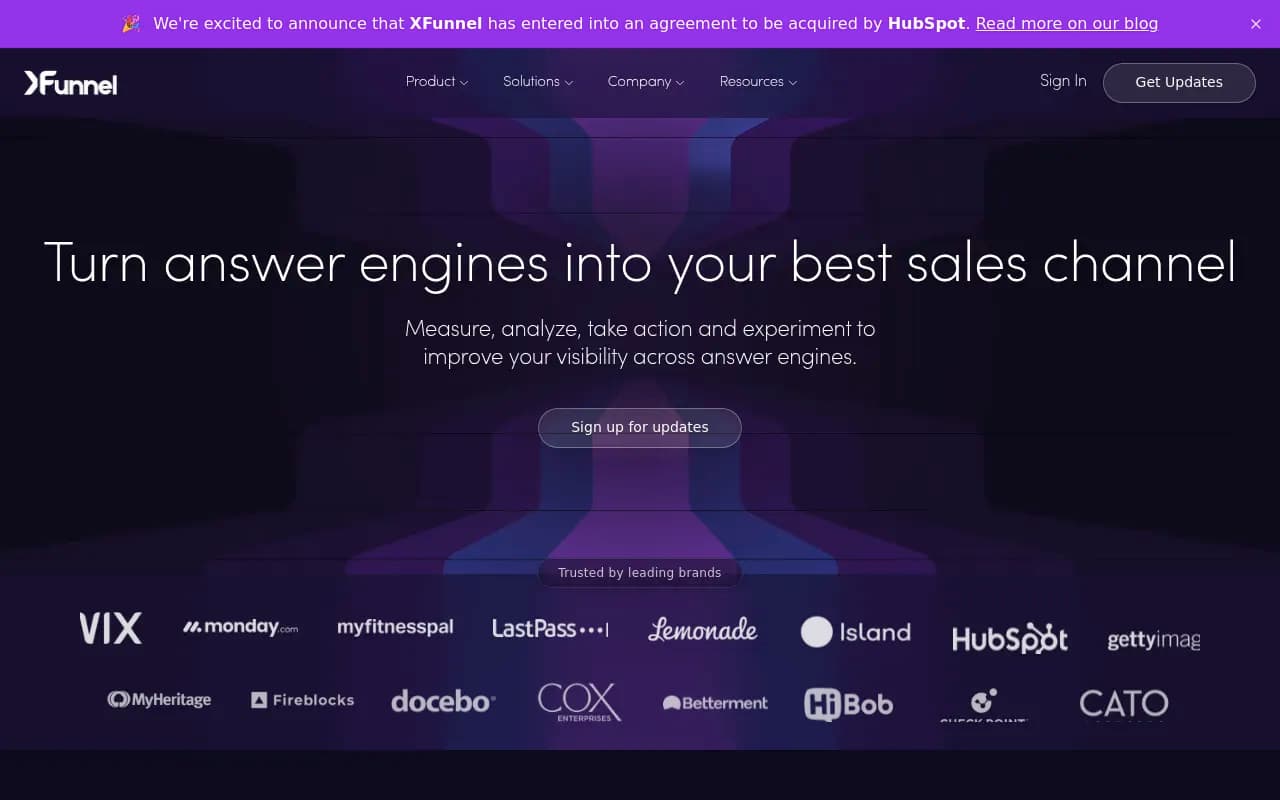
XFunnel positions itself as a generative engine optimization platform for marketing teams who want to track how their brand shows up across AI-powered search engines. The company landed major clients like Wix, Monday.com, MyFitnessPal, and LastPass before announcing an acquisition agreement with HubSpot in 2026. The platform focuses on measurement and analysis -- tracking citations, discovering relevant search questions, and benchmarking against competitors. It's built for teams that already have content operations in place and need visibility data to guide strategy.
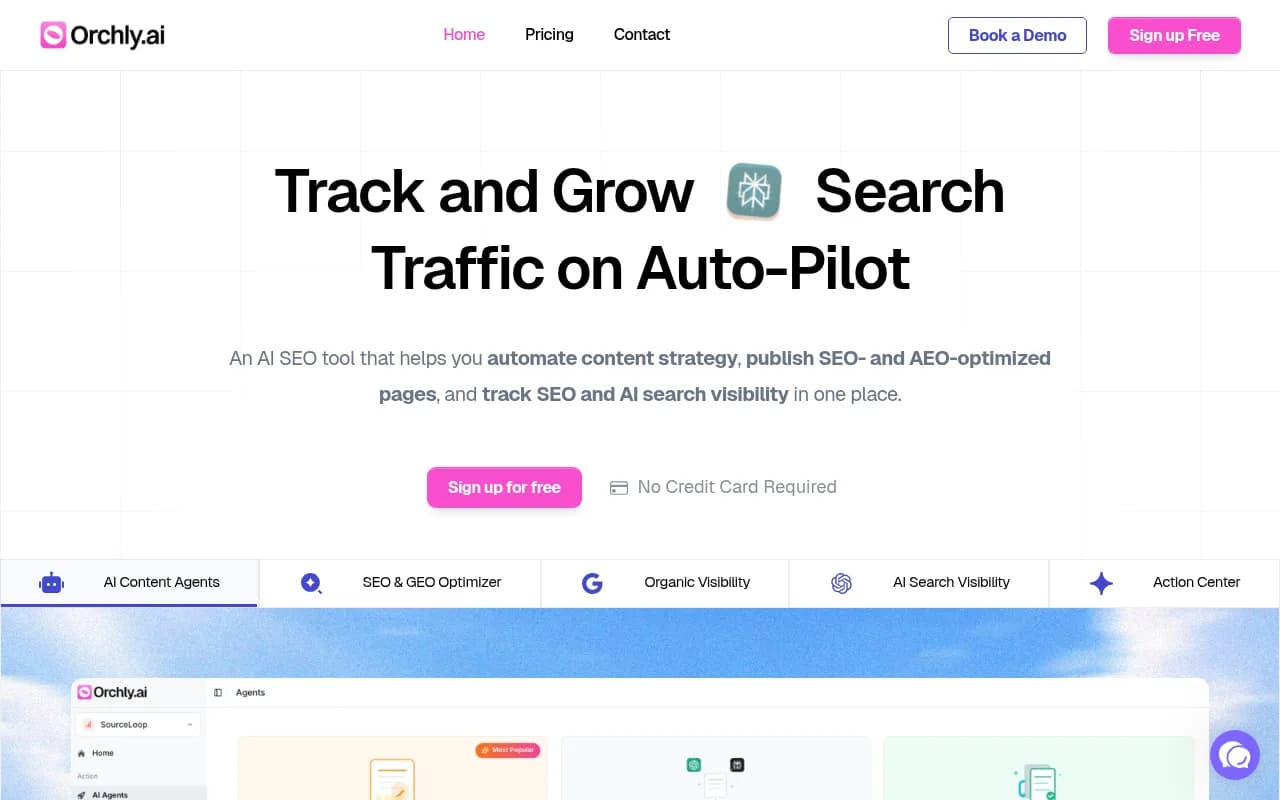
Orchly takes a different angle. It's an AI SEO automation platform that combines visibility tracking with content creation and optimization. Instead of just showing you where you rank in AI search, it helps you create and publish content designed to rank. The platform monitors both traditional Google search and AI platforms (ChatGPT, Perplexity, Claude, Gemini), then uses AI agents to generate SEO- and AEO-optimized content based on what's working. Pricing starts at $49/mo with a free trial, making it accessible to smaller teams.
Side-by-side comparison
| Feature | XFunnel | Orchly |
|---|---|---|
| Starting price | Custom enterprise (contact sales) | $49/mo (Essential plan) |
| Free trial | One-time audit | 14 days, no credit card |
| AI platforms monitored | ChatGPT, Perplexity, Claude, Google AI | ChatGPT, Perplexity, Claude, Gemini, Google AI |
| Google SEO tracking | No | Yes |
| Content creation | No | Yes (AI agents) |
| Content optimization | No | Yes (150+ factors) |
| Citation tracking | Yes | Yes |
| Competitor analysis | Yes | Yes |
| White-label reports | Not specified | Yes |
| API access | Not specified | Not specified |
| Target audience | Enterprise marketing teams | SMBs to mid-market |
| Company status | Acquired by HubSpot (2026) | Independent |
Pricing: Enterprise vs accessible
XFunnel pricing
XFunnel doesn't publish pricing. You contact sales for a custom enterprise quote. Based on their client roster (major SaaS brands, Fortune 500 companies), this is clearly positioned as a premium product. The one-time free audit gives you a taste, but ongoing access requires a sales conversation and likely a significant budget.
Orchly pricing
| Plan | Price | What you get |
|---|---|---|
| Essential | $49/mo | AI visibility tracking, basic SEO analytics, limited content generation |
| Pro | $125/mo | Full visibility tracking, advanced analytics, more content credits |
| Enterprise | Custom | White-label, API access, dedicated support |
Annual plans save 25%. Free 14-day trial available with no credit card required.
Verdict: Orchly wins on accessibility. Unless you're a large enterprise with budget to spare, the $49 entry point makes it possible to actually test AI visibility tracking without a sales cycle.
AI platform coverage
Both platforms track the major AI search engines that matter in 2026:
- ChatGPT (OpenAI)
- Perplexity
- Claude (Anthropic)
- Google AI products (AI Overviews, Gemini)
XFunnel emphasizes citation tracking -- seeing exactly which sources AI engines pull from when answering queries about your space. This is useful for understanding what content types and publishers get cited most often.
Orchly covers the same platforms but also tracks traditional Google organic search, giving you a unified view of both SEO and AEO performance. If you're managing both channels (and most teams are), having everything in one dashboard saves time.
Neither platform currently lists coverage for newer entrants like DeepSeek, Grok, or Meta AI. If you're looking for broader LLM coverage, Promptwatch monitors 10+ AI models including those platforms.

Content creation and optimization
This is where the platforms diverge sharply.
XFunnel: Analytics only
XFunnel shows you the data -- where you rank, which competitors are cited, what questions people ask. It doesn't help you create or optimize content. You take the insights and build content elsewhere (in your CMS, with your writers, using separate AI tools). For teams with established content operations, this might be fine. For smaller teams, it's a gap.
Orchly: End-to-end content workflow
Orchly includes AI content agents that:
- Generate new articles based on SEO and AEO opportunities
- Refresh existing content to improve rankings
- Auto-schedule and publish to your CMS
- Optimize for 150+ SEO and GEO factors (structured data, internal linking, NLP keywords, schema)
- Add rich formatting (images, videos, tables)
The platform claims its agents are "trained on your data" to avoid generic AI writing patterns. You maintain human oversight -- approve, edit, or reject what the agents produce.
This is a major functional difference. Orchly is trying to be your entire content ops stack. XFunnel is a specialized analytics layer.
Verdict: If you need help creating content that ranks in AI search, Orchly is the only option here. If you just want visibility data and already have content covered, XFunnel's focus might appeal to you.
Visibility tracking and analytics
XFunnel's approach
XFunnel built its reputation on citation analysis. The platform tracks:
- How often your brand gets mentioned in AI search results
- Which sources AI engines cite when discussing your category
- Competitor benchmarking (who's winning for specific queries)
- Relevant search questions that trigger AI responses
The interface emphasizes conversion -- turning AI search visibility into a sales channel. This makes sense given their client base (B2B SaaS companies where AI search can drive qualified leads).
Orchly's approach
Orchly combines AI visibility tracking with traditional SEO analytics:
- Track rankings across Google and AI platforms
- See where competitors rank
- Identify content gaps and opportunities
- Monitor Reddit discussions that influence AI search (similar to what Promptwatch offers)
- Technical SEO audits (crawl issues, schema gaps, indexing problems)
The "Action Center" surfaces specific recommendations -- which pages to update, which backlinks to build, which technical issues to fix. It's more prescriptive than XFunnel's analytics.
Verdict: XFunnel goes deeper on citation analysis and competitor intelligence. Orchly gives you a broader view that includes traditional SEO alongside AI search, plus actionable recommendations.
User experience and workflow
XFunnel's website emphasizes its enterprise client roster and the HubSpot acquisition. The messaging is polished but light on product details -- you need to book a demo to see the actual interface. This is typical for enterprise tools that sell through sales teams rather than self-service.
Orchly offers a free trial with no credit card, suggesting a more self-service approach. The website shows actual product screenshots and walks through the workflow: track visibility → get insights → create content → optimize → publish. It's designed for marketers who want to get started quickly without a sales cycle.
The HubSpot acquisition adds complexity to XFunnel's future. Will it remain a standalone product? Will it get folded into HubSpot's marketing suite? Will pricing or features change? These questions create uncertainty for potential buyers.
Integration and workflow fit
XFunnel
With the HubSpot acquisition, XFunnel will likely integrate deeply with HubSpot's CRM and marketing tools. If you're already a HubSpot customer, this could be a natural fit. If you're not, it's unclear how XFunnel will position itself as a standalone product going forward.
No other integrations are detailed on the website.
Orchly
Orchly mentions auto-publishing to your CMS and white-label reporting, suggesting it connects to common publishing platforms. Specific integrations aren't listed, but the workflow implies it can push content to WordPress, Webflow, or similar systems.
The white-label reporting is useful for agencies who need to brand reports for clients.
Pros and cons
XFunnel pros
- Strong enterprise client base (Wix, Monday.com, LastPass, HubSpot)
- Deep citation analysis and competitor benchmarking
- HubSpot acquisition may bring powerful integrations
- Built specifically for B2B marketing teams
XFunnel cons
- No public pricing (requires sales contact)
- No content creation or optimization features
- HubSpot acquisition creates uncertainty about standalone future
- No free trial beyond one-time audit
- Limited information about actual product features
Orchly pros
- Affordable pricing starting at $49/mo
- Free 14-day trial, no credit card required
- Combines visibility tracking with content creation
- Covers both Google SEO and AI search in one platform
- 150+ optimization factors for SEO and GEO
- White-label reporting for agencies
- Action Center with specific recommendations
Orchly cons
- Less established brand (no major client logos)
- AI content quality depends on training and oversight
- Fewer details about citation analysis depth
- No mention of API access at lower tiers
Who should choose which platform
Choose XFunnel if:
- You're an enterprise with budget for premium tools
- You already have content operations and just need visibility data
- You're a HubSpot customer interested in tight integration
- You need deep citation analysis and competitor intelligence
- You're comfortable with sales-driven purchasing
Choose Orchly if:
- You're a small-to-mid-sized team with limited budget
- You want an all-in-one solution for tracking and content creation
- You need both Google SEO and AI search visibility in one place
- You want to test the platform risk-free before committing
- You're an agency needing white-label reports
- You prefer self-service tools over sales cycles
Final verdict
Orchly offers better value for most teams. The combination of visibility tracking, content creation, and optimization at $49/mo is hard to beat. XFunnel's enterprise positioning and lack of public pricing put it out of reach for smaller teams, and the HubSpot acquisition creates questions about its standalone future.
If you're a large enterprise already using HubSpot and you only need analytics (not content creation), XFunnel might fit. For everyone else, Orchly delivers more functionality at a fraction of the likely cost.
The real question is whether you need an all-in-one platform (Orchly) or prefer best-of-breed tools. If you want specialized visibility tracking without content creation, you might also look at platforms like Promptwatch, which offers deeper AI search monitoring across 10+ models, citation analysis, and content gap identification -- though it doesn't include automated content generation like Orchly does.
Bottom line: Orchly wins on accessibility, feature breadth, and value. XFunnel is a premium option for enterprises with specific needs and deep pockets.