Fullstory Review 2026
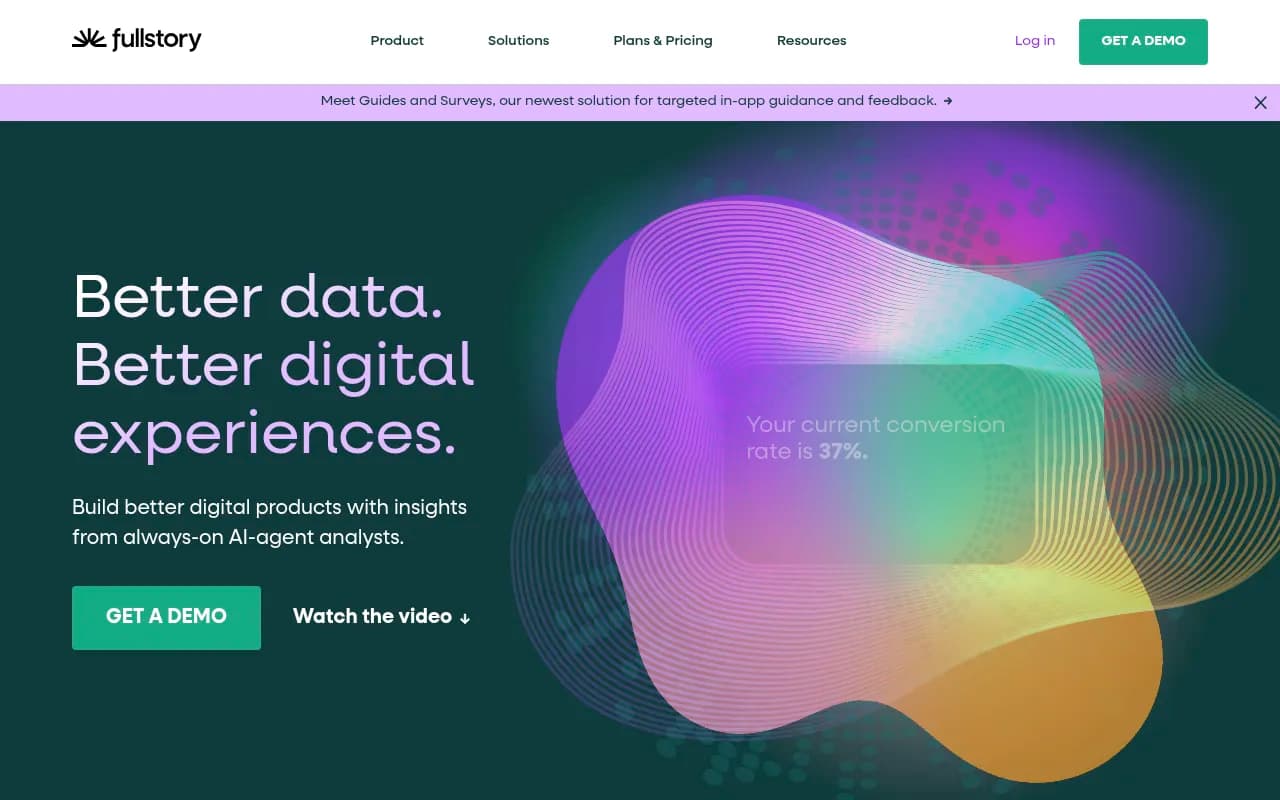
Fullstory is a behavioral data platform that captures every user interaction across web and mobile apps, then uses AI to surface friction points, optimize journeys, and improve digital experiences. Trusted by Duolingo, Chipotle, and 6,000+ brands to reduce support tickets, increase conversions, and
Key Takeaways:
- Complete behavioral data capture: Fullcapture records every click, scroll, rage click, and interaction across web and mobile with privacy-first architecture -- no manual event tagging required
- AI-powered insights, not just dashboards: StoryAI acts like an always-on analyst, answering questions in plain English and surfacing friction points automatically instead of making you dig through reports
- Action-oriented platform: Unlike passive analytics tools, Fullstory includes Guides & Surveys for in-app messaging, product tours, and feedback collection -- close the loop from insight to improvement
- Best for: Product teams, UX researchers, support teams, and digital experience leaders at mid-market to enterprise companies (SaaS, ecommerce, travel, fintech, gaming)
- Pricing: Starts around $10,000/year minimum; typical customers pay $300-$1,000/month depending on sessions, seats, and data retention
Fullstory is a behavioral data and digital analytics platform built for teams that want to understand why users struggle, not just where they drop off. Founded as a session replay tool, it has evolved into a comprehensive digital experience intelligence platform used by over 6,000 brands including Duolingo, Chipotle, Pizza Hut, Zipcar, and ServiceTitan. The platform captures granular user behavior across web and mobile apps, then applies AI to surface actionable insights -- friction points, conversion blockers, support triggers -- without requiring teams to manually instrument events or write complex queries.
What sets Fullstory apart from traditional analytics tools like Google Analytics or Mixpanel is its focus on behavioral context. Instead of just showing you funnel drop-off rates, Fullstory lets you watch session replays of actual users hitting errors, getting confused by UI, or rage-clicking broken buttons. Then StoryAI (their AI analyst layer) automatically identifies patterns across thousands of sessions and answers questions like "Why are users abandoning checkout?" or "What's causing support tickets to spike?" in plain English.
Fullcapture: Privacy-First Behavioral Data Collection
Fullstory's foundation is Fullcapture, an autocapture system that records every user interaction -- clicks, scrolls, form fills, rage clicks, dead clicks, page views, errors -- without requiring manual event instrumentation. You drop a JavaScript snippet on your site or integrate the mobile SDK (iOS/Android), and Fullstory starts recording.
Unlike older session replay tools that capture literal screenshots (privacy nightmare), Fullcapture reconstructs sessions from DOM snapshots and interaction events. This means:
- Privacy by design: Sensitive data (credit cards, passwords, PII) is automatically masked. You can configure additional redaction rules for GDPR/CCPA compliance.
- Retroactive analysis: Because everything is captured, you can define new segments or funnels after the fact and analyze historical data. No need to predict what you'll want to measure six months from now.
- Cross-platform tracking: Fullstory stitches together web and mobile app sessions into unified user journeys. See how a user browses on desktop, adds to cart on mobile, then completes purchase on tablet.
- Performance impact: Minimal -- the script is async and Fullstory claims <1% impact on page load times.
Fullcapture also includes frustration signals like rage clicks (repeated clicks on unresponsive elements), dead clicks (clicks that do nothing), and error clicks (clicks that trigger JavaScript errors). These are goldmines for UX teams trying to find where users get stuck.
StoryAI: Your Always-On AI Analyst
StoryAI is Fullstory's AI layer, launched in 2024-2025, and it's the biggest differentiator vs competitors. Instead of making you build dashboards or write SQL-like queries, StoryAI lets you ask questions in natural language:
- "Why are users abandoning the checkout flow?"
- "What's causing the spike in support tickets this week?"
- "Which pages have the highest rage click rates?"
- "Show me sessions where users encountered a 404 error."
StoryAI analyzes your Fullcapture data (billions of events) and returns specific answers with supporting session replays, funnel breakdowns, and friction heatmaps. It's trained on 880 million+ user sessions across Fullstory's customer base, so it understands common UX patterns and can spot anomalies.
Ask StoryAI (the conversational interface) is like having a product analyst on call 24/7. You type a question, it returns insights in seconds. For teams without dedicated data analysts, this is transformative -- product managers, designers, and support leads can self-serve insights without waiting on engineering.
StoryAI also powers automated insights: it proactively surfaces issues like "Checkout conversion dropped 12% this week due to payment gateway errors" or "Mobile users on iOS 17 are experiencing 3x more crashes." You don't have to ask -- it tells you what's broken.
Guides & Surveys: Close the Loop from Insight to Action
Most analytics platforms stop at "here's the problem." Fullstory goes further with Guides & Surveys, a recently launched module for in-app messaging and feedback collection.
- Product tours: Onboard new users with step-by-step walkthroughs, tooltips, and checklists. Target tours based on user behavior (e.g. show feature X to users who haven't used it in 30 days).
- In-app surveys: Trigger NPS, CSAT, or custom surveys at specific moments (e.g. after checkout, after support interaction). Responses are tied to session replays, so you can see what the user was doing when they gave you a low score.
- Targeted messaging: Show banners, modals, or slide-ins to specific user segments (e.g. "Users who rage-clicked the pricing page 3+ times").
This turns Fullstory from a passive analytics tool into an optimization platform. You identify friction with StoryAI, validate the fix with A/B testing (via integrations with Optimizely, VWO, LaunchDarkly), then guide users through the improved flow with Guides.
Session Replay & Heatmaps
Fullstory's session replay is industry-leading. You can watch pixel-perfect recreations of user sessions, complete with mouse movements, scrolls, form interactions, and console errors. Filters let you find specific sessions:
- Users who abandoned cart
- Users who encountered a 500 error
- Users who spent >5 minutes on the pricing page but didn't convert
- Users from a specific traffic source (e.g. Google Ads campaign)
Heatmaps show aggregate click, scroll, and attention patterns across pages. Combine heatmaps with session replays to see both the "what" (heatmap shows 80% of users click a non-clickable image) and the "why" (session replays show they expect it to open a lightbox).
Funnel Analysis & Conversion Optimization
Fullstory's funnel builder lets you define multi-step conversion flows (e.g. Homepage → Product Page → Add to Cart → Checkout → Purchase) and see drop-off rates at each step. But unlike Google Analytics funnels, you can:
- Click into any funnel step and watch session replays of users who dropped off
- See which errors, rage clicks, or dead clicks correlate with abandonment
- Segment funnels by device, traffic source, user cohort, or custom properties
Example: Pizza Hut used Fullstory to identify that mobile users were abandoning checkout because the "Apply Coupon" button was hidden below the fold. They moved it up, increased mobile conversions by 6.5%.
Integrations & Data Activation
Fullstory integrates with 50+ tools across analytics, support, product management, and marketing:
- Support: Zendesk, Intercom, Salesforce Service Cloud -- attach session replay links to support tickets so agents can see exactly what the customer experienced
- Product management: Jira, Asana, Productboard -- create tickets with embedded session replays as bug reports
- Analytics: Google Analytics, Segment, Amplitude, Mixpanel -- send Fullstory events to your data warehouse
- A/B testing: Optimizely, VWO, LaunchDarkly -- analyze test variants with session replays to see why variant B won
- Marketing: HubSpot, Marketo, Salesforce Marketing Cloud -- trigger campaigns based on user behavior (e.g. send email to users who rage-clicked pricing)
Fullstory Anywhere: Activation is a newer capability that lets technical teams act on Fullstory data in real-time. Example: if a user encounters an error, trigger a personalized in-app message or route them to priority support. This requires developer setup but unlocks powerful use cases.
Fullstory Workforce: Employee Experience Analytics
Fullstory Workforce applies the same behavioral data capture to internal tools and employee-facing apps. Use cases:
- Track how employees use CRM, ERP, or custom internal dashboards
- Identify workflow bottlenecks (e.g. "Sales reps spend 10 minutes per day fighting with the quote builder")
- Improve onboarding for new hires by seeing where they get stuck in training apps
This is a niche offering but valuable for enterprises with complex internal tooling.
Who Is Fullstory For?
Fullstory is built for mid-market to enterprise companies with significant digital traffic and a focus on user experience. Specific personas:
- Product teams at SaaS companies (50-500 employees) trying to improve onboarding, feature adoption, and retention. Example: ServiceTitan saved 100+ hours per month by using Fullstory to debug user-reported issues instead of manually reproducing bugs.
- Ecommerce and retail brands optimizing checkout flows, product pages, and mobile apps. Example: Chipotle reclaimed 71% of lost revenue by identifying and fixing cart abandonment triggers.
- Digital experience teams at travel, hospitality, and fintech companies where a single friction point (broken booking flow, confusing KYC form) costs millions. Example: Addison Lee reduced booking time by 80% after Fullstory revealed a hidden UI bug.
- Support and CX teams drowning in "I can't log in" tickets. Fullstory session replays let agents see exactly what happened, cutting resolution time and repeat tickets.
- UX researchers and designers who need qualitative data (session replays) to complement quantitative metrics (funnels, heatmaps).
Who should NOT use Fullstory:
- Early-stage startups with <10,000 monthly sessions -- the pricing doesn't make sense, and you're better off with free tools like Hotjar or Microsoft Clarity.
- Content publishers or blogs -- Fullstory is overkill if you're just tracking pageviews and don't have complex user flows.
- Teams without technical resources -- while StoryAI makes analysis easier, initial setup (SDK integration, event configuration, privacy rules) requires developer time.
Pricing & Value
Fullstory does not publish pricing publicly. Based on customer reports and vendor quotes:
- Minimum commitment: ~$10,000/year
- Typical pricing: $300-$1,000/month depending on:
- Number of sessions captured per month (e.g. 50K, 100K, 500K)
- Number of user seats (viewer, analyst, admin roles)
- Data retention period (1 month, 3 months, 12 months)
- Add-ons like Guides & Surveys, Workforce, or premium support
Example: A mid-sized SaaS company with 200K monthly sessions, 10 seats, and 3 months retention might pay $600-$800/month.
Fullstory offers a free trial (typically 14 days) with full platform access. No freemium tier.
How pricing compares:
- vs Hotjar ($39-$99/mo for basic session replay): Fullstory is 5-10x more expensive but includes AI insights, advanced funnels, and enterprise features Hotjar lacks.
- vs LogRocket ($99-$349/mo for similar session volumes): Comparable pricing, but Fullstory's StoryAI and Guides give it an edge for non-technical users.
- vs Heap or Amplitude (usage-based, can hit $1,000+/mo at scale): Fullstory is competitive but focuses more on qualitative insights (replays) vs quantitative product analytics.
For teams that can afford it, Fullstory delivers strong ROI. Chipotle's 71% revenue recovery and Pizza Hut's 6.5% conversion lift are real numbers that justify the cost.
Strengths
- StoryAI is genuinely useful: Unlike bolt-on AI features that feel like chatbots over dashboards, StoryAI actually saves time and surfaces insights you'd miss manually.
- Session replay quality: Pixel-perfect recreations with console logs, network requests, and error tracking. Best-in-class for debugging.
- Autocapture eliminates event tracking hell: No need to instrument every button click or form field. Just install the script and go.
- Guides & Surveys close the action loop: Rare to find a platform that does both analytics and in-app messaging well.
- Enterprise-grade privacy and compliance: GDPR, CCPA, SOC 2 Type II, HIPAA-ready. Automatic PII masking and granular redaction controls.
Limitations
- Pricing is opaque and high: The lack of public pricing frustrates buyers, and the $10K/year minimum locks out smaller companies. Competitors like Hotjar and Microsoft Clarity offer free tiers.
- Steep learning curve for advanced features: While StoryAI simplifies analysis, setting up custom segments, funnel attribution, and integrations requires training. Fullstory offers onboarding support, but expect a 2-4 week ramp.
- Mobile SDK can be tricky: iOS and Android integration requires more developer effort than web. Some customers report issues with React Native or Flutter apps.
- Limited real-time alerting: Fullstory surfaces insights retroactively ("Conversions dropped last week") but doesn't have robust real-time monitoring like Datadog or Sentry. If you need instant alerts for critical errors, you'll need a separate tool.
Bottom Line
Fullstory is the best choice for mid-market to enterprise teams that need to understand why users struggle, not just where they drop off, and have the budget to pay for premium insights. The combination of autocapture, AI-powered analysis, and in-app optimization tools (Guides & Surveys) makes it a true digital experience platform, not just another analytics dashboard.
Best use case in one sentence: Product and UX teams at SaaS, ecommerce, or fintech companies with 100K+ monthly sessions who want to reduce friction, increase conversions, and cut support costs by seeing exactly what users experience.
Tags:
Frequently asked questions
What is Fullstory and what does it do?
How much does Fullstory cost?
Who is Fullstory best for?
What is StoryAI in Fullstory?
How is Fullstory different from Google Analytics?
Does Fullstory require manual event tagging?
What features does Fullstory include besides analytics?
Is there a free version of Fullstory?
Similar and alternative tools to Fullstory