Key takeaways
- Peec AI is a solid monitoring tool, but most teams eventually hit a wall: they can see where they're invisible, but the platform doesn't help them fix it.
- The best alternatives in 2026 go beyond dashboards -- they identify content gaps, generate AI-optimized content, and track whether that content actually gets cited.
- Promptwatch is the only platform in this comparison rated as a "Leader" across all GEO categories, combining monitoring, content gap analysis, AI content generation, and traffic attribution in one loop.
- If you're purely monitoring, Otterly.AI and SE Visible are cheaper options. If you want to actually rank, you need a platform built around action.
- Budget and team size matter: there's a meaningful difference between tools built for solo marketers, agency teams, and enterprise brands.
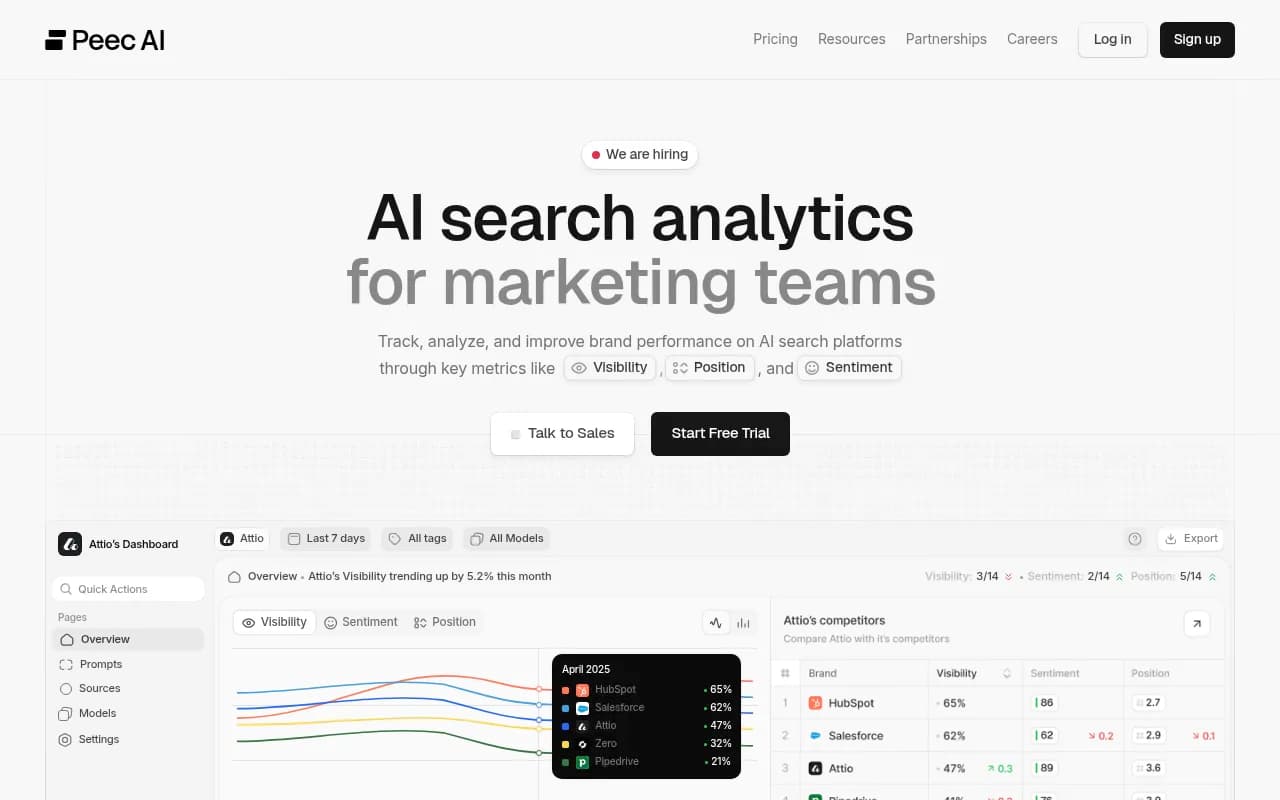
Peec AI does one thing well: it shows you where your brand appears (or doesn't) in AI-generated answers across ChatGPT, Perplexity, Claude, and Gemini. For teams just waking up to AI search visibility, that's a useful starting point.
But here's the problem most teams run into after a few months: the data is interesting, and then what? You can see that a competitor is getting cited for "best project management software for agencies" and you're not. Peec AI shows you the gap. It doesn't help you close it.
That's the real dividing line in this market right now. Some tools track. Others help you rank. This guide ranks 10 Peec AI alternatives by how much they actually move the needle -- not just how many dashboards they have.
What to look for in a Peec AI alternative
Before jumping into the list, here's the framework I used to evaluate these tools:
- Multi-engine coverage: Does it track ChatGPT, Perplexity, Google AI Overviews, Gemini, Claude, and others -- or just one or two?
- Actionability: Does it tell you why you're not being cited and what to do about it?
- Content gap analysis: Can it identify specific prompts where competitors rank but you don't?
- Content generation: Does it help you create content that's likely to get cited, or just show you what's missing?
- Traffic attribution: Can you connect AI visibility to actual website traffic and revenue?
- Pricing vs. value: Is the price justified by what it actually does?
The 10 best Peec AI alternatives in 2026
1. Promptwatch -- best overall for teams that want to rank, not just track
Promptwatch is the most complete platform in this space. Where most competitors stop at monitoring, Promptwatch is built around a full optimization loop: find the gaps, create content that fills them, track whether it works.

The Answer Gap Analysis is the feature that sets it apart. It shows you exactly which prompts your competitors are visible for but you're not -- and more importantly, it tells you what content your site is missing that would make AI models want to cite you. That's not something Peec AI or most of its competitors offer.
From there, the built-in AI writing agent generates articles, listicles, and comparisons grounded in real citation data (880M+ citations analyzed). This isn't generic content -- it's engineered around the specific prompts and topics where AI models are actively looking for sources.
The AI Crawler Logs are another feature worth mentioning. You can see in real time which pages ChatGPT, Claude, and Perplexity are crawling, how often they return, and what errors they encounter. Most competitors don't have this at all.
Pricing starts at $99/month (Essential: 1 site, 50 prompts, 5 articles), with Professional at $249/month and Business at $579/month. A free trial is available.
Best for: Marketing and SEO teams that want to actually improve their AI visibility, not just measure it.
2. Profound -- best for structured AI Overview tracking
Profound has built a strong reputation for accuracy, particularly around Google AI Overviews. If your primary concern is entity extraction and attribution mapping -- understanding exactly which entities AI models associate with your brand -- Profound does this more precisely than most.
Profound

It's a monitoring-focused platform, which means it's excellent at telling you what's happening but less useful for changing it. Pricing starts around $99/month, which makes it competitive with Peec AI.
Best for: SEO teams focused on Google AI Overviews and entity-driven visibility.
3. AthenaHQ -- best for multi-engine visibility benchmarking
AthenaHQ covers Google AI Overviews, Perplexity, ChatGPT, and Claude, and its competitive benchmarking is genuinely useful. You can see how your AI visibility stacks up against specific competitors across different engines, which helps prioritize where to focus.

The limitation is the same one that affects most tools in this category: it's a monitoring platform. It shows you the competitive landscape but doesn't help you change your position in it. Pricing starts at $295/month, which is on the higher end for what's essentially a tracking tool.
Best for: Brands competing in AI-native search who need multi-engine visibility data.
4. Otterly.AI -- best budget option for basic AI search tracking
Otterly.AI is one of the more straightforward tools in this space. It tracks brand mentions across ChatGPT, Perplexity, and Google AI Overviews, and the interface is clean enough that you can get up and running quickly.
Otterly.AI

It won't blow you away with depth. There's no content gap analysis, no content generation, no crawler logs. But if you're a small team that just needs to know whether you're showing up in AI answers and roughly how often, Otterly.AI gets the job done without a complex onboarding process.
Best for: Small teams or solo marketers who need basic AI visibility monitoring on a budget.
5. SE Visible -- best for marketing leaders who want strategic context
SE Visible (from SE Ranking) sits at the intersection of AI visibility tracking and strategic marketing context. It's built for CMOs and marketing leaders who want to understand their AI share of voice relative to competitors, with sentiment analysis layered in.
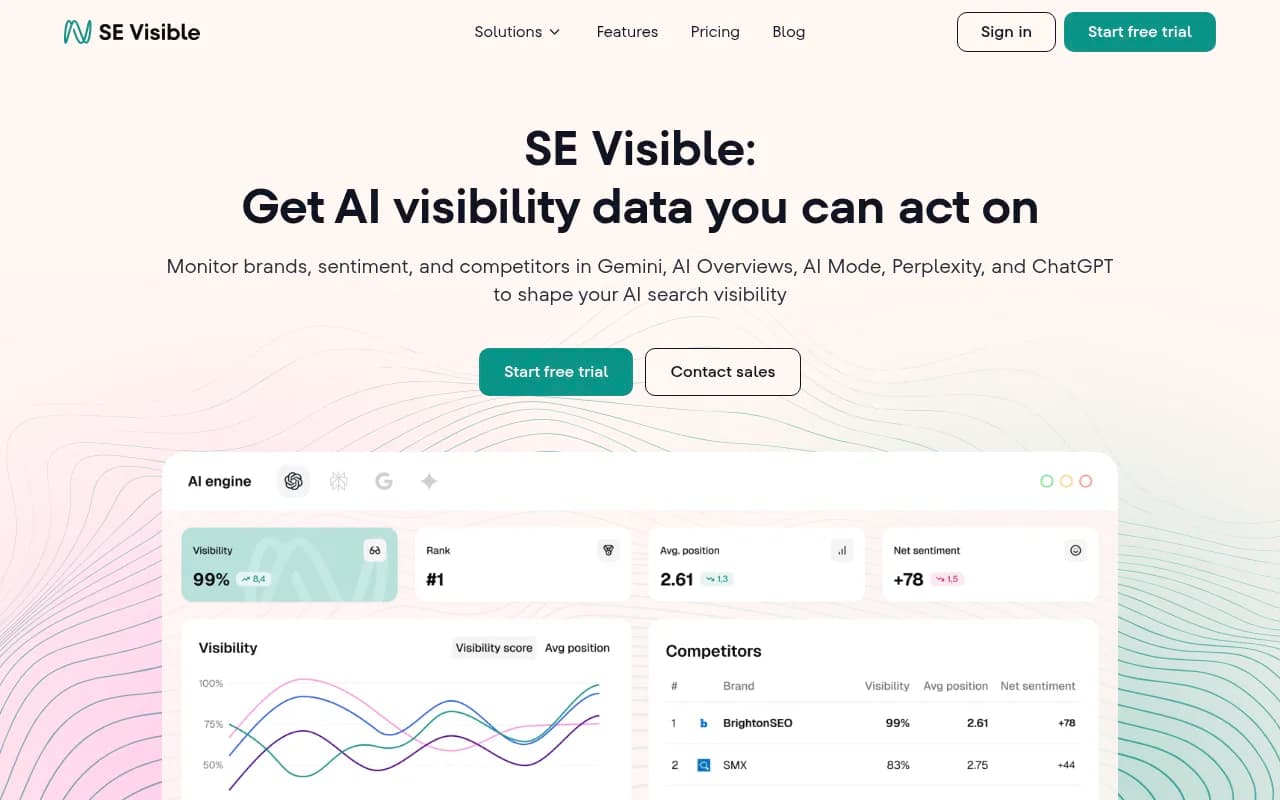
Starting at $189/month, it's priced for teams that need more than a basic tracker but aren't ready to commit to a full optimization platform. The strategic framing is useful -- it contextualizes AI visibility data in a way that's easier to present to leadership.
Best for: Marketing leaders and agency owners who need AI visibility data in a business context.
6. Scrunch AI -- best for enterprise brand narrative monitoring
Scrunch AI takes a different angle: it focuses on how AI models describe and characterize your brand, not just whether you appear. If you're an enterprise brand concerned about brand narrative -- what adjectives AI models use, how they position you relative to competitors -- Scrunch goes deeper than most.
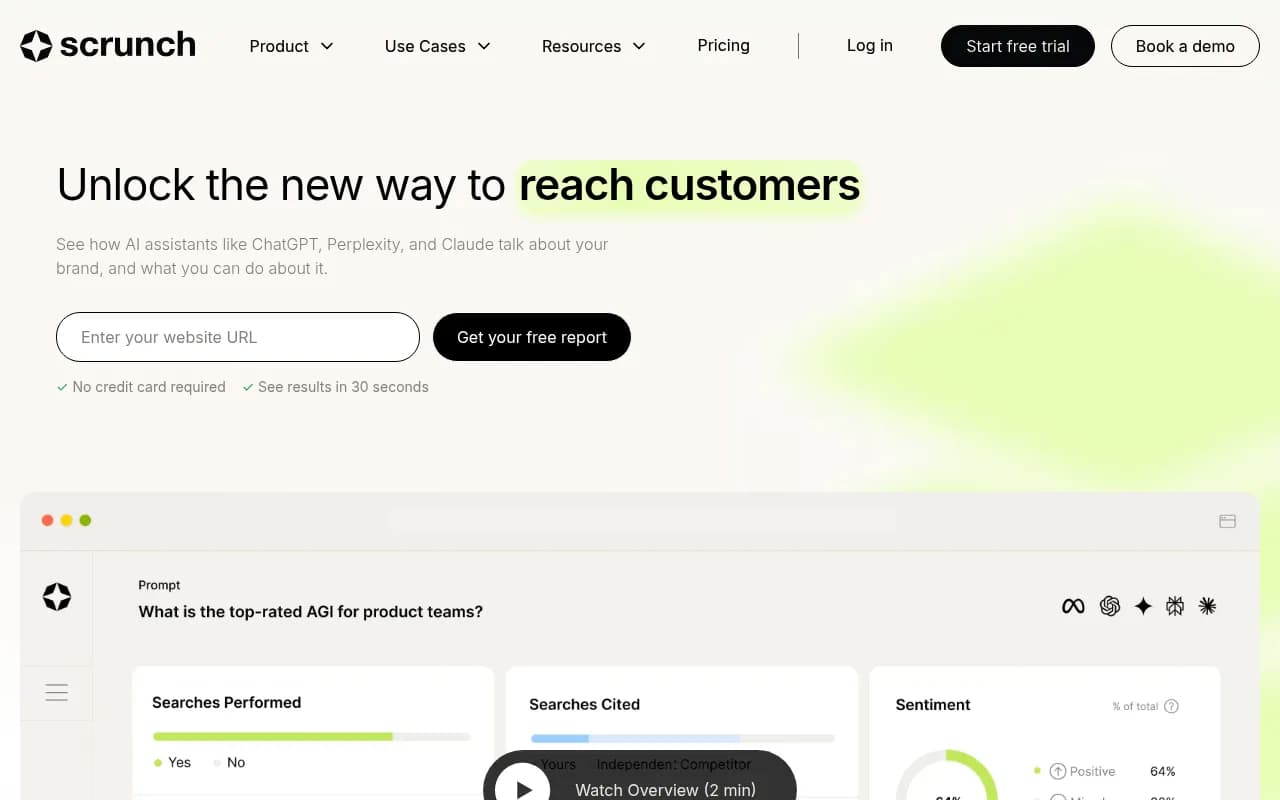
It's enterprise-oriented, which means the pricing reflects that. For smaller teams, it's probably overkill. But for brands where narrative control matters (financial services, healthcare, large consumer brands), the brand descriptor analysis is genuinely valuable.
Best for: Enterprise brands focused on AI-generated brand narrative and sentiment.
7. Rankscale -- best for agencies doing competitive AI visibility benchmarking
Rankscale is built with agencies in mind. The competitive benchmarking features let you compare AI visibility across multiple clients and their respective competitors, which is useful when you're managing several accounts and need to show progress.
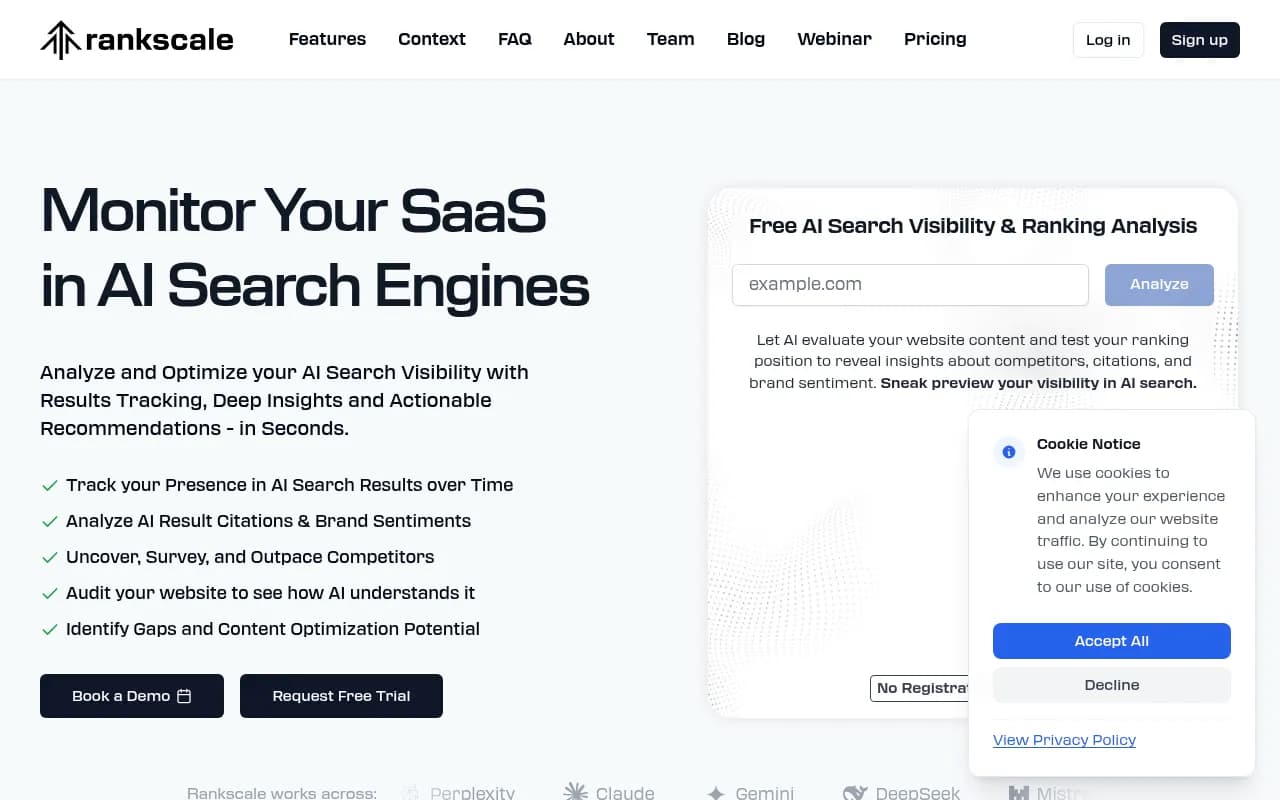
The platform is more monitoring-focused than action-oriented, but the agency-friendly reporting makes it easier to communicate AI visibility results to clients. Worth considering if you're running an agency and need something that scales across accounts.
Best for: Digital agencies managing multiple client accounts.
8. AirOps -- best for content engineering at scale
AirOps takes a different approach than most tools here. It's less about tracking your current AI visibility and more about building content pipelines that are engineered to get cited. The platform helps you create structured content workflows that produce articles and pages optimized for AI citation.
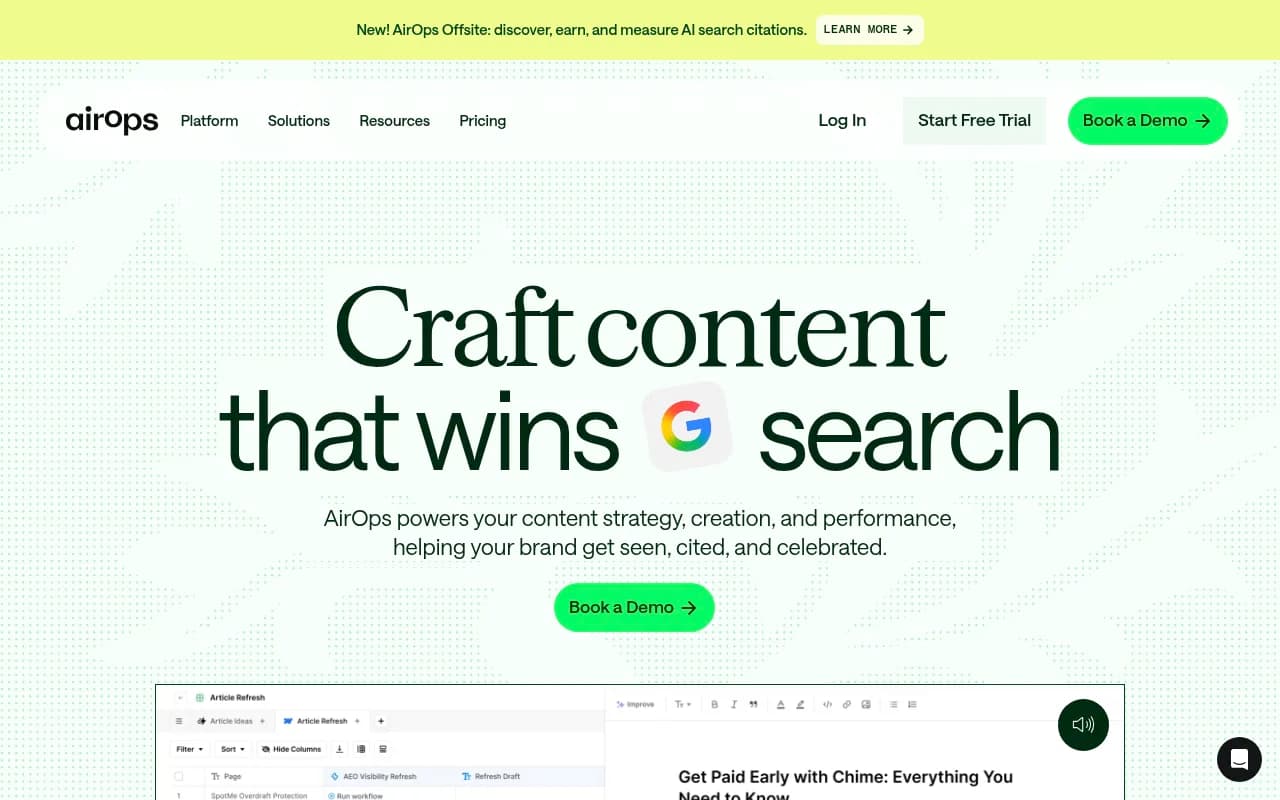
If your team's bottleneck is content production rather than visibility measurement, AirOps addresses that directly. It's not a monitoring tool -- you'd need to pair it with something else to track results. But for teams that already know what content they need to create and want to scale production, it's worth a look.
Best for: Content teams that need to scale AI-optimized content production.
9. Semrush -- best if you want AI tracking inside a traditional SEO suite
Semrush has been adding AI visibility features to its platform, which makes it appealing if you're already a Semrush customer and don't want to add another tool to your stack. The AI tracking features aren't as deep as dedicated GEO platforms, and the prompts are fixed rather than customizable, but the integration with keyword research, backlink analysis, and site auditing is genuinely useful.
The limitation is that Semrush's AI features feel bolted on rather than native. If AI visibility is your primary concern, a dedicated platform will serve you better. If you're a Semrush power user who wants some AI visibility data alongside your existing workflow, it's a reasonable option.
Best for: Existing Semrush users who want basic AI visibility data without switching tools.
10. LLMrefs -- best for citation and source tracking
LLMrefs focuses specifically on which sources AI models cite when answering questions in your category. This is a narrower use case than most tools here, but it's genuinely useful for understanding where AI models are pulling their information from -- Reddit threads, YouTube videos, specific domains, and so on.
LLMrefs
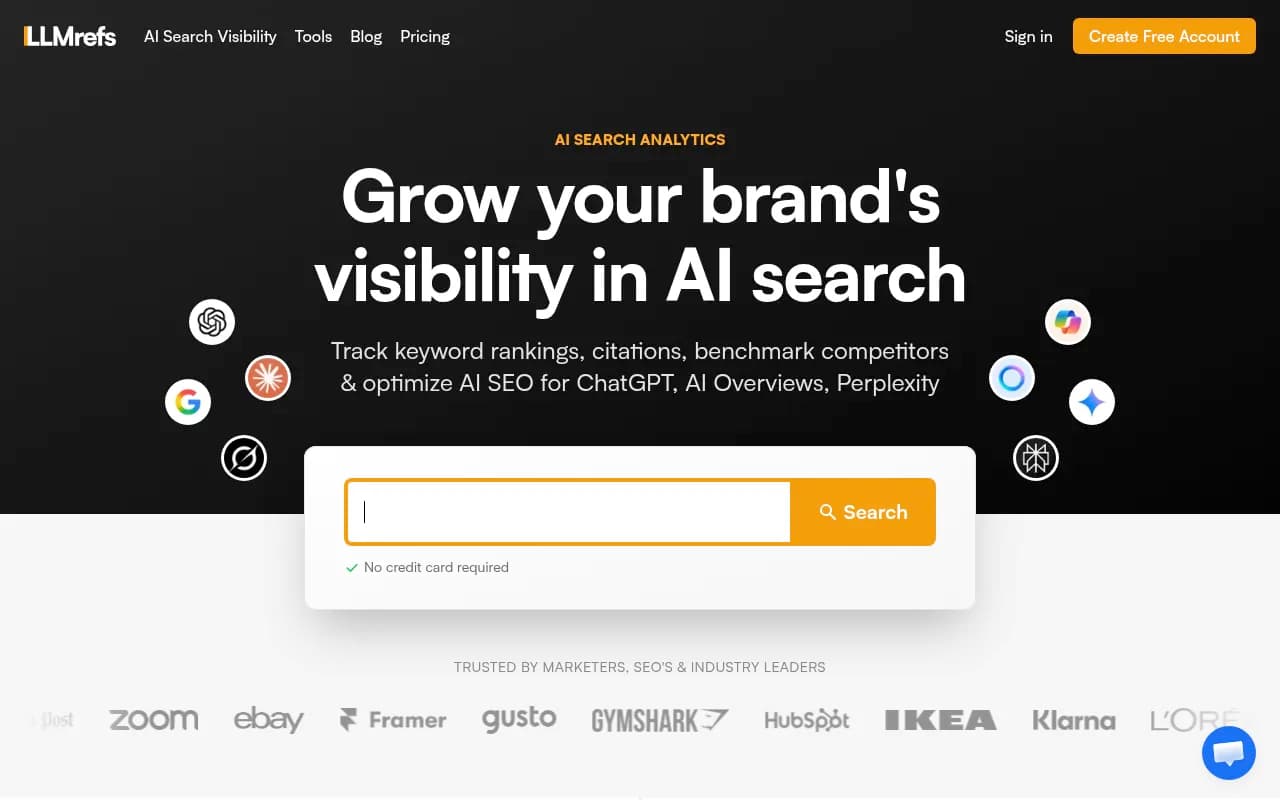
If your strategy involves building presence on third-party platforms that AI models trust (which is increasingly important), LLMrefs gives you the data to prioritize where to publish. It's not a full GEO platform, but as a research tool it fills a gap that most competitors ignore.
Best for: Teams building third-party content strategies (Reddit, YouTube, industry publications) to influence AI citations.
How they compare
Here's a side-by-side view of the key capabilities across all 10 alternatives:
| Tool | Multi-engine tracking | Content gap analysis | AI content generation | Crawler logs | Traffic attribution | Starting price |
|---|---|---|---|---|---|---|
| Promptwatch | Yes (10 engines) | Yes | Yes | Yes | Yes | $99/mo |
| Profound | Yes (9+ engines) | No | No | No | No | $99/mo |
| AthenaHQ | Yes (4 engines) | No | No | No | No | $295/mo |
| Otterly.AI | Yes (3 engines) | No | No | No | No | ~$49/mo |
| SE Visible | Yes | No | No | No | No | $189/mo |
| Scrunch AI | Yes | No | No | No | No | Enterprise |
| Rankscale | Yes | No | No | No | No | Custom |
| AirOps | No (content focus) | Partial | Yes | No | No | Custom |
| Semrush | Partial (fixed prompts) | No | No | No | No | $139/mo+ |
| LLMrefs | Yes (11 engines) | No | No | No | No | Free tier |
The pattern is clear. Most tools in this space are monitoring dashboards. They show you data. Promptwatch is the only one in this comparison that closes the full loop: find gaps, create content, track results, attribute traffic.
The monitoring trap -- and how to avoid it
Here's something worth saying plainly: monitoring your AI visibility without a plan to improve it is just expensive anxiety. You'll watch competitors gain ground in ChatGPT and Perplexity responses, see your brand absent from AI-generated buying guides, and have very nice charts showing exactly how invisible you are.
The tools that actually move the needle are the ones that answer "now what?" after showing you the data. That means content gap analysis that identifies specific missing topics, content generation that produces articles AI models actually want to cite, and tracking that closes the loop between content creation and visibility improvement.
Most teams start with a monitoring-only tool because it's cheaper and simpler. That's fine as a starting point. But if you've been monitoring for a few months and your AI visibility hasn't improved, the tool isn't the problem -- the missing piece is the optimization layer.
How to choose the right alternative for your situation
A few honest recommendations based on team type:
If you're a solo marketer or small team with a tight budget: Start with Otterly.AI for basic monitoring, or try the free tier of LLMrefs to understand your citation landscape. Neither will help you rank, but they'll give you enough data to understand where you stand.
If you're a mid-size marketing team that wants to actually improve AI visibility: Promptwatch is the clear choice. The combination of gap analysis, content generation, and traffic attribution means you're not just collecting data -- you're acting on it. The $249/month Professional plan covers most teams' needs.
If you're an agency managing multiple clients: Rankscale or Promptwatch's agency/enterprise tier, depending on how much optimization work you want to do versus just report on.
If you're an enterprise brand focused on narrative control: Scrunch AI or Profound, depending on whether your priority is brand characterization or entity accuracy.
If you're already deep in the Semrush ecosystem: Use Semrush's AI features as a starting point, but plan to graduate to a dedicated platform as AI search becomes more central to your strategy.
The bottom line: Peec AI is a reasonable starting point. But if you're serious about showing up in AI search results -- not just knowing that you don't -- you need a platform built around optimization, not just observation.