Key takeaways
- Peec AI works well for single-brand monitoring but lacks the multi-client workspaces, white-label reporting, and content optimization features agencies need
- The best alternatives go beyond dashboards -- they help you find gaps, generate content, and track results across multiple AI engines
- Promptwatch is the only platform in this comparison rated as a "Leader" across monitoring, content generation, and traffic attribution -- making it the strongest choice for agencies managing real client outcomes
- Pricing ranges from ~$99/mo for entry-level tools to $579/mo+ for full-featured agency platforms
- Most tools track ChatGPT and Perplexity; fewer cover Claude, Gemini, Google AI Overviews, DeepSeek, and Grok -- engine coverage matters more than most buyers realize
Peec AI made a lot of sense in early 2025. It was one of the first tools to give marketers a clear view of how their brands appeared in AI-generated answers -- tracking Google AI Overview visibility, brand presence in ChatGPT-style engines, and prompt-level analytics. For solo brand managers, it was a clean, fast starting point.
But agencies have different needs. You're managing five, ten, sometimes twenty clients. You need separate workspaces. You need reports you can put your logo on. And increasingly, clients aren't satisfied with "here's where you're not showing up" -- they want to know what to do about it.
That's where Peec AI runs into trouble. The platform is primarily a monitoring tool. It tells you where you stand. It doesn't tell you what to fix, and it wasn't built with agency workflows in mind.
This guide covers six alternatives that address those gaps -- with honest notes on what each one actually does well and where it falls short.
What agencies actually need from an AI visibility tool
Before getting into the tools, it's worth being specific about what separates an agency-grade platform from a solo-brand tracker.
Multi-client management is the obvious one -- separate dashboards per client, clean data separation, ideally with role-based access so clients can log in without seeing each other's data. White-label reporting matters too: PDFs or live dashboards with your agency's branding, not the tool vendor's.
Beyond that, agencies need prompt coverage that scales. If you're tracking 10 clients with 50 prompts each, you're running 500 queries. Credit-based pricing models can get expensive fast.
Content tools are increasingly non-negotiable. Clients don't just want to know they're invisible -- they want help getting visible. A tool that identifies content gaps and helps you fill them is worth considerably more than one that just shows a red dashboard.
Finally: traffic attribution. AI visibility scores are interesting, but "our brand appeared in 34% of ChatGPT responses this month" doesn't close a budget conversation. Connecting AI citations to actual site traffic and conversions does.
The 6 best Peec AI alternatives for agencies in 2026
1. Promptwatch -- best overall for agencies that want to act, not just monitor
Promptwatch is the most complete platform in this comparison. Where most tools stop at showing you visibility data, Promptwatch is built around a three-step loop: find the gaps, create content that ranks in AI, track the results.

The Answer Gap Analysis is the standout feature for agencies. It shows exactly which prompts your competitors are visible for that you're not -- not as a vague "you should cover this topic" suggestion, but as specific prompts with volume estimates and difficulty scores. You can see what content is missing from your client's site and why AI models aren't citing it.
From there, the built-in AI writing agent generates articles, listicles, and comparison pieces grounded in real citation data. This isn't generic content -- it's engineered around what AI models actually cite, based on 880M+ citations analyzed. For agencies running content programs for multiple clients, this is a significant time saver.
On the monitoring side, Promptwatch covers 10 AI engines: ChatGPT, Perplexity, Google AI Overviews, Google AI Mode, Claude, Gemini, Meta/Llama, DeepSeek, Grok, and Mistral. The AI Crawler Logs feature shows real-time data on which pages AI bots are reading, how often they return, and what errors they encounter -- a capability most competitors don't offer at all.
Traffic attribution closes the loop: a code snippet, GSC integration, or server log analysis connects AI visibility to actual site traffic and revenue. That's the kind of data that justifies agency retainers.
Pricing runs from $99/mo (Essential, 1 site) to $579/mo (Business, 5 sites, 350 prompts, 30 articles). Agency and enterprise plans are available with custom pricing. The multi-site plans and white-label reporting make it genuinely built for agency use.
Best for: Agencies that need to show clients measurable outcomes, not just visibility scores.
2. Scrunch AI -- best for brand safety and enterprise clients
Scrunch sits at the premium end of the market and earns it with the broadest engine coverage available. The platform tracks ChatGPT, Claude, Perplexity, Gemini, Google AI Overviews, AI Mode, and Meta AI from a single dashboard.
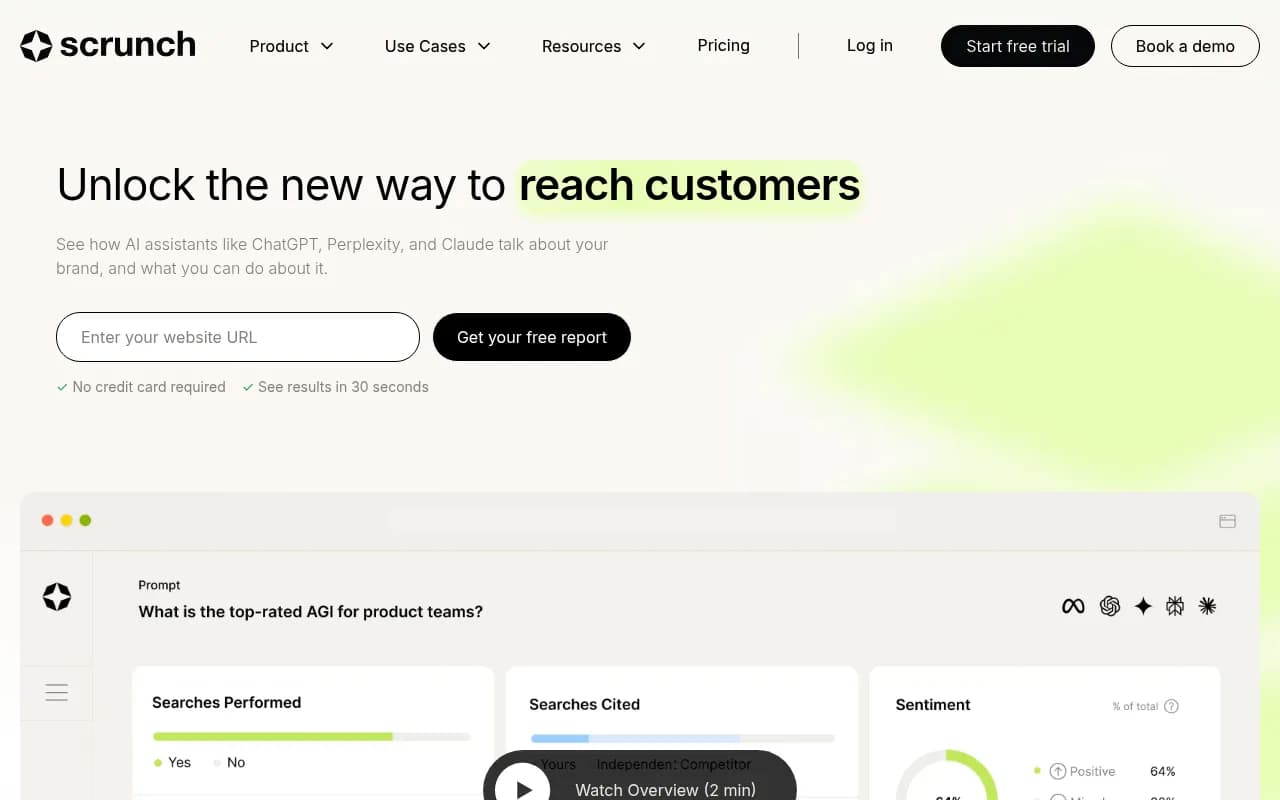
What makes Scrunch different is its focus on brand narrative -- not just whether you appear in AI responses, but how you're described. The platform detects hallucinations (when AI models make false claims about your brand) and maps customer journeys through AI interactions. For enterprise clients in regulated industries, this matters a lot.
The GA4 integration is solid, letting you connect AI visibility to actual traffic data. Reporting is polished enough for client-facing use.
The downside is price. Scrunch is one of the more expensive options in this space, which makes it harder to justify for smaller agency clients. It also doesn't have the content generation capabilities that Promptwatch offers -- it's primarily a monitoring and analysis tool.
Best for: Agencies with enterprise clients who care about brand safety and narrative accuracy, not just visibility scores.
3. Otterly.AI -- best budget entry point for getting started
Otterly.AI is the most accessible option in this list, both in terms of price and learning curve. It tracks brand mentions across ChatGPT, Perplexity, and Google AI Overviews, with daily monitoring and clean reporting.
Otterly.AI

For agencies just starting to offer AI visibility as a service, Otterly is a reasonable way to get clients onboarded quickly without a large upfront investment. The interface is straightforward, setup takes minutes, and the reports are readable.
The limitations become apparent quickly, though. Otterly doesn't have content generation tools, no crawler logs, no traffic attribution, and limited prompt volume at lower tiers. It's a monitoring dashboard -- useful for showing clients where they stand, but not for helping them improve.
Engine coverage is also narrower than the top-tier tools. If your clients are asking about visibility in Claude, Gemini, or DeepSeek, you'll hit gaps.
Best for: Agencies testing the waters with AI visibility services before committing to a full-featured platform.
4. Profound -- best for entity-driven SEO and precise AI Overview tracking
Profound has built a strong reputation for accuracy, particularly around Google AI Overviews. The platform does entity extraction and attribution mapping well -- useful for understanding why certain brands get cited and others don't.
Profound

For agencies working with clients in competitive verticals where entity authority matters (healthcare, finance, legal), Profound's approach to tracking which entities and topics drive AI citations is genuinely useful. It's more analytical than most tools in this space.
Starting at $99/mo, it's competitively priced. The trade-off is that Profound is primarily an analysis tool -- it helps you understand the landscape, but doesn't generate content or provide the kind of actionable optimization workflow that Promptwatch does.
White-label reporting and multi-client management are available but less polished than some alternatives.
Best for: Agencies with technically sophisticated clients who want to understand the entity and topic signals driving AI citations.
5. AthenaHQ -- best for multi-engine coverage without the enterprise price tag
AthenaHQ tracks Google AI Overviews, Perplexity, ChatGPT, and Claude from a single dashboard, with a focus on competitive intelligence. The competitor heatmaps -- showing which brands are winning for which prompts across different AI engines -- are among the best visualizations in this category.

Starting at $295/mo, it's priced in the mid-range. For agencies that need to show clients a clear competitive picture across multiple AI engines, AthenaHQ's reporting is strong. The prompt-level data is detailed, and the interface is clean enough for client-facing use.
The gap is on the optimization side. AthenaHQ is monitoring-focused -- it shows you where you're losing, but doesn't help you fix it. No content generation, no crawler logs, no traffic attribution. For agencies that have their own content production process and just need the data layer, that's fine. For agencies that want an end-to-end solution, it's not enough.
Best for: Agencies that want strong competitive intelligence and multi-engine coverage, and handle content production separately.
6. LLM Pulse -- best for value-conscious agencies tracking multiple brands
LLM Pulse is a newer entrant that's gained traction for its straightforward pricing and multi-brand tracking. It covers the main AI engines and offers daily monitoring with clean dashboards.
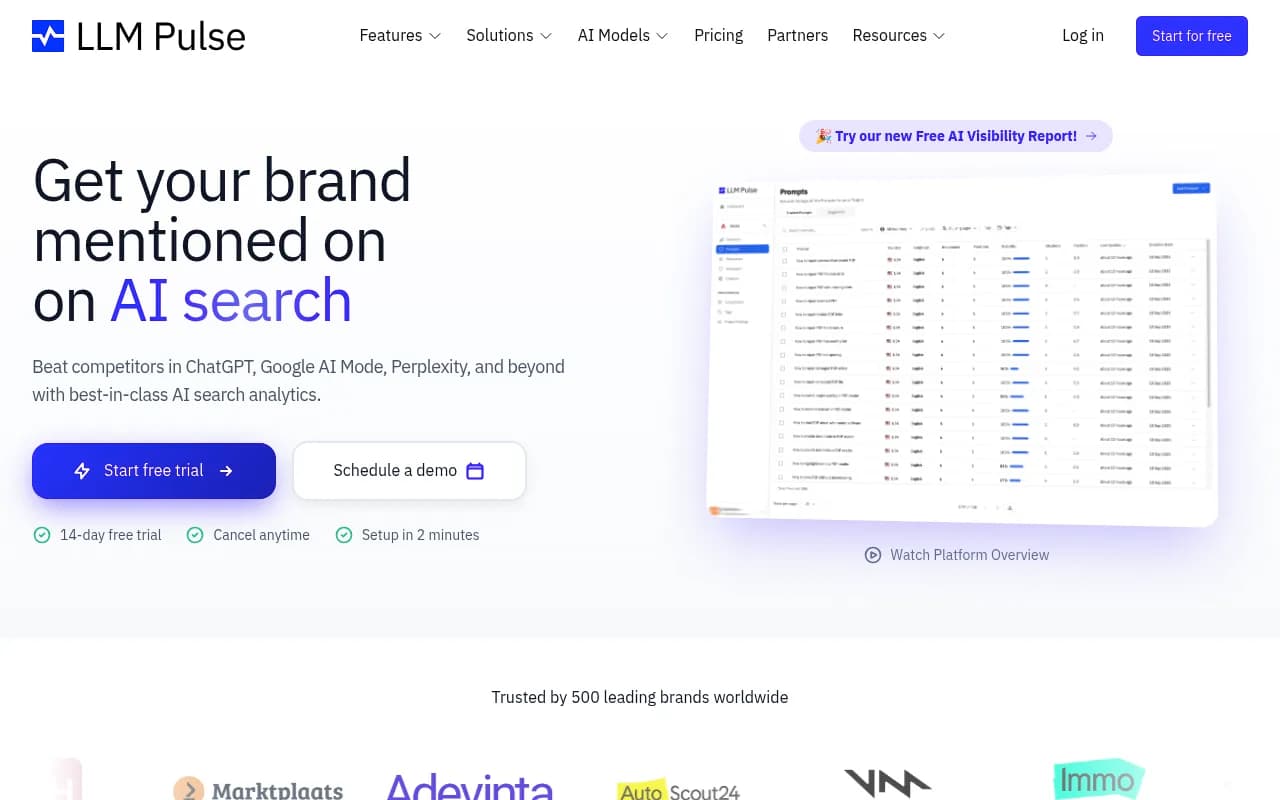
The value proposition is simple: more brands tracked per dollar than most competitors. For agencies with a high volume of smaller clients -- local businesses, SMBs -- where per-client budget is limited, LLM Pulse makes the math work.
The platform is honest about what it is: a monitoring tool. It doesn't have content generation, deep crawler data, or traffic attribution. But for agencies that need to cover a lot of ground at a reasonable price point, it's worth considering.
Best for: Agencies with high client volume and limited per-client budgets who need basic AI visibility monitoring at scale.
Side-by-side comparison
| Tool | AI engines covered | Content generation | Crawler logs | Traffic attribution | White-label reporting | Starting price |
|---|---|---|---|---|---|---|
| Promptwatch | 10 (ChatGPT, Perplexity, Claude, Gemini, Google AIO, AI Mode, DeepSeek, Grok, Mistral, Meta) | Yes (built-in AI writer) | Yes | Yes (GSC, snippet, logs) | Yes | $99/mo |
| Scrunch AI | 7+ | No | No | GA4 integration | Yes | Premium |
| Otterly.AI | 3 (ChatGPT, Perplexity, Google AIO) | No | No | No | Limited | Entry-level |
| Profound | 5+ | No | No | No | Limited | $99/mo |
| AthenaHQ | 4 (Google AIO, Perplexity, ChatGPT, Claude) | No | No | No | Yes | $295/mo |
| LLM Pulse | 4-5 | No | No | No | Basic | Entry-level |
| Peec AI | 3-4 | No | No | No | No | Entry-level |
How to choose
The honest answer is that the right tool depends on what you're selling to clients.
If you're selling AI visibility monitoring as a reporting service -- "here's how your brand appears in AI search this month" -- then Otterly.AI or LLM Pulse can handle that at a reasonable price. You won't be able to help clients improve, but you can show them the data.
If you're selling AI visibility as part of a broader SEO or content retainer, you need a tool that helps you actually move the needle. That means content gap analysis, content generation, and traffic attribution. Promptwatch is the only tool in this comparison that covers all three in one platform.
If you have enterprise clients with brand safety concerns -- regulated industries, high-profile brands worried about AI hallucinations -- Scrunch is worth the premium.
For agencies that want strong competitive intelligence without the full optimization stack, AthenaHQ's heatmaps and multi-engine coverage are genuinely good.
One thing worth noting: most of these tools are still maturing. Engine coverage, accuracy, and features are changing quickly. The gap between a monitoring-only tool and a full optimization platform is real today -- but it's also the gap that separates agencies that can demonstrate ROI from those that can't.
Clients are increasingly asking not just "where do we appear?" but "what are you doing to improve it?" The tools that help you answer the second question are the ones worth building your agency practice around.
The bottom line on Peec AI
Peec AI isn't a bad tool. For a single brand that wants a quick read on AI visibility, it does the job. The dashboard is clean, setup is fast, and it covers the basics.
But agencies have outgrown it. Multi-client management is clunky, white-label reporting is limited, and there's no path from "here's your visibility score" to "here's what we're doing to improve it."
The tools above fill those gaps in different ways. If you want the most complete solution -- one that covers monitoring, content creation, and traffic attribution in a single platform -- Promptwatch is the strongest choice. If budget is the primary constraint, Otterly.AI or LLM Pulse get you started without a large commitment.
Either way, the shift from monitoring to optimization is where agency value gets created. The tools that support that shift are the ones worth investing in.