Key takeaways
- Most AI brand monitoring tools are built for single brands, not agencies managing 5, 10, or 20+ clients simultaneously
- White-label reporting, multi-client dashboards, and per-seat pricing are the features that separate agency-ready tools from everything else
- The gap between "monitoring" and "optimization" is where agencies lose clients -- tools that only show data without helping you act on it are a liability
- Promptwatch is the only platform in this comparison rated as a leader across all categories, combining monitoring, content gap analysis, and AI-native content generation in one workflow
- Pricing ranges from free tiers to $500+/month, but agency-specific plans with white-label options typically start around $249/month
Running AI brand monitoring for one brand is manageable. Running it for a dozen clients simultaneously, each with different competitors, different AI visibility goals, and different reporting expectations? That's a different problem entirely.
The tools that work for in-house marketing teams often fall apart at agency scale. They lack multi-client workspaces, they don't support white-label reports, and they give you data without any clear path to improving what you're seeing. Clients don't pay agencies to stare at dashboards -- they pay for results.
This guide focuses specifically on what agencies need: tools that handle multi-client tracking cleanly, send alerts that actually matter, and produce reports you can put your brand on. We've evaluated seven platforms against those criteria.
What agencies actually need from AI brand monitoring
Before getting into the tools, it's worth being specific about what "agency-ready" means in this context. There are a few capabilities that matter more for agencies than for solo brands:
Multi-client workspaces. You need to manage separate projects for each client without data bleeding between accounts. Some tools handle this cleanly; others require separate logins or charge per seat in ways that get expensive fast.
White-label reporting. Sending a client a PDF with another company's logo on it looks unprofessional. Agency-grade tools let you brand reports with your own logo, colors, and domain.
Alerts that scale. When you're monitoring 15 brands across 10 AI models, you can't manually check dashboards every day. Automated alerts for significant visibility changes, new competitor citations, or hallucinations are non-negotiable.
Coverage across AI models. ChatGPT and Google AI Overviews get the most attention, but clients ask about Perplexity, Claude, Gemini, Grok, and others. A tool that only monitors two or three models will leave gaps you'll have to explain.
A path from data to action. This is the one most agencies underestimate. Showing a client their AI visibility score is easy. Showing them why it changed, what content is missing, and what to do next -- that's where agencies justify their retainers.
The 7 best AI brand monitoring tools for agencies in 2026
1. Promptwatch
Promptwatch is the most complete option for agencies that need to go beyond monitoring. Most tools in this space show you where your clients are invisible in AI search -- Promptwatch shows you that, then helps you fix it.

The core workflow is built around three steps: find the gaps, create content that addresses them, then track whether that content gets cited. The Answer Gap Analysis identifies exactly which prompts competitors appear for that your client doesn't -- not just "you're missing visibility" but the specific topics, angles, and questions that AI models want answered. The built-in AI writing agent then generates articles grounded in real citation data from over 880 million citations analyzed.
For agencies, the practical advantages are significant. Promptwatch supports multiple sites per plan (2 on Professional, 5 on Business), with custom agency/enterprise plans for larger portfolios. It monitors 10 AI models including ChatGPT, Perplexity, Claude, Gemini, Google AI Overviews, Grok, DeepSeek, Copilot, Meta AI, and Mistral. The AI Crawler Logs feature -- which shows exactly which pages AI crawlers are visiting, how often, and what errors they encounter -- is something most competitors don't offer at all.
Prompt Intelligence gives you volume estimates and difficulty scores for each prompt, so you can prioritize high-value opportunities for clients rather than chasing every gap. Page-level tracking shows which specific pages are getting cited by which models, and traffic attribution connects that visibility to actual revenue through a code snippet, Google Search Console integration, or server log analysis.
Pricing: Essential $99/month (1 site, 50 prompts), Professional $249/month (2 sites, 150 prompts, crawler logs), Business $579/month (5 sites, 350 prompts). Agency/Enterprise pricing available on request. Free trial available.
2. Otterly.AI
Otterly.AI is a solid entry point for agencies that want clean, prompt-based AI monitoring without a steep learning curve. It focuses on GEO (Generative Engine Optimization) tracking -- you define the prompts you want to monitor, and it checks how your client's brand appears in AI responses to those prompts.
Otterly.AI

The interface is straightforward, and the automated prompt testing makes it easy to set up monitoring for a new client quickly. It covers the major AI models and includes basic competitor benchmarking. At $29/month to start, it's one of the more affordable options in this space.
The limitation for agencies is that Otterly.AI is primarily a monitoring tool. It shows you what's happening but doesn't help you understand why or what to do about it. There's no content gap analysis, no AI writing capabilities, and no crawler log data. For agencies that handle content strategy in-house and just need reliable tracking data, that's fine. For agencies that want to offer optimization as a service, you'll need to pair it with other tools.
White-label reporting is available on higher tiers, which makes it viable for client-facing work.
3. Peec AI
Peec AI targets SaaS companies and B2B brands, but its clean dashboard and competitor benchmarking make it a reasonable choice for agencies managing clients in those verticals.

The platform tracks brand visibility across conversational AI engines and presents share-of-voice data in a way that's easy to explain to clients. The competitor comparison views are particularly useful for client reporting -- showing a client where they rank relative to three or four named competitors is a more compelling story than raw visibility scores.
Starting at €89/month, it sits in the mid-range. Like Otterly.AI, it's monitoring-focused, so agencies that need content optimization capabilities will hit a ceiling. It also lacks crawler log data and doesn't offer the kind of prompt volume intelligence that helps prioritize which gaps to address first.
4. Profound
Profound targets enterprise brands and larger agencies, with a more sophisticated feature set than the monitoring-only tools.
Profound

It covers 9+ AI search engines and includes content operations features that go beyond basic tracking. The "read/write AI model" approach means it can both analyze what AI models say about your client and suggest ways to influence those responses. For agencies managing enterprise clients with complex brand narratives, that's a meaningful capability.
The tradeoff is price -- Profound starts at $99/month but scales significantly for enterprise use cases. It also lacks Reddit tracking and ChatGPT Shopping monitoring, which are increasingly relevant as AI recommendations bleed into product discovery. Agencies working with e-commerce clients in particular may find those gaps limiting.
5. SE Visible
SE Visible is the AI visibility product from SE Ranking, which means it comes with the credibility of an established SEO platform behind it.
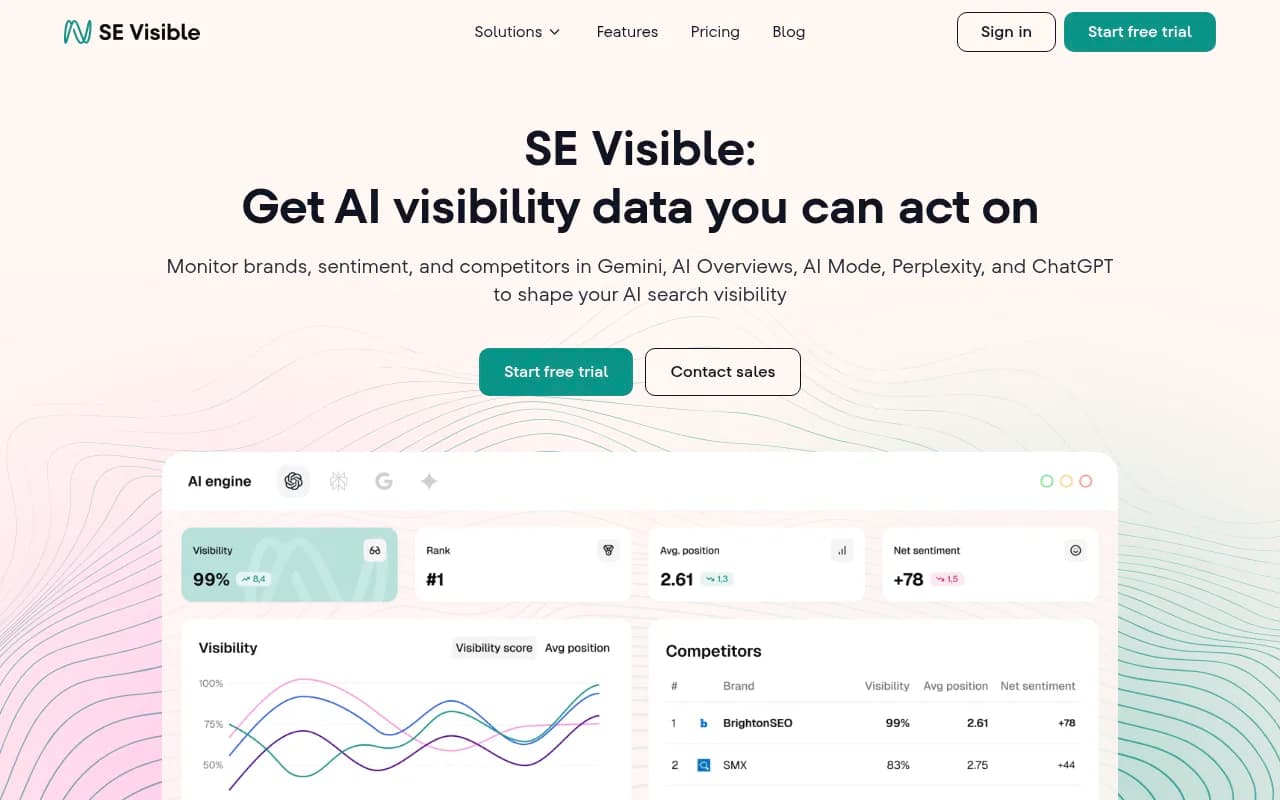
The platform tracks brand appearances in AI Mode, AI Overviews, and other AI-generated results, with competitor comparison and share-of-voice reporting. For agencies already using SE Ranking for traditional SEO, adding SE Visible creates a unified view of both traditional and AI search performance -- which is a genuinely useful thing to show clients.
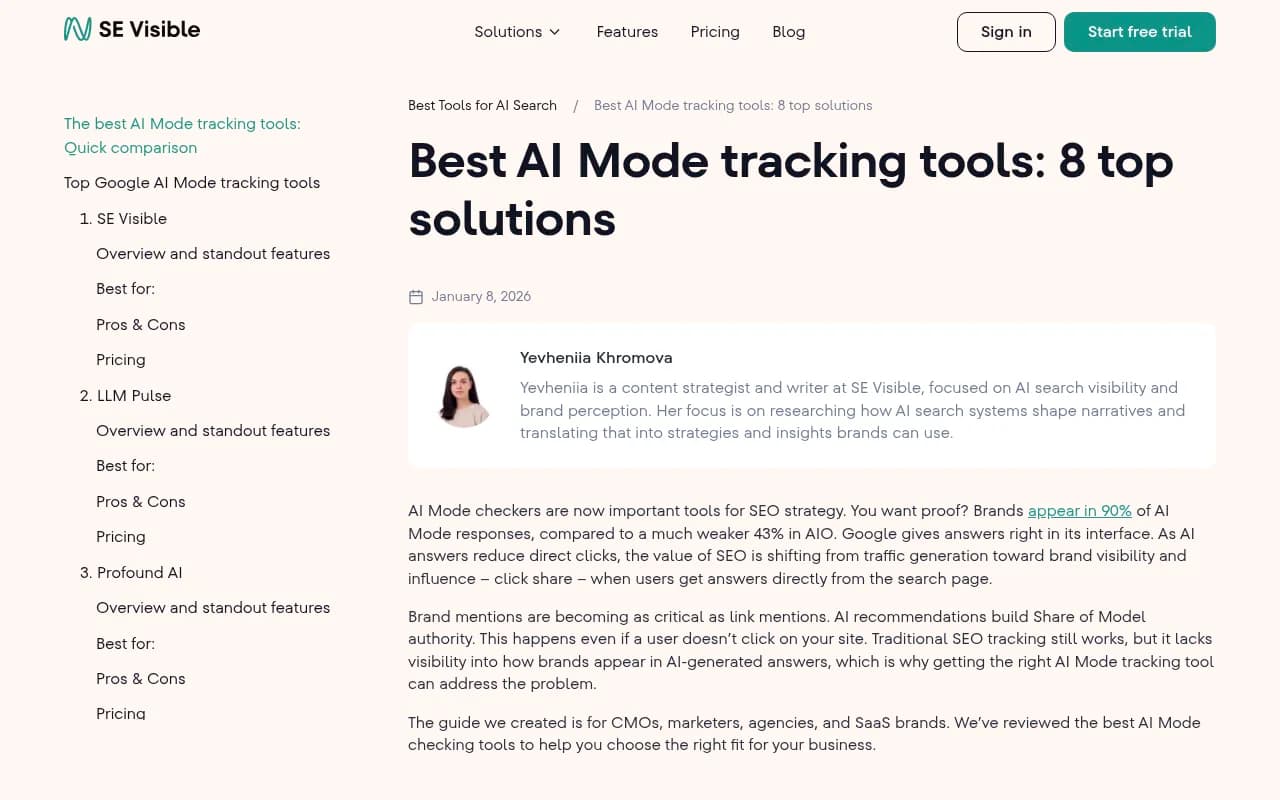
Starting at $189/month, it's positioned in the mid-to-upper range. The main limitation is that it's still primarily a tracking tool. It surfaces data well but doesn't offer content gap analysis or AI-native content generation. Agencies that want to close the loop between "here's what's missing" and "here's the content we created to fix it" will need to look elsewhere.
6. LLM Pulse
LLM Pulse focuses on brand recommendations and sentiment across LLMs, which makes it particularly useful for agencies managing clients where brand perception matters as much as raw visibility.
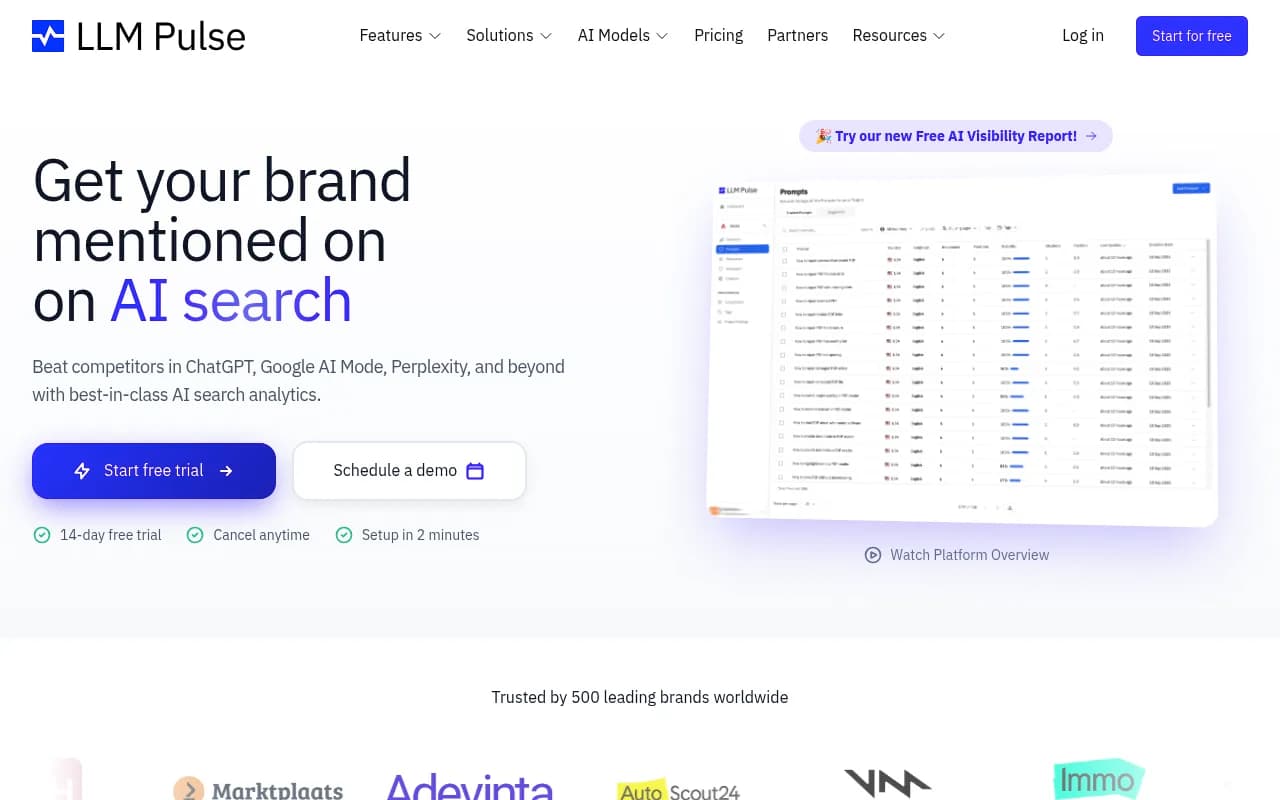
The platform tracks share of recommendations -- not just whether your client appears in AI responses, but whether AI models are actively recommending them. Sentiment analysis adds another layer, showing whether those mentions are positive, neutral, or negative. For PR-adjacent agencies or clients in competitive consumer categories, that distinction matters.
Starting at €49/month, it's one of the more affordable options with genuine depth. The limitation is scope -- it doesn't offer the content optimization or crawler log features that agencies need to move from reporting to results.
7. GetMint
GetMint is built specifically around AI brand monitoring and reputation management, with a focus on detecting hallucinations -- cases where AI models say something factually wrong about your client's brand.
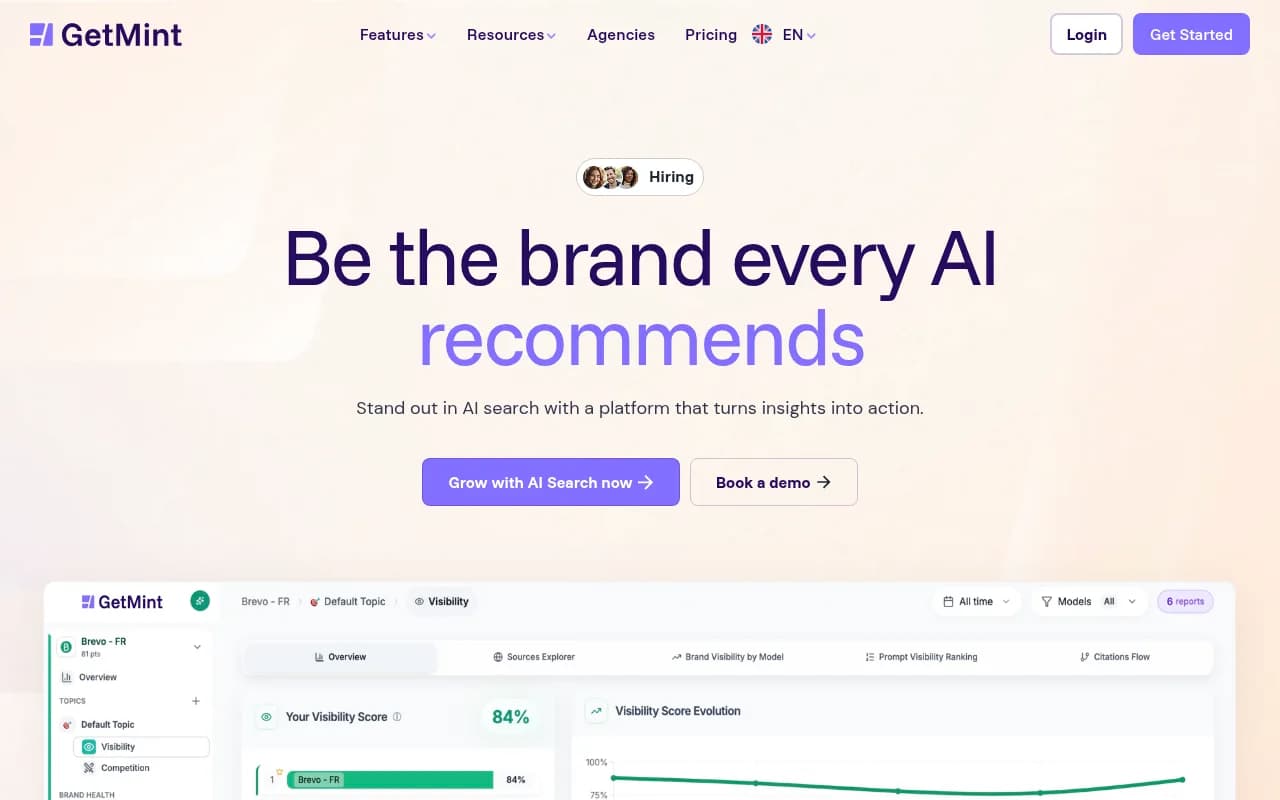
Hallucination detection is genuinely underserved in this space. Most monitoring tools tell you whether your brand appears in AI responses; GetMint also tells you whether what AI models say is accurate. For clients in regulated industries, or any brand where factual accuracy in AI responses matters (which is most of them), that's a meaningful differentiator.
The platform tracks sentiment and share of voice across major LLMs and is designed for brands that need to protect their reputation from AI-generated misinformation. It's more specialized than the other tools on this list, which means it works best as part of a broader agency stack rather than as a standalone solution.
Feature comparison
| Tool | Multi-client support | White-label reporting | Models covered | Content gap analysis | AI content generation | Crawler logs | Hallucination detection | Starting price |
|---|---|---|---|---|---|---|---|---|
| Promptwatch | Yes (agency plans) | Yes | 10 | Yes | Yes | Yes | No | $99/mo |
| Otterly.AI | Yes | Yes (higher tiers) | Major LLMs | No | No | No | No | $29/mo |
| Peec AI | Limited | Limited | Major LLMs | No | No | No | No | €89/mo |
| Profound | Yes | Yes | 9+ | Partial | No | No | No | $99/mo |
| SE Visible | Yes | Yes | AI Mode + AIO | No | No | No | No | $189/mo |
| LLM Pulse | Yes | Limited | Major LLMs | No | No | No | No | €49/mo |
| GetMint | Yes | Limited | Major LLMs | No | No | No | Yes | Custom |
How to choose the right tool for your agency
The right answer depends on what you're actually selling to clients.
If your agency sells monitoring and reporting as a service -- you track visibility, produce monthly reports, and flag issues -- then Otterly.AI or LLM Pulse will cover most of what you need at a reasonable price. Add SE Visible if your clients care about Google AI Mode specifically.
If your agency sells optimization -- you track visibility and then create content, fix technical issues, and improve AI citations -- then you need a tool that closes that loop. Promptwatch is the only option in this comparison that does all three steps (find gaps, create content, track results) in a single platform. That matters for agency efficiency: fewer tools, fewer handoffs, clearer client reporting.
If you're managing enterprise clients with complex brand narratives and large content teams, Profound is worth evaluating alongside Promptwatch.
One thing worth saying clearly: the agencies that will win in AI search over the next two years are the ones that can show clients a direct line from monitoring data to content created to visibility improved. Tools that only show dashboards will become commodities. The differentiation is in the action layer.
Setting up multi-client AI monitoring: practical tips
A few things that make multi-client AI monitoring work in practice:
Define prompts carefully for each client. The prompts you monitor should reflect how real customers actually ask about the client's category, not just branded searches. "Best [category] tools for [use case]" prompts are often more valuable than "[brand name]" prompts, because they show you where clients are winning or losing in discovery.
Set up alerts for significant changes, not everything. Monitoring 10 AI models across 20 clients generates a lot of data. Configure alerts for meaningful threshold changes -- a 10%+ drop in visibility, a new competitor appearing in responses, or a detected hallucination -- rather than daily summaries that nobody reads.
Build a reporting cadence that matches client expectations. Monthly reports work for most clients; weekly check-ins work for clients in fast-moving categories or those running active content campaigns. White-label reporting from tools like Promptwatch lets you produce these without manual assembly.
Track which content changes move the needle. When you publish new content targeting a visibility gap, you need to know whether it worked. Page-level citation tracking is the mechanism for this -- it shows you which specific pages are being cited by which AI models, so you can connect content investments to visibility outcomes.
The monitoring-only trap
One pattern worth watching out for: agencies that invest heavily in monitoring tools but have no clear process for acting on what they find. This is more common than it sounds.
A client sees their AI visibility score, asks "why is it low," and the agency says "we're tracking it." That's not a sustainable answer. The agencies that retain clients and grow retainers are the ones that can say "here's why it's low, here's the content we're creating to fix it, and here's how we'll know it worked."
That's the case for choosing a platform with optimization capabilities built in rather than stitching together a monitoring tool, a content tool, and a reporting tool. The fewer handoffs between data and action, the more efficiently an agency can operate -- and the clearer the story for clients.
Most of the tools in this guide are good at what they do. The question is whether what they do is enough for what your agency is trying to deliver.