Key takeaways
- Peec AI is a monitoring tool. It shows you where you're visible in AI search. It doesn't help you fix the gaps.
- Promptwatch's MCP integration connects AI visibility data to action — content generation, crawler diagnostics, traffic attribution, and more.
- The seven differences below aren't minor feature gaps. They represent a fundamentally different approach to AI search optimization.
- If you're a marketing or SEO team that needs to actually improve AI visibility (not just observe it), the tools aren't in the same category.
- MCP (Model Context Protocol) is the open standard that lets AI agents discover and use tools at runtime — Promptwatch's MCP server exposes its data and workflows to AI agents in ways monitoring-only platforms can't match.
Before getting into the list, a quick note on what MCP actually is. Anthropic released the Model Context Protocol in late 2024 as a standardized way for AI models to connect to external tools and data sources. Think of it as USB-C for AI integrations: instead of custom plumbing for every connection, you expose capabilities once and any compatible agent can discover and use them.
By 2026, MCP has become a serious part of how enterprise AI workflows are built. The platforms that expose rich, actionable data through MCP servers are the ones that slot into agent workflows. The ones that only expose basic monitoring data are... less useful.
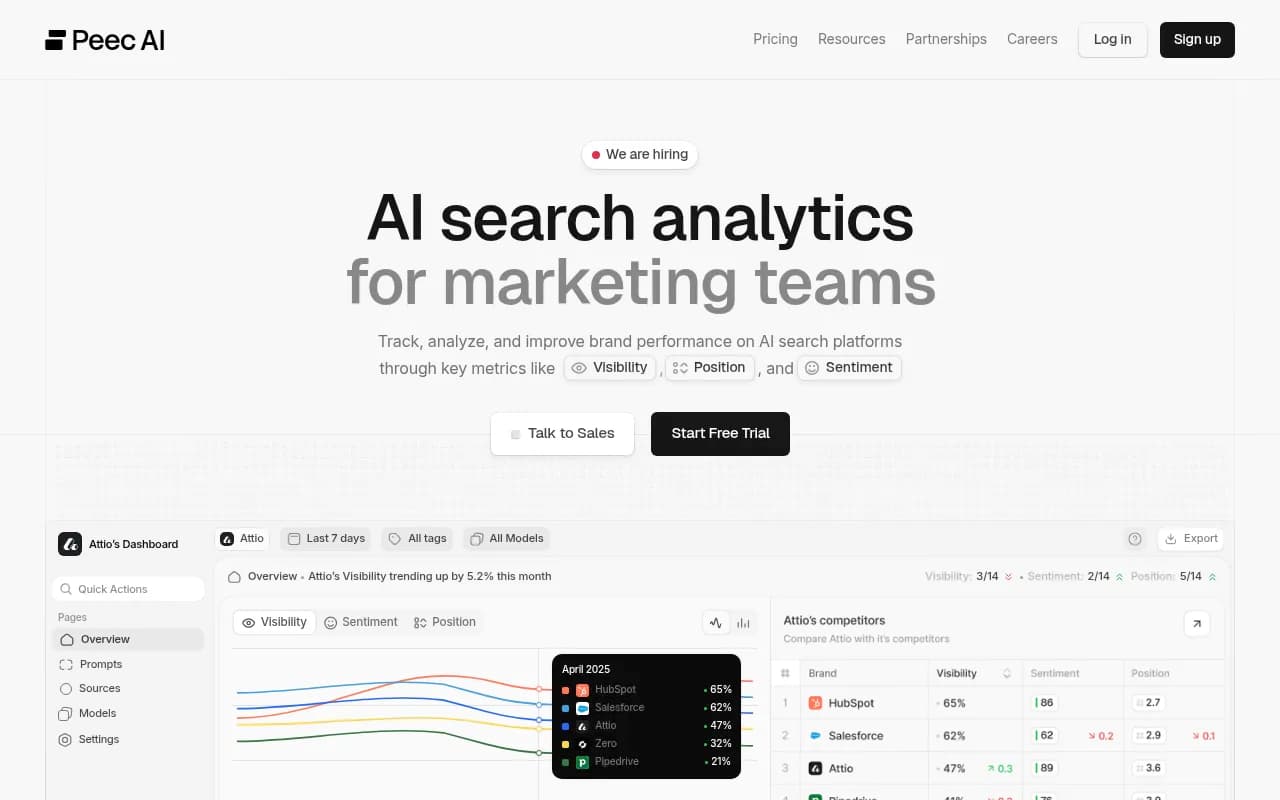
Peec AI tracks brand mentions across ChatGPT, Perplexity, and Claude. It's a clean, functional monitoring tool. But when you try to build an AI agent workflow around it, or ask it to help you actually improve your visibility, you hit a wall pretty quickly.
Promptwatch takes a different approach. Here's what that looks like in practice.

1. Close content gaps, not just observe them
This is the biggest one. Peec AI will tell you that a competitor appears in ChatGPT's response to "best project management tools for remote teams" and you don't. That's useful information. But what do you do with it?
Promptwatch's Answer Gap Analysis shows you the exact prompts where competitors are visible and you're not, then connects that directly to a content generation workflow. The built-in AI writing agent produces articles, listicles, and comparison pages grounded in real citation data from over 880 million citations analyzed. The content is engineered to get cited by ChatGPT, Claude, Perplexity, and other models — not generic SEO filler.
Through MCP, an AI agent can query Promptwatch's gap analysis, pull the highest-priority missing topics, and trigger content creation in a single workflow. With Peec AI, you'd export a CSV and figure out the rest yourself.
2. See which AI crawlers are actually reading your pages
Peec AI has no crawler log functionality. You can see your brand mentions in AI responses, but you have no visibility into whether ChatGPT's crawler has even visited your site, which pages it read, how often it returns, or whether it's hitting errors.
Promptwatch's AI Crawler Logs give you real-time data on GPTBot, ClaudeBot, PerplexityBot, and other AI crawlers. You can see which pages they're reading, which ones they're skipping, and what errors they encounter. This matters because if an AI crawler can't access your content, it can't cite it — and you'd never know why your visibility isn't improving.
Through MCP, an agent can query these logs to diagnose indexing issues automatically. Something like: "Check which pages GPTBot visited in the last 7 days, flag any 404s or redirect chains, and generate a fix list." That's a real workflow. Peec AI can't participate in it.
3. Track prompt volume and difficulty before you invest in content
Not all prompts are worth targeting. Some have high volume but are dominated by Wikipedia and Reddit. Others are winnable with the right content. Knowing the difference before you spend time writing is the difference between a smart content strategy and a lot of wasted effort.
Promptwatch provides volume estimates and difficulty scores for each prompt, plus query fan-outs that show how one prompt branches into related sub-queries. You can prioritize high-value, winnable prompts instead of guessing.
Peec AI doesn't offer this. You can see which prompts you're monitoring, but there's no signal about which ones are worth pursuing. Through MCP, Promptwatch's prompt intelligence becomes queryable by an AI agent — so you can build workflows that automatically surface the best opportunities based on volume, difficulty, and your current visibility score.
4. Connect AI visibility to actual revenue
Monitoring tools measure visibility. But visibility doesn't pay salaries. At some point you need to connect AI search appearances to traffic, leads, and revenue.
Promptwatch offers three ways to do this: a JavaScript snippet for client-side attribution, a Google Search Console integration, and server log analysis. Page-level tracking shows exactly which pages are being cited, how often, and by which AI models. You can close the loop from "ChatGPT cited our pricing page" to "three of those visitors converted."
Peec AI has no traffic attribution. It tracks mentions. What happens after those mentions is invisible to it.
For MCP workflows, this matters a lot. An agent that can query Promptwatch's attribution data can answer questions like "which AI-cited pages drove the most conversions last month?" and feed that back into content prioritization. That's a closed loop. Peec AI can't close it.
5. Monitor Reddit and YouTube as AI citation sources
This one surprises people. A significant portion of AI model citations come from Reddit threads, YouTube videos, and forum discussions — not just brand websites. If you're only tracking your own domain's visibility, you're missing a major part of the picture.
Promptwatch surfaces Reddit discussions and YouTube content that directly influence AI recommendations. You can see which threads are being cited when someone asks about your category, and use that to inform where you publish content, what angles you take, and which communities you should be active in.
Peec AI doesn't track Reddit or YouTube as citation sources. Through MCP, Promptwatch's Reddit and YouTube insights become part of an agent's research toolkit — useful for competitive analysis, content strategy, and understanding why a competitor keeps getting recommended even when their website isn't obviously better than yours.
6. Track ChatGPT Shopping appearances
ChatGPT's shopping and product recommendation features have become a real acquisition channel for e-commerce and SaaS brands in 2026. When someone asks ChatGPT "what's the best CRM for a 10-person sales team," they might get a structured product recommendation with links. Appearing in those results is valuable.
Promptwatch tracks when your brand appears in ChatGPT's product recommendations and shopping carousels. This is a distinct tracking surface from standard AI search visibility — the format, the intent, and the competitive dynamics are different.
Peec AI doesn't track ChatGPT Shopping. If this channel matters to your business (and for many brands it does), you're flying blind with a monitoring-only tool.
7. Build multi-step agent workflows on top of real AI visibility data
This is where MCP really changes the equation. The whole point of MCP is that AI agents can discover tools at runtime, understand their capabilities, and chain them together to complete complex tasks. A Promptwatch MCP server exposes rich, actionable data: visibility scores, content gaps, crawler logs, citation sources, prompt volumes, attribution data.
An agent connected to Promptwatch can do things like:
- Pull this week's biggest visibility drops, identify the likely cause (crawler error, new competitor content, prompt shift), and draft a remediation plan
- Find the 10 highest-volume prompts where a competitor outranks you, generate content briefs for each, and schedule them for the writing queue
- Check which AI-cited pages had the highest conversion rates last quarter and recommend doubling down on similar content
Peec AI's data is much thinner. It can tell an agent which prompts you're tracking and whether you appeared in responses. That's a starting point, not a workflow. There's no content generation, no crawler data, no attribution, no prompt intelligence to build on.
The gap isn't just about features. It's about what kind of platform you're building on. Monitoring data is a dead end for agents. Optimization data with action loops is what makes MCP integrations actually useful.
How the two platforms compare
| Capability | Promptwatch | Peec AI |
|---|---|---|
| Brand mention tracking | Yes (10 AI models) | Yes (ChatGPT, Perplexity, Claude) |
| Answer gap analysis | Yes | No |
| AI content generation | Yes (built-in writing agent) | No |
| AI crawler logs | Yes (GPTBot, ClaudeBot, etc.) | No |
| Prompt volume & difficulty scoring | Yes | No |
| Query fan-outs | Yes | No |
| Traffic attribution | Yes (snippet, GSC, server logs) | No |
| Reddit & YouTube citation tracking | Yes | No |
| ChatGPT Shopping tracking | Yes | No |
| Competitor heatmaps | Yes | Limited |
| MCP-ready action workflows | Yes | Monitoring only |
| Page-level citation tracking | Yes | No |
The honest summary
Peec AI is a reasonable entry point if you want to start tracking AI visibility without a big investment. It's clean, it works, and for teams that are just getting started with GEO it might be enough.
But if you're past the "let's see what's happening" stage and into "let's actually improve our AI search visibility and connect it to revenue," Peec AI runs out of runway fast. There's no content engine, no crawler diagnostics, no attribution, and no MCP-ready workflows that let AI agents do anything meaningful with the data.
Promptwatch is built around a different premise: find the gaps, fix them with content, track the results. The MCP integration makes that loop accessible to AI agents, which means the platform gets more useful as your AI workflows get more sophisticated — not less.
For teams serious about AI search optimization in 2026, that distinction matters more than it might seem at first glance.