Key takeaways
- Scrunch AI is a solid monitoring platform but starts at $300/mo with no free tier, no built-in content generation, and limited actionability -- agencies often need more.
- The best alternatives combine AI visibility tracking with content gap analysis, optimization tools, and multi-client management.
- Promptwatch is the only platform in this comparison rated as a "Leader" across all GEO categories, covering 10 AI models with built-in content generation and crawler logs.
- For agencies specifically, look for white-label reporting, multi-site management, and the ability to show clients a clear path from visibility gaps to fixed content.
- Most tools in this space are monitoring-only dashboards -- only a handful actually help you do something about what they find.
If you're running an agency and evaluating Scrunch AI, you've probably already noticed the tension: it's a capable monitoring platform, but it hands you data and then leaves you to figure out the rest. For a solo brand team, that might be fine. For agencies managing 5, 10, or 20 clients, "here's where you're invisible" without "here's how to fix it" creates a bottleneck that scales badly.
Scrunch AI (scrunch.com) does some things genuinely well. Hallucination detection -- identifying when AI models generate false information about a brand -- is a real differentiator, especially for clients in regulated industries like finance or healthcare. Their Influence Score for citation tracking is useful. And they cover a solid range of AI platforms on the Enterprise tier. But the pricing structure is a problem for agencies: $300/mo base, $25/user for additional seats, and no free tier to test with a prospect before committing.
The other issue is optimization. Scrunch AI's prompt trend feature has been described by practitioners as "too basic to be actionable." You can see that a competitor is winning for a prompt. You can't easily figure out why, or get help creating the content that would close that gap.
These 8 alternatives address those gaps in different ways. Some are cheaper. Some are more powerful. A few do both.
What to look for in a Scrunch AI alternative (for agencies)
Before jumping to the list, it's worth being clear about what actually matters for agency use cases specifically:
- Multi-client management: Can you manage multiple brands/domains from one account without paying per-seat fees that spiral out of control?
- White-label or client-ready reporting: Can you send reports to clients without it looking like a raw data export?
- Optimization tools, not just monitoring: Does the platform help you create or improve content, or does it just show you the problem?
- AI model coverage: Are you tracking ChatGPT, Perplexity, Claude, Gemini, and the others your clients' customers actually use?
- Prompt intelligence: Do you get volume estimates and difficulty scores, or just a list of prompts with no prioritization?
- Traffic attribution: Can you connect AI visibility to actual website visits and revenue?
Keep these in mind as you read through the options below.
The 8 best Scrunch AI alternatives for agencies in 2026
1. Promptwatch
Promptwatch is the most complete option in this comparison for agencies that want to go beyond monitoring. It covers 10 AI models (ChatGPT, Perplexity, Claude, Gemini, Google AI Overviews, Google AI Mode, Grok, DeepSeek, Meta AI, Copilot) and is built around what it calls an "action loop": find the gaps, create content to fill them, track the results.
The Answer Gap Analysis shows exactly which prompts competitors are visible for that your client isn't -- and the built-in AI writing agent generates articles, listicles, and comparisons grounded in real citation data. That's the part most tools skip entirely. You're not just told "you're missing coverage for this topic" -- you get a draft article engineered to get cited by AI models.
For agencies, the Business plan ($579/mo) covers 5 sites with 350 prompts and 30 articles per month. Custom agency/enterprise pricing is available for larger portfolios. The crawler logs feature (from the Professional plan at $249/mo) shows exactly which pages AI crawlers are reading, how often, and what errors they're hitting -- which is the kind of technical detail clients love seeing in a report.
Other agency-relevant features: prompt volume estimates and difficulty scoring (so you can prioritize high-value, winnable prompts), competitor heatmaps, Reddit and YouTube citation tracking, ChatGPT Shopping monitoring, and traffic attribution via code snippet, GSC integration, or server log analysis.

2. Profound
Profound is the other enterprise-grade option in this space. It covers 9+ AI engines and its standout data point is Prompt Volumes -- actual search volume estimates for AI prompts, which most platforms don't offer. Pricing runs from $99/mo on the low end to $5,000+/mo for enterprise, which gives it a wider range than Scrunch AI.
The platform is strong on competitive intelligence and has solid persona and geography segmentation. Where it falls short for agencies is content generation -- like Scrunch AI, Profound is primarily a monitoring and analytics platform. You'll still need to take the data somewhere else to act on it.
Profound

3. AthenaHQ
AthenaHQ positions itself as an enterprise AI visibility platform with a focus on structured competitive analysis. It's well-regarded for the depth of its prompt tracking and the clarity of its competitive benchmarking reports -- the kind of output that looks good in a client presentation.
The limitation is the same one that comes up repeatedly in this category: it's monitoring-focused. AthenaHQ shows you where you stand and how you compare. It doesn't help you create the content that would change those numbers. For agencies that have their own content production capacity and just need the intelligence layer, that's fine. For agencies that want an end-to-end solution, it's a gap.

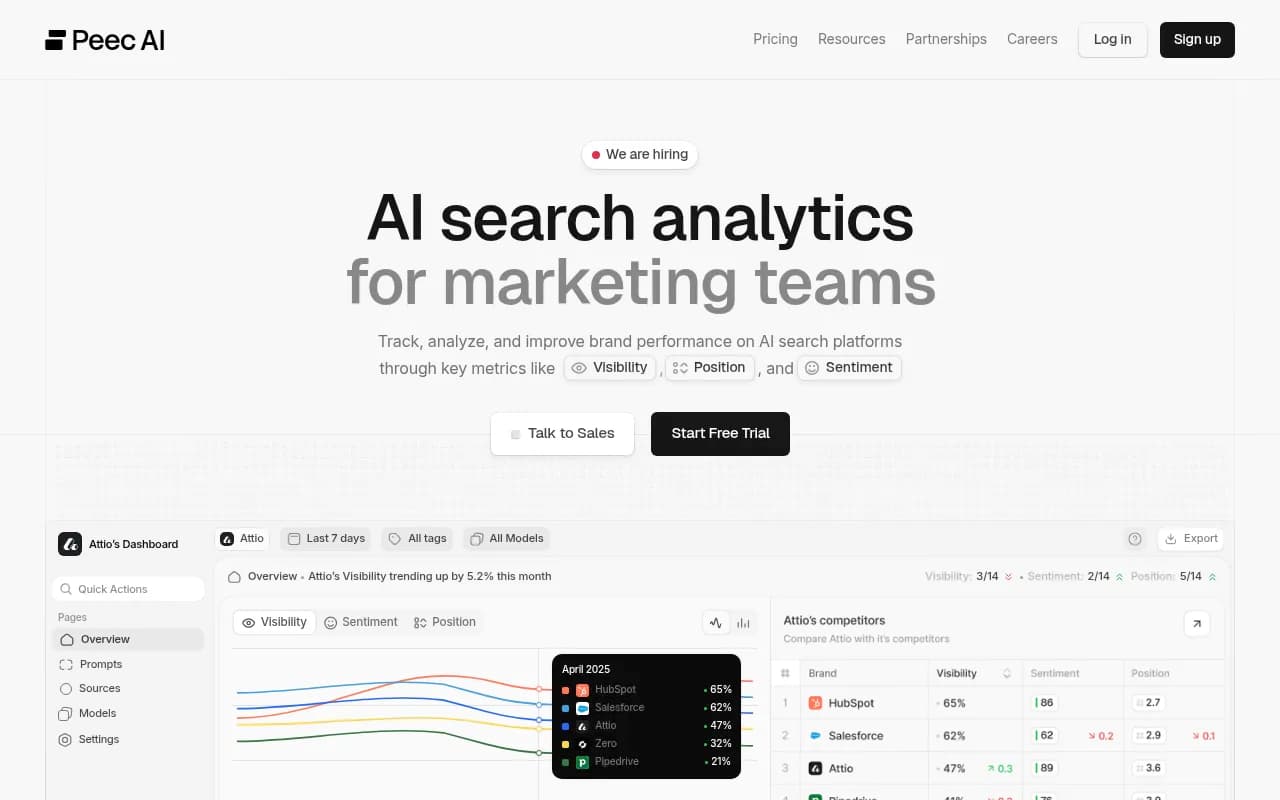
4. Peec AI
Peec AI is a purpose-built AI search analytics platform with particular strength in structured reporting and competitive benchmarking. It covers the major AI engines and has a clean interface that makes it relatively easy to onboard new clients.
The pricing is more accessible than Scrunch AI, which makes it worth considering for agencies with smaller clients or tighter margins. The trade-off is depth -- Peec AI doesn't have the crawler log functionality, Reddit/YouTube tracking, or content generation capabilities that more comprehensive platforms offer.
5. Otterly.AI
Otterly.AI is one of the more established names in AI search monitoring. It tracks brand mentions across ChatGPT, Perplexity, and Google AI Overviews, and has a reasonably clean reporting interface.
It's honest about what it is: a monitoring tool. There's no content generation, no crawler logs, no traffic attribution. For agencies that already have strong content and technical SEO processes and just need visibility data to layer on top, Otterly.AI is a reasonable choice. For agencies looking for a platform that does more of the work, it's not the right fit.
Otterly.AI

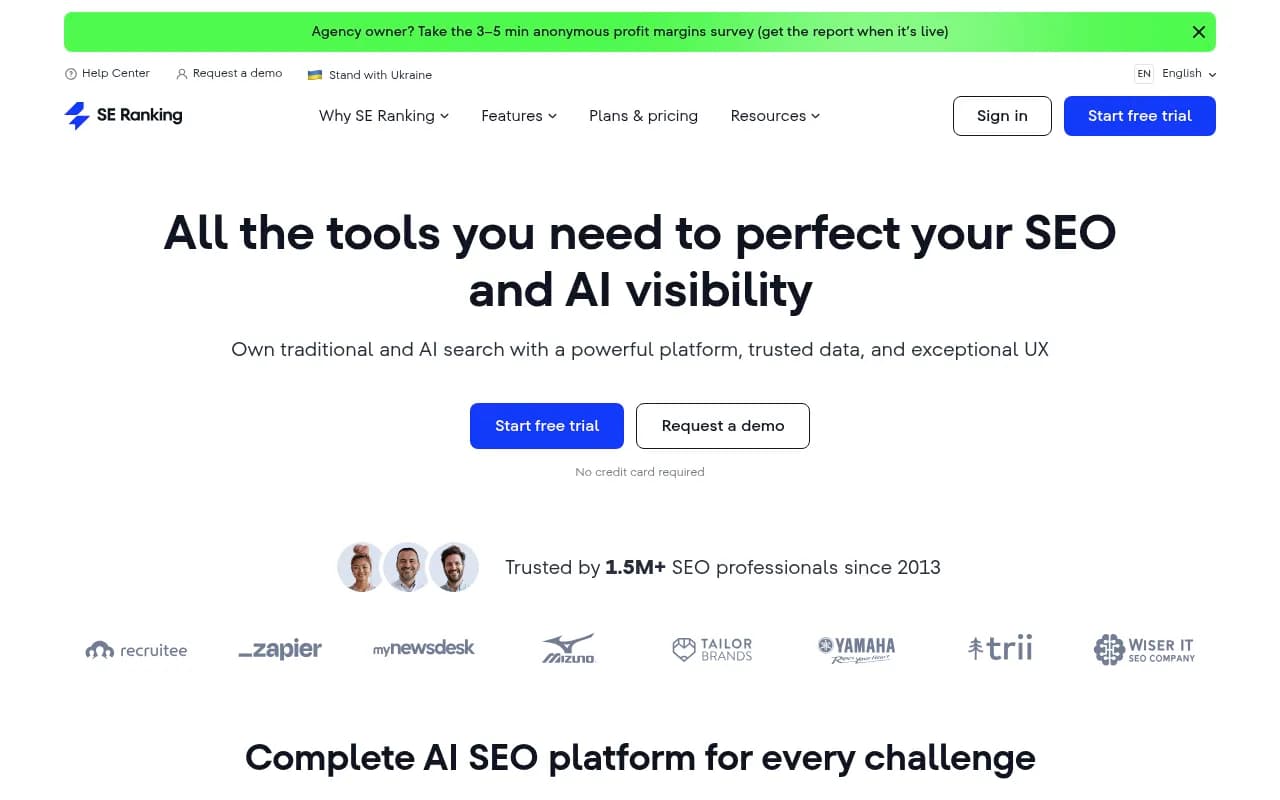
6. SE Ranking
SE Ranking is an interesting option because it's not a pure-play AI visibility tool -- it's a full SEO platform that has added AI visibility tracking. Starting at $129/mo, it's one of the more affordable options here, and the combination of traditional SEO features (rank tracking, site audits, backlink analysis) with AI monitoring makes it genuinely useful for agencies that want one platform for both.
The AI visibility features are less deep than dedicated platforms. You won't get prompt volume data, crawler logs, or content generation. But if your agency is already using SE Ranking for traditional SEO and wants to add AI monitoring without switching platforms, it's a practical choice.
7. Semrush
Semrush has added AI visibility tracking to its platform, which means agencies already paying for Semrush can access some AI monitoring without adding another tool. The integration with the broader Semrush feature set -- keyword research, content tools, competitor analysis -- is genuinely useful.
The limitation is that Semrush's AI tracking uses fixed prompts rather than letting you define custom prompts around your clients' specific use cases. There's also no AI traffic attribution. For agencies that need flexible, deep AI visibility monitoring, Semrush is a supplement rather than a replacement for a dedicated platform.
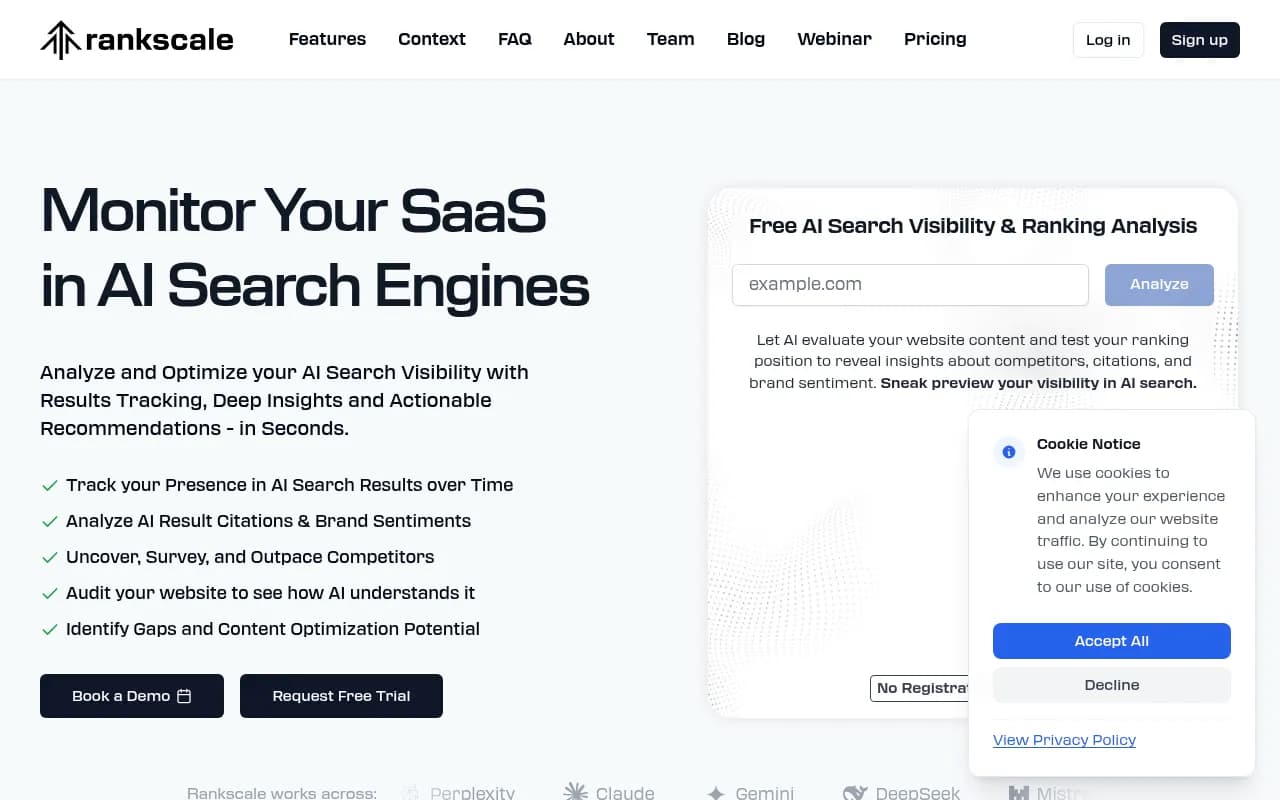
8. Rankscale
Rankscale is an agency-focused AI visibility tracking platform that covers the major AI engines and has multi-client management built in. It's designed specifically for agencies, which means the reporting and client management workflows are more developed than on some of the broader platforms.
The feature set is more limited than Promptwatch or Profound -- no content generation, no crawler logs, no Reddit tracking. But the agency-first design philosophy means the day-to-day workflow of managing multiple clients is smoother, and the pricing is more predictable than per-seat models.
Feature comparison table
| Tool | AI models covered | Content generation | Crawler logs | Multi-client | Traffic attribution | Starting price |
|---|---|---|---|---|---|---|
| Promptwatch | 10 | Yes (built-in AI writer) | Yes | Yes | Yes (GSC, snippet, logs) | $99/mo |
| Profound | 9+ | No | No | Yes | Limited | $99/mo |
| AthenaHQ | 6+ | No | No | Yes | No | Custom |
| Peec AI | 5+ | No | No | Yes | No | ~$99/mo |
| Otterly.AI | 3 (ChatGPT, Perplexity, AI Overviews) | No | No | Limited | No | ~$99/mo |
| SE Ranking | 3-4 | No | No | Yes | No | $129/mo |
| Semrush | 4 (fixed prompts) | Limited | No | Yes | No | $139/mo |
| Rankscale | 5+ | No | No | Yes | No | Custom |
| Scrunch AI (baseline) | 4 (Core) / 9 (Enterprise) | No | No | Yes | GA4 integration | $300/mo |
How to choose the right one for your agency
The right choice depends on where your agency's biggest gap actually is.
If your clients are asking "why aren't we showing up in ChatGPT?" and you need to both diagnose the problem and fix it, Promptwatch is the only platform here that closes that loop end-to-end. The combination of Answer Gap Analysis and built-in content generation means you can go from "here's the problem" to "here's the article that addresses it" without leaving the platform.
If you need enterprise-grade competitive intelligence and have your own content production capacity, Profound is the stronger choice. The Prompt Volumes data is genuinely useful for prioritizing which gaps matter most.
If budget is the primary constraint, SE Ranking gives you the most functionality per dollar, especially if you're already using it for traditional SEO. The AI visibility features aren't as deep, but they're real and they're included.
If your clients are in regulated industries where hallucination detection matters, Scrunch AI's core differentiator is still worth considering -- none of the alternatives above have matched it on that specific feature. But weigh that against the $300/mo floor and the lack of optimization tools.
One thing worth saying directly: most of the tools in this space are still monitoring-only platforms. They show you data. They don't help you act on it. For agencies, that matters more than it does for a single brand team, because your value to clients isn't just reporting -- it's moving the numbers. A platform that generates the content to fill visibility gaps is doing part of your job for you.
What Scrunch AI does well (and when to stick with it)
It would be misleading to frame this as "Scrunch AI is bad, switch immediately." For specific use cases, it's genuinely the right tool:
- Hallucination detection is unique and valuable for brands where AI models generating false information is a real risk (financial services, healthcare, legal).
- The 9-platform Enterprise tier coverage is comprehensive.
- GA4 integration for bot traffic analysis is a useful bridge between AI visibility and traditional analytics.
- For brands with large internal content teams who just need the intelligence layer, the monitoring-first approach isn't a limitation.
The problems are the price floor ($300/mo with no free tier makes it hard to test with a prospect), the per-seat pricing ($25/user adds up fast for agency teams), and the lack of optimization tools for agencies that need to show clients a path forward, not just a diagnosis.
The agency workflow question
Here's the practical question worth asking before you commit to any platform: what does your workflow look like after you get the data?
If the answer is "we export it, put it in a deck, and then go figure out what content to create," you're adding friction at every step. The agencies getting the most out of AI visibility tools in 2026 are the ones using platforms where the data and the action are in the same place -- where you can see a prompt gap, generate a draft article, track whether it gets cited, and show the client the before/after in a single report.
That's a higher bar than most platforms currently meet. But it's the right bar to hold them to.