Key takeaways
- Peec AI is a capable entry-level AI visibility tracker, but teams consistently run into three walls: prompt limits, accuracy inconsistencies across industries, and no clear path from data to action.
- Most alternatives fall into two camps: monitoring-only dashboards (more data, same problem) and full optimization platforms (monitoring plus content gap analysis, content generation, and traffic attribution).
- If you just need broader engine coverage or a lower price point, tools like Otterly.AI, LLMrefs, or Promptmonitor are worth a look.
- If you need to actually move the needle on AI visibility, not just measure it, the gap between monitoring tools and optimization platforms like Promptwatch is significant.
- Pricing across the category ranges from $29/month to $295+/month. The right choice depends heavily on whether you need monitoring, optimization, or both.
Peec AI had a good run as an early mover. When generative engine optimization (GEO) was still a niche concern, it gave SEOs and brand marketers a clean way to see how their brand appeared in ChatGPT, Perplexity, and Google AI Overviews. The dashboard was simple. Setup was fast. For a lot of teams, it was the first real look at AI search visibility.
But "first look" is different from "ongoing strategy."
By 2026, teams are hitting the same friction points: prompt ceilings on starter plans, results that vary in accuracy depending on the industry, and a fundamental gap between what the platform shows you and what you're supposed to do about it. Peec AI tells you where you stand. It doesn't tell you how to change it.
That's the core tension this guide addresses. Some alternatives here are better monitors. Others are actual optimization platforms. The difference matters more than any feature comparison table can capture, so I'll call it out clearly as we go.
What to look for before switching
Before jumping to alternatives, it's worth being honest about what you actually need. A few questions worth asking:
- Do you need more AI engine coverage (Claude, DeepSeek, Grok, Meta AI), or is ChatGPT + Perplexity + Google AI Overviews enough?
- Are you primarily monitoring brand mentions, or do you need to understand why competitors are getting cited and you're not?
- Does your team have the bandwidth to act on data, or do you need a tool that generates content recommendations alongside the insights?
- Are you managing one brand or multiple clients?
The answers change which tool makes sense. A solo brand manager with a tight budget has different needs than an agency running 20 client accounts.
The 8 best Peec AI alternatives in 2026
1. Promptwatch — best for teams that want to fix visibility, not just track it
Promptwatch is the most complete option on this list if your goal is actually improving AI search visibility rather than just reporting on it. Most tools in this category show you a dashboard and leave you to figure out the rest. Promptwatch closes the loop.

The core workflow is built around three steps: find the gaps, create content that fills them, and track whether it worked. The Answer Gap Analysis shows you exactly which prompts competitors rank for that you don't, with the specific topics and angles that AI models are looking for but can't find on your site. The built-in AI writing agent then generates articles, listicles, and comparisons grounded in citation data from over 880 million sources analyzed. After publishing, page-level tracking shows which pages are being cited, by which models, and how often.
A few things that separate it from the field: AI Crawler Logs show you in real time which AI crawlers (ChatGPT, Claude, Perplexity, etc.) are hitting your site, which pages they're reading, and what errors they're encountering. Prompt Intelligence gives you volume estimates and difficulty scores for individual prompts, plus query fan-outs that show how one prompt branches into sub-queries. There's also Reddit and YouTube tracking, which surfaces discussions that directly influence AI recommendations -- a channel most competitors ignore entirely.
Coverage spans 10 AI models: ChatGPT, Perplexity, Google AI Overviews, Google AI Mode, Claude, Gemini, Meta/Llama, DeepSeek, Grok, Mistral, and Copilot.
Pricing starts at $99/month (Essential: 1 site, 50 prompts, 5 articles), $249/month (Professional: 2 sites, 150 prompts, 15 articles, crawler logs), and $579/month (Business: 5 sites, 350 prompts, 30 articles). A free trial is available.
The honest caveat: if you only need basic brand monitoring and have no interest in content optimization, this is more tool than you need. But for anyone who's frustrated by dashboards that show problems without helping you solve them, it's the most actionable option in the category.
2. Scrunch AI — best for enterprise brand safety monitoring
Scrunch sits at the premium end of the market, and it earns that position with the broadest engine coverage available: ChatGPT, Claude, Perplexity, Gemini, Google AI Overviews, AI Mode, and Meta AI from a single dashboard.
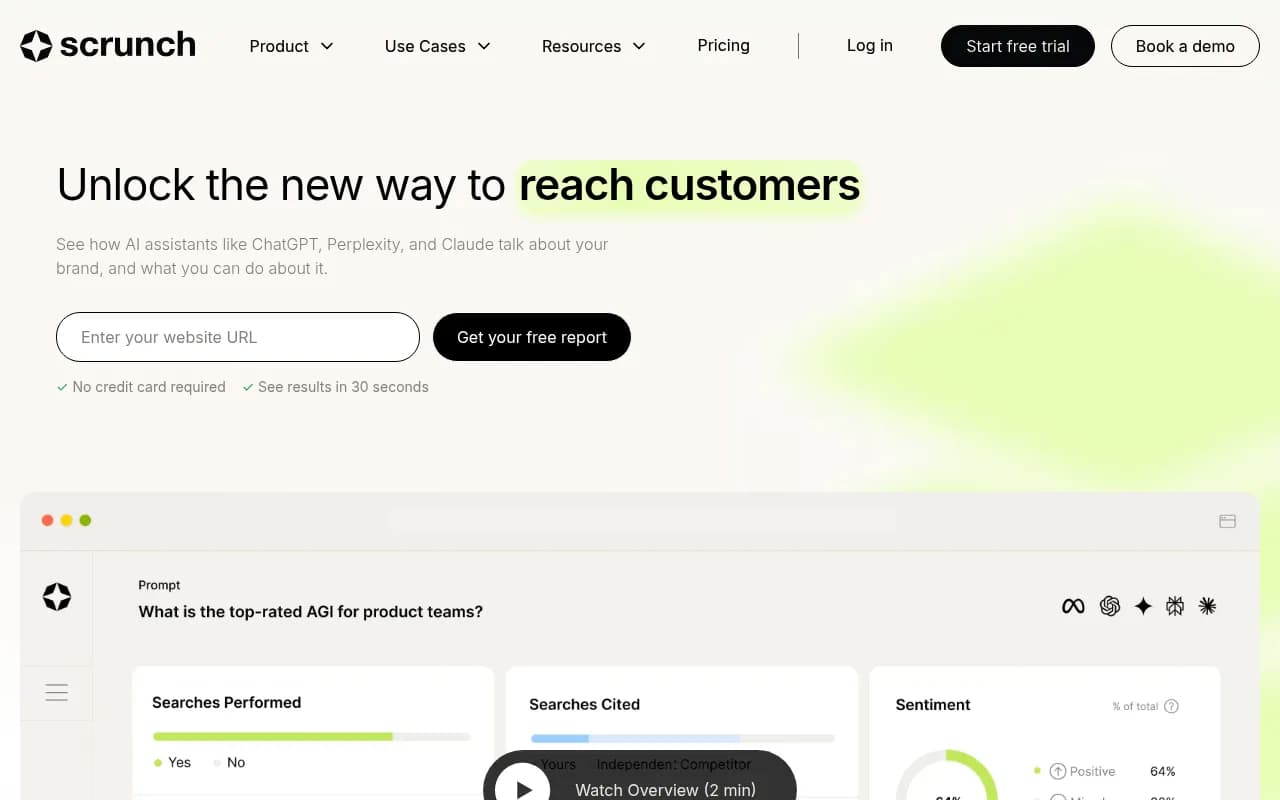
What makes Scrunch genuinely different from lighter tools is its focus on brand safety. The platform detects when AI models make false claims about your brand (hallucinations) and maps customer journeys through AI interactions. For enterprise teams worried about misinformation, that's not a nice-to-have. It connects directly to GA4, so you can see actual traffic attribution from AI-driven visits.
The tradeoff is price. Scrunch is positioned for enterprise budgets, and smaller teams will likely find the cost hard to justify. It's also primarily a monitoring platform -- it doesn't generate content or provide the kind of gap analysis that optimization-focused tools offer.
Best for: Enterprise brands with brand safety concerns and budget to match.
3. Profound — best for precise AI Overview tracking and entity analysis
Profound has built a strong reputation for accuracy, particularly around Google AI Overviews. If entity extraction and attribution mapping matter to your workflow, it's worth a close look.
Profound

The platform tracks AI visibility across ChatGPT, Perplexity, Google AI Overviews, Claude, and several others. Its entity-level analysis is more granular than most competitors -- you can see which specific entities (brands, products, topics) are being surfaced in AI responses and how your presence compares to competitors.
Starting at $99/month, it's competitively priced for what it offers. The gap is on the optimization side: Profound shows you what's happening but doesn't help you create content to change it. Teams that already have strong content operations will find it more useful than those who need end-to-end support.
Best for: SEO teams focused on AI Overview visibility and entity-driven optimization.
4. AthenaHQ — best for multi-engine competitive intelligence
AthenaHQ covers Google AI Overviews, Perplexity, ChatGPT, and Claude with a focus on competitive benchmarking. If your primary use case is understanding how your brand stacks up against competitors across multiple AI engines, it does that well.

The platform is strong on the monitoring and competitive intelligence side. Pricing starts around $295/month, which puts it above Peec AI and most other alternatives on this list. Like most tools in the monitoring-only camp, it doesn't offer content generation or gap analysis -- you get the data, but the "what to do about it" is left to you.
Best for: Brands and CI teams that need multi-engine competitive benchmarking.
5. Otterly.AI — best for focused AI search tracking on a budget
Otterly.AI is one of the cleaner, more focused options in the category. It tracks brand mentions across ChatGPT, Perplexity, and Google AI Overviews with a straightforward interface that doesn't try to do too much.
Otterly.AI

It's a good fit for teams that want reliable monitoring without the complexity of a full platform. The pricing is accessible, and the setup is fast. The limitation is the same one that applies to most monitoring-only tools: it shows you where you stand, but doesn't help you improve. No crawler logs, no content generation, no traffic attribution.
Best for: Small teams or solo marketers who need clean AI visibility monitoring without the overhead.
6. Rankscale — best for agency-focused AI visibility benchmarking
Rankscale is built with agencies in mind. It offers competitive AI visibility benchmarking with a workflow that scales across multiple clients, making it a reasonable option for agencies that need to report on AI search performance across accounts.
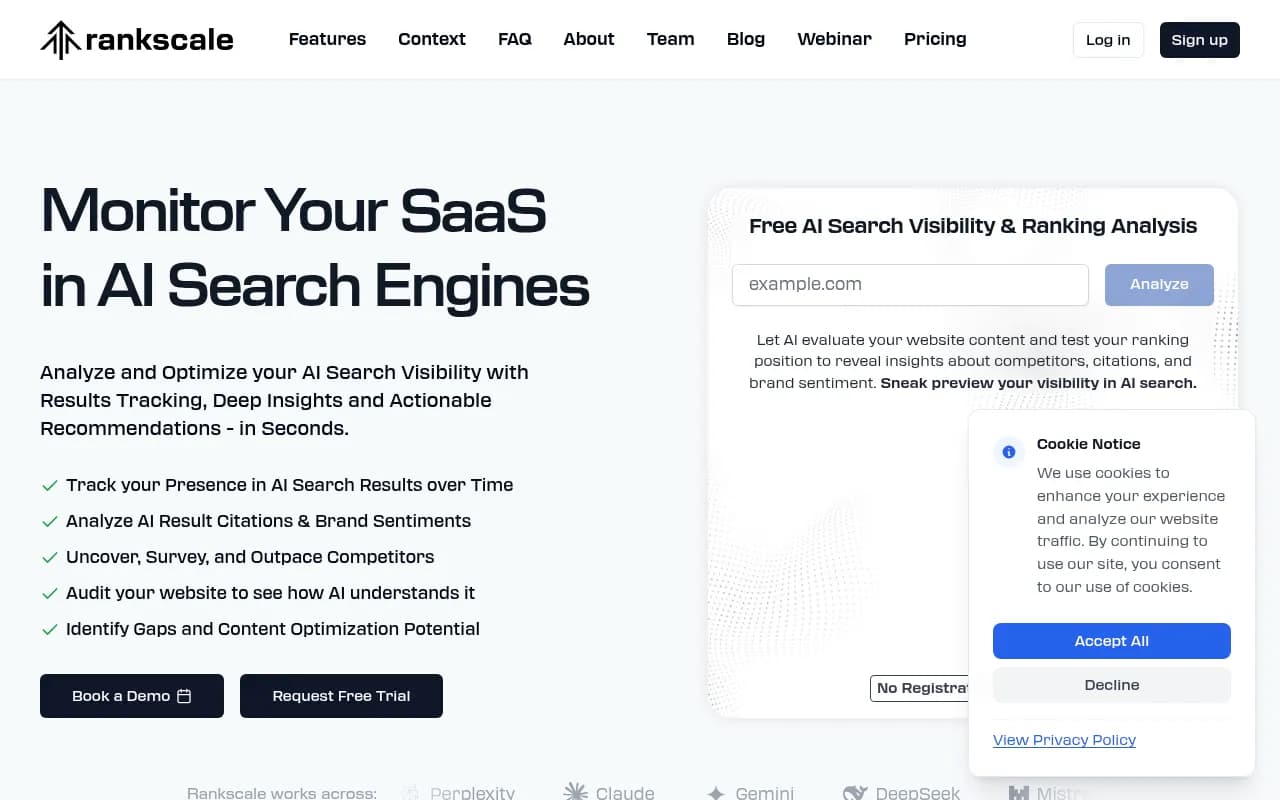
The platform covers the major AI engines and provides share-of-voice metrics that work well in client-facing reports. It's not an optimization tool -- it doesn't generate content or identify specific gaps -- but for agencies whose primary deliverable is visibility reporting, it covers the basics.
Best for: Digital agencies that need scalable AI visibility reporting for multiple clients.
7. LLMrefs — best affordable on-ramp for citation tracking
LLMrefs focuses specifically on citation and source tracking across AI models. If you want to understand which pages, domains, and sources AI engines are pulling from when they answer questions in your space, it's one of the more affordable ways to get that data.
LLMrefs
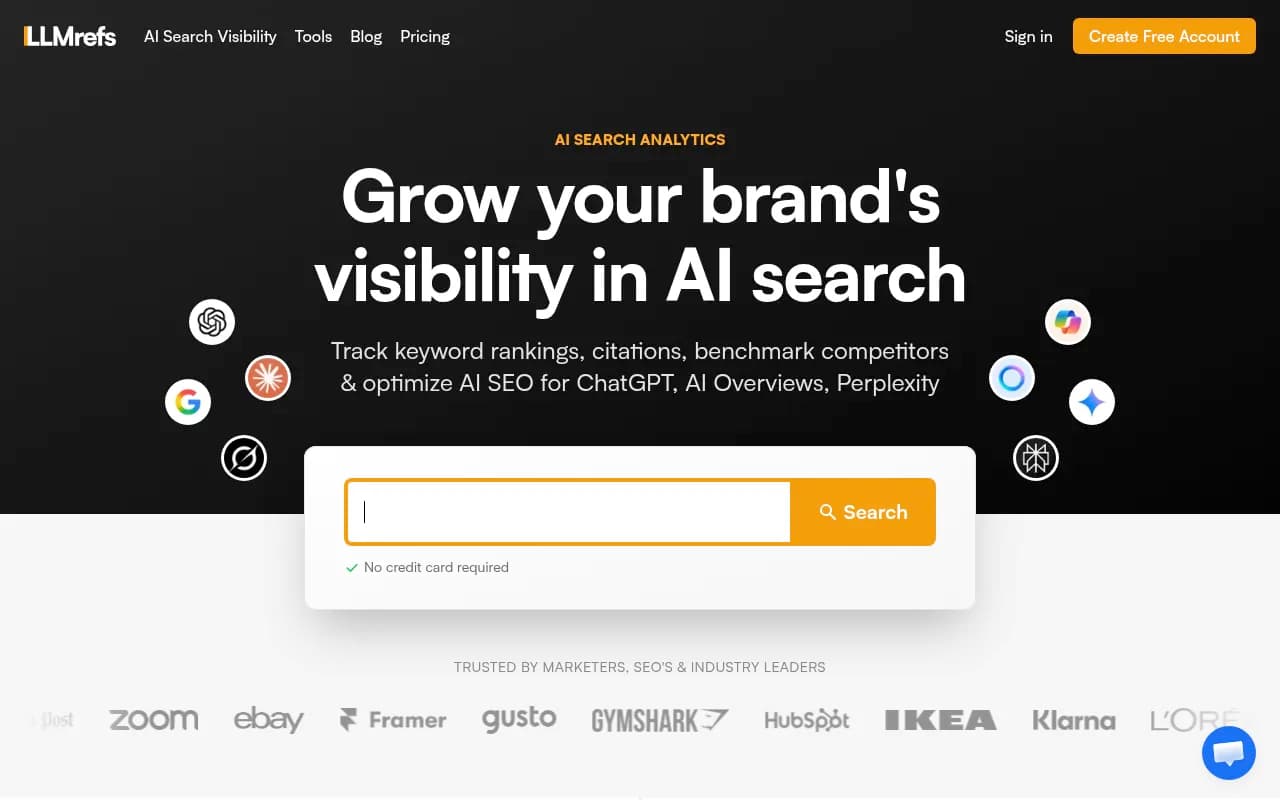
It covers ChatGPT, Perplexity, and several other AI engines. The interface is lean, the pricing is accessible, and it's a good starting point for teams that are new to AI visibility and want to understand the citation landscape before investing in a more comprehensive platform.
Best for: Teams new to GEO who want to understand citation patterns without a large budget commitment.
8. SE Ranking (AI Visibility module) — best for teams already using SE Ranking for SEO
If you're already using SE Ranking for traditional SEO, its AI Visibility module is a natural extension. It adds AI search monitoring to an existing SEO workflow without requiring a separate tool or login.
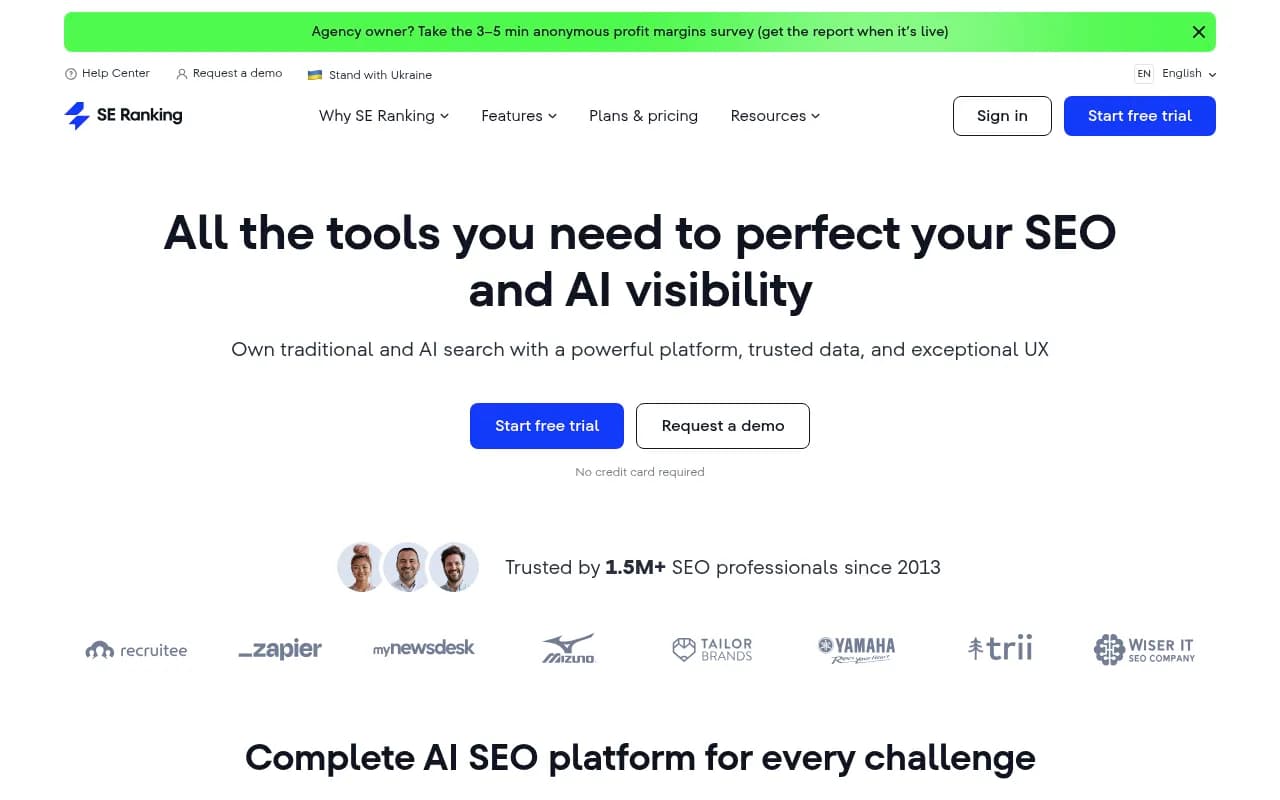
The module tracks brand mentions across major AI engines and integrates with SE Ranking's keyword research, site audit, and rank tracking features. For teams that want a single platform for both traditional SEO and AI search visibility, it's a practical choice. For teams that need deep AI-specific features like crawler logs, content gap analysis, or prompt intelligence, it's not built for that level of depth.
Best for: Existing SE Ranking users who want to add AI visibility monitoring without switching platforms.
Side-by-side comparison
| Tool | AI engines covered | Content generation | Crawler logs | Traffic attribution | Starting price |
|---|---|---|---|---|---|
| Promptwatch | 10 (ChatGPT, Perplexity, Claude, Gemini, Google AIO, AI Mode, DeepSeek, Grok, Mistral, Copilot) | Yes | Yes | Yes | $99/mo |
| Scrunch AI | 7+ | No | No | Yes (GA4) | Enterprise |
| Profound | 5+ | No | No | No | $99/mo |
| AthenaHQ | 4 | No | No | No | $295/mo |
| Otterly.AI | 3 | No | No | No | ~$49/mo |
| Rankscale | 4+ | No | No | No | Custom |
| LLMrefs | 9+ | No | No | No | Free tier + paid |
| SE Ranking AI | 4+ | No | No | No | $95/mo (add-on) |
| Peec AI | 4 | No | No | No | ~€89/mo |
The monitoring vs. optimization gap
This is worth saying plainly because most comparison articles gloss over it.
Every tool on this list will show you visibility data. They'll tell you how often your brand appears in AI responses, which competitors are outperforming you, and which AI engines are citing your pages. That's table stakes in 2026.
The question is what happens next.
With a monitoring-only tool, the answer is: you take the data, figure out what it means, decide what content to create, write it, publish it, and then check back in a few weeks to see if anything changed. That's a lot of manual work sitting between "I see the problem" and "I fixed the problem."
With an optimization platform, the gap analysis tells you specifically what content is missing, the writing tools help you create it, and the tracking closes the loop by showing you whether the new content is getting cited. The workflow is tighter.

For teams with strong content operations already in place, a monitoring-only tool might be enough -- you just need the data signal, and you have the resources to act on it. For everyone else, the monitoring-only approach tends to produce dashboards that get checked once a week and don't drive much change.
Which tool should you actually pick?
A few honest recommendations based on what teams typically need:
If you're an agency managing multiple clients and need to show AI visibility progress: Promptwatch's Business or Agency plan covers the monitoring, gap analysis, and content generation in one place. The white-label reporting and multi-site tracking are built for that workflow.
If you're an enterprise brand worried about hallucinations and brand safety: Scrunch AI is the most purpose-built option for that specific concern.
If you're already deep in the SE Ranking ecosystem: The AI Visibility module is the path of least resistance.
If you're just starting out and want to understand citation patterns before committing to a bigger platform: LLMrefs is a low-cost way to get oriented.
If you need the most complete picture of why competitors are winning in AI search and what to do about it: Promptwatch is the only tool on this list that covers the full cycle from gap identification to content creation to result tracking.
A note on Peec AI itself

Peec AI isn't a bad tool. It was one of the first to take AI search visibility seriously, and for teams with modest prompt volumes and straightforward monitoring needs, it still works. The UI is clean, the setup is fast, and the 7-day trial gives you a real sense of what you're getting.
The issue isn't that Peec AI is broken. It's that the category has moved. In 2025, showing up in an AI response was novel enough that just knowing about it felt valuable. In 2026, teams need to know why they're not showing up, what to create to change that, and whether their efforts are working. That's a different ask than what Peec AI was built to answer.
If you're hitting the prompt ceiling, struggling with accuracy in your industry, or finding that the data doesn't translate into action, the tools above are worth evaluating. Most offer free trials, so the comparison cost is low.