Key takeaways
- Ahrefs Brand Radar and Semrush's AI Toolkit are both add-ons to existing SEO platforms, not purpose-built GEO tools
- Ahrefs Brand Radar costs an extra $699/month on top of an existing Ahrefs plan and covers 6 AI tools with a large prompt dataset (210M+ search-backed prompts)
- Semrush's AI features are spread across multiple products (AI Toolkit, ContentShake, Sensor) and use fixed prompts, which limits how much you can customize tracking
- Neither platform offers AI crawler logs, content gap analysis tied to AI responses, or content generation grounded in prompt data
- For teams that already pay for one of these suites, the AI features are a reasonable starting point -- but they won't replace a dedicated AI visibility platform if you actually want to act on the data
If you're already paying for Ahrefs or Semrush, the obvious question is: do I need anything else to track AI search? Both platforms have added AI visibility features in 2026, and both are marketing them hard. The honest answer is more complicated than either vendor would like.
This guide breaks down what each tool actually does, where they differ, and when you'd outgrow them.
What Ahrefs Brand Radar actually does
Brand Radar is Ahrefs' dedicated AI visibility product, launched separately from the core Ahrefs suite. It's been growing fast -- reportedly adding $1M in ARR every two weeks as of early 2026 -- which tells you something about demand for this category.
Ahrefs positions Brand Radar around breadth: it draws on 210M+ search-backed prompts to give you a wide view of where your brand appears across AI tools. You can also add custom prompts for more targeted tracking.
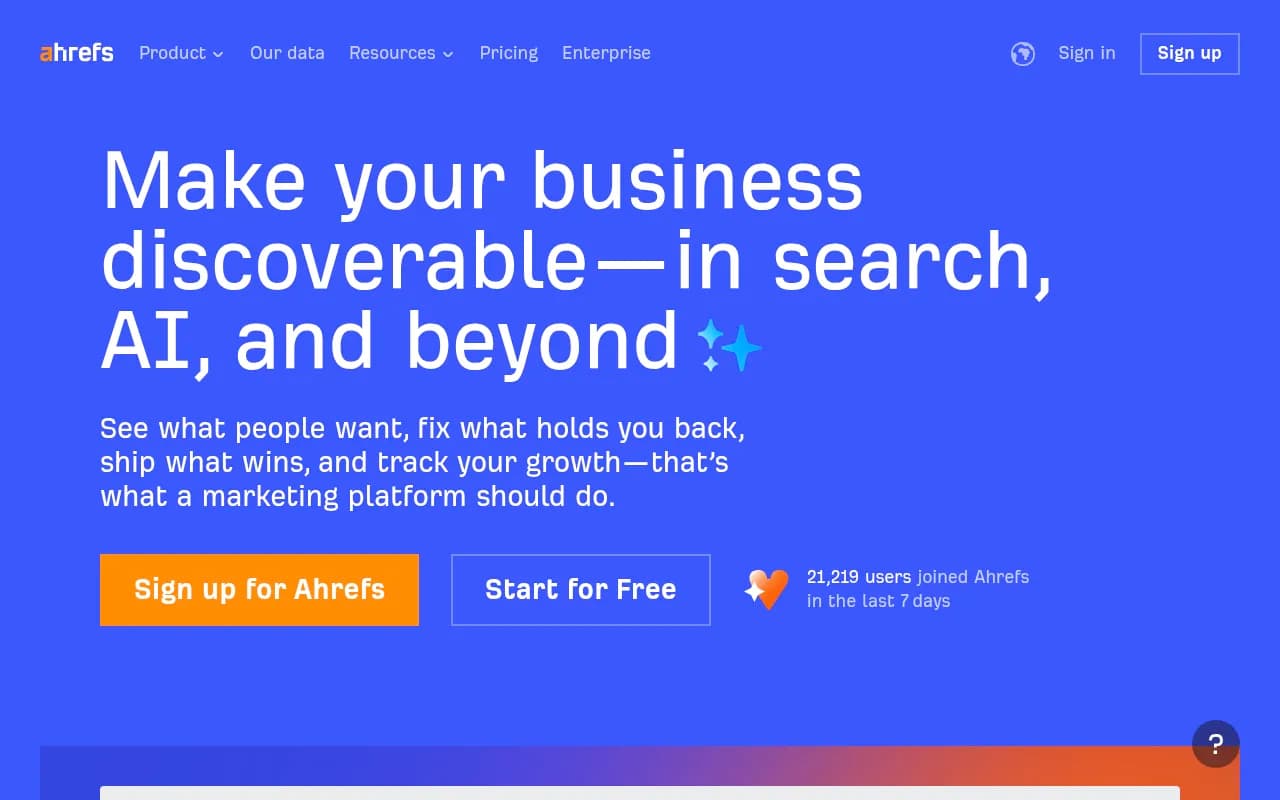
The product covers 6 AI tools (the exact lineup includes ChatGPT, Perplexity, Google AI Overviews, and a few others), and it maps what Ahrefs calls your "full AI funnel." The interface shows brand mention rates, share of voice against competitors, and which prompts you're appearing in.
What it does well:
- Large prompt dataset means you're not just tracking the handful of queries you manually enter
- Competitor benchmarking is solid, consistent with Ahrefs' traditional strength in competitive analysis
- If you're already in the Ahrefs ecosystem, the learning curve is minimal
- Data quality is generally considered reliable -- Ahrefs has a reputation for methodological rigor
What it doesn't do:
- No AI crawler logs -- you can't see which pages AI bots are actually reading on your site
- No content gap analysis tied to AI responses -- it shows you where you're missing but not what content would fix it
- No content generation features -- you're on your own once you have the data
- Fixed prompt volumes aren't surfaced, so prioritizing which gaps to close first is guesswork
- No traffic attribution connecting AI visibility to actual site visits or revenue
The pricing is the other thing worth knowing. Brand Radar costs $699/month on top of your existing Ahrefs plan. That's not cheap, and it's a meaningful commitment for a monitoring-only product.
What Semrush's AI features actually do
Semrush's approach to AI search is more fragmented. Rather than one dedicated product, AI visibility features are spread across the platform: the AI Toolkit, ContentShake AI, the AI Sensor (which tracks AI Overview presence in SERPs), and the Writing Assistant.
The core AI Toolkit tracks brand mentions in AI-generated answers and gives you a share-of-voice view similar to Brand Radar. ContentShake AI helps you write content, though it's more of a general AI writing tool than something specifically engineered around AI search gaps.
What Semrush does well:
- If you're already a Semrush One subscriber, some AI features are included without extra cost
- The AI Sensor is genuinely useful for tracking how often AI Overviews appear for your target keywords
- ContentShake lowers the barrier to producing content, even if it's not optimized specifically for AI citation
- Semrush's keyword and competitive data is deep, and that context carries over into AI tracking
What it doesn't do:
- Semrush uses fixed prompts for AI tracking -- you can't build a custom prompt set around your specific market or customer questions
- No AI crawler logs or agent analytics
- No traffic attribution from AI search to revenue
- No Reddit or YouTube tracking (both are significant sources that AI models cite heavily)
- Content generation isn't grounded in AI citation data -- ContentShake writes for SEO, not specifically for AI answer engines
Head-to-head comparison
| Feature | Ahrefs Brand Radar | Semrush AI Toolkit |
|---|---|---|
| AI models tracked | 6 | Varies by feature |
| Custom prompts | Yes | Limited / fixed |
| Prompt volume data | No | No |
| Competitor benchmarking | Strong | Moderate |
| AI crawler logs | No | No |
| Content gap analysis | No | No |
| Content generation for AI | No | Basic (ContentShake) |
| Reddit/YouTube tracking | No | No |
| Traffic attribution | No | No |
| ChatGPT Shopping tracking | No | No |
| Pricing (AI features) | +$699/mo on top of plan | Included in some Semrush One tiers |
| Best for | Existing Ahrefs enterprise users | Existing Semrush users wanting a starting point |
The table tells the story pretty clearly. These are both monitoring products. They show you data. Neither helps you close the gaps they reveal.
Where both tools fall short
The fundamental limitation of both platforms is the same: they were built as SEO tools first, and AI visibility was added on. That architectural decision has real consequences.
When you find out you're not appearing for a high-value prompt in ChatGPT, what do you do next? With Brand Radar or Semrush's AI Toolkit, the answer is: figure it out yourself. You'd need to manually analyze what content competitors have that you don't, write something to fill the gap, publish it, and then wait to see if it moves the needle -- with no direct feedback loop connecting your content efforts to AI citation outcomes.
That's a lot of manual work, and it's exactly the workflow that purpose-built GEO platforms are designed to automate.
There's also the prompt coverage question. Semrush's fixed prompts are a real constraint. If you're in a niche market or your customers ask questions in ways that don't match Semrush's preset prompt library, you're not getting an accurate picture of your AI visibility. Ahrefs handles this better with custom prompts, but even then, you're not getting prompt volume data to help you prioritize.
Who should use each tool
Ahrefs Brand Radar makes sense if:
- You're already an Ahrefs enterprise customer and the $699/month incremental cost fits your budget
- Your primary goal is competitive benchmarking -- seeing how your brand stacks up against competitors in AI responses
- You want AI tracking that integrates with the rest of your Ahrefs workflow without adding another platform
- You're in an early stage of AI visibility work and need a baseline before investing in more sophisticated tooling
Semrush AI Toolkit makes sense if:
- You're already on Semrush One and want to start tracking AI visibility without additional spend
- Your team uses ContentShake for content production and you want some AI tracking alongside it
- You want to monitor AI Overview presence in traditional SERPs (the AI Sensor is genuinely useful for this)
- You're not yet ready to invest in a dedicated GEO platform
Neither is the right choice if:
- You want to understand why you're not appearing in AI responses and what content would fix it
- You need to track AI crawler activity on your site
- You want to connect AI visibility to actual traffic and revenue
- You're tracking prompts in multiple languages or regions
- Your team needs to produce content specifically engineered for AI citation, not just general SEO content
The case for a dedicated GEO platform
Both tools are honest about what they are: SEO platforms with AI tracking bolted on. For teams that want to go beyond monitoring, that's the gap.
Promptwatch is worth looking at here because it's built around a different premise. Instead of showing you visibility data and leaving you to figure out what to do, it's designed around a loop: find the gaps, create content to fill them, track whether it works. The Answer Gap Analysis shows which prompts competitors rank for that you don't, the Content Agents generate articles grounded in that prompt data, and the page-level tracking shows when new content starts getting cited.

That's a different product category from Brand Radar or Semrush's AI Toolkit -- not just more features, but a different theory of what the tool should do.
Other dedicated options worth considering:
Profound

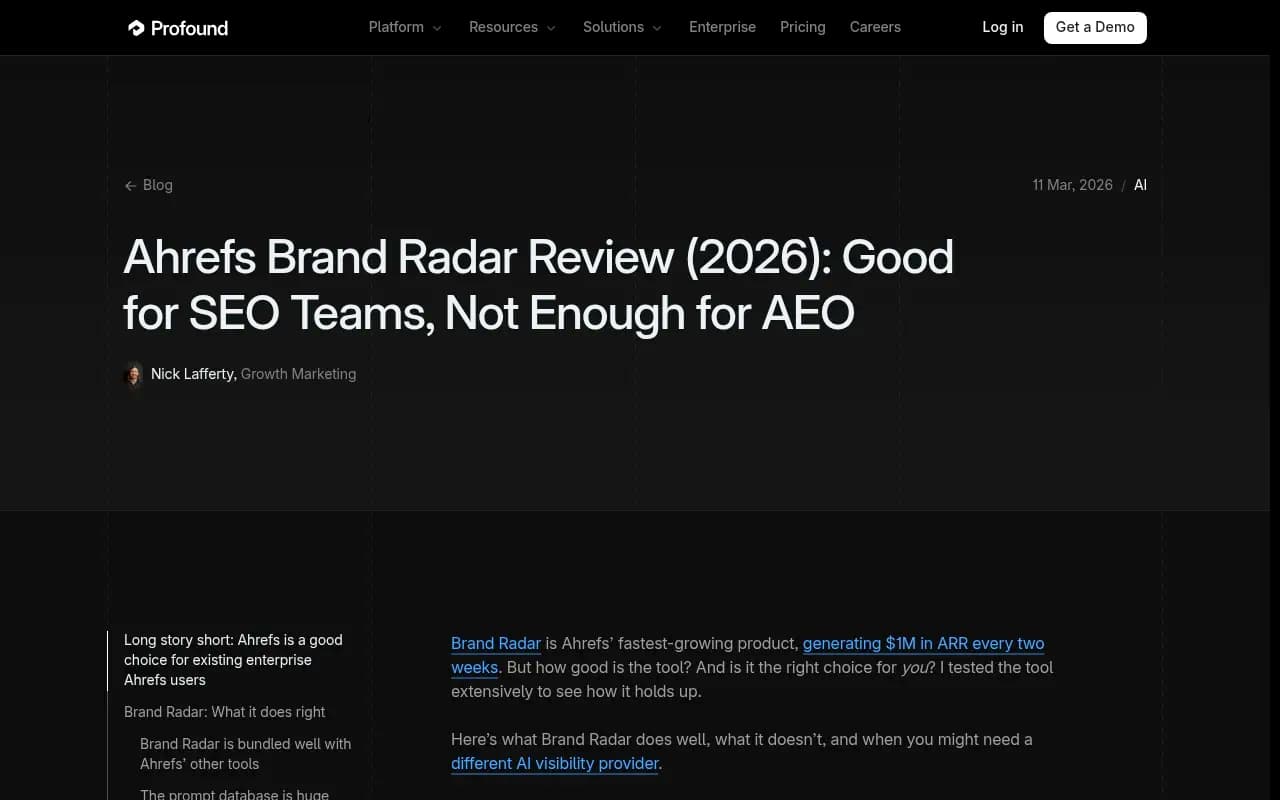
Profound is strong for enterprise teams that want deep AI search analytics and are willing to pay enterprise prices. It covers more AI models than Brand Radar and has more granular prompt data.
Otterly.AI

Otterly.AI is a lighter-weight monitoring option. It covers ChatGPT, Perplexity, and Google AI Overviews, and it's more affordable than the big-suite add-ons -- but like Brand Radar and Semrush, it's monitoring-only.

AthenaHQ sits in a similar space: solid monitoring, good competitor benchmarking, but no content generation or crawler analytics.
The Reddit take
The SEO community's view on this is pretty consistent. A recent r/DigitalMarketing thread on Ahrefs vs Semrush for AEO summarized it well: both tools are solid for traditional SEO, but for specific AEO and AI visibility work, most people end up looking at dedicated tools.
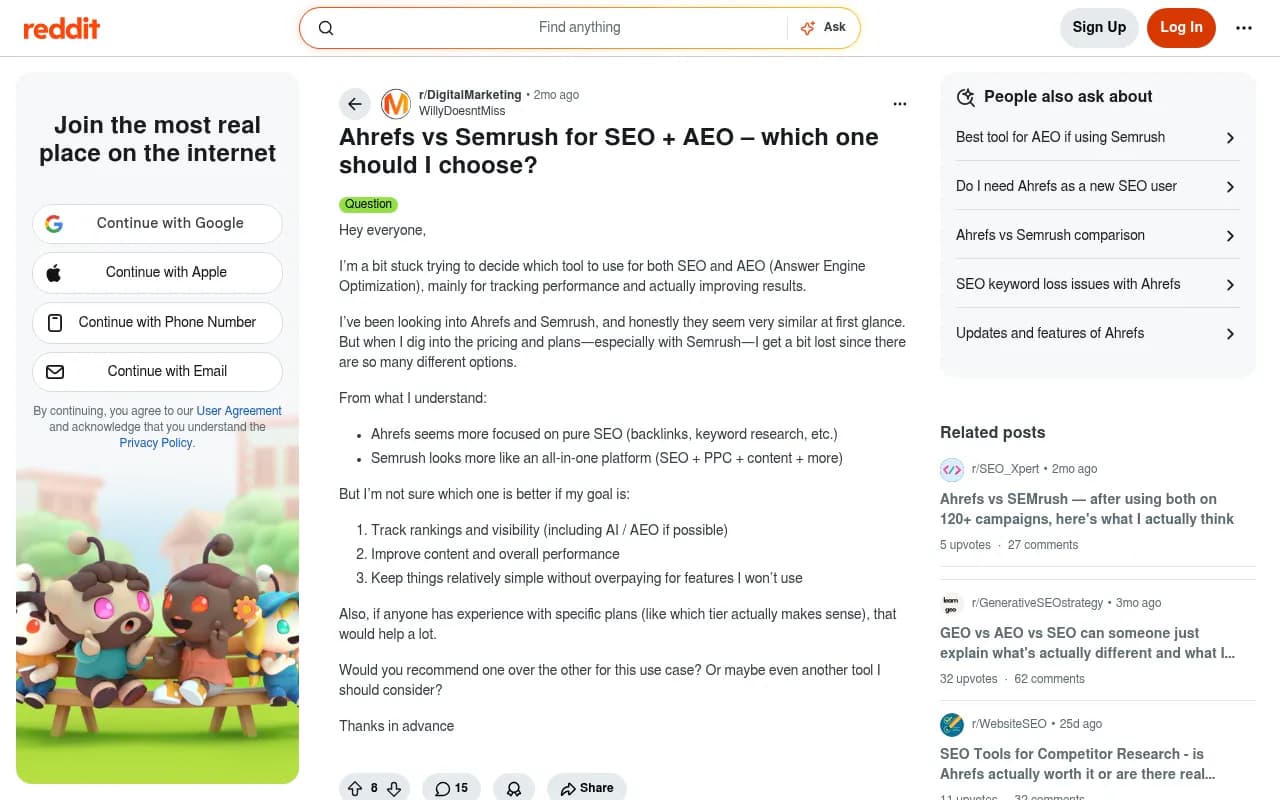
That's not a knock on either platform -- it's just an honest assessment of what they were built to do. If you're a solo SEO or a small team and you're already paying for one of these suites, the AI features are worth turning on. If AI search visibility is a real priority for your business, you'll probably want something more.
Bottom line
Ahrefs Brand Radar is the better of the two for dedicated AI visibility tracking -- more customizable prompts, cleaner data, and a product that's actually designed around the use case rather than grafted onto an existing SEO dashboard. The $699/month add-on cost is steep, but if you're already an Ahrefs enterprise user, it's the path of least resistance.
Semrush's AI features are more fragmented and the fixed-prompt limitation is a real constraint. But if you're already on Semrush One and just want a starting point, it's a reasonable first step.
For teams that want to actually move the needle -- not just measure where they stand -- both tools will eventually feel limiting. The monitoring data is only useful if you have a clear path from insight to action, and that's where dedicated GEO platforms have a structural advantage over SEO suites with AI features added on.