Key Takeaways
- Real-time crawler monitoring is rare: Most AI visibility platforms track brand mentions in AI responses but don't monitor the bots crawling your website—leaving you blind to indexing issues, crawl frequency, and content discovery patterns
- Crawler logs reveal the "why" behind visibility: Platforms with bot monitoring show which pages AI engines read, how often they return, what errors they encounter, and whether your content is even being discovered
- Only a few platforms offer this capability: Promptwatch, Scrunch AI, and Profound provide real-time AI crawler tracking—most competitors (Otterly.AI, Peec.ai, AthenaHQ, Search Party) stop at monitoring citations
- Bot traffic is exploding: Agentic traffic is up 6900% year-over-year, with AI agents and agentic browsers now generating significant volumes of automated requests alongside traditional crawlers
- The action loop requires crawler data: To optimize for AI search, you need to see what AI engines are actually reading on your site—not just guess based on where competitors appear
Why Crawler Monitoring Matters for AI Visibility
Here's the problem most brands face in 2026: they're tracking where their brand appears in ChatGPT, Perplexity, and Google AI Overviews, but they have no idea whether AI engines are even crawling their website properly.
You might see competitors dominating AI responses while your brand is invisible. The usual assumption? "We need better content." But what if the real issue is that ChatGPT's crawler hit a 403 error on your key pages last week? Or that Perplexity hasn't crawled your site in 45 days because your robots.txt is blocking it?
Traditional AI visibility platforms show you the scoreboard. Crawler monitoring shows you whether you're even allowed on the field.
AI crawlers—bots like GPTBot (OpenAI), PerplexityBot, Google-Extended, ClaudeBot, and dozens of others—are the gatekeepers to AI search visibility. They determine:
- Which pages get indexed by AI models for citation and recommendation
- How fresh your content is in AI training data and retrieval systems
- Whether technical issues (slow load times, errors, blocked resources) are preventing discovery
- Which sections of your site AI engines prioritize when building their knowledge base
Without real-time crawler logs, you're flying blind. You're optimizing content without knowing if AI engines can even see it.
The AI Crawler Landscape in 2026
The bot ecosystem has evolved dramatically. According to HUMAN Security's 2026 crawler analysis, legitimate bot traffic now includes:
Traditional AI Crawlers
- GPTBot (OpenAI/ChatGPT): Crawls for training data and real-time retrieval
- PerplexityBot: Indexes content for Perplexity's answer engine
- ClaudeBot (Anthropic): Gathers data for Claude's knowledge base
- Google-Extended: Separate from Googlebot, used for Gemini and AI Overviews
- Bingbot: Powers Copilot's web grounding
- Applebot-Extended: Feeds Apple Intelligence and Siri
Agentic Traffic (New in 2025-2026)
Agentic traffic—automated requests from AI agents and agentic browsers acting on behalf of users—has exploded 6900% year-over-year. These aren't traditional crawlers; they're goal-oriented bots that:
- Research products and compare prices
- Book appointments and make reservations
- Fill out forms and complete transactions
- Navigate multi-step workflows autonomously
This traffic behaves differently from traditional crawlers. It's more dynamic, session-based, and harder to distinguish from human visitors. Platforms that track only static crawler behavior miss this entirely.
Preview and Social Bots
These generate link previews and social cards:
- Slackbot, Discordbot, WhatsApp, LinkedInBot
- Twitterbot (now X), facebookexternalhit
- TelegramBot, SkypeUriPreview
While not AI search crawlers, blocking these accidentally breaks social sharing—a common mistake when implementing blanket bot blocks.
Platforms That Actually Monitor AI Crawlers
Most AI visibility platforms are monitoring-only dashboards. They query ChatGPT, Perplexity, and other AI engines with prompts, then report where your brand appears. That's useful, but it's reactive. You see the outcome without understanding the underlying mechanics.
Only three platforms in 2026 offer real-time AI crawler monitoring as a core feature: Promptwatch, Scrunch AI, and Profound.
Promptwatch: The Action Loop Platform
Promptwatch is the only AI visibility platform rated as a "Leader" across all categories in a 2026 comparison of 12 GEO platforms. The core difference: it's built around taking action, not just monitoring.

AI Crawler Logs are a standout feature. You get real-time logs of:
- Which AI crawlers (GPTBot, PerplexityBot, ClaudeBot, etc.) are hitting your site
- Which pages they're reading and how often they return
- Errors they encounter (403s, 404s, timeouts, blocked resources)
- Crawl frequency patterns that reveal whether you're being indexed regularly or ignored
This closes the loop between visibility tracking and optimization. You see gaps in your AI presence (Answer Gap Analysis), generate content to fill those gaps (AI writing agent grounded in 880M+ citations), then verify that AI crawlers are actually discovering and indexing your new pages.
Most competitors—Otterly.AI, Peec.ai, AthenaHQ, Search Party—stop at step one. They show you where competitors appear but leave you stuck when it comes to fixing your own visibility.
Additional capabilities that support crawler monitoring:
- Prompt Intelligence: Volume estimates and difficulty scores help you prioritize which content to create based on what AI engines are actually being asked
- Citation & Source Analysis: See exactly which pages AI models cite, so you know what's working
- Reddit & YouTube Insights: Surface discussions that influence AI recommendations—channels most platforms ignore
- ChatGPT Shopping Tracking: Monitor product recommendations and shopping carousels
- Multi-language & Multi-region: Track crawler behavior across geographies and languages
Pricing: Essential $99/mo (1 site, 50 prompts, 5 articles), Professional $249/mo (2 sites, 150 prompts, 15 articles, crawler logs, state/city tracking), Business $579/mo (5 sites, 350 prompts, 30 articles). Crawler logs are available starting at the Professional tier.
Scrunch AI: Enterprise Monitoring with API Access
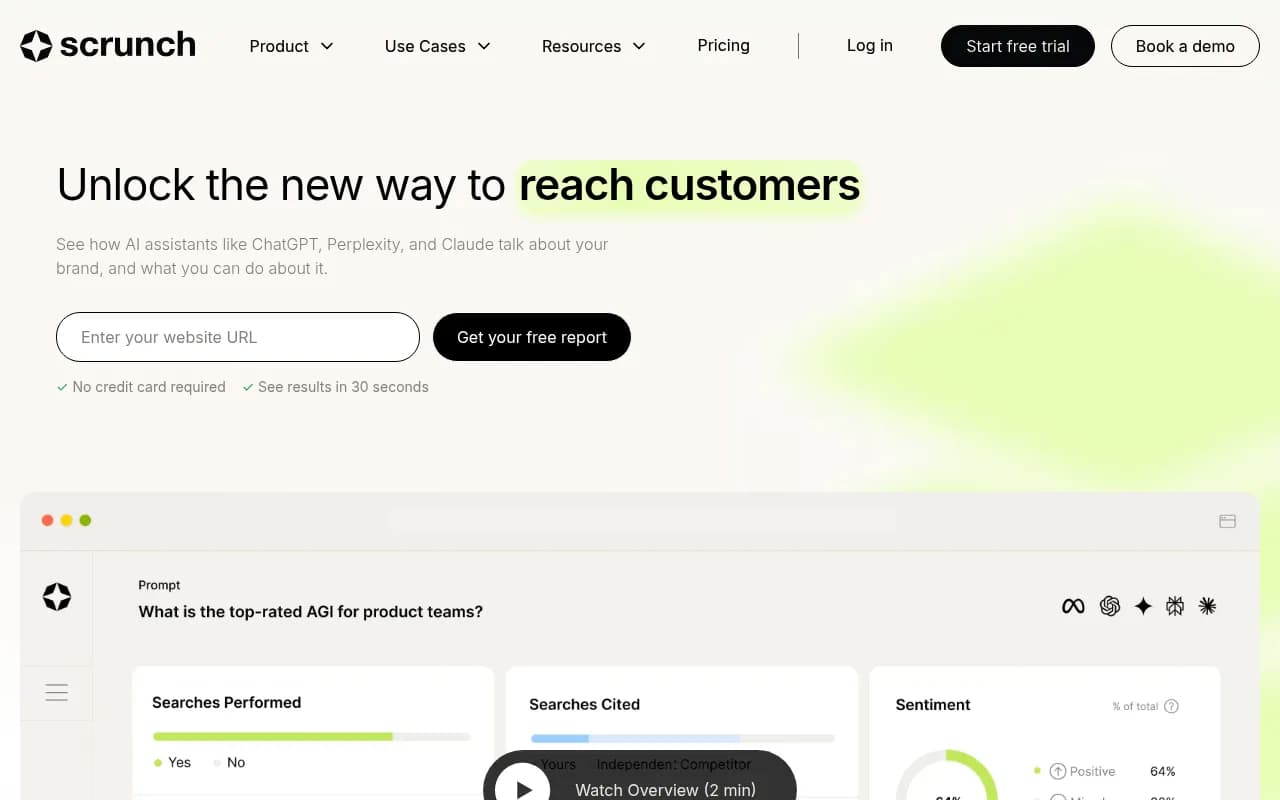
Scrunch positions itself as an enterprise-grade monitoring platform with crawler tracking capabilities. According to multiple 2026 reviews, it offers:
- AI bot crawling behavior tracking across major AI engines
- API access for custom integrations and data exports
- Broad AI engine coverage (ChatGPT, Perplexity, Claude, Gemini, Copilot, etc.)
- Competitor tracking to see where rivals appear vs. your brand
Scrunch is strong for teams that need reliable visibility tracking and want to monitor crawler activity. However, several reviews note it's more monitoring-focused than optimization-focused—you see what's happening but get less prescriptive guidance on what to do next.
Best for: Marketing teams and agencies that want crawler monitoring alongside standard visibility tracking, with API access for custom reporting.
Pricing: Starts around $300/mo for entry plans, ~$500/mo for team plans. Enterprise pricing available.
Profound: Enterprise Depth with Advanced Analytics
Profound

Profound is an enterprise-grade platform that tracks 10+ AI engines and provides crawler monitoring as part of its analytics suite. It's positioned for large brands running global GEO programs.
Crawler-related features:
- Bot behavior tracking to understand which AI engines are indexing your content
- 400M+ prompt insights to prioritize optimization efforts
- SOC 2 Type II compliance for enterprise security requirements
- Advanced analytics that connect crawler activity to visibility outcomes
Profound is strong on governance, depth, and "why did we appear?" analysis. It's built for teams that need enterprise-level reporting and want to understand the mechanics behind their AI visibility.
Best for: Enterprise brands with dedicated GEO teams, global operations, and strict compliance requirements.
Pricing: Custom enterprise pricing. Not disclosed publicly.
What Most Platforms Are Missing
The majority of AI visibility platforms in 2026 do not track crawler behavior. Here's what they're missing:
Otterly.AI
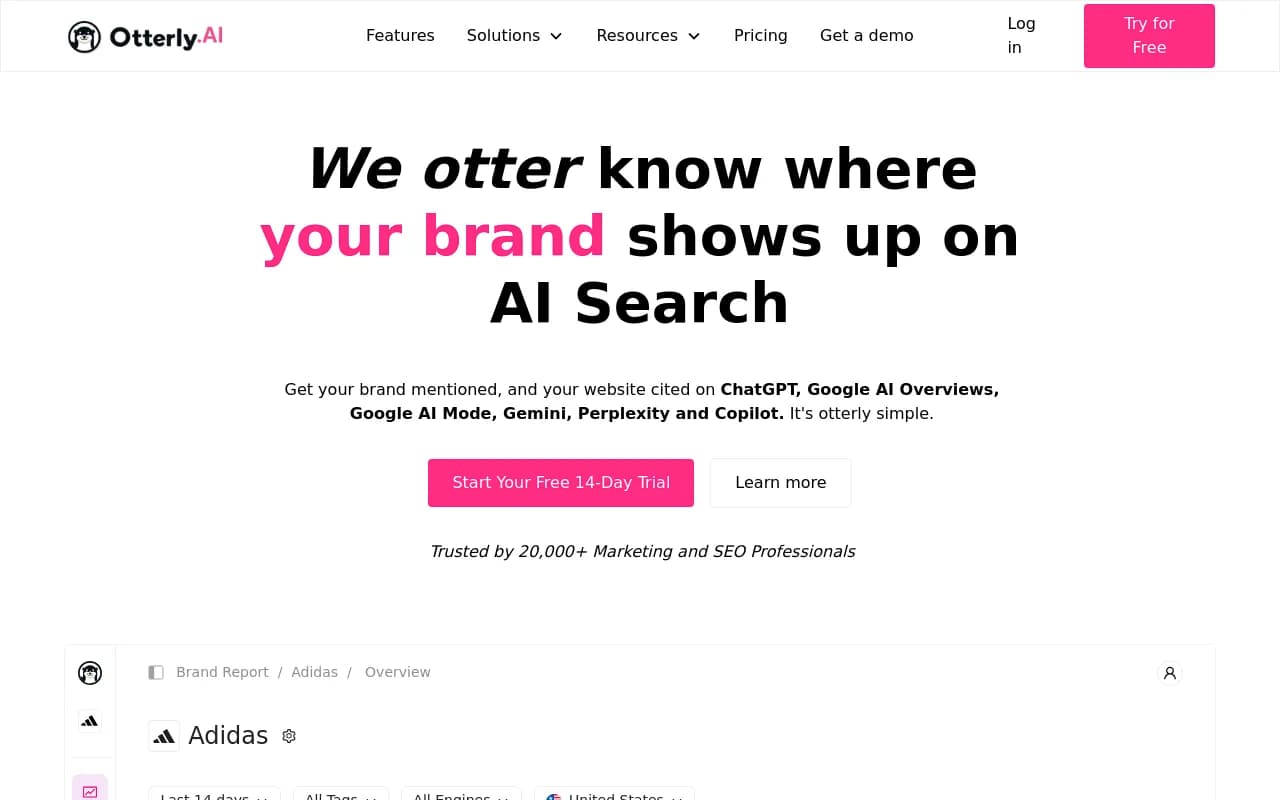
Otterly.AI is an affordable monitoring platform that tracks brand mentions across ChatGPT, Perplexity, and Google AI Overviews. It's solid for basic visibility tracking but offers:
- No crawler logs: You can't see which bots are hitting your site
- No visitor analytics: No way to connect AI visibility to actual traffic
- No content generation: Monitoring only, no optimization tools
Best for: Small teams that need affordable AI visibility tracking without advanced features.
Peec.ai

Peec.ai is a simple, multi-country AI visibility tracker. It's easy to use and covers multiple geographies, but:
- No crawler monitoring: You can't see bot activity on your site
- No content gap analysis: No way to identify which prompts you're missing
- No optimization tools: Monitoring only
Best for: Brands that need basic multi-country visibility tracking without optimization features.
AthenaHQ

AthenaHQ tracks brand visibility across AI search engines with a focus on monitoring and reporting. However:
- No crawler logs: You can't see which AI bots are crawling your site
- Limited optimization features: Monitoring-focused, lacks content generation and gap analysis
Best for: Teams that want straightforward AI visibility tracking without crawler-level insights.
Search Party
Search Party
Search Party is an AI automation consultancy that engineers custom workflows. While they offer strategic guidance:
- No built-in crawler monitoring: Not a self-service platform with real-time bot logs
- Agency-oriented: Custom solutions rather than a standardized tracking tool
Best for: Brands that want custom AI automation workflows rather than a self-service monitoring platform.
Semrush AI Visibility Toolkit
Semrush has added AI visibility tracking to its traditional SEO platform. However:
- Fixed prompts: You can't customize the prompts being tracked
- No crawler logs: No visibility into which AI bots are crawling your site
- Traditional SEO focus: AI visibility is an add-on, not the core product
Best for: Existing Semrush users who want to add basic AI visibility tracking to their SEO workflow.
Ahrefs Brand Radar
Ahrefs Brand Radar tracks brand mentions in AI search engines. It's part of the broader Ahrefs SEO suite, but:
- Fixed prompts: You can't customize which prompts are monitored
- No crawler logs: No real-time bot activity tracking
- No AI traffic attribution: Can't connect AI visibility to actual website traffic
Best for: Ahrefs users who want to add AI brand monitoring to their existing SEO toolkit.
How to Use Crawler Data to Improve AI Visibility
If you have access to real-time crawler logs (via Promptwatch, Scrunch AI, or Profound), here's how to use them:
1. Identify Crawl Gaps
Look for pages that AI crawlers haven't visited recently. If your competitors are being cited for a topic but you're not, check whether AI bots have even crawled your relevant content in the past 30-60 days.
Action: Update and republish stale content to trigger a fresh crawl.
2. Fix Crawl Errors
Monitor for 403s, 404s, timeouts, and blocked resources. A single misconfigured robots.txt rule can block GPTBot from your entire site.
Action: Review your robots.txt and server logs. Ensure AI crawlers have access to key pages.
3. Track Crawl Frequency
AI engines crawl high-authority, frequently updated sites more often. If your crawl frequency is low, it signals that AI models see your site as less important.
Action: Publish fresh, high-quality content consistently. Internal linking and external backlinks also influence crawl priority.
4. Monitor Agentic Traffic Patterns
Agentic traffic behaves differently from traditional crawlers. It's session-based, goal-oriented, and harder to distinguish from human visitors. Platforms with advanced bot analytics can help you:
- Identify agentic sessions: See when AI agents are navigating your site to complete tasks
- Optimize for agent workflows: Ensure your site structure supports multi-step agent interactions
- Track agent conversions: Understand whether agentic traffic is converting into leads or sales
5. Close the Loop with Traffic Attribution
Crawler monitoring is most powerful when combined with traffic attribution. Platforms like Promptwatch offer code snippets, Google Search Console integration, or server log analysis to connect AI visibility to actual revenue.
Action: Implement tracking to see which AI-driven visits convert into customers.
The Future of AI Crawler Monitoring
The crawler landscape will continue to evolve rapidly. Here's what to expect:
More AI Engines, More Crawlers
New AI search engines launch regularly. Each brings its own crawler with unique behavior patterns. Platforms that support custom crawler tracking (not just fixed lists) will have an advantage.
Agentic Traffic Will Dominate
By 2027, agentic traffic may exceed traditional crawler traffic. Platforms that can distinguish between static indexing bots and goal-oriented agents will provide deeper insights.
Crawler Behavior Will Influence Rankings
AI engines are already using crawl data to assess content quality. Sites that load slowly, return errors, or block crawlers will see lower visibility in AI responses.
Privacy and Compliance Challenges
As AI crawlers scrape more aggressively, expect regulatory scrutiny. Platforms with SOC 2 compliance and transparent data handling (like Profound) will be better positioned for enterprise adoption.
How to Choose the Right Platform
If crawler monitoring is critical to your AI visibility strategy, here's how to evaluate platforms:
Must-Have Features
- Real-time crawler logs: See which AI bots are hitting your site, which pages they're reading, and what errors they encounter
- Crawl frequency tracking: Understand how often AI engines return to your site
- Error monitoring: Get alerts when crawlers hit 403s, 404s, or timeouts
- Multi-engine coverage: Track crawlers from ChatGPT, Perplexity, Claude, Gemini, Copilot, and others
Nice-to-Have Features
- Agentic traffic analytics: Distinguish between traditional crawlers and goal-oriented AI agents
- Traffic attribution: Connect AI visibility to actual website traffic and conversions
- Content gap analysis: Identify which prompts competitors rank for but you don't
- AI content generation: Create optimized content based on crawler data and citation analysis
Red Flags
- No crawler monitoring: If a platform only tracks brand mentions without showing bot activity, you're missing half the picture
- Fixed prompts: Platforms that don't let you customize tracked prompts limit your ability to monitor what matters to your business
- No optimization tools: Monitoring-only platforms leave you stuck after showing you the data
Final Thoughts
AI visibility in 2026 isn't just about appearing in ChatGPT responses. It's about understanding the entire pipeline: which AI crawlers are discovering your content, how often they return, what errors they encounter, and whether your optimization efforts are actually working.
Most platforms stop at the scoreboard. They show you where your brand appears but leave you guessing about why. The few platforms that offer real-time crawler monitoring—Promptwatch, Scrunch AI, and Profound—give you the data you need to diagnose issues, fix them, and verify that AI engines are actually indexing your improvements.
If you're serious about AI search visibility, crawler monitoring isn't optional. It's the foundation of an effective optimization strategy. Without it, you're optimizing in the dark.