Key takeaways
- AthenaHQ is a solid monitoring tool but lacks content generation, crawler logs, and the multi-client workflow features agencies actually need at scale.
- The best AthenaHQ alternatives in 2026 go beyond tracking -- they help you identify content gaps, generate optimized content, and connect AI visibility to real traffic and revenue.
- For agencies managing 10+ clients, workspace architecture, white-label reporting, and prompt-level data matter as much as raw model coverage.
- Promptwatch is the only platform in this comparison rated as a "Leader" across all categories in a 2026 review of 12 GEO platforms -- primarily because it closes the loop from monitoring to content creation to results.
- Pricing ranges from free tiers to $500+/month, so there's a real choice to make based on how many clients you manage and how deep you need to go.
If you've been using AthenaHQ to track your clients' AI visibility, you already know the core problem: it tells you where your clients aren't showing up, and then... that's it. You're left staring at a dashboard full of gaps with no clear path to fixing them.
That's fine if you're a solo brand manager doing light monitoring. But agencies don't just need to know the problem -- they need to solve it, report on it, and do it across 15 or 30 or 50 clients without losing their minds.
This guide covers the best AthenaHQ alternatives for agencies in 2026, with an honest look at what each tool actually does (and doesn't do) for multi-client workflows.
What agencies actually need from an AI visibility tool
Before getting into specific tools, it's worth being precise about what "agency-ready" means in this context. A lot of platforms market themselves to agencies but are really just single-brand tools with a slightly wider dashboard.
Here's what genuinely matters for agency use:
Multi-client workspace architecture. Can you manage all clients from one login without switching accounts? Is there per-client segmentation? This is the single biggest operational differentiator.
Prompt-level data, not just brand mentions. Knowing your client is mentioned in 12% of AI responses is less useful than knowing exactly which prompts they're missing and why. Volume estimates and difficulty scores let you prioritize.
Content gap analysis and generation. Monitoring tells you what's wrong. Content tools help you fix it. Agencies that can deliver both -- tracking and optimization -- are far more valuable to clients than those who just send a monthly PDF.
White-label reporting. Clients don't want to log into your tool. They want a clean report with their brand on it, ideally delivered automatically.
Competitive benchmarking. Clients always want to know how they compare to competitors. Tools that show this clearly, per AI model, are much easier to sell internally.
Crawler and traffic data. Knowing which of your client's pages AI models are actually reading -- and whether those pages are being cited -- is the difference between guessing and knowing.
AthenaHQ covers some of this. It monitors brand mentions across several AI models, shows competitive comparisons, and has a reasonably clean interface. But it's fundamentally a monitoring dashboard. It doesn't generate content, doesn't have crawler logs, and its multi-client architecture is limited compared to purpose-built agency tools.
The best AthenaHQ alternatives for agencies in 2026
Promptwatch -- best for agencies that want to close the loop
Promptwatch is the most complete option on this list. The core difference from AthenaHQ (and most other tools) is that it's built around an action loop: find the gaps, create content to fill them, track the results.

The Answer Gap Analysis shows exactly which prompts competitors are visible for but your clients aren't -- not just that a gap exists, but the specific topics, angles, and questions AI models want answers to. From there, Content Agents generate articles, listicles, and briefs grounded in real prompt data, citation analysis, and competitor research. This isn't generic AI writing -- it's content engineered to answer the specific gaps the data surfaces.
For agencies, the practical advantages are significant. AI Crawler Logs show which pages on a client's site AI crawlers are reading, what errors they're hitting, and how often they return -- data that most competitors lack entirely. Page-level tracking shows exactly which pages are being cited, by which models, and how often. Traffic attribution connects visibility to actual revenue, which is the conversation clients actually want to have.
Promptwatch monitors 10 AI models: ChatGPT, Perplexity, Google AI Overviews, Google AI Mode, Claude, Gemini, Meta/Llama, DeepSeek, Grok, Mistral, and Copilot. It also tracks Reddit threads and YouTube videos that influence AI recommendations -- a channel most competitors ignore.
Pricing: Essential at $99/mo (1 site, 50 prompts), Professional at $249/mo (2 sites, 150 prompts, crawler logs), Business at $579/mo (5 sites, 350 prompts). Agency and enterprise plans available with custom pricing.
The main caveat: if you only need light monitoring for one or two clients and have no interest in content optimization, Promptwatch may be more than you need. But for agencies trying to deliver real outcomes, it's the strongest option available.
Profound -- best for enterprise-tier monitoring depth
Profound has strong model coverage and a clean interface for tracking brand mentions across AI search engines. It's positioned at the enterprise end of the market, with pricing to match.
Profound

Where Profound does well: the depth of its citation analysis and the quality of its competitive benchmarking. It covers the major AI models and gives you a clear picture of share-of-voice across them. The reporting is polished enough for client-facing use.
Where it falls short for agencies: it's still primarily a monitoring tool. There's no content generation, no crawler logs, and the multi-client workspace architecture isn't as flexible as you'd want when managing 20+ brands. Pricing is also on the higher end, which can be hard to justify when you're trying to build a scalable agency offering.
Good fit for: agencies with a small number of high-value enterprise clients who need deep monitoring and don't need content optimization built in.
Scrunch AI -- decent monitoring, limited action
Scrunch AI tracks brand mentions across AI models and provides competitive comparisons. The interface is straightforward and the onboarding is fast.
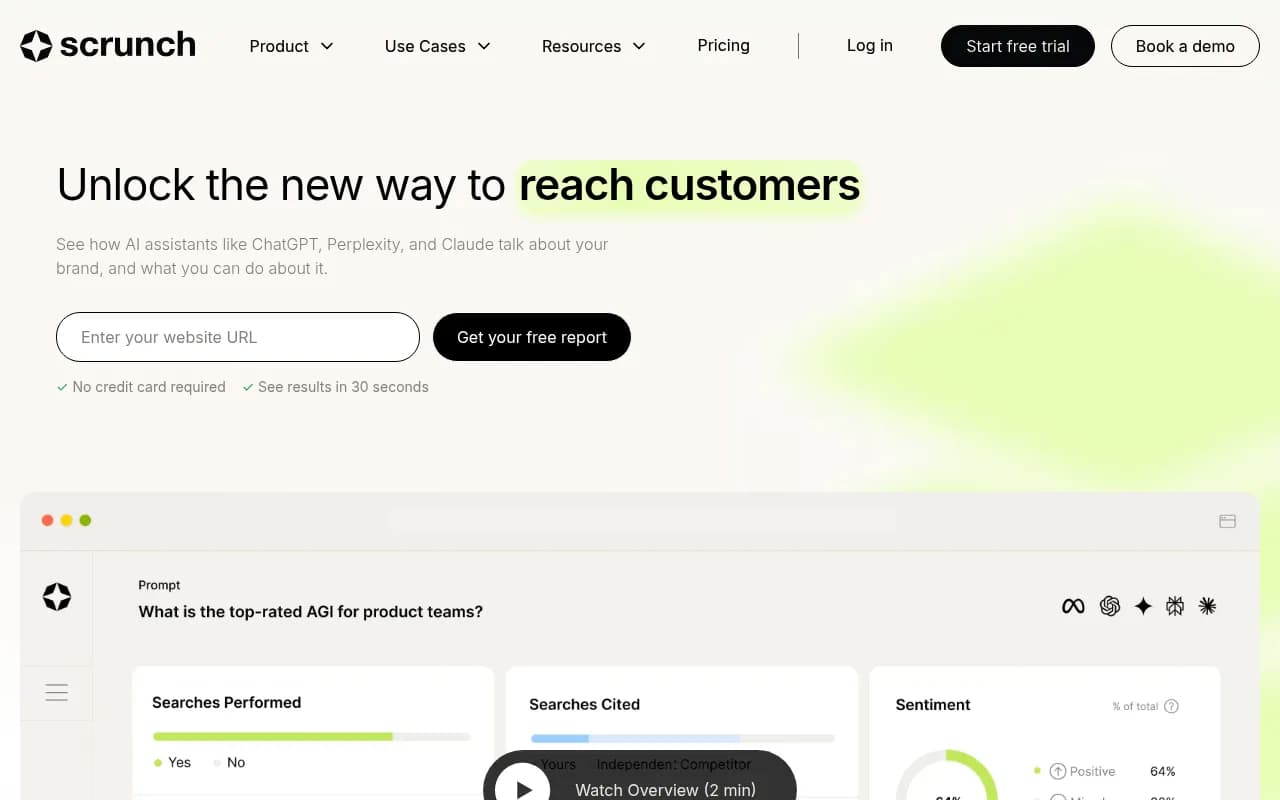
The honest assessment: Scrunch is a monitoring-only platform. It shows you where you stand but doesn't help you improve. For agencies, this means you're still doing the heavy lifting of diagnosing gaps, creating content briefs, and figuring out what to actually do with the data.
It's worth considering if you're an agency that already has strong content production capabilities and just needs a clean monitoring layer on top. But if you're selling AI visibility as a managed service, you'll hit the ceiling quickly.
Otterly.AI -- simple and affordable, but limited at scale
Otterly.AI is one of the more accessible tools in this space. It monitors brand mentions across ChatGPT, Perplexity, and Google AI Overviews, and the pricing is reasonable for small agencies.
Otterly.AI

The limitations become obvious at scale. There are no crawler logs, no visitor analytics, no content generation, and the multi-client workspace is basic. It's a good starting point for agencies just getting into AI visibility tracking, but you'll likely outgrow it within a few months.
Worth considering if: you're a small agency with 5 or fewer clients and want a low-cost way to start tracking AI visibility without a major commitment.
Rankscale -- built with agencies in mind
Rankscale is specifically designed for agency use, with multi-client dashboards and white-label reporting built into the core product. It covers the major AI models and gives you prompt-level tracking with some competitive benchmarking.
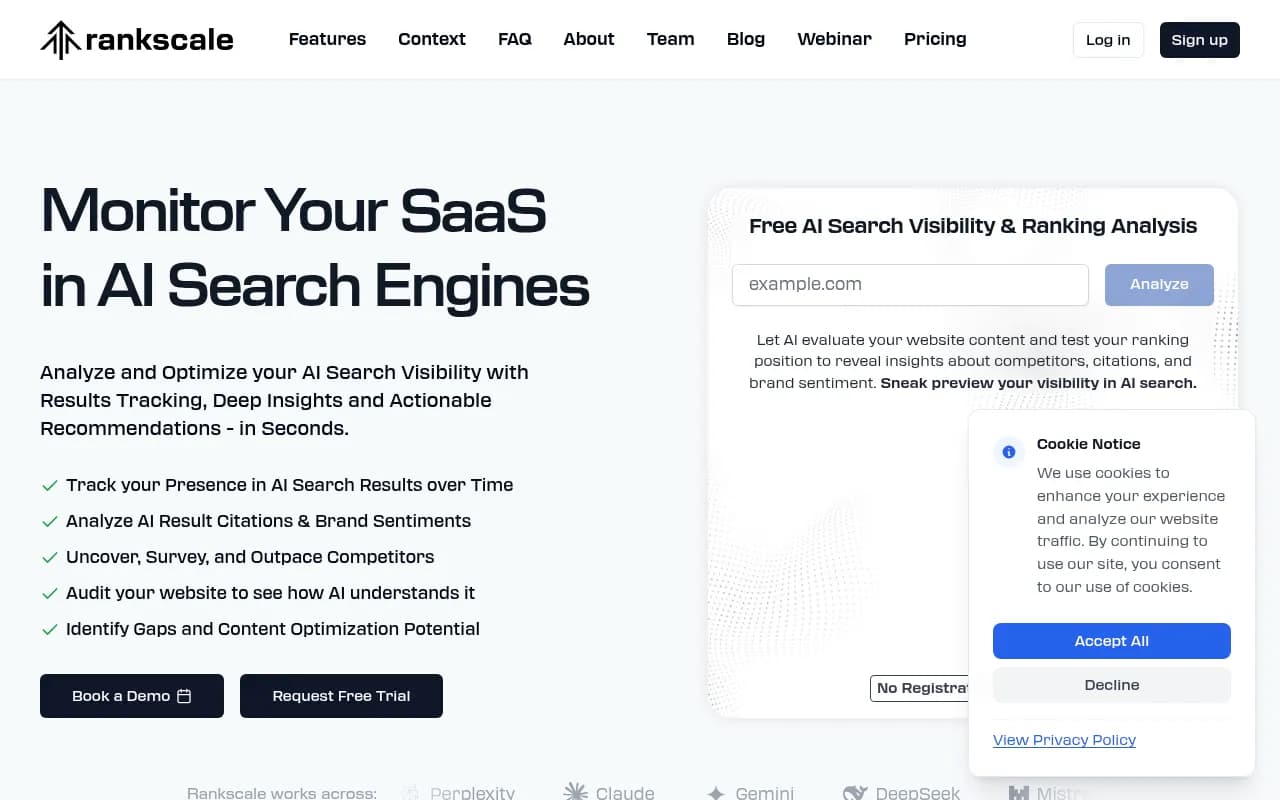
The agency-first architecture is genuinely useful -- you can manage multiple clients from one login, segment by client, and generate branded reports without much manual work. The prompt tracking is solid.
What it lacks: content generation and optimization tools. Like most tools in this space, Rankscale tells you where gaps exist but doesn't help you fill them. The crawler log functionality is also limited compared to Promptwatch.
Good fit for: agencies that want a clean, scalable monitoring setup and are comfortable handling content strategy separately.
SE Ranking -- traditional SEO with AI visibility added
SE Ranking is primarily a traditional SEO platform that has added AI visibility tracking through its AI Search Toolkit. If your agency is already using SE Ranking for rank tracking and site audits, the AI visibility features are a natural extension.
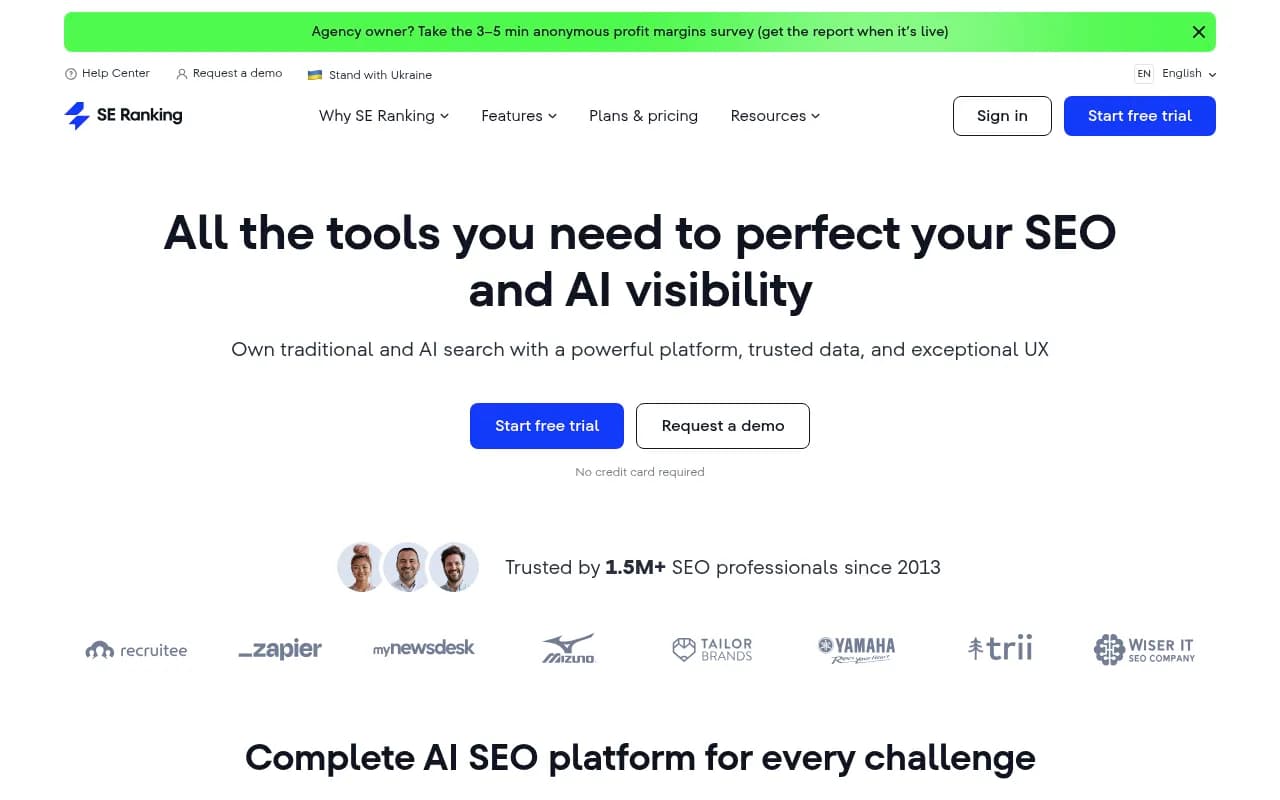
The advantage here is consolidation -- one platform for traditional SEO and AI visibility monitoring. The disadvantage is that the AI visibility features feel bolted on rather than purpose-built. Coverage is narrower than dedicated GEO platforms, and there's no content generation specifically designed for AI search.
Good fit for: agencies that are heavily invested in traditional SEO and want to add AI visibility tracking without switching platforms.
Peec AI -- lightweight monitoring for smaller teams
Peec AI is a straightforward AI visibility tracker. It monitors brand mentions across the major AI models and provides basic competitive comparisons.

It's clean and easy to use, but it's firmly in the monitoring-only category. No content tools, no crawler data, no traffic attribution. For agencies managing multiple clients, the workspace architecture is limited.
Good fit for: individual consultants or very small agencies who want a simple, affordable way to track AI visibility for a handful of clients.
Feature comparison: AthenaHQ vs. the alternatives
| Tool | AI model coverage | Multi-client workspace | Content generation | Crawler logs | Traffic attribution | White-label reporting | Starting price |
|---|---|---|---|---|---|---|---|
| Promptwatch | 10 models | Yes (agency plans) | Yes (Content Agents) | Yes | Yes | Yes | $99/mo |
| AthenaHQ | 6+ models | Limited | No | No | No | Limited | Custom |
| Profound | 9+ models | Limited | No | No | No | Yes | Custom |
| Scrunch AI | 5+ models | Basic | No | No | No | Basic | Custom |
| Otterly.AI | 3 models | Basic | No | No | No | No | ~$49/mo |
| Rankscale | 5+ models | Yes | No | No | No | Yes | Custom |
| SE Ranking | 4+ models | Yes | Limited | No | No | Yes | $65/mo |
| Peec AI | 4+ models | No | No | No | No | No | ~$39/mo |
What the research says about agency needs in 2026
The agency-specific research from Slate's April 2026 analysis makes a useful point: the biggest operational differentiator between tools built for agencies and tools built for individual brands is multi-client workspace architecture. Raw feature counts don't matter much if the tool falls apart when you're managing 30 clients.
That's a fair framing, but it undersells the content gap. Agencies that can only monitor -- not optimize -- are selling a commodity. The real opportunity in 2026 is being the agency that doesn't just report on AI visibility but actively improves it. That requires tools with content generation built in, not just dashboards.
The Frase.io comparison of AI visibility tools makes a similar point: the strongest platforms "close the loop" -- they track citations, diagnose the gaps, and help you create and optimize the content that wins them back. Most tools in this space only do the first part.
How to choose the right tool for your agency
The decision mostly comes down to three questions:
How many clients are you managing? If it's fewer than five, almost any tool on this list will work operationally. If it's 15 or more, you need purpose-built multi-client architecture and the ability to generate reports at scale without manual work.
Are you selling monitoring or outcomes? If you're positioning AI visibility as a managed service -- where clients pay you to improve their visibility, not just report on it -- you need content generation and optimization tools. Monitoring-only platforms make this very hard to deliver.
What's your budget model? Some tools charge per client, some per prompt, some flat. For agencies, per-prompt pricing can get expensive fast if you're tracking competitive landscapes across many clients. Flat-rate agency plans (like Promptwatch's custom agency tier) are usually more predictable.
For most agencies in 2026, the honest recommendation is Promptwatch if you want to deliver real outcomes, Rankscale if you want clean multi-client monitoring without content tools, and SE Ranking if you're already in their ecosystem and just want to add AI visibility tracking.
The tools that only monitor -- Otterly.AI, Peec AI, Scrunch, AthenaHQ itself -- are fine for individual brands doing light tracking. But agencies need to deliver more than a monthly screenshot of where their clients aren't showing up.
A note on what "AI visibility" actually means in 2026
One thing worth saying clearly: AI visibility isn't a single number. ChatGPT's recommendations differ from Perplexity's, which differ from Google AI Overviews, which differ from Claude. A client might be well-cited in Perplexity and invisible in ChatGPT Shopping recommendations. A competitor might dominate Google AI Mode but barely appear in Gemini.
This is why model coverage matters, but it's also why prompt-level data matters more than aggregate visibility scores. Knowing that your client appears in 23% of AI responses is less useful than knowing they're missing from the top 10 prompts in their category on ChatGPT -- and knowing exactly what content would fix that.
The agencies that figure this out in 2026 will have a significant advantage. The ones still sending clients a monthly "your AI visibility score is 34%" report will find that clients start asking harder questions about what that actually means and what's being done about it.