Key takeaways
- Most AI visibility platforms stop at monitoring. They show you citation data but offer no way to act on it.
- A true end-to-end platform needs three things: gap analysis to find what's missing, content generation grounded in real prompt data, and citation tracking to confirm it worked.
- As of mid-2026, only a handful of platforms attempt all three — and most fall short on at least one leg.
- Promptwatch is the only platform rated "Leader" across all three categories in a 2026 comparison of 12 GEO tools, with crawler logs that show the timeline from publish to crawl to citation.
- If you're evaluating tools, the right question isn't "does it track AI visibility?" — it's "does it help me improve it?"
The problem nobody talks about
Here's a scenario that plays out constantly in 2026: a marketing team spends three months building out an AI visibility monitoring stack. They track their brand across ChatGPT, Perplexity, Google AI Overviews, and a few others. The dashboards look great. They can see exactly which prompts competitors are winning and which ones they're invisible for.
Then what?
That's where most tools stop. You have a list of gaps. You know your competitor gets cited for "best project management software for remote teams" and you don't. But the tool has nothing to say about what to do next. You're back to guessing — write a blog post? Update a landing page? Publish a comparison article?
The end-to-end problem is real: generating content that gets cited by AI engines requires understanding why AI engines cite what they cite, and then verifying that your new content actually moved the needle. That's a three-step loop, and most platforms only handle one step.
This guide tests which platforms actually close that loop in 2026.
What "end-to-end" actually means
Before getting into specific tools, it's worth being precise about what the loop requires:
Step 1: Find the gaps. Which prompts are AI engines answering without citing you? Which ones are your competitors winning? This is the monitoring layer — necessary but not sufficient.
Step 2: Generate content that can get cited. Not generic SEO content. Content that answers the specific questions AI models are already being asked, structured in a way that makes it easy for a model to extract and cite. This requires real prompt data, not keyword guesswork.
Step 3: Track whether it worked. After you publish, does the AI engine crawl it? How quickly? Does it start citing the new page? Which models pick it up first? Without this feedback loop, you're flying blind.
Most tools in 2026 handle step 1 reasonably well. A few attempt step 2. Almost none close step 3 properly — meaning they can't connect a specific piece of published content to a change in citation behavior.
The platforms, tested
Promptwatch — the only true end-to-end platform
Promptwatch is the clearest example of a platform built around the full loop rather than just the monitoring layer.

The gap analysis is genuinely useful — it shows exactly which prompts competitors are visible for that you're not, with prompt volume estimates and difficulty scores so you can prioritize. That's step 1.
For step 2, Promptwatch's Content Agents generate articles, listicles, comparisons, and briefs grounded in real prompt data, citation data, and competitor analysis. The briefs include screenshots of actual AI responses, brand guidance inputs, and uploaded knowledge-base files. This isn't a generic AI writer bolted onto a dashboard — the content is engineered around the specific gaps the gap analysis surfaces.
Step 3 is where Promptwatch separates itself most clearly from the field. The AI Crawler Logs track when GPTBot, ClaudeBot, and other AI crawlers hit your pages, which pages they read, errors they encounter, and how often they return. Agent Analytics shows the timeline from publish to crawl to citation. Traffic attribution connects citation visibility to actual revenue. You can watch a piece of content move from "just published" to "being crawled" to "cited in ChatGPT responses" — and see which models picked it up first.
It monitors 10 AI models (ChatGPT, Perplexity, Google AI Overviews, Google AI Mode, Claude, Gemini, Meta/Llama, DeepSeek, Grok, Mistral, Copilot) and tracks real user-interface behavior rather than just API outputs, which matters because the answers users actually see can differ from what the API returns.
Pricing starts at $99/month for the Essential plan (1 site, 50 prompts, 5 articles). Crawler logs and traffic attribution come in at the Professional tier ($249/month). A free trial is available.
In a 2026 comparison of 12 GEO platforms, Promptwatch was the only tool rated "Leader" across all categories — the core distinction being that it's built to take action, not just report data.
Profound — strong monitoring, limited content generation
Profound

Profound is a well-built enterprise monitoring platform. It tracks brand mentions across 9+ AI engines with solid prompt coverage and good reporting. The interface is clean and the data is reliable.
Where it falls short for end-to-end use: there's no content generation layer. You get the gap data, but creating content to fill those gaps is entirely on you. Profound also lacks Reddit and YouTube tracking, which matters because those sources directly influence what AI models cite. No ChatGPT Shopping tracking either.
It's a strong step-1 tool for enterprise teams that have a separate content operation. As a standalone end-to-end solution, it's incomplete.
AthenaHQ — monitoring-focused, no optimization

AthenaHQ does solid AI visibility monitoring with decent prompt coverage. The UI is clean and the competitive benchmarking is useful for understanding where you stand relative to competitors across different models.
But it's explicitly a monitoring platform. There's no content generation, no content gap analysis that produces briefs, and no crawler log data. You can see what's happening; you can't do much about it from within the tool. For teams that want to understand their AI visibility baseline, it works. For teams that want to improve it systematically, it's a starting point at best.
Otterly.AI — basic monitoring, nothing more
Otterly.AI

Otterly.AI is one of the more widely used entry-level AI monitoring tools. It tracks brand mentions across ChatGPT, Perplexity, and Google AI Overviews at a price point that makes it accessible for smaller teams.
The honest assessment: it's a monitoring dashboard. No content generation, no crawler logs, no visitor analytics, no prompt volume data. It tells you whether you're being mentioned — not why, not how to change it, not whether changes you make are working. Fine as a first step for teams just getting started with AI visibility. Not suitable as an end-to-end solution.
Search Atlas — content generation with some tracking
Search Atlas takes a different approach: it's primarily an SEO content platform that has added AI search tracking. The content generation capabilities are real — it can write and optimize articles with SEO intent — and it has some AI visibility monitoring built in.
The limitation is that the tracking layer is less sophisticated than dedicated GEO platforms. It doesn't have the crawler log depth of Promptwatch, and the connection between content published through the platform and citation changes in AI engines isn't as tight. It's a reasonable option for teams that want to consolidate SEO content creation and basic AI monitoring in one tool, but the end-to-end loop isn't fully closed.
Scrunch AI — tracking with some content support
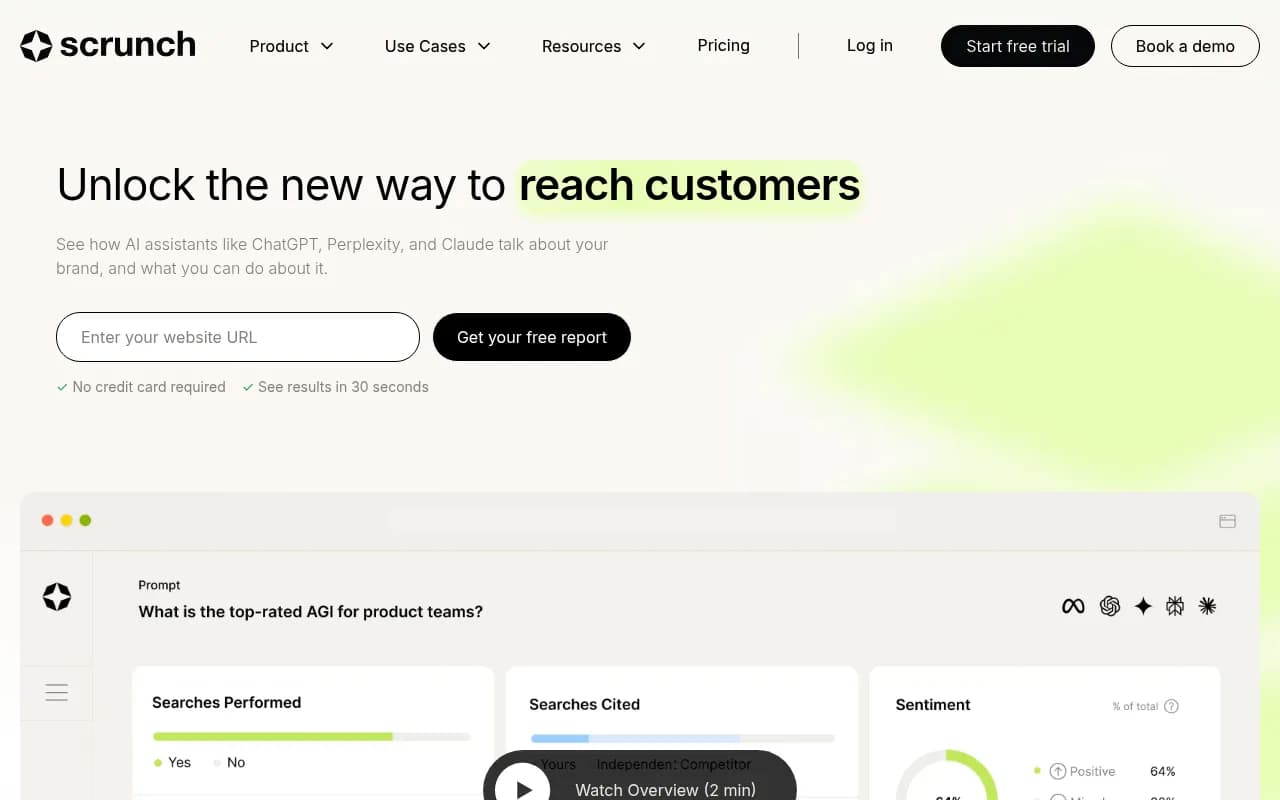
Scrunch AI tracks brand visibility across AI engines and has some content optimization features. It's positioned more toward the enterprise end of the market with pricing to match.
The content support is more advisory than generative — it helps you understand what kind of content might improve visibility rather than generating it for you. The tracking is solid. For teams with strong in-house content capabilities who need better AI visibility data to direct that content, Scrunch is worth evaluating. As a fully integrated end-to-end platform, it's not quite there.
Searchable — end-to-end ambition, worth watching
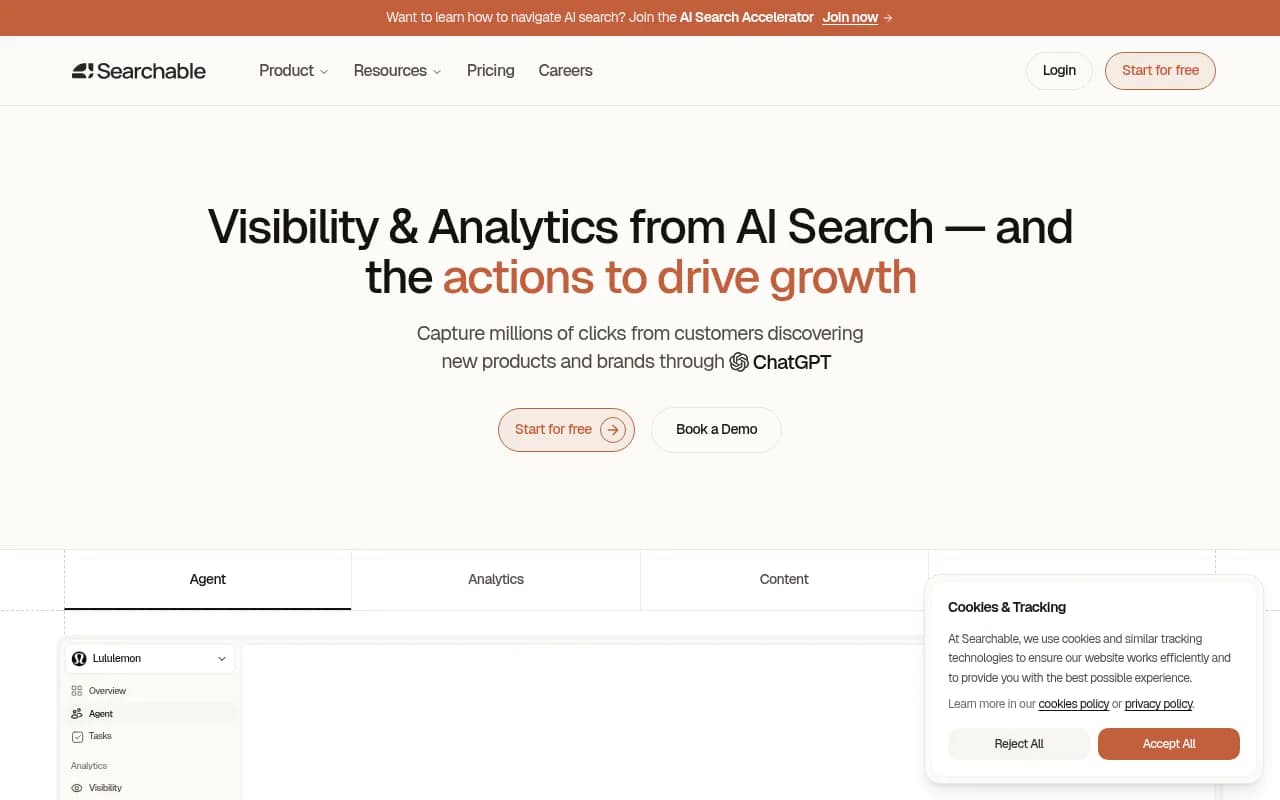
Searchable is one of the newer platforms explicitly positioning itself as an end-to-end AI search visibility solution with built-in content generation. It's worth watching.
The content generation and tracking integration is more tightly coupled than most competitors. The platform is still maturing in 2026 — prompt coverage and crawler log depth aren't at Promptwatch's level yet — but the architecture is right. Teams evaluating the space should include it in their shortlist.
AirOps — content engineering for AI search
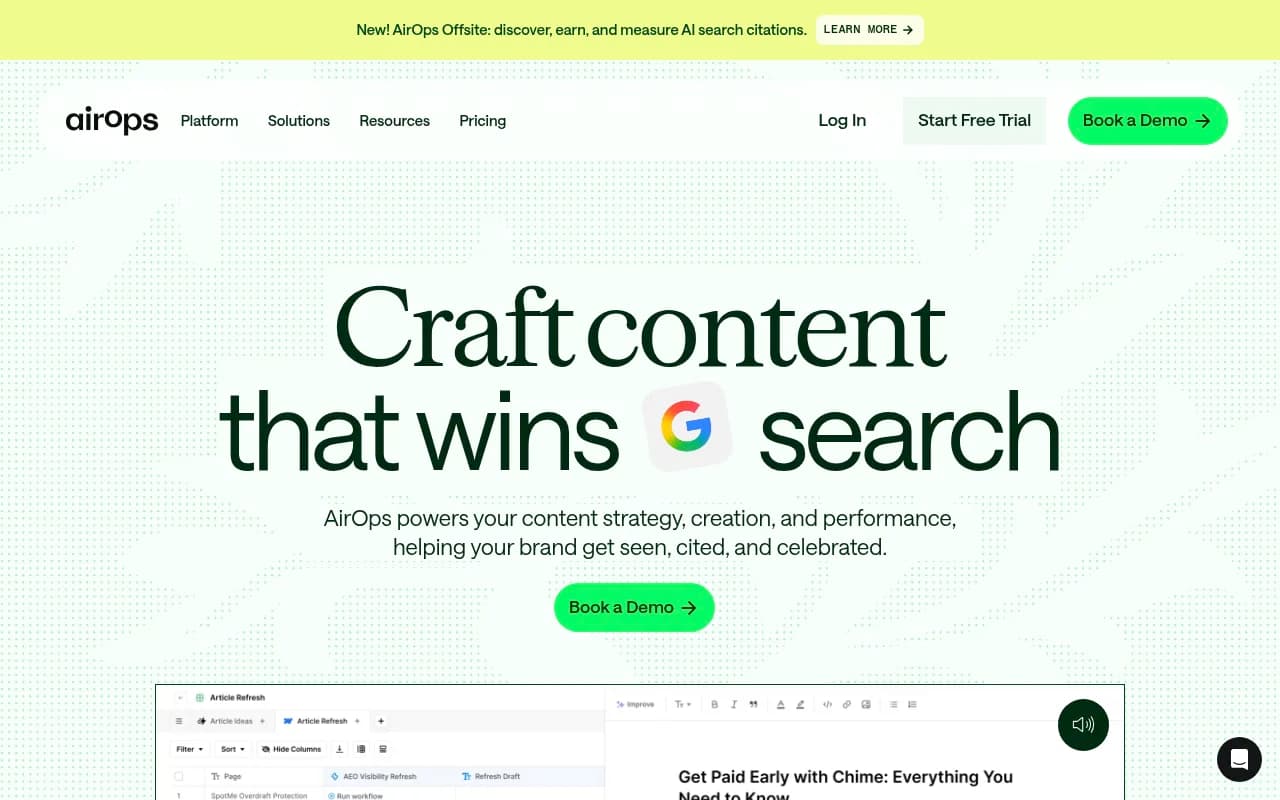
AirOps takes a content-engineering approach to AI search visibility. It's built around creating content that performs in AI search rather than traditional SEO, with workflows for generating and optimizing articles at scale.
The monitoring side is less developed — AirOps is primarily a content production platform that understands AI search, not a full GEO monitoring tool. If your main need is scaling content production with AI search in mind, it's strong. If you need the full loop including citation tracking and crawler logs, you'll need to pair it with a dedicated monitoring tool.
Feature comparison
| Platform | Gap analysis | Content generation | Crawler logs | Citation tracking | Prompt volume data | Reddit/YouTube tracking |
|---|---|---|---|---|---|---|
| Promptwatch | Yes | Yes (Content Agents) | Yes | Yes (page-level) | Yes | Yes |
| Profound | Yes | No | No | Basic | Limited | No |
| AthenaHQ | Yes | No | No | Basic | Limited | No |
| Otterly.AI | Basic | No | No | No | No | No |
| Search Atlas | Limited | Yes | No | Limited | No | No |
| Scrunch AI | Yes | Advisory | No | Yes | Limited | No |
| Searchable | Yes | Yes | Limited | Yes | Limited | No |
| AirOps | Limited | Yes | No | No | No | No |
What to look for when evaluating
A few things worth checking before committing to any platform:
Does it track real UI behavior or just API outputs? AI engines can return different answers in their user-facing products than through their APIs. Platforms that only query APIs may give you an incomplete picture of what users actually see.
How granular is the citation tracking? "Your brand was mentioned 47 times this week" is much less useful than "this specific page was cited in ChatGPT responses to this specific prompt, starting three days after publication." Page-level tracking and timeline data matter.
Does the content generation connect to the gap analysis? Some platforms have both features but they don't talk to each other — you run the gap analysis, then separately go to the content tool and manually describe what you want. The best implementations use the gap data to directly inform what the content agent generates.
Can you see AI crawler activity on your own site? This is underappreciated. Knowing that GPTBot crawled your new article two days after publication, encountered no errors, and returned twice more before the page started appearing in citations is genuinely useful signal. Most platforms don't offer this at all.
Does it connect to revenue? Citation counts are a vanity metric if you can't connect them to traffic and conversions. Traffic attribution that ties AI visibility to actual business outcomes is the difference between a reporting tool and a growth tool.
The honest verdict
The market in 2026 is full of AI visibility monitoring tools. Most of them are genuinely useful for step 1 — understanding where you stand and where the gaps are. The field thins out quickly when you get to steps 2 and 3.
For teams that want a single platform to find gaps, generate content to fill them, and verify that the content is getting cited, Promptwatch is the only tool that handles all three with real depth. The crawler logs and agent analytics are particularly hard to replicate — they give you visibility into the AI indexing process that no other platform currently offers.
For teams with strong in-house content capabilities who mainly need better gap data and competitive benchmarking, Profound and AthenaHQ are solid choices. For teams just getting started with AI visibility monitoring on a limited budget, Otterly.AI is a reasonable entry point — just understand what it doesn't do.
The broader point: AI search is now a meaningful traffic and revenue channel for most brands. The question isn't whether to track it. It's whether you're tracking it in a way that actually helps you improve, or just watching the numbers.