Key takeaways
- AI-referred traffic to e-commerce sites grew 393% year over year in Q1 2026 (Adobe), and those visitors convert 42% better than paid search traffic.
- Most AI visibility platforms only monitor brand mentions -- they don't track individual products, shopping carousels, or revenue impact.
- ChatGPT Shopping is one surface. Full e-commerce LLM coverage means tracking product recommendations across ChatGPT, Perplexity, Google AI Overviews, Gemini, Claude, and more.
- The platforms worth paying for in 2026 are the ones that close the loop: find gaps, generate content that fixes them, and connect visibility back to revenue.
- Promptwatch is the only platform rated "Leader" across all categories in a 2026 comparison of 12 GEO tools, and one of the few that includes ChatGPT Shopping tracking alongside content generation and crawler logs.
Why e-commerce AI visibility is different from regular brand tracking
When a shopper types "best noise-cancelling headphones under $300" into ChatGPT, they don't get ten blue links. They get a short list of products, sometimes with prices and images, and a recommendation. If your SKU isn't in that list, the shopper never reaches your category page. There's no page two.
That's a fundamentally different problem from traditional SEO, and it requires different tooling. Most AI visibility platforms were built to answer one question: "Does our brand get mentioned in AI responses?" That's useful, but it's the wrong question for e-commerce teams. The right questions are:
- Which of our products appear in AI shopping recommendations, and for which queries?
- Are we showing up with accurate pricing, images, and ratings -- or just a text mention?
- Which competitors are winning the product recommendation slots we're losing?
- What content or feed changes would actually move the needle?
According to data from Adobe, AI-referred traffic to e-commerce sites grew 393% year over year in Q1 2026. Visitors arriving from ChatGPT, Perplexity, and Google AI Overviews convert 42% better than traffic from paid search or email, and spend 37% more per visit. The math is simple: this channel matters, and most brands are flying blind in it.
What to look for in an e-commerce AI visibility platform
Before comparing tools, it helps to know what actually separates a useful platform from a dashboard that looks impressive but doesn't change anything.
Product-level tracking vs. brand-level tracking
Brand-level tracking tells you your company name appeared in X% of responses about your category. Product-level tracking tells you that your Bose QC45 appeared in 34% of "best noise-cancelling headphones" queries on ChatGPT, but only 8% on Perplexity, and zero on Google AI Overviews. One of these is actionable. The other is a vanity metric.
Shopping surface coverage
ChatGPT Shopping is the most talked-about surface right now, but it's one of many. Google AI Overviews surfaces product carousels. Perplexity recommends products with citations. Gemini integrates with Google Shopping. A platform that only tracks one surface gives you an incomplete picture.
Citation and source analysis
AI models cite sources when they recommend products. Knowing which pages, review sites, Reddit threads, and third-party listings are driving those recommendations tells you where to invest -- whether that's your own product pages, review generation, or offsite content.
Content gap analysis and optimization
Monitoring tells you where you're invisible. Optimization tells you what to do about it. The platforms that matter in 2026 are the ones that can identify the specific prompts competitors rank for that you don't, then help you create content that closes those gaps.
Revenue attribution
Visibility scores are fine. Revenue attribution is better. The best platforms connect AI citation data to actual traffic and conversions, so you can prove the channel's value and prioritize accordingly.
The platforms worth knowing in 2026
Promptwatch: the full-loop platform
Promptwatch is the platform that goes furthest in closing the loop between tracking and action. It's one of the few tools that includes ChatGPT Shopping tracking specifically -- monitoring when your brand appears in ChatGPT's product recommendations and shopping carousels -- alongside standard brand mention tracking across 10+ AI models.

What makes it different for e-commerce teams is the combination of features that most competitors split across separate products:
- ChatGPT Shopping and entity tracking, so you know when your products appear in purchase-intent contexts
- Answer Gap Analysis that shows exactly which prompts competitors rank for that you don't, with the specific content gaps causing the miss
- Content Agents that generate product-focused articles, comparisons, and briefs grounded in real prompt data and citation analysis
- AI Crawler Logs that show which pages ChatGPT, Perplexity, and Claude are actually reading on your site -- and which ones they're ignoring or hitting errors on
- Page-level tracking that connects specific product pages to citation rates across models
- Offsite citation analysis covering Reddit, YouTube, and third-party review sites that influence AI recommendations
In a 2026 comparison of 12 GEO platforms, Promptwatch was the only tool rated "Leader" across all categories. Most competitors stop at monitoring. Promptwatch is built around the idea that tracking without fixing is half a product.
Pricing starts at $99/month for one site and 50 prompts. The Professional plan at $249/month adds crawler logs, state/city tracking, and 15 content articles per month -- which is where most e-commerce teams will want to be.
Profound: strong enterprise feature set, steep pricing curve
Profound was one of the early movers in AI visibility tracking and has some genuinely unique features. Its Amazon Rufus shopping module is one of the few tools tracking AI recommendations inside Amazon's own AI assistant -- a surface most competitors ignore entirely. It also captures front-end responses (what users actually see in the UI, not just API outputs) and has real-user prompt volume data.
Profound

The catch is pricing. The Starter plan at $99/month covers ChatGPT only. Adding Perplexity and Google AI Overviews jumps to $399/month. Full model coverage requires enterprise pricing that isn't published. For e-commerce teams that need broad coverage across multiple models, the cost escalates quickly.
Ahrefs Brand Radar: data quality over dashboard polish
Ahrefs Brand Radar takes a different approach to the data problem that most AI visibility tools ignore. Instead of constructing hypothetical prompts and running them, it sources its 243M+ prompts from real search data -- specifically "People Also Ask" questions with measurable search volume behind them. That means the visibility scores reflect queries real people actually typed.
For e-commerce teams that care about data integrity over feature count, that's a meaningful differentiator. Pricing is modular: $50/month for 2,500 checks, up to $699/month for all 6 AI indexes plus custom prompt checks. It's best for teams already in the Ahrefs ecosystem or those prioritizing prompt authenticity over content generation features.
Semrush: familiar platform, limited AI depth
Semrush has added AI visibility tracking to its existing SEO suite, which is convenient for teams already paying for it. The integration means you can see AI visibility data alongside traditional rank tracking without switching tools.
The limitation is depth. Semrush uses fixed prompts rather than dynamic tracking, which means you're seeing a snapshot rather than a live picture of how AI models are recommending products. There's no ChatGPT Shopping tracking, no crawler logs, and no content generation tied to AI gap analysis. It's a reasonable starting point for teams dipping their toes in, but not a complete solution for e-commerce brands where AI recommendations are a primary revenue channel.
AthenaHQ: solid monitoring, limited action
AthenaHQ has built a clean monitoring product with good model coverage and a clear interface. Its "State of AI Search 2026" report is one of the more cited pieces of research in the GEO space, which gives you a sense of the team's depth of knowledge.

Where it falls short for e-commerce is the same place most monitoring-only tools fall short: it shows you the problem but doesn't help you fix it. There's no content generation, no crawler logs, and no revenue attribution. For teams that want to understand their AI visibility landscape before investing in optimization, it's a reasonable research tool. For teams that need to move the needle on product recommendations, it's a starting point, not a destination.
Otterly.AI: budget-friendly brand monitoring
Otterly.AI is the most accessible entry point in the category, with pricing that makes it viable for smaller e-commerce brands or teams testing the waters. It tracks brand mentions across ChatGPT, Perplexity, and Google AI Overviews with a clean interface.
Otterly.AI

The trade-offs are significant for serious e-commerce use: no product-level tracking, no crawler logs, no content generation, no revenue attribution, and limited model coverage compared to enterprise platforms. It's a monitoring dashboard, and a good one for the price. But if your goal is to understand why your products aren't appearing in AI shopping recommendations and fix it, you'll outgrow it quickly.
Peec AI: simple tracking for small teams
Peec AI sits in a similar position to Otterly -- accessible, straightforward, and limited. It tracks brand mentions across a handful of AI models and surfaces basic share-of-voice data.

For e-commerce teams, the absence of product-level tracking and shopping surface coverage is the main gap. It's a reasonable tool for a brand that wants to know whether it's being mentioned at all, but not for one that needs to understand which SKUs are winning or losing in AI product recommendations.
Scrunch AI: content-aware tracking
Scrunch AI has built more content awareness into its tracking than most monitoring-only tools. It looks at the content AI models are pulling from and gives you some signal about what's driving citations.
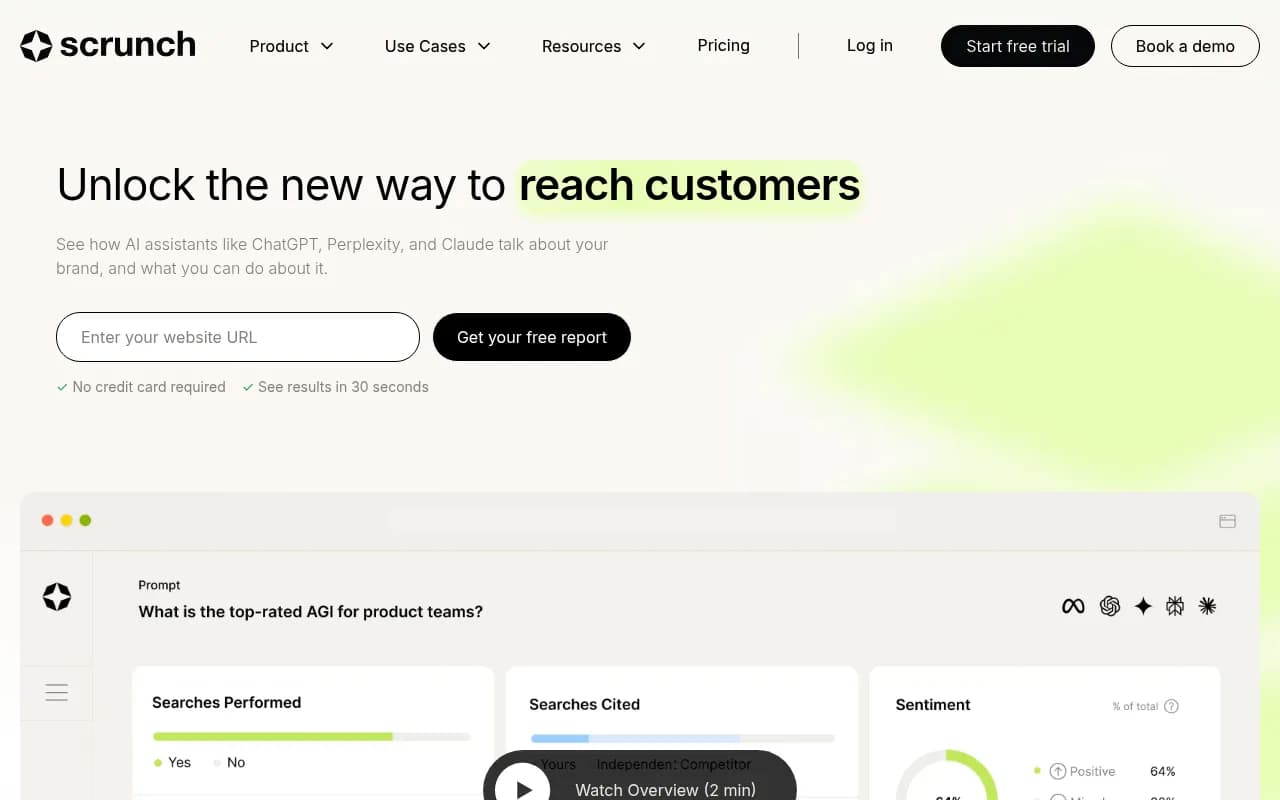
It's a step in the right direction for e-commerce teams, but the content generation and gap analysis capabilities are less developed than what you get from a full-loop platform. Worth evaluating if you're between a basic monitoring tool and a full optimization platform.
LLM Pulse: lightweight and focused
LLM Pulse is a lighter-weight tool focused on tracking brand visibility across ChatGPT, Perplexity, and a handful of other models. It's straightforward to set up and gives you basic citation and mention data.
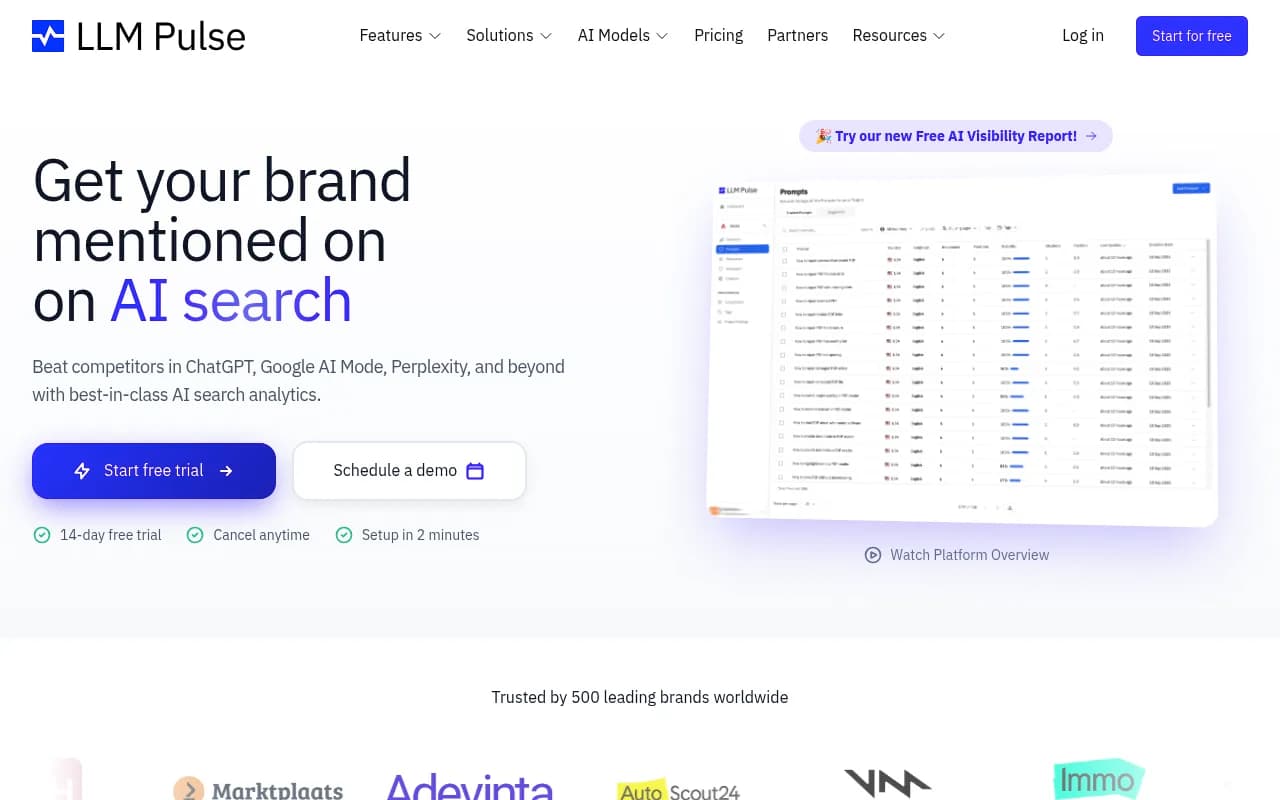
For e-commerce specifically, it lacks the product-level granularity and shopping surface tracking that the category requires. It's a useful sanity check tool but not a primary platform for brands where AI product recommendations are a meaningful revenue driver.
Comparison: which platform fits which e-commerce need
| Platform | Product-level tracking | ChatGPT Shopping | Content generation | Crawler logs | Revenue attribution | Starting price |
|---|---|---|---|---|---|---|
| Promptwatch | Yes | Yes | Yes (Content Agents) | Yes | Yes | $99/mo |
| Profound | Partial (Amazon Rufus) | Partial | No | No | No | $99/mo (ChatGPT only) |
| Ahrefs Brand Radar | No | No | No | No | No | $50/mo |
| Semrush | No | No | No | No | No | Included in plans |
| AthenaHQ | No | No | No | No | No | Not published |
| Otterly.AI | No | No | No | No | No | Low |
| Peec AI | No | No | No | No | No | Low |
| Scrunch AI | Partial | No | Partial | No | No | Mid |
| LLM Pulse | No | No | No | No | No | Low |
The surfaces that matter for e-commerce in 2026
One thing worth being specific about: "AI search visibility" in e-commerce isn't a single surface. It's at least five distinct places where AI models can recommend or ignore your products.
ChatGPT Shopping carousels are the most visible right now. When users ask purchase-intent questions, ChatGPT surfaces product cards with images, prices, and links. Appearing here requires clean product data, strong brand presence in training data, and pages that AI crawlers can actually read.
Google AI Overviews integrate with Google Shopping and pull from product feeds. If your Google Shopping feed has quality issues, your AI Overview visibility suffers. This is where traditional feed optimization and AI visibility overlap most directly.
Perplexity product recommendations are citation-heavy. Perplexity tends to cite specific review pages, comparison articles, and brand pages. Knowing which sources it's pulling from tells you where to invest in content or partnerships.
Gemini integrates with Google's broader product ecosystem and is increasingly surfacing product recommendations in conversational contexts. Coverage here is still developing in most tracking tools.
Amazon Rufus is the outlier -- an AI assistant inside the world's largest shopping platform. Profound is currently the only mainstream AI visibility tool with specific Rufus tracking. For brands selling on Amazon, this matters.
A platform that only tracks one or two of these surfaces is giving you an incomplete picture of where your products are winning and losing.
How to actually improve your AI product visibility
Tracking is step one. Here's what the optimization loop looks like in practice:
Audit your product pages for AI crawlability. AI crawlers behave differently from Googlebot. Pages that rank well in traditional search can be effectively invisible to AI models if they're JavaScript-heavy, slow to load, or structured in ways that make product attributes hard to parse. Tools with crawler logs (like Promptwatch) show you exactly which pages AI agents are reading and which they're skipping.
Find the prompt gaps your competitors are exploiting. If a competitor's product appears in "best running shoes for flat feet" responses and yours doesn't, there's a specific content gap causing that miss. Answer Gap Analysis surfaces these gaps with the exact prompts and the content that would close them.
Fix your product data quality. AI models pull product information from multiple sources: your product pages, Google Shopping feeds, review sites, and third-party listings. Inconsistent pricing, missing GTINs, or thin product descriptions create gaps that AI models fill with competitor information.
Build content around high-intent product queries. AI models recommend products based on the content they've indexed. Articles that directly answer "what's the best [product] for [use case]" with specific product recommendations, comparison data, and clear reasoning are the content type most likely to drive AI citations.
Track offsite citations. Reddit threads, YouTube reviews, and third-party comparison sites often have more influence on AI product recommendations than your own product pages. Knowing which external sources are driving (or blocking) your AI visibility tells you where to invest in PR, review generation, or content partnerships.
The bottom line
The e-commerce AI visibility category has matured fast. In 2024, the question was whether to track AI mentions at all. In 2026, the question is which platform gives you the full picture -- product-level tracking, shopping surface coverage, content optimization, and revenue attribution -- without requiring you to stitch together four separate tools.
Most platforms in this category are still monitoring dashboards. They'll tell you your brand is invisible in ChatGPT. Very few will tell you why, and fewer still will help you fix it.
For e-commerce teams where AI product recommendations are becoming a meaningful revenue channel, the platforms worth serious evaluation are the ones that close that loop. Promptwatch covers the most ground in a single platform. Profound is worth considering if Amazon Rufus tracking is a priority. Ahrefs Brand Radar is the right call if data quality is your primary concern and you're already in the Ahrefs ecosystem.
The brands showing up in AI shopping recommendations right now are pulling real revenue from the ones that aren't. The gap between tracking and optimizing is where most of that revenue is being left on the table.